Exploring Agentic AI Platforms: Capabilities, Challenges, and Future Trends
By Sriram
Updated on Oct 20, 2026 | 8 min read | 393 views
Share:

All courses
Certifications
More
By Sriram
Updated on Oct 20, 2026 | 8 min read | 393 views
Share:
Table of Contents
Agentic AI platforms are enterprise-grade systems that enable AI agents to plan, reason, make decisions, and execute complex multi-step tasks autonomously. Unlike traditional chatbots that primarily generate responses, these platforms provide the infrastructure needed to manage workflows, integrate with business applications, maintain memory, enforce governance controls, and coordinate actions across multiple systems to achieve specific goals.
In this blog, you'll learn what agentic AI platforms are, how they work, their core components, practical applications, benefits, limitations, and what to consider when choosing a platform. Whether you're a developer, AI practitioner, student, or technology leader, this article provides a practical understanding of the rapidly growing agentic AI ecosystem.
Ready to go beyond using AI platforms? Learn how upGrad’s Online Generative AI Courses can help you build AI agents, automate multi-step workflows, and solve real business problems through hands-on projects and industry mentors.
Agentic AI Courses to upskill
Explore Agentic AI Courses for Career Progression
IIIT Bangalore
EPGP in Applied AI and Agentic AIIIIT Bangalore
Executive Diploma in Machine Learning and AI360° Career Support
The rapid growth of agentic AI has led to the emergence of several platforms that help organizations build, deploy, and manage autonomous AI agents. Some platforms focus on developer flexibility, while others prioritize enterprise governance, no-code automation, or specialized AI assistants.
The table below provides an overview of some of the most popular agentic AI platforms and their primary strengths.
Platform |
Category |
Primary Use Case |
| CrewAI | Developer Framework | Building collaborative multi-agent systems |
| LangChain | Developer Framework | Developing context-aware AI applications |
| Relevance AI | No-Code Platform | Creating and managing AI workforces |
| Zapier Central | No-Code Platform | Workflow automation across applications |
| Gumloop | No-Code Platform | Visual AI workflow creation |
| Microsoft Copilot Studio | Enterprise Platform | Building AI agents within Microsoft ecosystems |
| Salesforce Agentforce | Enterprise Platform | AI-powered CRM and customer service automation |
| UiPath | Automation Platform | Intelligent business process automation |
| Automation Anywhere | Automation Platform | Enterprise workflow orchestration and reasoning |
| Lindy | AI Employee Platform | Administrative and productivity automation |
The following platforms represent different approaches to building autonomous AI systems.
CrewAI is intended for multi-agent environments, where multiple AI agents work together to achieve a common goal. Developers can assign different agents specialized roles, making the framework useful for research workflows, software development projects, and business process automation.
LangChain is one of the most popular frameworks to build agentic applications. It enables developers to hook up large language models to databases, APIs, search engines, and other external tools so that agents can think and do complex things.
Relevance AI is dedicated to assisting organizations in creating AI-powered workforces through a visual interface. This enables businesses to deploy agents to generate leads, provide customer support, update CRM, enrich data, and perform a number of operational tasks without a lot of coding.
Users can build AI agents with natural language instructions on Zapier Central. These agents are capable of automating tasks across thousands of connected applications, and can be especially valuable for business teams that are looking to automate quickly.
Gumloop offers a visual workflow builder that simplifies the creation of AI-powered automation processes. It is frequently used for web research, data collection, content generation, and multi-step business workflows.
Microsoft Copilot Studio allows businesses to build AI agents that integrate seamlessly across Microsoft 365, Dynamics 365, Teams and other Microsoft services. Large organizations have gravitated to it because of its enterprise-grade security and governance features.
Salesforce Agentforce lets businesses create autonomous agents that can directly interact with customer data, support operations and sales workflows. Organizations can automate service requests, customer engagement and CRM related activities while still maintaining compliance standards.
UiPath, which started life as a robotic process automation company, has added AI-powered agents to its capabilities. It provides intelligent automation to departments, combining autonomous execution with human oversight where needed.
Automation Anywhere is bringing AI reasoning to enterprise automation workflows. Agents can handle more dynamic and complex business processes that traditional rule-based automation often struggles with, thanks to its Process Reasoning Engine.
Lindy is an AI employee that can manage scheduling, email communication, meetings and administrative tasks. Users describe workflows in plain language, making automation accessible to even non-technical teams.
The following factors can help organizations evaluate different platforms:
The best agentic AI platform ultimately comes down to whether you want custom development, enterprise automation, workflow orchestration or ready-to-use AI workers. As autonomous AI capabilities continue to mature, these platforms will be a key enabler of intelligent business at scale.
Do Read : Agentic AI Learning Path: A Complete Guide for Developers and AI Professionals
Agentic AI platforms depend on a coordinated architecture that supports reasoning, planning, execution, and learning. The actual implementations will differ between vendors and open source frameworks but most platforms will operate in a similar cycle.
The process begins with a user stating a goal. Instead of producing an answer right away, the agent thinks about the goal and makes a plan for action.
There are several stages in a typical workflow.
If you are interested to know more about AI, check out our DBA in Emerging Technologies with a concentration in Generative and Agentic AI.
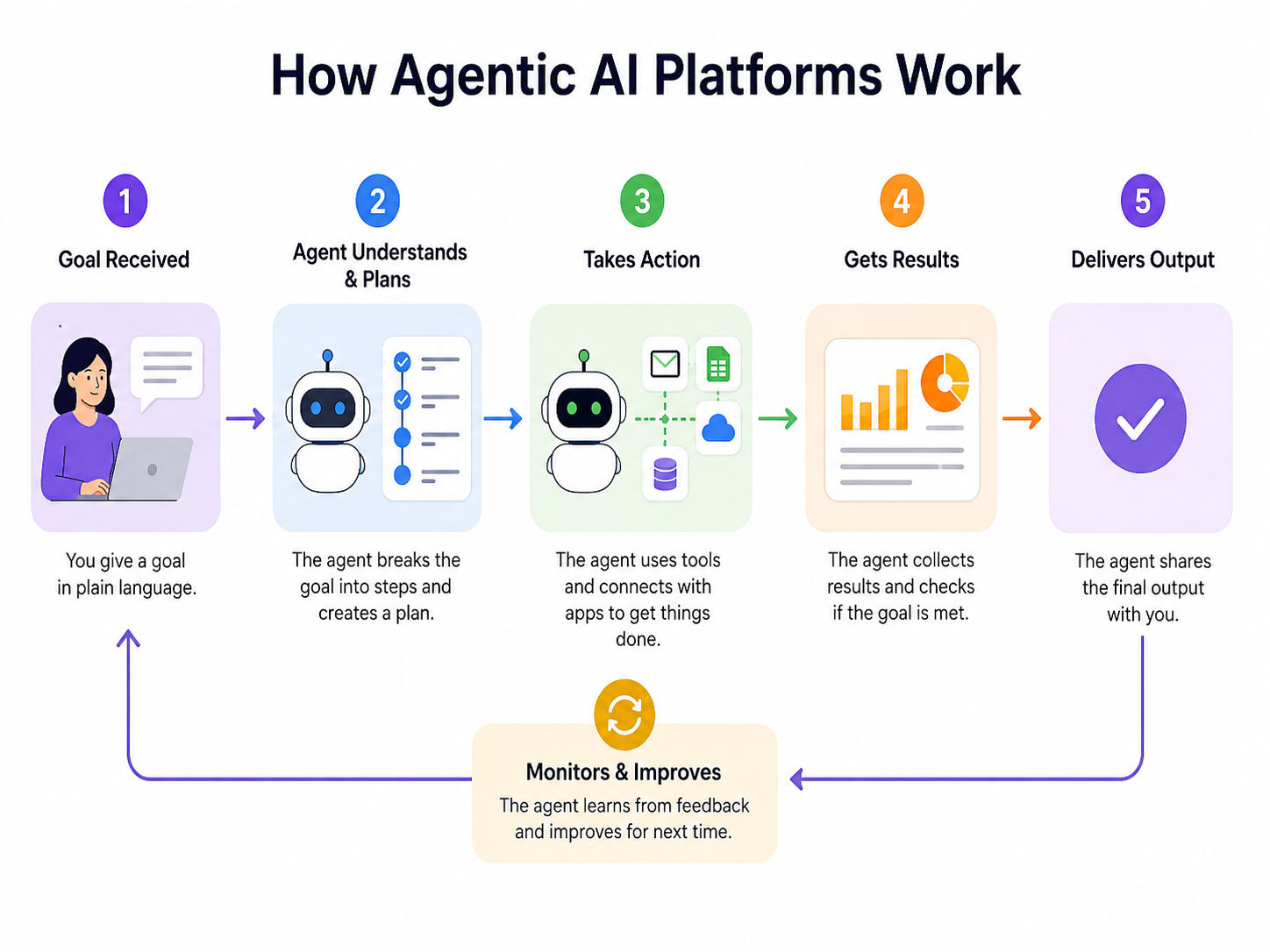
Agentic AI platforms help organizations automate complex workflows, improve operational efficiency, and reduce manual effort. Unlike traditional automation tools, they can make decisions, coordinate tasks, and adapt to changing conditions with minimal human intervention.
The table below highlights the key features and benefits of agentic AI platforms.
Feature |
Benefit |
| Autonomous Task Execution | Completes multi-step tasks without constant human guidance. |
| Multi-Agent Collaboration | Enables specialized agents to work together on complex workflows. |
| Persistent Memory | Maintains context and learns from previous interactions. |
| Workflow Orchestration | Coordinates tasks across multiple systems and applications. |
| Tool Integration | Connects with APIs, databases, and business software. |
| Scalability | Supports the deployment of hundreds or thousands of agents simultaneously. |
| Human-in-the-Loop Controls | Allows human oversight for critical decisions and actions. |
| Continuous Learning | Improves performance through feedback and historical outcomes. |
These capabilities make agentic AI platforms valuable for customer support, marketing automation, software development, data analysis, and other business functions that require intelligent decision-making and workflow management.
Must read : Agentic AI Roadmap: Skills, Tools, Frameworks, and Career Guide
While agentic AI platforms can automate complex workflows and improve efficiency, organizations must address several challenges to ensure reliable and secure deployment.
The table below summarizes the most common challenges associated with agentic AI platforms.
Challenge |
Description |
| Reliability and Accuracy | AI agents may make incorrect decisions or take inappropriate actions when working with incomplete, outdated, or inaccurate information. |
| Security Risks | Agents often access multiple systems and datasets, increasing the need for strong authentication, access controls, and data protection measures. |
| Governance Complexity | Organizations must establish clear policies for accountability, compliance, transparency, and human oversight. |
| Tool Misuse | Agents may select the wrong tools or execute unintended actions if workflows are not properly configured. |
| Cost Management | Continuous agent operations can increase costs related to LLM usage, infrastructure, APIs, and monitoring systems. |
| Performance Monitoring | Businesses need ongoing monitoring to evaluate agent performance, identify errors, and optimize workflows over time. |
Addressing these challenges through proper governance, monitoring, and security controls helps organizations maximize the benefits of agentic AI while minimizing operational risks.
Must read : Agentic AI Design Patterns: Building Smarter AI Systems
Agentic AI platforms will likely become more capable, autonomous and integrated into everyday business operations. Future AI agents will not just perform single tasks, but will also manage whole workflows by cooperating with other specialized agents.
Improvements in reasoning, memory, planning, and multimodal AI will allow these systems to be more reliable and effective across industries.
Here are some trends that will shape the future of agentic AI:
As Agentic AI platforms become more capable, many learners want to know how they can build these skills in a structured way. One common question around learners is:
If you want to build practical skills alongside learning about Agentic AI platforms, choose a program that combines AI fundamentals with hands-on projects. upGrad's Executive Post Graduate Certificate in Generative AI & Agentic AI with IIT Kharagpur and Executive Post Graduate Programme (EPGP) in Applied AI & Agentic AI with IIIT Bangalore offer industry-recognized certification while covering LLMs, RAG, AI agents, and real-world deployment.
As adoption grows, agentic AI platforms will increasingly become intelligent digital coworkers, helping organizations automate complex processes while maintaining human oversight and control.
Conclusion
Agentic AI platforms represent a major shift from the passive AI assistants we’ve come to expect. These platforms bring together large language models, memory systems, planning engines and tool integrations to allow AI agents to do meaningful work in business and technical environments.
Organizations will continue to need robust agentic AI platforms as they look to automation at a larger scale. Understanding their architecture, capabilities, benefits and limitations helps developers, students and business leaders make informed decisions about embracing this emerging technology.
Ready to start your journey? Book a free consultation with upGrad today to find the best path for your career.
Most agentic AI platforms can operate with limited human involvement, but complete autonomy is still uncommon in critical business environments. Organizations typically implement approval workflows, monitoring systems, and human oversight for high-impact decisions. This approach helps reduce errors while still benefiting from automation and faster task execution.
AI copilots primarily assist users by providing suggestions, recommendations, or generated content. Agentic AI platforms go further by taking actions on behalf of users. They can plan tasks, access tools, interact with software systems, and execute workflows without requiring constant instructions throughout the process.
Industries with large volumes of repetitive processes are seeing rapid adoption. These include customer service, healthcare administration, financial services, software development, e-commerce, and marketing operations. Businesses in these sectors often use AI agents to streamline workflows, improve response times, and reduce manual effort.
Not always. Many modern platforms offer visual workflow builders and no-code interfaces that allow business users to create AI agents without programming skills. However, organizations that require advanced customization, integrations, or complex workflows often rely on developers to build and manage agent behavior.
Advanced platforms use reasoning and planning capabilities to adapt when conditions change. For example, if an API fails or required data is unavailable, an agent may attempt alternative actions. In more complex situations, the system can escalate the issue to a human operator for review.
Yes. Small businesses can use agentic AI platforms for tasks such as lead qualification, appointment scheduling, customer support, content research, and workflow automation. Many cloud-based solutions offer affordable entry points, making autonomous AI accessible without requiring large technology teams.
Useful skills include prompt engineering, workflow design, API integration, automation tools, data analysis, and understanding large language models. Developers may also benefit from learning frameworks such as LangChain and CrewAI, while business professionals should focus on process automation and AI governance concepts.
Memory allows AI agents to retain information across tasks and interactions. Instead of starting from scratch every time, agents can remember previous actions, user preferences, project details, and workflow history. This helps improve consistency, decision-making, and long-term task management.
Yes. Many organizations use AI agents to answer inquiries, retrieve account information, create support tickets, and escalate complex cases. The most effective implementations combine automation with human support teams, ensuring customers receive accurate responses when issues require deeper expertise.
Key factors include integration capabilities, scalability, security controls, compliance requirements, ease of deployment, and total cost of ownership. Organizations should also assess whether the platform supports their specific workflows and provides sufficient monitoring, governance, and customization options.
Future platforms will likely support stronger reasoning, longer-term memory, and better collaboration between multiple AI agents. Businesses may use interconnected agents to manage entire operational workflows rather than individual tasks. At the same time, governance, transparency, and security features will become increasingly important as adoption grows.
695 articles published
Sriram K is a Senior SEO Executive with a B.Tech in Information Technology from Dr. M.G.R. Educational and Research Institute, Chennai. With over a decade of experience in digital marketing, he specia...
Speak with AI & ML expert
By submitting, I accept the T&C and
Privacy Policy