Agentic AI Design Patterns: Building Smarter AI Systems
By Sriram
Updated on Jun 02, 2026 | 8 min read | 2.6K+ views
Share:

All courses
Certifications
More
By Sriram
Updated on Jun 02, 2026 | 8 min read | 2.6K+ views
Share:
Table of Contents
Agentic AI design patterns are becoming the foundation of AI applications. As AI systems get more advanced and move beyond simple chatbots, people who make these systems need a way to help AI models think, plan, use tools to work together and fix their own mistakes. This is where agentic AI design patterns come in. They give us frameworks that have been tested. That helps AI agents solve hard problems by making decisions in an organized way.
In this guide you will learn what agentic AI design patterns are, and why they are important. If you are looking at AI for things like automating business tasks, planning trips, designing software or doing research that involves steps this guide will help you understand the basic ideas of agentic AI design patterns in a way that is easy to understand.
Explore Agentic AI Courses Online in upGrad and learn how intelligent systems reason, plan, use tools, and collaborate to solve complex tasks efficiently.
Agentic AI Courses to upskill
Explore Agentic AI Courses for Career Progression
IIIT Bangalore
EPGP in Applied AI and Agentic AIIIIT Bangalore
Executive Diploma in Machine Learning and AI360° Career Support
Agentic AI design patterns are like blueprints that help create AI agents. These blueprints show how AI agents think and make decisions. They help agents' complete tasks in a step-by-step way. This approach is different from giving an answer.
Agentic systems work through a process to reach a goal. They use a method to get things done. Agentic AI design patterns are useful for building AI agents. These patterns help agents achieve their goals.
Traditional AI systems typically operate in a simple input-output format whereas agentic systems behave differently. They can break down problems, make plans, call tools, evaluate outcomes, and improve their actions.
Without structure, AI agents often struggle with:
Many new artificial intelligence systems are made to help Large Language Models think, make plans, to use tools to work together and fix their mistakes. This helps LLMs do things that people used to do themselves; they can also solve problems that used to need a person to help.
A useful way to think about agentic AI design patterns is as software engineering, best practices for intelligent systems. Just as software developers rely on proven software architecture patterns, AI developers use agentic patterns to build reliable agents.
Characteristic |
Description |
| Goal-Oriented | Works toward a defined objective |
| Planning Ability | Creates execution plans |
| Tool Integration | Uses external tools and APIs |
| Memory | Maintains context over time |
| Self-Correction | Identifies and fixes mistakes |
| Collaboration | Works with other agents or humans |
Also Read: What Is Agentic AI? The Simple Guide to Self-Driving Software
Several agentic AI design patterns have emerged as industry standards. Each pattern addresses specific types of problems and workflows.
One of the most widely adopted patterns is ReAct (Reason + Act).
The process follows a simple loop:
This cycle is often represented as:
Reasons → Action → Observation
Example
A travel assistant receives a request for vacation planning.
The agent:
This makes ReAct highly effective for Trip planning, customer support, and operational workflows.
The Planning pattern requires the agent to generate a complete plan before taking action.
Benefits include:
The Decomposition pattern breaks large problems into smaller, manageable pieces. These actionable sub-tasks improve accuracy and execution quality.
Example:
Software architecture drafting may involve:
Main Task |
Actionable Sub-Tasks |
| Design system architecture | Gather requirements |
| Design database | Define entities |
| Design APIs | Create endpoints |
| Review architecture | Identify improvements |
The Tool Use (Function Calling) pattern allows AI agents to interact with external systems. Through Tool Use (Function Calling), agents can access real-time information rather than relying solely on model training data.
Common tools include:
The Reflection and Critique pattern introduces self-evaluation. This enables systems to self-correct before presenting final answers.
The agent:
Also Read: What Is Agentic AI? Features, Use Cases, Benefits & Examples
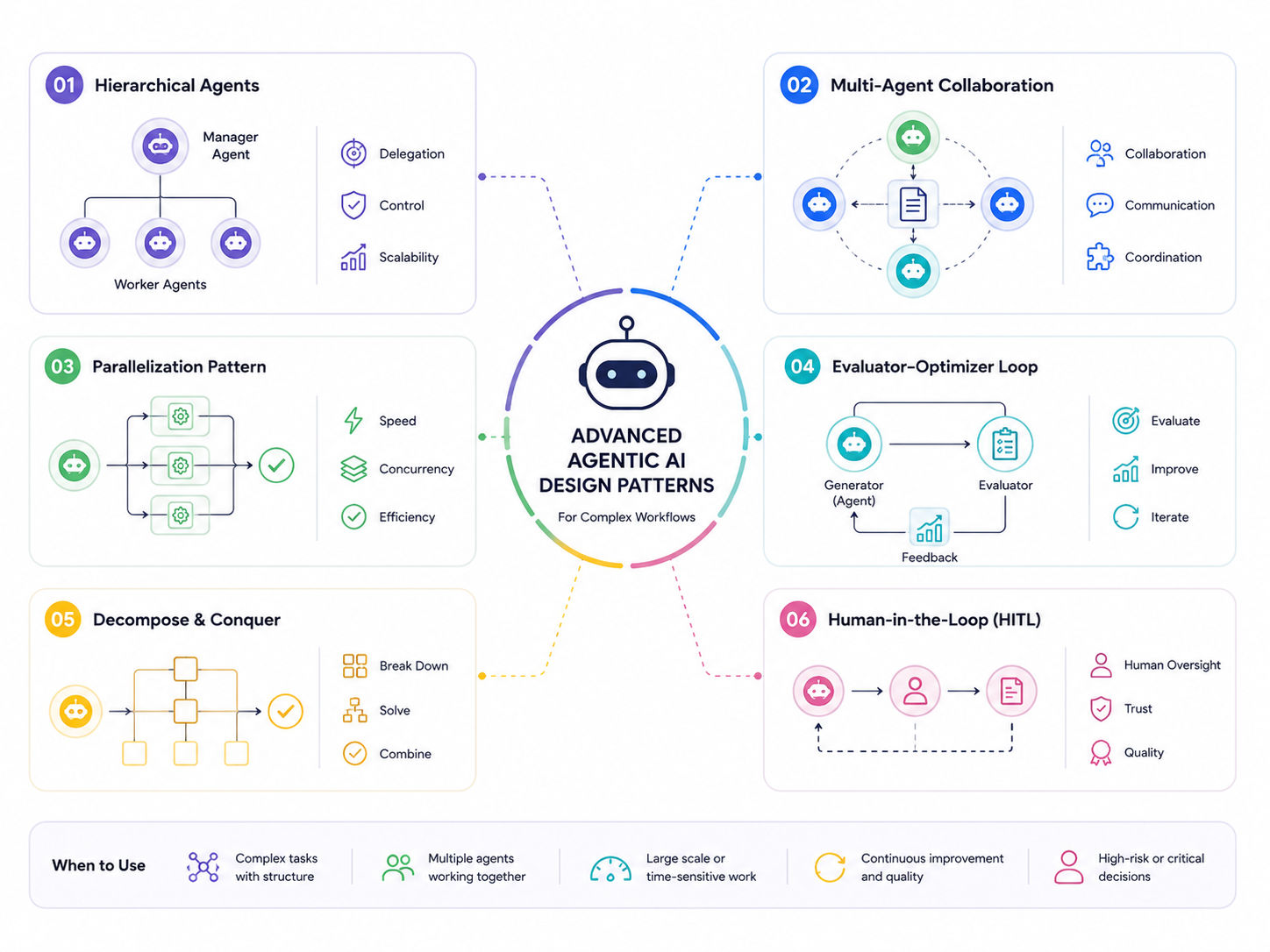
As AI applications grow more sophisticated, organizations increasingly adopt advanced agentic AI design patterns.
These patterns focus on scalability, specialization, and coordination.
The Sequential pattern executes tasks one after another.
Example workflow:
Advantages:
Best for:
The Parallel pattern executes multiple tasks simultaneously.
Example:
A research assistant may:
All activities occur at the same time.
Benefits include:
Multi-Agent Collaboration involves multiple specialized agents working together.
Example team:
Agent |
Responsibility |
| Research Agent | Collect information |
| Analysis Agent | Interpret data |
| Writing Agent | Draft content |
| Review Agent | Quality assurance |
This approach mirrors how human teams operate.
The Supervisor/Swarm pattern adds a coordinator agent.
The supervisor:
Worker agents focus on specialized responsibilities.
This architecture is increasingly used for:
The Human-in-the-Loop (HITL) pattern introduces human oversight.
Critical decisions require human approval before execution.
Common use cases:
Benefits include:
Organizations often combine Human-in-the-Loop (HITL) with Reflection and Critique to improve reliability.
Understanding theory is important, but practical implementation is where agentic AI design patterns create real value.
A travel agent can:
Agentic systems can:
Research agents can:
Also Read: 10+ Real Agentic AI Examples Across Industries (2026 Guide)
Implementing agentic AI successfully requires more than choosing the right design pattern. Organizations must focus on simplicity, clear objectives, visibility, and strategic pattern selection.
Many teams immediately pursue complex architecture.
A better approach:
Agents perform better when objectives are specific.
Instead of: "Research competitors"
Use: "Identify the top five competitors and summarize pricing models."
Visibility makes troubleshooting easier.
Track:
Many successful systems blend multiple approaches.
Example:
Requirement |
Pattern |
| Task breakdown | Decomposition |
| Execution | Sequential |
| Research | Parallel |
| Review | Reflection and Critique |
| Governance | Human-in-the-Loop (HITL) |
When companies have a system, it usually works better than a really complicated one. Just because you have a lot of agents working on something, it does not mean that you will get a result.
Simpler architectures can be very good. Often, they are better than complex designs. More agents are not always the answer to getting outcomes. Simpler architecture is often the way to go.
Agentic AI design patterns are the basis for creating reliable AI systems that can do a lot of things. These patterns are like templates that help agents think, make plans, use tools to work together, and get better over time.
There are patterns like ReAct, Planning, Decomposition, Tool Use, Reflection and Critique Sequential, Parallel, Multi-Agent Collaboration, Supervisor/Swarm and Human-in-the-Loop that each solve different problems when building agents.
As companies start using autonomous systems, it is very important for developers, architects, product teams, and business leaders to understand Agentic AI design patterns. The best AI systems in the future will not just use one model they will use designed Agentic AI design patterns that combine thinking, doing things working together and overseeing in a structured way. Agentic AI design patterns will be very important for creating AI systems.
Want personalized guidance on Agentic AI design patterns? Speak with an expert for a free 1:1 counselling session today.
Agentic AI design patterns are structured frameworks that guide how AI agents perform tasks. They help systems plan actions, use tools, evaluate results, and improve decisions. These patterns make AI applications more reliable and capable of handling complex workflows.
They provide consistency and predictability when building intelligent systems. Instead of relying on random outputs, developers can use proven approaches that improve reasoning, planning, execution, and error handling across different AI applications.
ReAct follows a cycle of reasoning, acting, and observing results. The agent evaluates a problem, takes an action, checks outcomes, and repeats the process until the objective is achieved. This method supports dynamic decision-making and adaptability.
Planning creates a roadmap for completing a task. Decomposition breaks a large task into smaller actionable sub-tasks. Many agentic systems combine both techniques to improve execution quality and maintain better control over complex workflows.
Tool Use (Function Calling) allows AI agents to interact with external applications and services. Examples include APIs, databases, search engines, calculators, and enterprise software. This capability expands what agents can accomplish beyond their training data.
Reflection and Critique is a self-review process where the agent evaluates its own output before delivering results. It identifies weaknesses, corrects mistakes, and improves quality. This pattern is especially useful for research, coding, and content generation.
Businesses should use Multi-Agent Collaboration when tasks require different forms of expertise. Specialized agents can handle research, analysis, writing, validation, and reporting separately. This often improves efficiency and output quality for large projects.
The Supervisor/Swarm model includes a coordinating agent that manages multiple worker agents. The supervisor assigns responsibilities, tracks progress and combines outputs. This architecture supports large-scale automation and distributed problem-solving.
Human-in-the-Loop (HITL) introduces human review at critical stages. This reduces risks, improves accountability, and helps ensure compliance with organizational policies. HITL is commonly used in healthcare, finance, and legal environments.
Yes. Many enterprise AI systems rely on agentic AI design patterns to automate research, customer support, workflow management, software architecture drafting, and operational decision-making. These patterns improve scalability and governance.
Beginners should start with ReAct (Reason + Act), Planning, Decomposition, and Tool Use (Function Calling). These patterns are easier to understand and implement while providing a strong foundation for more advanced architectures later.
724 articles published
Sriram K is a Senior SEO Executive with a B.Tech in Information Technology from Dr. M.G.R. Educational and Research Institute, Chennai. With over a decade of experience in digital marketing, he specia...
Speak with AI & ML expert
By submitting, I accept the T&C and
Privacy Policy