Agentic AI Solutions: How Autonomous AI Systems Are Transforming Business Operations
By Sriram
Updated on Jun 14, 2026 | 7 min read | 4.55K+ views
Share:

All courses
Certifications
More
By Sriram
Updated on Jun 14, 2026 | 7 min read | 4.55K+ views
Share:
Agentic AI solutions are autonomous systems that go beyond traditional chatbots and generative AI tools. Instead of simply responding to prompts, they can understand goals, analyze information, make decisions, and execute multi-step tasks independently. This allows them to complete complex workflows with minimal human involvement while adapting to changing conditions.
This guide, you'll learn what Agentic AI solutions are, how they work, where organizations use them today, their benefits and limitations, and what businesses should consider before implementing them. You'll also explore real-world examples that show why autonomous AI agents are becoming a major focus across industries.
Build an Agenti AI and AI programs with upGrad’s to develop practical skills in large language models (LLMs), generative AI, machine learning, model evaluation and data-driven decision-making.
Popular AI Programs
Agentic AI solutions are AI systems that can operate with a degree of autonomy. Instead of relying on constant human instructions, they can understand goals, create plans, take actions, evaluate results, and adapt when conditions change.
Unlike traditional AI tools that mainly respond to prompts, Agentic AI acts more like a digital worker capable of managing multi-step tasks. For example, in customer support, an AI agent can prioritize tickets, gather information, draft responses, escalate urgent issues, and track outcomes with minimal human involvement.
The following table highlights the differences between traditional AI and agentic systems.
Feature |
Traditional AI |
Agentic AI Solutions |
| Decision-making | Limited | Autonomous |
| Goal-oriented behavior | Minimal | High |
| Multi-step planning | Rare | Core capability |
| Adaptability | Rule-based | Dynamic |
| Tool usage | Restricted | Extensive |
| Continuous learning | Limited | Often integrated |
Several technologies make agentic systems possible:
What makes these systems especially valuable is their ability to bridge reasoning and action. Rather than just producing outputs, they can also do meaningful things in real environments.
Agentic AI solutions can be usefully thought of as a project coordinator. The coordinator gets an objective, makes a plan, delegates work, tracks progress, and changes the approach when obstacles arise. The goal of agentic AI is to replicate a similar process with software.
As businesses seek increased automation, these systems transcend worker support and start working with them.
Do Read : Agentic AI Learning Path: A Complete Guide for Developers and AI Professionals
Free Courses
Agentic AI solutions combine multiple AI components that work together to achieve objectives. While architectures vary, most systems follow a similar operational cycle.
At a high level, an agent receives a goal, develops a strategy, takes actions, evaluates outcomes, and repeats the process until the objective is achieved.
The workflow below explains the process.
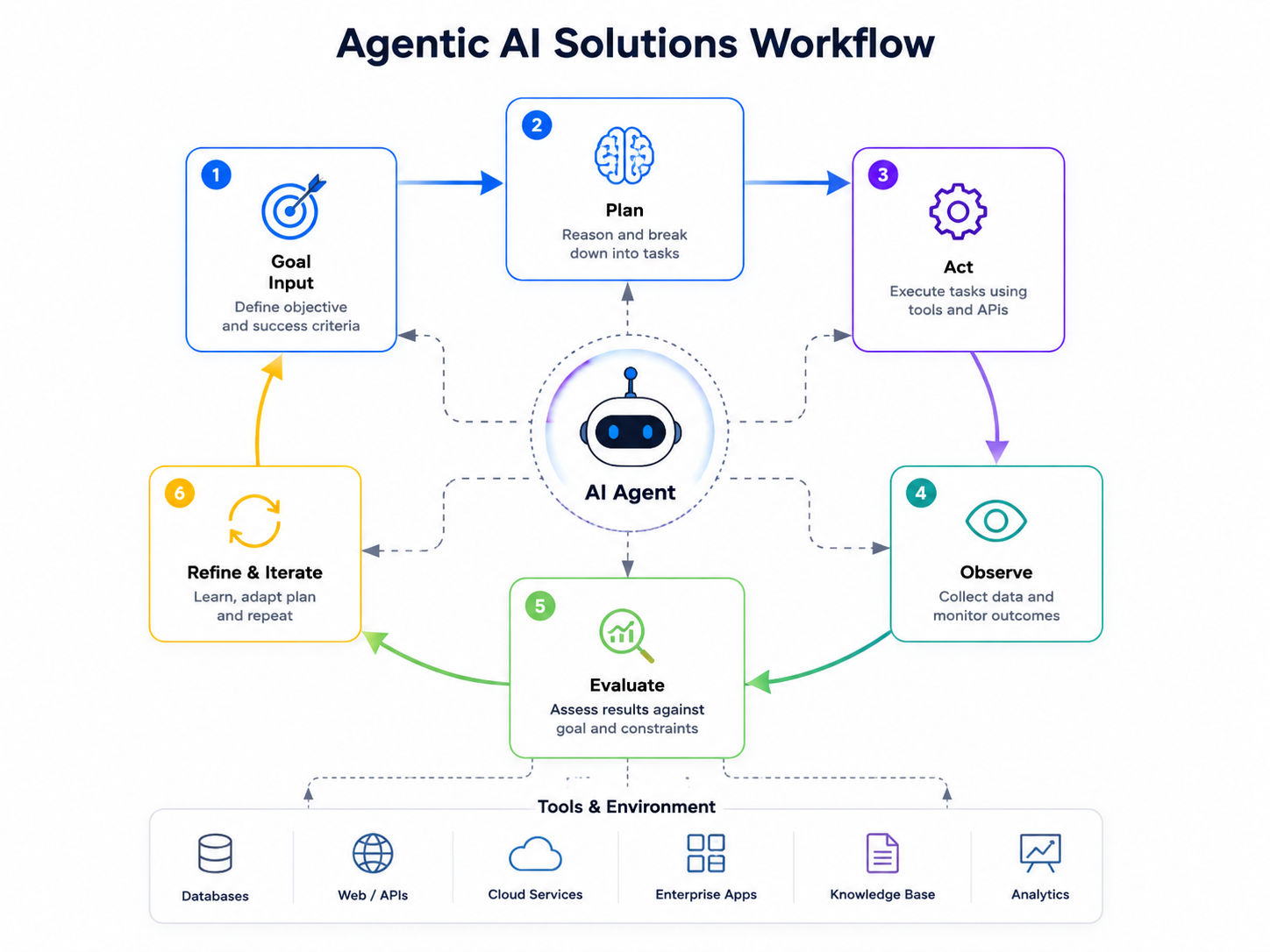
Several key components support this workflow.
The reasoning layer helps the agent decide what actions to take. It evaluates available information, identifies dependencies, and selects an appropriate path toward the goal.
For instance, an AI sales assistant might determine whether it should generate leads, send follow-up emails, or update CRM records based on current priorities.
Without memory, an AI agent treats every interaction as new. With memory, it can recall previous actions, user preferences, project history, and business context.
This capability becomes critical for long-running tasks that span days or weeks.
Modern agentic systems interact with external tools.
Examples include:
Rather than merely generating suggestions, the agent can execute actions through these tools.
Feedback mechanisms allow the system to assess outcomes and improve future decisions.
Suppose an AI agent launches a marketing campaign. It can monitor performance metrics, identify weak results, modify targeting strategies, and continue optimizing without requiring constant human intervention.
One of the most important characteristics of Agentic AI solutions is that they operate through iterative improvement rather than single-step execution. This creates systems that become more effective as they interact with complex environments.
Must read : Agentic AI Design Patterns: Building Smarter AI Systems
AI Courses to upskill
Explore Artificial Intelligence Courses for Career Progression
Organizations invest in Agentic AI solutions because they address limitations found in conventional automation systems.
Traditional automation works well for predictable workflows. However, many business processes involve uncertainty, changing priorities, and decision-making requirements.
Agentic systems help fill this gap.
The following list highlights the primary benefits :
Let's examine these benefits in more detail.
Many business processes require employees to switch between systems, gather information, and coordinate multiple tasks.
Agentic AI can handle much of this administrative overhead.
For example, an operations agent could monitor inventory levels, forecast demand, place supplier orders, and notify stakeholders when issues arise.
In customer-facing environments, speed matters.
An agentic customer support system can analyze requests, retrieve relevant information, generate responses, and execute resolutions significantly faster than manual workflows.
This reduces delays while improving customer experiences.
Agentic systems process large volumes of data across multiple sources.
They can identify patterns that might not be immediately visible to human teams.
Rather than replacing human decision-makers, they provide recommendations and actionable insights that support better choices.
Businesses often struggle to expand operations without increasing staffing costs.
Agentic AI solutions offer a way to scale workflows efficiently.
A single AI agent may manage hundreds of repetitive processes simultaneously while maintaining consistency and accuracy.
Many agentic systems improve through feedback and historical performance analysis.
This creates a cycle where outcomes become increasingly optimized over time.
However, organizations should recognize that learning systems require governance, monitoring, and validation to prevent unintended behaviors.
The most successful implementations combine AI autonomy with human oversight rather than relying entirely on automated decision-making.
Read : Agentic AI vs Generative AI: What Sets Them Apart
The adoption of Agentic AI solutions is accelerating across industries because many operational challenges involve coordination, planning, and decision-making rather than simple task execution.
These systems already support a wide range of business functions.
The table below highlights common applications:
Industry |
Agentic AI Application |
| Healthcare | Patient scheduling and care coordination |
| Finance | Fraud detection and risk assessment |
| Retail | Inventory optimization and demand forecasting |
| Marketing | Campaign management and personalization |
| Manufacturing | Predictive maintenance and production planning |
| Customer Service | Autonomous ticket resolution |
Agentic systems can manage entire support workflows.
Instead of merely answering questions, they can:
This creates a more efficient support experience.
Marketing teams increasingly use AI agents to manage campaigns.
An agent can analyze audience behavior, generate content recommendations, monitor engagement metrics, adjust budgets, and report performance outcomes.
This reduces manual optimization efforts.
Development teams use AI agents to support coding, testing, documentation, and debugging.
An agent may review pull requests, identify vulnerabilities, suggest fixes, and track project progress across repositories.
Supply chains involve numerous interconnected decisions.
Agentic systems can monitor inventory, predict shortages, coordinate suppliers, and recommend alternative logistics routes when disruptions occur.
This capability becomes especially valuable during periods of market volatility.
As organizations gain confidence in autonomous systems, these use cases continue expanding into new business functions.
Also Read: Generative AI vs Traditional AI: Which One Is Right for You?
While Agentic AI solutions provide considerable benefits, they also present new challenges that organisations need to address with care.
Recognising these limitations is crucial for responsible deployment.
There are a number of common concerns that do arise during deployment :
Many AI systems are complicated black boxes.
It can be difficult to understand the reasoning behind an agent’s unexpected decision.
Explainability mechanisms are needed for organisations to remain trusted and accountable.
Agentic systems frequently need access to a wide variety of business applications and data sources.
This wide access increases potential security risks if permissions are not properly controlled.
Strong authentication and monitoring practices are critical.
Even state-of-the-art AI models can produce hallucinated outputs.
If an autonomous system acts on wrong information, business consequences may arise.
High-stakes decisions still need human review.
Industries such as healthcare, finance, and insurance operate under strict regulations.
Organizations must ensure that agentic systems comply with industry-specific requirements related to privacy, auditing, and decision transparency.
Building effective agentic systems requires more than deploying a language model.
Teams often need:
These requirements increase implementation effort but help ensure long-term success.
The future of Agentic AI solutions will likely depend on balancing autonomy with control, allowing organizations to benefit from intelligent automation without sacrificing accountability.
Also Read: How to Build Your Own AI System: Step-by-Step Guide
The following trends are expected to influence the future of Agentic AI solutions:
Must read : Agentic AI Design Patterns: Building Smarter AI Systems
Agentic AI solutions are transforming how organizations automate work by combining reasoning, planning, and autonomous decision-making. While challenges around governance and reliability remain, these systems can improve efficiency, scalability, and productivity across industries. As adoption grows, understanding agentic AI will become increasingly important for businesses and technology professionals.
Ready to start your journey? Book a free consultation with upGrad today to find the best path for your career.
AI copilots mainly assist users by generating suggestions, content, or recommendations based on prompts. Agentic AI solutions go a step further by taking actions on their own. They can create plans, use tools, execute workflows, and adjust their approach based on results. For example, a copilot may suggest an email response, while an AI agent can draft, send, track, and optimize the entire communication process.
Yes, small businesses can use Agentic AI solutions to automate repetitive tasks without building large AI teams. Common applications include customer support, lead management, appointment scheduling, and marketing automation. The key is to start with a specific business problem and gradually expand adoption as the organization gains confidence in the technology.
You do not always need advanced AI expertise to work with these systems. Understanding workflows, data management, prompt design, API integrations, and automation platforms can be valuable. Technical professionals may also benefit from learning Python, cloud technologies, and AI orchestration frameworks that support autonomous agent development.
They can be used in regulated sectors such as healthcare, banking, and insurance, but organizations need additional safeguards. Human oversight, audit trails, access controls, and explainability mechanisms become essential. Many businesses use AI agents for operational support while keeping critical decisions under human supervision to meet compliance requirements.
Most agentic systems rely on reasoning models, feedback loops, and predefined guardrails. When unexpected conditions occur, the AI evaluates available information and selects an alternative course of action. However, performance depends on the quality of training, data access, and governance rules. Human intervention remains important for complex or high-risk scenarios.
APIs allow AI agents to interact with external systems and perform real actions. Through APIs, an agent can retrieve customer information, update records, process transactions, generate reports, or trigger workflows. Without these integrations, the AI would be limited to generating responses instead of completing meaningful business tasks.
Most modern Agentic AI solutions are designed to integrate with existing business tools such as CRM platforms, ERP systems, project management applications, and communication software. This allows organizations to enhance current workflows rather than replace their technology stack. Integration capabilities often determine the overall success of an AI deployment.
Organizations typically track metrics related to efficiency, cost savings, productivity, response times, and task completion rates. The most useful measurements align with specific business goals. For example, a customer service agent may be evaluated based on resolution speed, while a marketing agent may be measured by lead quality and conversion rates.
Many organizations struggle with data quality, system integration, governance, and workflow design. Deploying an AI agent often requires more than connecting a language model to business applications. Teams need clear objectives, reliable data sources, monitoring tools, and oversight processes to ensure the system performs consistently and safely.
In most cases, Agentic AI solutions are more likely to augment human work than fully replace it. They excel at handling repetitive processes, data analysis, and routine decision-making. Human professionals still provide judgment, creativity, relationship management, and strategic thinking. The strongest results often come from collaboration between people and AI agents.
Several developments are expected to drive adoption in the coming years. These include multi-agent collaboration, stronger memory systems, better reasoning capabilities, real-time decision-making, and tighter integration with enterprise platforms. Businesses are also focusing on governance, transparency, and security to ensure autonomous AI systems operate responsibly as their capabilities expand.
695 articles published
Sriram K is a Senior SEO Executive with a B.Tech in Information Technology from Dr. M.G.R. Educational and Research Institute, Chennai. With over a decade of experience in digital marketing, he specia...
Speak with AI & ML expert
By submitting, I accept the T&C and
Privacy Policy
Top Resources
Master's Degree
18 Months
Executive Diploma
12 Months
IIIT Bangalore
Executive Programme in Generative AI & Agentic AI for LeadersIndia’s #1 Tech University
Dual Certification
5 Months