Lead Management System: Process, Features, Use Cases & Benefits
By Sriram
Updated on Jul 27, 2026 | 8 min read | 7.18K+ views
Share:

All courses
Certifications
More
By Sriram
Updated on Jul 27, 2026 | 8 min read | 7.18K+ views
Share:
Table of Contents
Key Highlights
Ready to advance your career? Discover the best management courses in India on upGrad and learn practical management skills that help you lead teams, solve business challenges, and accelerate your professional growth.
Popular Management Programs
A lead management system helps businesses capture, organise, track and convert potential customers through a structured sales process. All lead info is centralised in one location, not in spreadsheets or scattered records which makes it easier for sales and marketing teams to collaborate and follow up efficiently.
Manual lead management is restricted to traditional tracking methods. A lead management system uses automation and technology to make the lead capture, nurturing and conversion process more efficient.
Here are the Differences :
Manual Lead Management |
Lead Management System |
| Uses spreadsheets | Centralised platform |
| Manual follow-ups | Automated workflows |
| Limited visibility | Real-time tracking |
| Duplicate records | Organised customer database |
| Basic reporting | Built-in dashboards |
When the business expands, it becomes inefficient to manage leads manually. A lead management system helps you respond faster, stay organised with customer data, reduce missed opportunities and help sales teams focus on high-priority leads.
It also improves collaboration between marketing and sales, leading to higher productivity and conversion rates.
A lead management system follows a structured process that helps businesses capture, organise, qualify, and convert leads efficiently. Each stage has a specific purpose, ensuring no opportunity is missed and every prospect receives timely follow-ups.
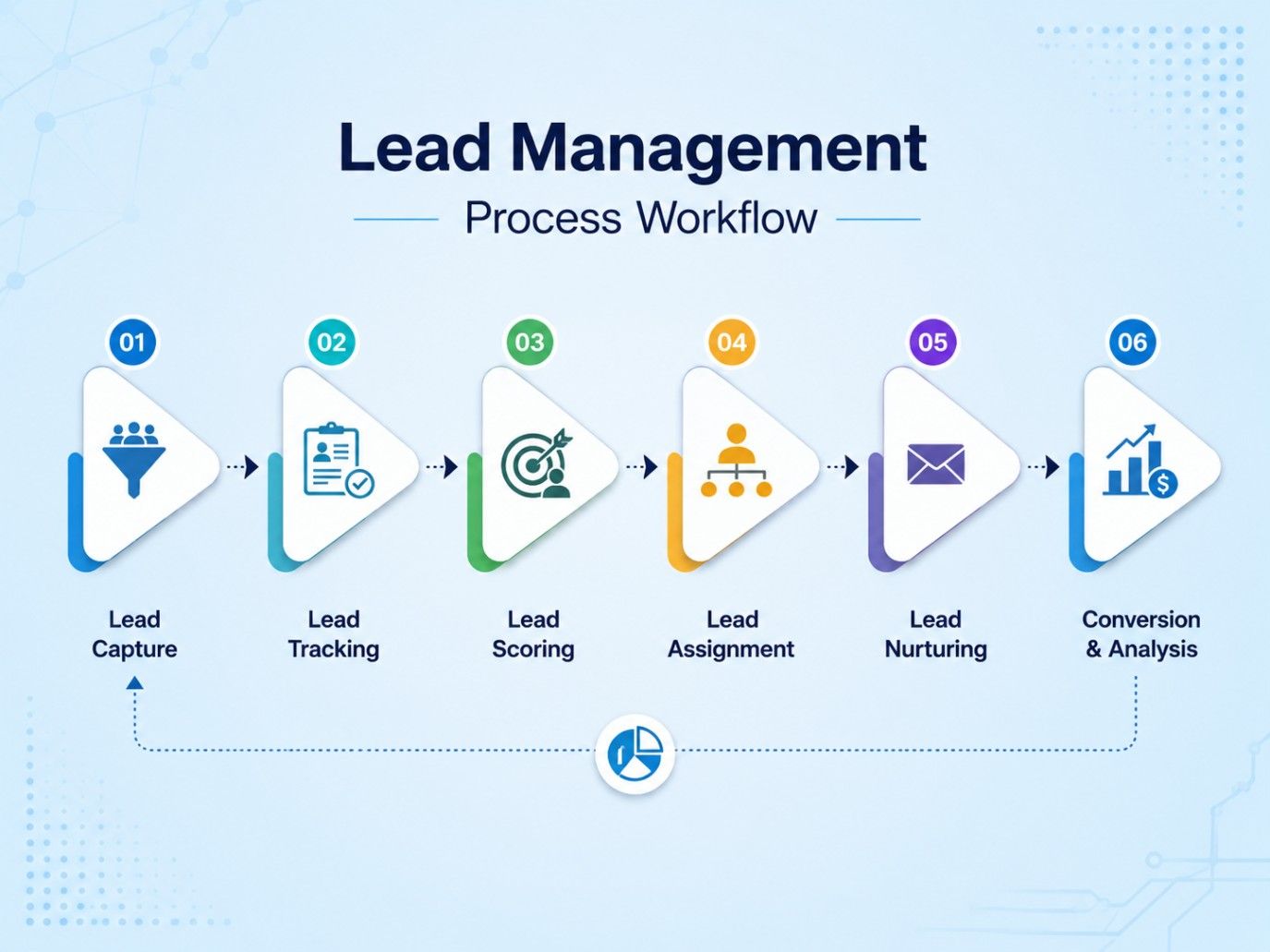
Lead capture is the first step in the process. It involves collecting enquiries from different marketing and sales channels and storing them in a central location.
A lead management system automatically gathers leads from multiple sources, eliminating manual data entry and reducing the risk of missed enquiries.
Common Lead Sources
Once a lead enters the system, every interaction is recorded to help sales teams understand customer behavior and engagement.
A lead management system tracks activities such as:
Without Lead Tracking |
With Lead Tracking |
| Limited customer history | Complete interaction timeline |
| Generic conversations | Personalised conversations |
| Missed follow-ups | Automated reminders |
| Manual reporting | Real-time visibility |
Tracking gives sales representatives the context they need before contacting a prospect, resulting in more relevant conversations and higher engagement.
Not every lead has the same buying intent. Lead scoring helps businesses prioritise prospects based on their likelihood of converting.
A lead management system assigns scores using factors such as customer profile, behaviour, and engagement.
Common Lead Scoring Criteria :
Category |
Lead Scoring Criteria |
| Demographic Fit | Job title, Industry, Company size, Location, Budget |
| Behaviour | Pricing page visits, Demo requests, Webinar attendance, Product downloads, Multiple website visits |
| Engagement | Email opens, Link clicks, Campaign responses, Meeting bookings |
Sample Lead Scoring :
Activity |
Score |
| Website visit | 5 |
| Whitepaper download | 10 |
| Webinar registration | 15 |
| Pricing page visit | 20 |
| Demo request | 35 |
| Free trial signup | 40 |
Higher scores indicate stronger purchase intent, allowing sales teams to focus on the most qualified leads.
Also read : A Guide to Training Management System
After a lead is qualified, it should be assigned to the right sales representative without delay. A lead management system automates this process using predefined assignment rules.
Common Assignment Rules
Assignment Workflow
| New Lead | → | Assignment Rules | → | Sales Representative | → | First Follow-up |
Automatic assignment improves response times, balances workloads, and prevents leads from being overlooked.
Most prospects don't make a purchase immediately. Lead nurturing keeps them engaged until they're ready to buy.
A lead management system automates personalized communication based on customer behavior and interests.
Common Nurturing Activities
Example Lead Nurturing Timeline
Timeline |
Activity |
| Day 1 | Welcome email |
| Day 3 | Industry case study |
| Day 7 | Product demo invitation |
| Day 14 | Sales follow-up call |
| Day 21 | Customer success story |
| Day 30 | Consultation or special offer |
Consistent and relevant communication builds trust, strengthens relationships, and improves conversion rates.
A structured lead management process helps businesses move every prospect through the sales pipeline efficiently without missing follow-ups or creating duplicate efforts. It improves team collaboration, shortens response times, and increases the chances of converting qualified leads into customers.
A structured lead management system helps businesses:
The best lead management system combines automation, lead scoring, tracking, assignment, and nurturing into a single workflow, helping businesses manage every lead efficiently from first contact to final conversion.
Build a strong foundation in management with the Certificate Programme in General Management for Young Leaders (YLP) from IIMB. Learn from experienced faculty, develop strategic thinking, and prepare for leadership roles across industries.
Free Courses
A lead management system does more than store customer data. It helps businesses capture leads, automate repetitive tasks, track interactions, and improve collaboration between sales and marketing teams. The right features streamline the sales process and improve lead conversion.
Automatically collects leads from multiple sources, including:
Stores all lead information in one central database, including:
| Component | Purpose |
| Contact Details | Stores basic lead information. |
| Communication History | Tracks emails, calls, and messages. |
| Meeting Notes | Records key discussion points. |
| Previous Interactions | Keeps a history of all engagements. |
| Documents & Attachments | Stores related files and documents. |
Tracks customer activities such as:
This gives sales teams complete visibility into each lead's journey.
Prioritises leads based on factors like:
| Lead Scoring Factor | Purpose |
| Customer Profile | Matches the ideal customer criteria. |
| Website Activity | Tracks visits and on-site behaviour. |
| Email Engagement | Measures opens, clicks, and replies. |
| Buying Intent | Identifies readiness to make a purchase. |
This helps sales teams focus on leads that are most likely to convert.
Automates routine tasks, including:
Track key sales metrics in real time.
Metric |
Purpose |
| New Leads | Measure campaign performance |
| Conversion Rate | Track sales success |
| Response Time | Monitor follow-up speed |
| Pipeline Value | Forecast revenue |
| Lead Source | Identify top-performing channels |
Connects with CRM, email, and marketing tools to keep customer information updated across teams, reduce manual work, and provide a seamless customer experience.
Also read : What is Customer Relationship Management? A Complete Guide
A lead management system helps businesses organise their sales process, respond faster, and improve collaboration between teams. By automating routine tasks and providing complete visibility into every lead, it increases efficiency and improves conversion rates.
1.Higher Lead Conversion
Automatically captures, tracks, and prioritises leads, helping sales teams respond quickly and convert more prospects.
2.Faster Follow-ups
Automated reminders and notifications help sales representatives follow up on time without missing opportunities.
3. Better Sales and Marketing Alignment
Provides both teams with shared access to lead data, campaign sources, and customer interactions, improving collaboration.
4. Improved Productivity
Centralises customer information, reduces manual tasks, and allows sales teams to spend more time selling.
5. Better Customer Experience
Maintains complete interaction history, enabling personalised communication and consistent customer engagement.
6. More Accurate Sales Forecasting
Real-time reports and dashboards help managers track pipeline performance, forecast revenue, and identify bottlenecks.
Even with a lead management system, poor processes can reduce sales performance. Avoiding these common mistakes helps improve efficiency and lead conversion.
Common Mistakes
Quick Checklist
Also Read : Best Business Management Courses in India [2026]
Getting the most from a lead management system requires clear processes and regular optimization. These best practices can help improve efficiency and increase lead conversions.
The best lead management system is one that fits your business needs, simplifies workflows, and includes the lead management system features that help your team work more efficiently.
Also Read: What is Management? : Understanding Key Concepts and Functions of Management
Management Courses to upskill
Explore Management Courses for Career Progression
IIIT-B & IIM, Udaipur
Chief Technology Officer & AI Leadership ProgrammeA lead management system isn't limited to one industry. Any organisation that receives enquiries, follows up with prospects, or manages a sales pipeline can benefit from using one.
The workflow stays largely the same. The difference lies in how each industry captures, qualifies, and nurtures leads before conversion.
Let's look at a few practical examples.
Industry |
How the Lead Management System Is Used |
Typical Lead Source |
| Education | Tracks student enquiries from application to admission | Website, education fairs, ads |
| SaaS | Manages free trials, demos, and product enquiries | Website, webinars, referrals |
| Real Estate | Assigns property enquiries to the right sales agent | Property portals, social media |
| Healthcare | Schedules consultations and manages appointment requests | Website, phone calls |
| Banking | Handles loan, credit card, and investment enquiries | Online forms, branches |
| Insurance | Routes policy enquiries based on product type | Website, partner referrals |
| Automotive | Tracks vehicle enquiries and test drive bookings | Dealer websites, events |
| E-commerce | Identifies repeat buyers and abandoned cart prospects | Website, email campaigns |
Also read : Practical Steps to Become a Management Consultant in 2026
Tracking the right metrics helps businesses evaluate sales performance, identify bottlenecks, and improve lead conversions. A lead management system provides real-time dashboards to monitor these KPIs.
Key Metrics :
One of the most valuable lead management system features is real-time reporting, which helps businesses monitor performance and make data-driven decisions without manual reporting.
Also read: 25 Common Program Manager Interview Questions and Answers
A lead management system helps businesses capture, organize, track, and nurture leads through a structured sales process. It improves collaboration between sales and marketing teams, reduces manual work, and helps convert more qualified leads into customers.
When choosing the best lead management system, focus on the features that match your business needs and support future growth. The right lead management system features can streamline workflows, improve customer experience, and build a more predictable and efficient sales pipeline.
Ready to start your journey? Book a free consultation with upGrad today to find the best path for your career.
The four main types of CRM are Operational CRM, Analytical CRM, Collaborative CRM, and Strategic CRM. Operational CRM focuses on sales and marketing automation, Analytical CRM provides customer insights, Collaborative CRM improves team communication, and Strategic CRM helps businesses build long-term customer relationships based on customer data.
A lead management system focuses on capturing, qualifying, tracking, and converting prospects before they become customers. A CRM manages the entire customer lifecycle, including existing customers, sales opportunities, service requests, and long-term relationship management. Many businesses integrate both systems for a complete sales workflow.
Sales teams typically classify leads as Cold, Warm, Hot, and Qualified Leads. Cold leads have little engagement, warm leads show some interest, hot leads are ready to purchase, and qualified leads meet predefined sales or marketing criteria based on their behaviour and profile.
Lead management is valuable for both B2B and B2C organisations. B2B businesses often have longer sales cycles with multiple decision-makers, while B2C companies usually focus on faster conversions. A lead management system can be customised to support either sales process effectively.
Some of the most widely used CRM platforms include Salesforce, HubSpot CRM, Zoho CRM, Microsoft Dynamics 365, and Pipedrive. The right choice depends on business size, budget, integration needs, and whether you require advanced lead management system features alongside customer relationship management.
The best CRM for lead generation depends on your business requirements. Platforms such as HubSpot, Salesforce, Zoho CRM, and Fresh sales offer tools for lead capture, automation, and tracking. Pairing a CRM with the best lead management system can improve lead qualification and conversion rates.
No. WhatsApp is a communication platform, not a CRM. However, many businesses integrate WhatsApp with their CRM or LMS lead management system to manage customer conversations, automate responses, and maintain a complete communication history alongside lead records.
The 7 C's of CRM commonly include Customer, Convenience, Communication, Customisation, Coordination, Care, and Consistency. Together, these principles help businesses deliver better customer experiences, improve engagement, and strengthen long-term relationships across multiple touchpoints.
AI is unlikely to replace CRM systems. Instead, it enhances them by automating repetitive tasks, predicting customer behaviour, recommending follow-ups, and improving lead scoring. Modern CRM platforms increasingly combine AI capabilities with lead management system features to help sales teams work more efficiently.
Yes. Most modern CRM platforms are designed with user-friendly dashboards and guided workflows, making them accessible to beginners. Learning the basics of contact management, lead tracking, and reporting usually takes only a short time, while advanced automation features can be mastered gradually.
Choose a solution that matches your sales process, team size, and growth plans. Look for features such as lead capture, automation, lead scoring, reporting, CRM integration, and mobile access. The best lead management system should simplify workflows rather than add unnecessary complexity.
727 articles published
Sriram K is a Senior SEO Executive with a B.Tech in Information Technology from Dr. M.G.R. Educational and Research Institute, Chennai. With over a decade of experience in digital marketing, he specia...
Get Free Consultation
By submitting, I accept the T&C and
Privacy Policy
Top Resources
Certification
3 Months
Certification
6 Months
O.P. Jindal Global University
Masters in International Accounting and Finance (Accredited by ACCA, UK)Master's Degree
12 Months