Future of Robotics: Trends, Applications, Challenges and What to Expect
By Sriram
Updated on Jul 27, 2026 | 10 min read | 7.17K+ views
Share:

All courses
Certifications
More
By Sriram
Updated on Jul 27, 2026 | 10 min read | 7.17K+ views
Share:
Table of Contents
Key Highlights
The future of robotics is powered by AI. Learn machine learning, computer vision, and generative AI with upGrad's AI courses to build the skills behind next-generation intelligent robots.
Popular AI Programs
The future of robotics is about creating intelligent machines that can learn, adapt, and work in changing environments. Instead of following fixed instructions, future robots will use AI, computer vision, and sensors to analyze data, make decisions, and perform tasks with minimal human intervention.
Today's robots already assist in manufacturing, healthcare, logistics, and public services. As technologies continue to advance, the future technology of robots will enable greater autonomy, better collaboration with humans, and wider real-world adoption.
Key technologies driving this transformation include:
The future of robotics in India is also growing rapidly, with increasing adoption across manufacturing, healthcare, agriculture, and logistics, supported by startups, research institutions, and government initiatives.
Quick Snapshot :
Today's Robotics |
Future of Robotics |
| Rule-based machines | AI-driven intelligent systems |
| Fixed programming | Self-learning capabilities |
| Limited flexibility | Adaptive decision-making |
| Factory-focused | Multi-industry adoption |
| Human supervision | Greater autonomy |
Free Courses
The future trends in robotics are shifting from rule-based machines to intelligent systems that can learn, adapt, and collaborate with humans. Advances in AI, sensors, and computing are making robots smarter, more flexible, and capable of handling real-world tasks across industries.
Artificial intelligence is becoming the core of modern robotics. AI-powered robots can understand their surroundings, recognize patterns, and make decisions in real time instead of relying only on pre-programmed instructions.
This is expanding the future applications of robotics in healthcare, logistics, manufacturing, and disaster response.
Cobots are designed to work alongside people rather than replace them. They handle repetitive or physically demanding tasks, allowing employees to focus on work that requires creativity and decision-making.
Their flexibility makes them an important part of the future of robotics and automation, especially for small and medium-sized businesses.
Autonomous Mobile Robots (AMRs) use AI, cameras, and sensors to move independently through changing environments. At the same time, self-learning robots improve their performance by analyzing previous tasks and identifying more efficient ways to work.
These robots are increasingly used in:
As these technologies mature, they will continue driving the future technology of robots by improving speed, accuracy, and operational efficiency.
Cloud robotics enables robots to share data and access powerful computing resources remotely, while Edge AI processes critical information directly on the robot for faster decision-making.
Together, these technologies create smarter and more responsive robotic systems. They are also accelerating the future of robotics in India, where industries are adopting AI-powered automation to improve productivity and support digital transformation.
Key Robotics Trends at a Glance:
Trend |
Why It Matters |
Common Applications |
| AI-Native Robots | Smarter decision-making | Healthcare, logistics |
| Collaborative Robots | Safe human collaboration | Manufacturing |
| Autonomous Mobile Robots | Independent navigation | Warehousing, retail |
| Self-Learning Robots | Continuous improvement | Industrial automation |
| Cloud Robotics | Shared intelligence | Connected factories |
| Edge AI | Real-time responses | Autonomous systems |
Must read : What Is Robotics? Definition, Uses, and Career Scope
AI Courses to upskill
Explore Artificial Intelligence Courses for Career Progression
The future scope of robotics is expanding far beyond industrial automation. Robots are becoming part of healthcare, agriculture, education, logistics, construction, and even everyday household activities. As technology improves, organisations are investing in robots that can work safely with people, adapt to changing environments, and perform complex tasks with greater accuracy.
This growth isn't limited to developed nations. The future of robotics in India is also promising, driven by government initiatives, startup innovation, digital transformation, and increasing demand for automation across industries.
Many industries are adopting robotics to improve productivity, reduce repetitive work, and enhance safety. While factories remain a major user, several new sectors are emerging as strong growth areas.
Robotics is creating value across industries by combining AI, automation, and connected systems.
Industry |
How Robotics Is Used |
Future Potential |
| Manufacturing | Assembly, inspection, welding | Very High |
| Healthcare | Surgery, rehabilitation, patient care | Very High |
| Agriculture | Crop monitoring, harvesting | High |
| Logistics | Warehouse automation, sorting | High |
| Construction | Site inspection, material handling | Growing |
| Retail | Inventory management, customer service | Growing |
| Space Exploration | Planetary missions and maintenance | High |
These sectors will continue to shape the future applications of robotics as businesses look for faster, safer, and more accurate ways to operate.
The robotics market isn't growing because robots are replacing people. It's growing because businesses need intelligent systems that improve efficiency while supporting human workers.
Several opportunities are expected to expand over the next decade.
Many of these innovations are powered by the future technology of robots, including AI, advanced sensors, computer vision, and cloud connectivity.
The future of robotics in India is growing rapidly, driven by investments in manufacturing, healthcare, agriculture, and automation. Startups, research institutions, and government initiatives are making robotics more accessible across industries.
Also Read: Automation vs AI: Key Differences and How They're Shaping the Future
The future applications of robotics are expanding every year as robots become more intelligent and affordable. Instead of being limited to repetitive factory work, robots are now solving real-world problems in healthcare, logistics, agriculture, public safety, and even homes.
The biggest change is flexibility. Future robots won't be built for just one task. They'll learn, adapt, and perform multiple functions depending on the environment.
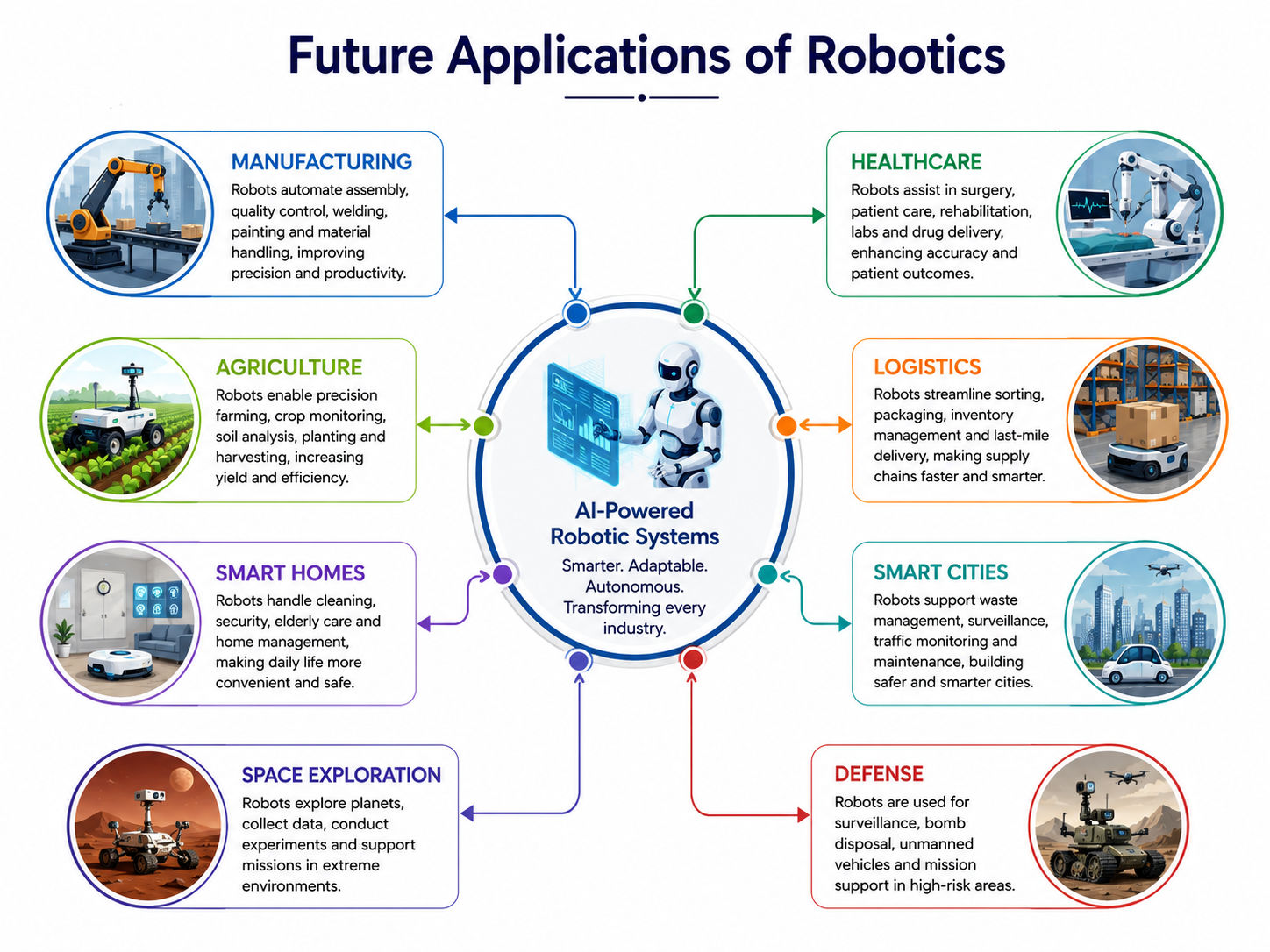
Manufacturing continues to lead robotics adoption. Intelligent robots can assemble products, inspect quality, transport materials, and work alongside human employees.
As the future of robotics and automation evolves, factories will rely more on collaborative robots that improve productivity without removing the need for skilled workers.
Healthcare is becoming one of the fastest-growing areas for robotics.
Future robots will help with:
These developments highlight how the future technology of robots is improving patient safety and reducing the workload for healthcare professionals.
Agricultural robots are helping farmers monitor crops, identify plant diseases, apply fertilizers precisely, and harvest produce more efficiently.
This improves productivity while reducing waste, making robotics an important solution for sustainable farming.
Also Read: Applications of Robotics: Industrial & Everyday Use Cases
Warehouses already use autonomous robots to transport goods and manage inventory. Retail businesses are also testing robots for shelf scanning, stock management, and customer assistance.
These are among the fastest-growing future applications of robotics, especially as online shopping continues to increase worldwide.
The future of robots in everyday life includes smart home assistants, city infrastructure monitoring, and emergency response. At the same time, military robots of the future are expected to enhance surveillance, logistics, and disaster recovery while raising important ethical considerations.
The future of robotics and automation is moving beyond machines that simply follow instructions. Modern robots use AI, sensors, and real-time data to adapt to changing environments, making them more flexible and efficient. Instead of replacing people, they are designed to work alongside humans and improve productivity.
This shift is expanding the future applications of robotics across manufacturing, healthcare, logistics, and retail, while also advancing the future technology of robots.
Robotics performs physical tasks, while AI automation manages repetitive workflows. When combined with AI, robots can make decisions, learn from data, and respond to changing situations without constant human intervention.
This combination is also driving the future of robotics in India, where industries are increasingly adopting intelligent automation to improve efficiency and quality.
Robotics vs AI-Powered Automation:
Traditional Automation |
AI-Powered Robotics |
| Fixed, repetitive tasks | Learns and adapts |
| Rule-based operations | AI-driven decisions |
| Limited flexibility | Handles dynamic environments |
| Requires reprogramming | Continuously improves through learning |
As AI continues to evolve, the future of robotics and automation will focus on smarter collaboration between humans and machines rather than complete automation.
Check out: Scope of Robotics: Career Opportunities & Industry Trends
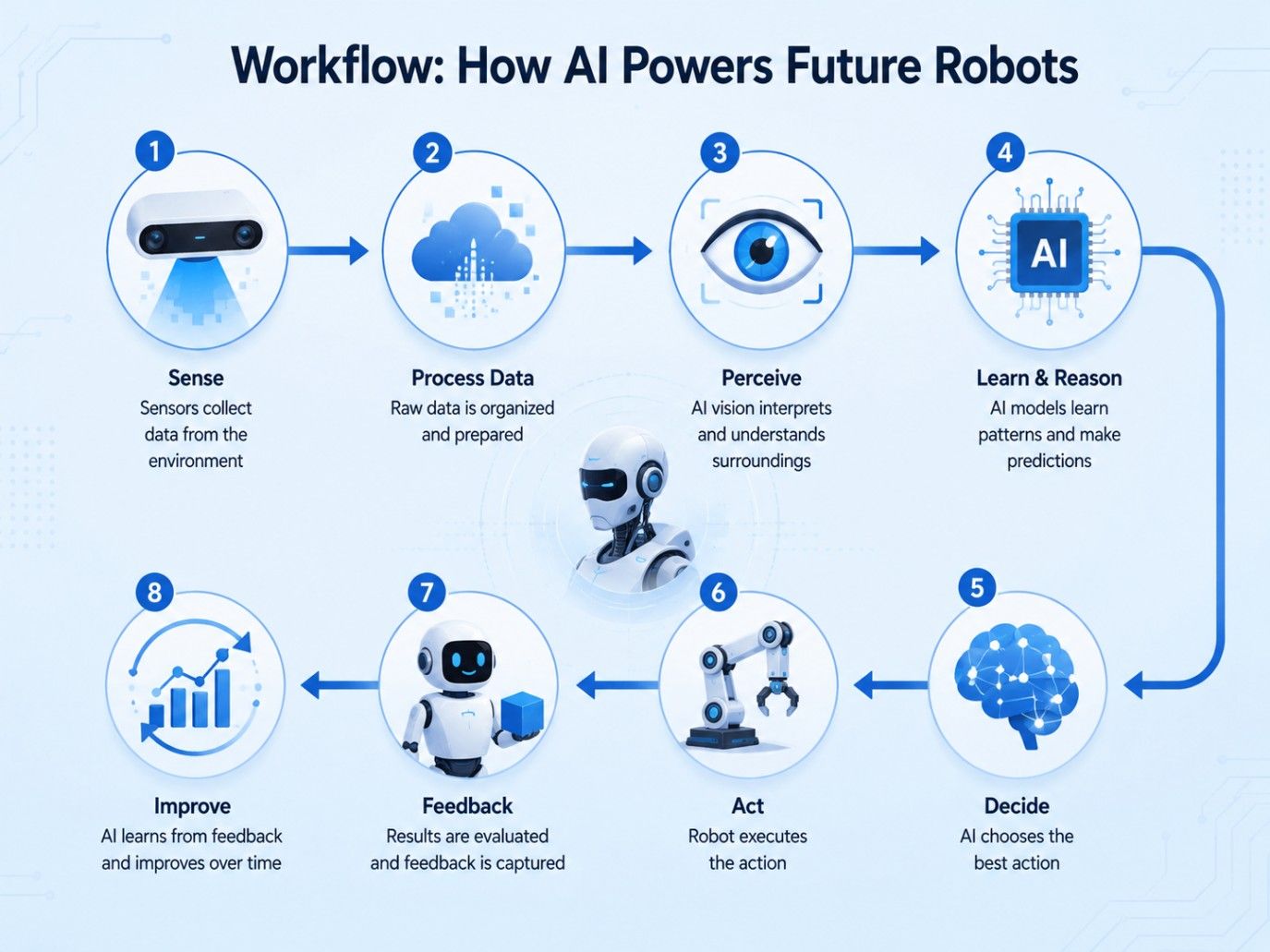
AI changes everything, Earlier robots followed fixed instructions, but today's intelligent systems can recognize objects, understand speech, analyze data, and improve their performance over time. This combination of AI and robotics is driving the next generation of automation.
The future of robotics in artificial intelligence is built around robots that don't just complete tasks. They understand context, adapt to new situations, and make better decisions with every interaction.
Computer vision allows robots to "see" their surroundings using cameras and image-processing algorithms. This helps them identify objects, avoid obstacles, and inspect products with high accuracy.
You'll find this technology in manufacturing, healthcare, agriculture, and autonomous delivery robots. It's becoming a core part of the future technology of robots, enabling machines to work safely in dynamic environments.
Machine learning enables robots to learn from data instead of relying only on fixed programming. Every completed task helps improve future performance.
For example, a warehouse robot can discover shorter delivery routes over time, while an agricultural robot can become better at identifying crop diseases after analyzing thousands of images.
Generative AI is helping robots understand natural language, follow detailed instructions, and communicate more effectively with people.
Instead of programming every action manually, users can describe a task in simple language. The robot interprets the request and determines how to complete it. This capability is expanding the future applications of robotics across industries where flexibility is essential.
Embodied AI combines artificial intelligence with physical robotic systems. It allows robots to learn by interacting with their surroundings rather than depending only on digital simulations.
This technology is expected to play a major role in warehouses, hospitals, smart homes, and factories, making robots more adaptable and reliable in real-world situations.
Humanoid robots are designed to resemble the human body and perform tasks in environments created for people. They can walk, lift objects, communicate, and assist with daily activities. They're improving quickly.
The future of humanoid robots isn't about replacing humans. It's about supporting people in jobs that are repetitive, physically demanding, or hazardous.
Several companies are investing heavily in humanoid robotics.
Some notable examples include:
These robots are being developed for manufacturing, logistics, healthcare, research, and customer service.
Humanoid robots could become valuable assistants in many settings.
Potential applications include:
As hardware becomes more affordable and AI grows more capable, the future of robotics in India may also include humanoid robots for healthcare, education, manufacturing, and public services.
Shape the future of intelligent automation with upGrad's Executive Diploma in Data Science & Artificial Intelligence from IIIT Bangalore. Gain practical AI skills for next-generation technologies.
Robots are gradually becoming part of everyday routines. While industrial robots remain important, the next generation will focus on helping people at home, at work, and in public spaces. They're already here.
The future of robots in everyday life will revolve around convenience, safety, and personalized assistance rather than simple automation.
Home robots are expected to move beyond vacuum cleaning. Future systems may help with cooking, security monitoring, household maintenance, and energy management.
These developments reflect the growing future technology of robots, where machines understand routines and respond to changing household needs.
Healthcare robots will assist patients with medication reminders, mobility support, rehabilitation exercises, and remote health monitoring.
They won't replace doctors or nurses. Instead, they'll reduce routine workloads and improve patient care.
Also Read: Artificial Intelligence Tools: Platforms, Frameworks, & Uses
Educational robots are helping students learn coding, science, mathematics, and problem-solving through interactive experiences.
Schools are also using robotics to encourage innovation and practical STEM learning.
Robots will increasingly support public services by inspecting roads, monitoring infrastructure, managing waste, and assisting emergency teams. The future applications of robotics also include autonomous delivery robots, intelligent public transport systems, and AI-powered assistants that simplify daily life for individuals and communities.
Also read : Top 28 Robotics Projects for Students in 2026
The future of robotics looks promising, but several obstacles still slow widespread adoption. Building intelligent robots isn't only about adding AI. They must also operate safely, remain affordable, and perform reliably in unpredictable environments.
As the future technology of robots evolves, developers must solve technical, social, and regulatory challenges before robots become a common part of everyday life.
Building advanced robots requires expensive hardware, AI models, sensors, and continuous software updates. While prices are falling, many small businesses still find large-scale deployment difficult.
As production increases, costs are expected to decrease, making the future applications of robotics more accessible across industries.
Connected robots collect and exchange large amounts of data. If these systems aren't protected, they can become targets for cyberattacks.
Strong encryption, secure software updates, and continuous monitoring are essential to keep robotic systems safe.
Also Read: IoT: History, Present & Future
Modern robots still struggle with unexpected situations.
Common challenges include:
These limitations show why the future technology of robots still requires continuous research and testing.
Many countries are still developing policies for AI-powered robots. Questions about accountability, safety standards, and liability remain unanswered.
The future of robotics in India will also depend on clear regulations, industry standards, and investment in research to encourage responsible innovation.
Challenges Checklist
Challenge |
Current Impact |
Expected Progress |
| High costs | High | Improving |
| Battery life | Medium | Improving |
| Cybersecurity | High | Ongoing |
| Privacy | High | Ongoing |
| Regulations | Medium | Developing |
| Public trust | Medium | Growing |
Also Read: 50 IoT Projects for 2026 to Boost Your Skills (With Source Code)
The rapid growth of robotics brings important ethical questions. As robots become more autonomous, people expect them to make safe and fair decisions. That isn't always easy.
The ethical issues in the future of robotics require cooperation between engineers, governments, businesses, and researchers to balance innovation with responsibility.
AI systems learn from data. If that data contains bias, robots can make unfair decisions.
Developers must regularly test AI models to reduce bias and improve reliability.
Robots operating in homes, workplaces, and public areas collect images, audio, and other personal information.
Clear privacy policies and secure data handling will become increasingly important.
Who is responsible if an autonomous robot makes a mistake?
This remains one of the biggest ethical debates in robotics and artificial intelligence.
The development of military robots of the future has created global discussions about human oversight and responsible use.
Many experts believe that humans should always remain responsible for critical decisions involving the use of force.
Ethics quick Overview :
Ethical Issue |
Why It Matters |
Possible Solution |
| AI Bias | Unfair decisions | Better training data |
| Privacy | Personal information | Strong security controls |
| Accountability | Legal responsibility | Clear regulations |
| Autonomous Weapons | Human safety | Human oversight |
| Job Displacement | Workforce impact | Reskilling programs |
Also Read: How to Become a Robotics Engineer? 8 Steps, Skills, and Careers for 2026
One of the most common questions about the future of robotics is whether robots will replace people at work. The answer is more balanced than many expect.
Robots will automate repetitive and physically demanding tasks. Human creativity, emotional intelligence, leadership, and complex decision-making will remain difficult to replace.
Some roles involve repetitive work that robots can perform efficiently.
Examples include:
Many professions depend on creativity, empathy, and critical thinking.
These include:
The future workplace won't be about competition alone. People will supervise intelligent systems, solve complex problems, and make strategic decisions while robots handle repetitive or hazardous work. This partnership will define the future of robotics and automation across manufacturing, healthcare, logistics, and service industries.
The future of robotics isn't about creating machines that simply perform tasks faster. It's about building intelligent systems that can work alongside people, solve real-world problems, and improve safety, productivity, and quality of life.
From AI-powered factories and healthcare assistants to smart homes and military robots of the future, robotics is entering a new phase where intelligence matters as much as automation. As the future technology of robots continues to advance and the future of robotics in India gains momentum, businesses, researchers, and governments have an opportunity to shape a future where robots complement human capabilities instead of replacing them.
Ready to start your journey? Book a free consultation with upGrad today to find the best path for your career.
The future of robotics will be shaped by AI, machine learning, and advanced sensors that enable robots to work more independently. Over the next decade, robots are expected to become common in healthcare, manufacturing, logistics, agriculture, and smart homes, supporting people with complex and repetitive tasks rather than replacing them entirely.
The biggest challenges include high development costs, limited battery life, cybersecurity risks, ethical concerns, data privacy, complex real-world navigation, and evolving regulations. Addressing these issues is essential for expanding the future applications of robotics safely across industries and increasing public trust in autonomous systems.
Yes. Robotics is expected to remain a high-growth career because industries increasingly rely on automation and AI. Professionals with skills in robotics, artificial intelligence, computer vision, embedded systems, and programming will have opportunities in manufacturing, healthcare, autonomous vehicles, aerospace, and research.
No. AI is changing how robots are designed, but robotics engineers are still needed to build hardware, develop software, integrate AI models, and solve real-world engineering problems. As the future technology of robots advances, engineers will work alongside AI rather than compete with it.
Robots are expected to automate repetitive jobs such as warehouse operations, assembly line production, quality inspection, inventory management, and basic customer service. However, roles requiring creativity, leadership, empathy, critical thinking, and complex decision-making are expected to remain largely human-driven.
Jobs that depend on emotional intelligence, creativity, strategic thinking, and human interaction are less likely to be replaced. These include doctors, teachers, psychologists, designers, researchers, managers, and skilled engineers who solve complex problems beyond routine automation.
Japan, South Korea, Germany, the United States, and China are among the global leaders in robotics innovation and adoption. At the same time, the future of robotics in India is gaining momentum through growing investments in AI, industrial automation, startups, and research initiatives.
Robotics is becoming more affordable through collaborative robots, cloud robotics, and Robotics-as-a-Service (RaaS). Small businesses can automate repetitive tasks, improve productivity, reduce operational costs, and compete more effectively without making large upfront investments in automation.
Modern robots can make limited decisions using AI, sensors, and real-time data analysis. However, most advanced robotic systems still operate under human supervision, especially in healthcare, transportation, and defense, where safety, ethics, and regulations require human oversight.
The future of robots in everyday life includes smart home assistants, educational robots, healthcare support, and intelligent public services. Robotics will also transform classrooms by helping students learn coding, engineering, and problem-solving through interactive and hands-on experiences.
Students should build a strong foundation in programming, mathematics, artificial intelligence, electronics, machine learning, and computer vision. Practical experience with robotics projects, automation tools, and AI frameworks will prepare them for careers shaping the future applications of robotics across multiple industries.
695 articles published
Sriram K is a Senior SEO Executive with a B.Tech in Information Technology from Dr. M.G.R. Educational and Research Institute, Chennai. With over a decade of experience in digital marketing, he specia...
Speak with AI & ML expert
By submitting, I accept the T&C and
Privacy Policy
Top Resources
Master's Degree
18 Months
Executive Diploma
12 Months
IIIT Bangalore
Executive Programme in Generative AI & Agentic AI for LeadersIndia’s #1 Tech University
Dual Certification
5 Months