Future of Generative AI: Trends and What Comes Next
By Sriram
Updated on Jun 19, 2026 | 7 min read | 2.5K+ views
Share:

All courses
Certifications
More
By Sriram
Updated on Jun 19, 2026 | 7 min read | 2.5K+ views
Share:
Table of Contents
Future of Generative AI is not something that will happen later; it is already shaping the industries, careers and digital experiences. It has become a part of our lives, implemented in various fields like creating content, writing code, image generation, and automating tasks. This technology is changing how people and businesses work.
In this blog, you’ll learn about the future of Generative AI, technologies driving its growth, benefits and challenges, skills etc. This article will help anyone who is enthusiastic to know more about Generative AI, whether you are a student, working professional or business leader.
Explore Agentic AI Courses Online from upGrad and be a part of reshaping industries with generative AI.
Generative AI Courses to upskill
Explore Generative AI Courses for Career Progression
IIIT Bangalore
Executive Diploma in Machine Learning and AI360° Career Support
The future of AI will be shaped by models that are smart as more people start using them, and they will become part of the tools we use every day. It was not invented just to make content. It was invented to help people make decisions and solve problems that are rather hard to solve.
Predictions show that the market for AI is growing stronger. Gartner states that the amount spend of AI model will go up to around $75 billion by 2029. Simultaneously, Grand View Research estimates that the global AI market will be worth more than $324 billion by 2033. These numbers only project the growing importance of generative AI.
Also Read: Generative AI Fundamentals: A Practical Guide to Understanding How Modern AI Works
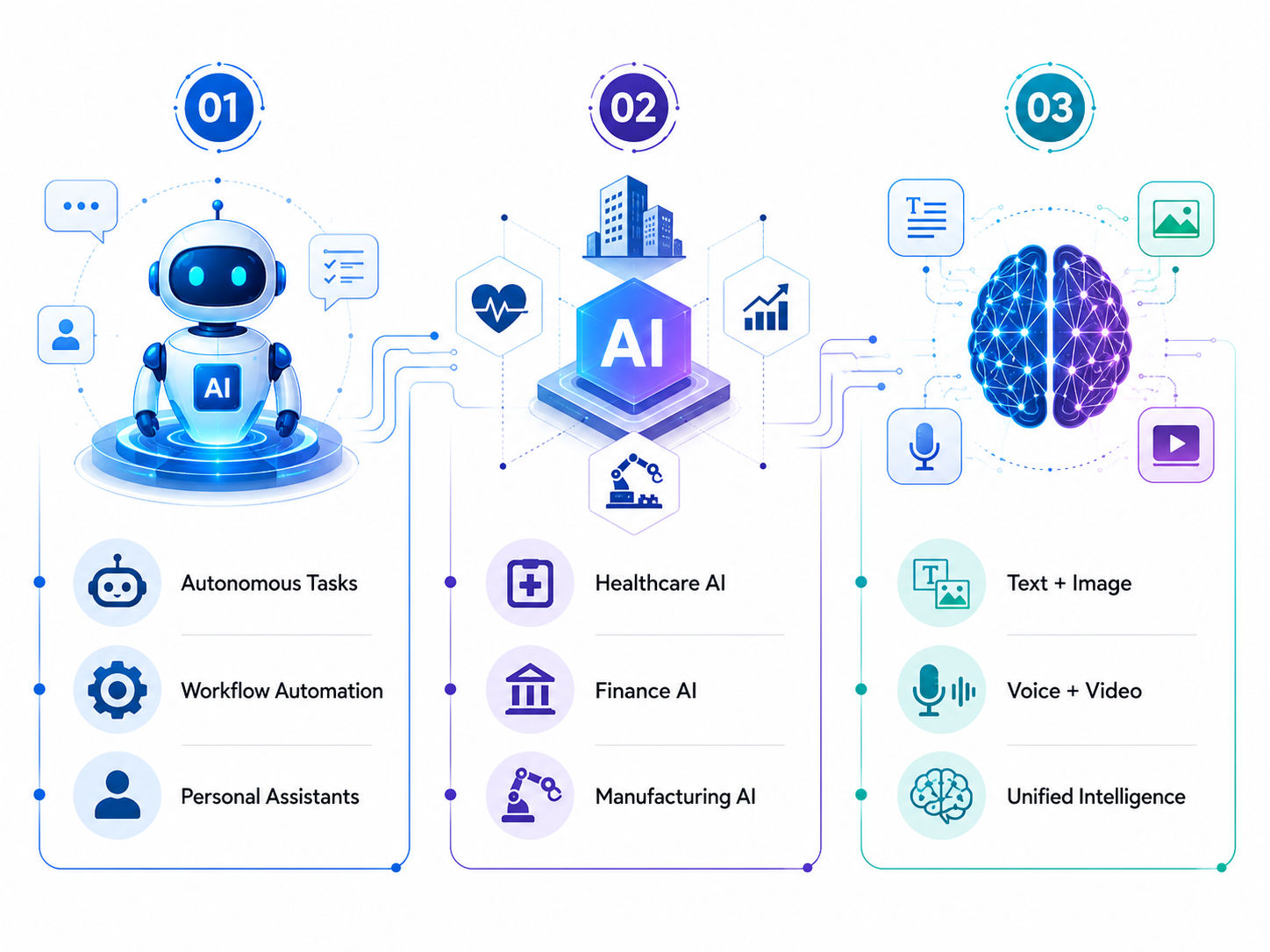
Important characteristics of Generative AI that is pioneering the future of AI.
Most AI tools today just wait for prompts and react to whatever you type. That's starting to shift. The next wave of AI will be able to carry out full tasks on its own, working more like a digital teammate than a simple chatbot.
Some examples of what that could look like:
In other words, these agents won't just generate content. They'll actually get things done from start to finish, with little need for someone to step in along the way.
Generic, one-size-fits-all AI is starting to lose ground. Companies increasingly want models trained on their own industry data, ones that actually understand the language, rules, and quirks of their specific field.
Industry |
Potential AI Applications |
| Healthcare | Clinical documentation and diagnosis support |
| Finance | Risk assessment and fraud detection |
| Education | Personalized learning experiences |
| Retail | Customer recommendations and forecasting |
| Manufacturing | Predictive maintenance and quality control |
In fact, Gartner expects more than half of all enterprise AI models to be industry-specific by 2027, a sign of just how fast this shift is happening.
AI is also getting better at juggling different types of content at once instead of treating each format as a separate job. The goal is one system that understands it all together; not five different tools stitched into a workflow.
That includes:
So rather than bouncing between separate apps for writing, image editing, and transcription, users will be able to lean on a single system that handles all of it smoothly.
Also Read: Generative AI Roadmap
The future of AI is not just about machines doing things for us. It is about making our work better, making us more creative, and helping us make decisions. Companies that use AI in a smart way are already seeing real benefits, especially when they use it for important tasks that matter a lot to their business.
Read: Generative AI for Beginners: A Practical Guide to Understanding Modern AI
The future of AI is exciting as it will impact various industries, unlike the previous technologies that only impact one area it can be used in almost every area. Generative AI will have an impact on specific industries, and this is what makes generative AI interesting and gives room across industries something to think about.
Healthcare professionals spend a lot of time on documentation and administrative tasks. Generative AI can help with this. So that doctors can focus more on patients while not having administrative tasks to worry about.
Paperwork such as:
Also Read: Introduction on Generative AI in Healthcare
The education sector is changing a lot. Students get to learn in a way that's just right, for them, and mentors do not have to spend so much time doing repetitive work over and over again in the education sector.
AI-powered tools can:
Generative AI has increased the efficiency of developers by assistance. AI usage in software engineering has increased, by benefiting them in faster development and making developers more productive, with generative AI.
Common use cases include:
Human oversight is necessary for maintaining originality, quality, and for maintaining brand voice.
Content teams increasingly use AI for:
A lot of companies are using Artificial Intelligence in different areas, but when it comes to making big changes with Artificial Intelligence, they still need to do it carefully and make sure they are following the rules, with Artificial Intelligence.
Generative AI helps organizations improve efficiency.
Business Function |
AI Impact |
| Customer Service | Faster response times |
| HR | Resume screening and onboarding |
| Sales | Lead qualification |
| Finance | Report generation |
| Operations | Workflow automation |
Also Read: Generative AI for Business: Benefits, Use Cases, Challenges, and Future Trends
A lot of people think that Artificial Intelligence will take over every job.
Actually many experts think that the future of Artificial Intelligence will be about humans and machines working together. Artificial Intelligence does the repetitive work while humans focus on:
This change is probably going to change what people do in their jobs rather than get rid of the jobs altogether.
Also Read: Generative AI Examples: Real-World Applications Explained
The future of generative AI presents enormous opportunities for individuals, businesses, and economies.
The future of Artificial Intelligence is going to be really big. It will bring a lot of chances for people, companies, and the economy as a whole.
At the time the jobs we are used to are changing and now they need skills related to Artificial Intelligence.
Popular careers include:
Organizations use generative AI to increase efficiency across various departments. Some companies are already reporting strong returns from focused AI investments.
Potential benefits include:
Startups and enterprises are creating entirely new products using generative AI. This creates opportunities for entrepreneurs and technology professionals alike.
Examples include:
The economic impact of this could be really big in the run. Market forecasts suggest that companies will spend a lot of money on generative AI and use it a lot more over the next ten years.
Analysts expect that generative AI will become a foundation rather than just something extra that some companies implement. Generative AI will be a part of how businesses operate.
Researchers suggest that companies that use AI value higher thinking ability, and technical skills combined with social skills.
Professionals preparing for the future should focus on:
Technical Skills |
Human Skills |
| AI Tools | Communication |
| Data Analysis | Leadership |
| Prompt Engineering | Critical Thinking |
| Automation | Creativity |
| Machine Learning Basics | Problem Solving |
Also Read: Generative AI Architecture: A Beginner’s Guide
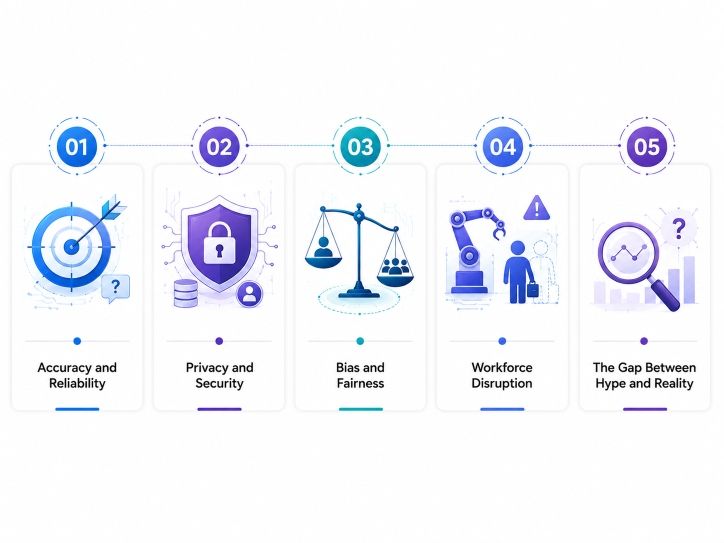
The future of AI is really exciting, but it also has some big problems that we need to think about. Understanding AI risks is very important if we want to use generative AI in a responsible way.
AI systems can generate incorrect information; this is often called hallucination. So, human review remains essential, especially in high-stakes environments.
Potential consequences include:
As AI adoption increases, stronger governance frameworks will become essential. Many organizations worry about:
AI models learn from existing data. If that data contains bias, the outputs may reflect it.
Organizations must invest in:
Certain tasks will become highly automated. This could hit some jobs harder than others. Looking back in history, we see that technology usually changes the way we work by getting rid of jobs completely. The real task is to help workers learn skills to keep up.
Not every artificial intelligence project works out. Some studies show that a lot of AI project do not really help businesses because they were not planned well or it is not clear what they are supposed to do, or they do not work well with other things.
You can also explore: The Future Scope of Artificial Intelligence in 2026 and Beyond
Using AI in a responsible way is going to be a plus point for companies. It will not just be a compliance requirement. It will actually help them stand out from the rest.
The organizations that succeed in the future of generative AI will focus on:
Also Read: Generative AI vs Traditional AI: Which One Is Right for You?
The future of generative AI is both exciting and complex. We are moving beyond simple content generation into a world where AI supports decision-making, automates workflows, and helps people solve problems faster. At the same time, success will depend on balancing innovation with responsibility.
The most likely outcome is not a future where AI replaces humans. Instead, it is a future where people who know how to work with AI gain a significant advantage. Those who adapt early, learn continuously, and use AI responsibly will be best positioned to benefit from the opportunities ahead.
Want to explore more about, future of generative AI? Book your free 1:1 personal consultation with our expert today.
The future of generative AI over the next 5 years is expected to include smarter AI agents, multimodal systems, and broader business adoption. Organizations will increasingly integrate AI into daily operations rather than using it only for experimentation. Professionals will also see AI embedded into workplace tools, making productivity and collaboration more efficient across industries.
Generative AI is more likely to transform jobs than replace them entirely. Many routine and repetitive tasks may become automated, but human skills such as creativity, judgment, leadership, and relationship management will remain valuable. Workers who learn to collaborate with AI will likely have better career opportunities than those who avoid it.
Industries such as healthcare, education, finance, software development, manufacturing, and marketing are expected to benefit significantly. These sectors handle large volumes of information and repetitive tasks that AI can streamline. The technology also enables faster decision-making and improved customer experiences.
Generative AI can personalize learning experiences by adapting content to individual student needs. It can create quizzes, explain concepts, and provide instant feedback. Teachers can also use AI to reduce administrative work and focus more on student engagement.
Yes. Demand for AI-related skills continues to grow across industries. Roles such as AI engineer, data scientist, machine learning specialist, and AI product manager are increasingly sought after. Even non-technical professionals can benefit from learning AI tools and workflows.
Key skills include prompt engineering, data literacy, AI tool usage, automation knowledge, and basic machine learning concepts. Equally important are - communication, creativity, critical thinking, and problem-solving abilities. The combination of technical and human skills will be highly valuable.
Future AI systems will likely become more accurate through better training methods, stronger reasoning capabilities, and improved access to real-time information. However, human verification will still be necessary because no AI system is expected to be perfect in every situation.
Major risks include misinformation, bias, privacy concerns, security vulnerabilities, and overreliance on automated outputs. Organizations must implement governance frameworks to manage these challenges. Responsible AI practices will become increasingly important as adoption grows.
Yes. Small businesses can use generative AI to create content, automate customer service, analyze data, and improve marketing efforts. Many AI tools are becoming more affordable and accessible. This allows smaller organizations to compete more effectively with larger companies.
AI agents are expected to become a major part of workplace operations. These systems will handle tasks such as scheduling, research, reporting, and workflow automation with limited human intervention. Their role will continue to expand as technology improves.
Professionals should start by learning AI fundamentals and experimenting with widely used AI tools. Understanding how AI fits into their industry is equally important. Continuous learning, adaptability, and strong problem-solving skills will help individuals stay competitive as AI evolves.
730 articles published
Sriram K is a Senior SEO Executive with a B.Tech in Information Technology from Dr. M.G.R. Educational and Research Institute, Chennai. With over a decade of experience in digital marketing, he specia...
Speak with AI & ML expert
By submitting, I accept the T&C and
Privacy Policy