Break Even Analysis: Know When Your Business Starts Covering Its Costs
By upGrad
Updated on Nov 09, 2026 | 9 min read | 2.36K+ views
Share:

All courses
Certifications
More
By upGrad
Updated on Nov 09, 2026 | 9 min read | 2.36K+ views
Share:
Table of Contents
Key Highlights
Want to make smarter business decisions with the help of cost analysis, pricing and financial planning? Explore upGrad’s Online MBA Courses to learn practical management and finance skills for your career.
Popular MBA Programs
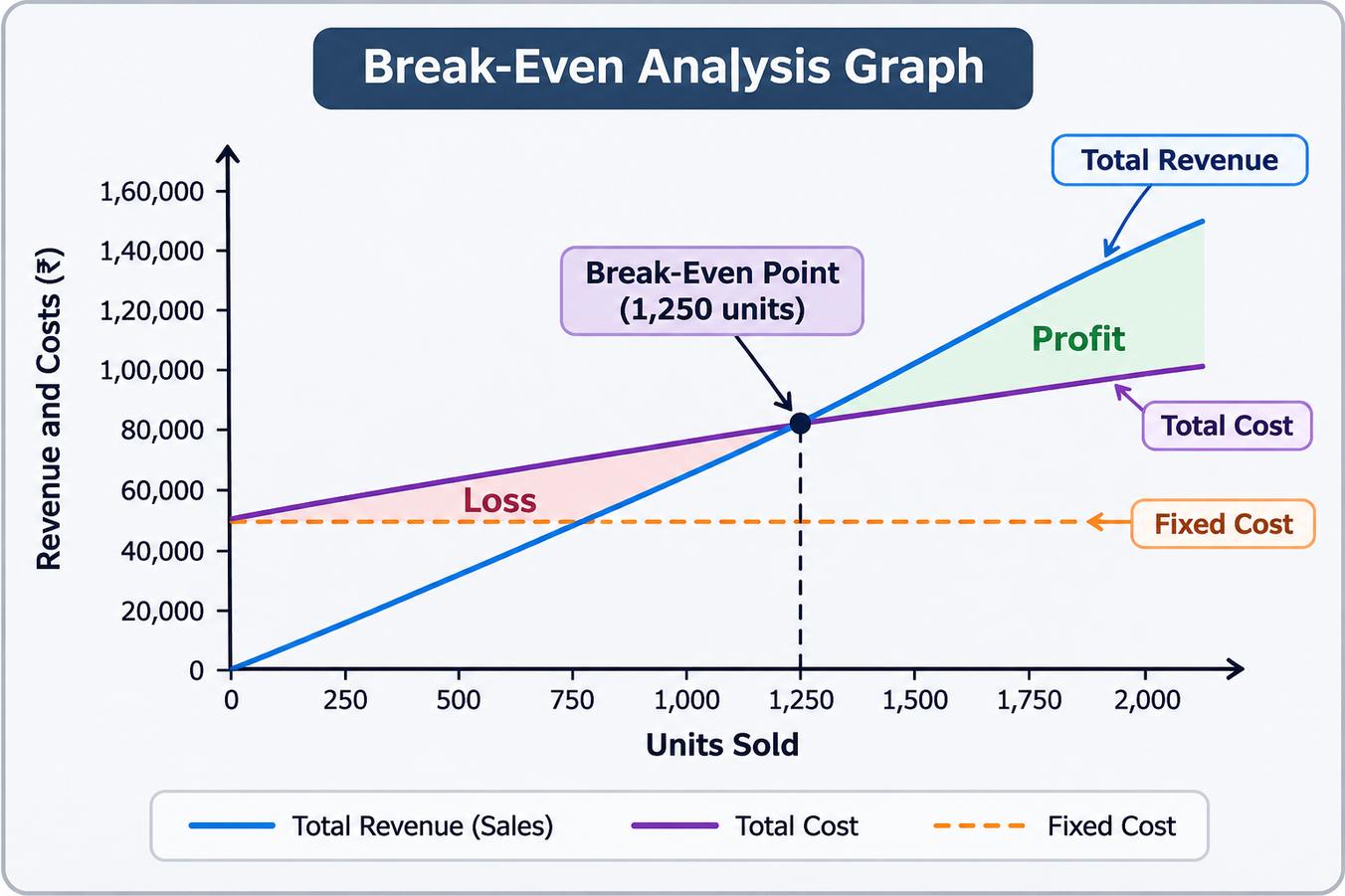
Break even analysis is a point in a financial calculation where your total revenue and total cost match, which results in zero profit and loss. These are some reasons that shows why you should calculate your break even point:
Free Courses
The break even calculation is based on few inputs, so get them right otherwise the results will mislead you.
Fixed costs are expenses you pay no matter how much you produce or sell. Even if you sell nothing this month, they still arrive. They are also called overhead costs.
Common break even analysis example includes:
Variable costs rise and fall with your output. For a manufactured product, majorly the variable cost is the labour and material cost.
To get a total variable cost, you have to multiply the cost of one unit by the total number of units. Like if one unit costs ₹4 to make and you make 1,000 units, then your total variable cost will be ₹4,000.
Selling price is an amount that customers pay for one unit of your product or service. It is important as it sets how much sales you will get.
The relationship works in both directions:
If you |
Then the break-even point |
| Raise the price | Falls, because each sale covers more cost |
| Lower the price | Rises, because you must sell more units |
This is why discounting needs care. A lower price may bring more customers, but you may not be able to sell enough extra units to cover the higher break-even target.
The contribution margin is the selling price minus the variable cost per unit. It is the amount each sale has left to pay off fixed costs. Once fixed costs are covered, whatever remains is profit.
Unit contribution margin = Selling price per unit − Variable cost per unit
Suppose you sell a product for ₹24 and it costs ₹4 to make. Your contribution margin is ₹20. Each unit sold gives you ₹20 toward your fixed costs.
Looking to strengthen your understanding of costing, pricing and business planning? Explore upGrad’s MBA from Golden Gate University to learn from U.S. faculty and apply concepts through 15+ hands-on projects.
MBA Courses to upskill
Explore MBA Courses for Career Progression
O.P.Jindal Global University
MBA (with Career Acceleration Program by upGrad)Become interview ready with Career Services
PSB MBA + IIML Certification
MBA from Paris School of Business with Certification from IIM LucknowThe formula needs only three numbers: your fixed costs, your selling price per unit and your variable cost per unit. You can use it to get the answer in units or in rupees.
This tells you how many units you must sell to cover all your costs.
Break-even point (units) = Fixed costs ÷ (Selling price per unit − Variable cost per unit)
The part in brackets is the contribution margin. It is the money each unit leaves behind after its own cost is paid. That money goes toward your fixed costs.
Let’s use the bakery again.
Each cake leaves ₹40 (100 − 60) toward fixed costs.
Break-even point = 50,000 ÷ 40 = 1,250 cakes
So the bakery must sell 1,250 cakes a month to cover its costs. Cake number 1,251 is the first one that earns profit.
Check: Cost and Management Accounting
Sometimes you need the answer in rupees, not units. This is useful when you sell many products at different prices.
There are two ways to find it.
Break-even sales = Break-even units × Selling price per unit
For the bakery: 1,250 × ₹100 = ₹1,25,000
First, find the ratio. It shows what share of each sale is left after variable costs.
Contribution margin ratio = Contribution margin ÷ Selling price per unit
For the bakery: 40 ÷ 100 = 0.40, or 40%
Then divide your fixed costs by that ratio.
Break-even sales = Fixed costs ÷ Contribution margin ratio
For the bakery: 50,000 ÷ 0.40 = ₹1,25,000
Both methods give the same answer. Use the first when you sell one product. Use the second when you sell a mix of products and don’t have one single price.
Must read: Leverage in Financial Management: Types, Formulas, and Examples
The concept of break even analysis is easy to use but it is not perfect. It gives you a clear number after some inputs. But real business is not that simple, so if you know where the concepts are lacking, you can use it better.
By using the formula you can check how many units you have to sell, but it does not tell you whether people are ready to buy that many units or not.
So, check your break even against the real demand. Look at what your competitors sell. Look at your own past sales. Take feedback from some customers, and set a realistic target.
Giving discounts is an easier way to get more customers. But it lowers the money you will earn per unit, in that case you have to sell more units.
For example, Meena reduced the price of a product from ₹500 to ₹450. See what happens to her break-even point.
Before discount |
After discount |
|
| Selling price | ₹500 | ₹450 |
| Contribution margin | ₹200 | ₹150 |
| Break-even point | 150 shirts | 200 shirts |
She now has to sell 50 more shirts every month just to reach zero profit. That is a third more work for the same result.
Also read: Accounting Profit: What It Is, How to Calculate It, and Key Differences
Conclusion
A break even analysis shows how many units you have to sell, to stop losing the money. In a formula, it uses three units, fixed costs, variable costs, and selling price. By the formula you will get the number of units or the amount of sales you have to cover to recover costs.
If the break even point is high, then you can lower the price, cut variable costs or reduce fixed costs. Do small changes in each, as it works better than a big change in one.
So, whether you are starting a new business or planning to launch a new product, calculate your break even point first.
Book a one-on-one consultation with upGrad counsellors to get personalized guidance on selecting the best course for your career.
Margin of safety is how much your sales exceed the break-even point. If the bakery sells 1,500 cakes against a break-even of 1,250, the margin of safety is 250 cakes. It shows how far sales can fall before losses begin.
Add your target profit to your fixed costs, then divide by the contribution margin. If the bakery wants ₹10,000 profit, it needs (50,000 + 10,000) ÷ 40, which is 1,500 cakes.
Break-even point shows the sales needed to cover costs in a period, usually a month or year. Payback period shows how long it takes to recover an initial investment. One measures volume, the other measures time.
Cost-volume-profit analysis studies how changes in costs, sales volume and price affect profit. Break even analysis is one part of it. CVP goes further by testing different scenarios, such as price changes or new costs.
There is no fixed time. Six to eighteen months is common, but it depends on the industry, the funding and the business model. Technology and pharmaceutical firms often take longer because of high research costs.
Yes. A service business can treat an hour, a client or a project as one unit. A tutor, for example, can divide monthly fixed costs by the amount left per class after direct costs to find the classes needed.
Use a weighted average. Work out the average contribution margin based on how much of each product you usually sell, then divide fixed costs by it. This gives a combined break-even figure for the whole sales mix.
The shutdown point is where revenue only covers variable costs. Below it, producing loses more money than stopping. Between the shutdown point and break-even, a firm loses money but may keep running in the short term.
Yes. Enter fixed costs, price and variable cost in separate cells, then use a simple formula for the break-even units. You can also build a table of sales volumes and plot a line chart to see where revenue meets costs.
Net present value, internal rate of return and return on investment are common choices. Each judges profitability differently, so businesses often use them alongside break even analysis before approving a large investment.
Yes. Investors use it to find the price an asset must reach to recover purchase and selling fees. Governments use it to judge public projects, set utility rates or assess policy changes. It is not limited to private businesses.
1349 articles published
We are an online education platform providing industry-relevant programs for professionals, designed and delivered in collaboration with world-class faculty and businesses. Merging the latest technolo...
Speak with MBA expert
By submitting, I accept the T&C and
Privacy Policy
From MBA to Dream Job - Explore Our Alumni Success Stories
Top Resources
Master's Degree
13 Months
Master's Degree
12 Months
O.P.Jindal Global University
MBA (with Career Acceleration Program by upGrad)Become interview ready with Career Services
Master's Degree
12 Months