Product Owner vs Product Manager: What's the Real Difference
By upGrad
Updated on Oct 19, 2026 | 6 min read | 1.65K+ views
Share:

All courses
Certifications
More
By upGrad
Updated on Oct 19, 2026 | 6 min read | 1.65K+ views
Share:
Product Owner vs Product Manager is one of the most common comparisons for anyone exploring a career in product management. While both roles contribute to building successful products, they don't perform the same job. One focuses on defining the product's vision and business goals, while the other works closely with the development team to turn that vision into working features.
If you're trying to figure out the difference between a product owner and a product manager, you're not alone. These two titles get thrown around interchangeably in job postings, team meetings, and LinkedIn bios. But they're not the same job.
This blog breaks down exactly what each role does, where they overlap, and where they don't.
Explore upGrad's MBA programs and management courses online to build strong business and leadership skills. Learn product strategy, business analytics, marketing, finance, operations, and strategic decision-making through real-world case studies, hands-on projects, and industry-focused learning.
Popular MBA Programs
A product manager owns the "why" and the "what." A product owner owns the "how" and the "when," at least within a single sprint or development cycle.
Here's the simplest way to think about it. The product manager sets strategy, talks to customers, studies the market, and decides what the product should become over the next year. The product owner takes that vision and breaks it into a backlog the engineering team can actually build, sprint by sprint.
In a lot of startups, one person does both jobs. In larger companies, a product owner reports into a product manager, or the PM might delegate sprint planning entirely. The product owner vs product manager distinction matters more in companies running formal Scrum, where "Product Owner" is actually a defined role in the framework itself.
A few quick contrasts
Basis of Comparison |
Product Owner |
Product Manager |
| Primary focus | Executes the product vision by managing development priorities | Defines the product vision and long-term strategy |
| Main objective | Deliver the right features in each sprint | Build products that solve customer and business problems |
| Scope of work | Focuses on day-to-day product execution | Focuses on product direction and growth |
| Key responsibility | Owns and prioritizes the product backlog | Owns the product roadmap and strategy |
| Decision-making | Makes tactical decisions during development | Makes strategic product and business decisions |
| Works closely with | Developers, Scrum Master, QA engineers | Customers, executives, marketing, sales, and design teams |
| Customer interaction | Limited and usually indirect | Frequent customer interviews and market research |
| Success metrics | Sprint completion, backlog quality, and feature delivery | Customer satisfaction, product adoption, revenue, and business impact |
| Agile involvement | Plays a central role in Scrum ceremonies and sprint planning | Participates in planning but focuses more on strategic alignment |
| Time horizon | Short-term delivery and upcoming sprints | Medium to long-term product planning and vision |
| Key deliverables | User stories, acceptance criteria, and prioritized backlog | Product roadmap, business case, product strategy, and market plans |
Free Courses
Product Managers are responsible for identifying problems worth solving. They talk to users, dig through data, watch competitors, and figure out what gaps exist in the market.
From there, they build a roadmap. This is a living plan that shifts as priorities change. A good Product Manager constantly asks whether the team is building the right thing, not just building things fast.
Key responsibilities typically include:
A Product Manager at a fintech startup, for example, might spend weeks researching whether to build a budgeting tool or a credit score tracker first. That decision shapes the entire next quarter. It's research, conversations, and a lot of spreadsheets.
Product Managers also need a working understanding of tech, even if they don't write code. They need to know what's feasible, what's expensive to build, and what tradeoffs engineering teams face. Without that, roadmap conversations turn into guesswork.
Explore upGrad's Dual MBA & DBA from Edgewood University to build advanced business, leadership, and research expertise. Gain hands-on experience in strategic management, organizational leadership, business analytics, and applied research while preparing for senior leadership, consulting, and academic roles through a globally accredited dual-degree program.
MBA Courses to upskill
Explore MBA Courses for Career Progression
O.P.Jindal Global University
MBA (with Career Acceleration Program by upGrad)Become interview ready with Career Services
PSB MBA + IIML Certification
MBA from Paris School of Business with Certification from IIM LucknowThe Product Owner role is narrower and more tactical. If the Product Manager is thinking about the next year, the Product Owner is thinking about the next two weeks.
Product Owners own the product backlog. They write user stories, set acceptance criteria, and decide what gets built in the current sprint. They're the go-to person when a developer has a question about a feature's intended behavior.
A day in the life often looks like this:
This role demands constant availability. Developers can't wait three days for an answer about how a button should behave. They need it now, and that's exactly why Product Owners s sit close to the engineering team, often literally.
One challenge Product Owners face? Saying no to mid-sprint changes. Stakeholders show up wanting "just one small tweak," and the Product Owner has to protect the sprint's integrity while still being reasonable. It's a constant balancing act between flexibility and discipline.
Also read: A Complete Guide to a Career In Product Management
Although Product Owners and Product Managers have different responsibilities, they work toward the same objective: building products that deliver value to customers and the business. Both roles require collaboration, communication, problem-solving, and a deep understanding of user needs. In many organizations, they work closely together throughout the product development lifecycle.
Similarity |
Product Owner & Product Manager |
| Primary Goal | Both focus on delivering valuable products that meet customer and business needs. |
| Customer Focus | Both use customer feedback to improve the product. |
| Product Knowledge | Both need a strong understanding of the product and its users. |
| Collaboration | Both work closely with developers, designers, and stakeholders. |
| Decision-Making | Both make product-related decisions based on business priorities and user needs. |
| Communication | Both regularly communicate with cross-functional teams and stakeholders. |
| Problem-Solving | Both identify challenges and find practical solutions. |
| Agile Environment | Both commonly work within Agile product development teams. |
| Prioritization | Both help determine what work should be done first to maximize value. |
| Business Awareness | Both align product decisions with business objectives. |
| Data-Driven Approach | Both rely on user insights, analytics, and feedback to make informed decisions. |
| Product Success | Both share responsibility for creating successful, high-quality products. |
Also read: What is Product Management? Key Aspects, Skills and Career Paths
The skill sets for these roles overlap but aren't identical. Product managers lean heavily on strategic thinking, market research, and stakeholder communication across the whole company. Product owners lean into backlog management, Agile or Scrum expertise, and tight collaboration with developers.
Here's a comparison of common skill requirements:
Aspect |
Product Owner (PO) |
Product Manager (PM) |
| Career Path | Often starts here before moving to a PM role. | Usually a more advanced product role. |
| Focus | Builds experience through product execution. | Focuses on product strategy and growth. |
| Certifications | CSPO is a common certification. | Certifications are usually optional. |
| Hiring Priority | Scrum and Agile knowledge are valued. | Experience and results matter more. |
| Salary | Generally earns less than a PM. | Usually earns more than a PO. |
| Best For | People who enjoy working closely with developers. | People who enjoy customer research and strategy. |
The product owner vs product manager debate isn't really about which job is "better." They're built for different parts of the product lifecycle, and most successful products need both functions working well together.
Small teams often combine these roles into one person wearing two hats. Larger organizations split them deliberately, especially when running Scrum at scale across multiple squads. Neither structure is wrong. It depends on team size, product complexity, and how the organization likes to operate.
If you're choosing a career direction, try both early on if you can. Some people discover they love the strategic, big-picture pace of product management. Others thrive in the fast, collaborative rhythm of product ownership. There's no universally "correct" path here, just the one that fits how you like to work.
Ready to start your journey? Book a free consultation with upGrad today to find the best path for your career.
No. A Product Owner isn't higher than a Product Manager, and a Product Manager isn't automatically senior to a Product Owner. These are different roles with different responsibilities. In Scrum teams, the Product Owner focuses on delivery, while the Product Manager drives product strategy and long-term business outcomes.
Neither role is better. It depends on your interests and career goals. If you enjoy customer research, product vision, and business strategy, Product Management is a better fit. If you prefer working closely with developers and managing Agile delivery, Product Ownership is likely the right choice.
Yes. Many startups and small companies combine both responsibilities into one role because teams are lean. As products grow and become more complex, organizations often separate the positions so one person can focus on strategy while the other manages execution and sprint delivery.
A Product Owner is an important leadership role within an Agile team, but it isn't always a senior management position. The level depends on the organization's structure. Some Product Owners lead critical products, while others report to Product Managers or Heads of Product.
In most organizations, Product Managers earn higher salaries because they're responsible for product vision, market strategy, and business performance. Product Owners are also well compensated, particularly in experienced Agile teams. Pay ultimately depends on experience, industry, company size, and location rather than title alone.
Scrum recommends keeping these roles separate because they serve different purposes. The Product Owner decides what should be built, while the Scrum Master coaches the team and supports the Scrum process. Combining both roles can create conflicts of interest, although smaller teams sometimes do it temporarily.
Not usually. Most employers expect Product Owners to understand Agile practices, stakeholder management, and software development workflows before taking ownership of a product backlog. Many professionals transition into the role after working as business analysts, developers, QA engineers, or Associate Product Managers.
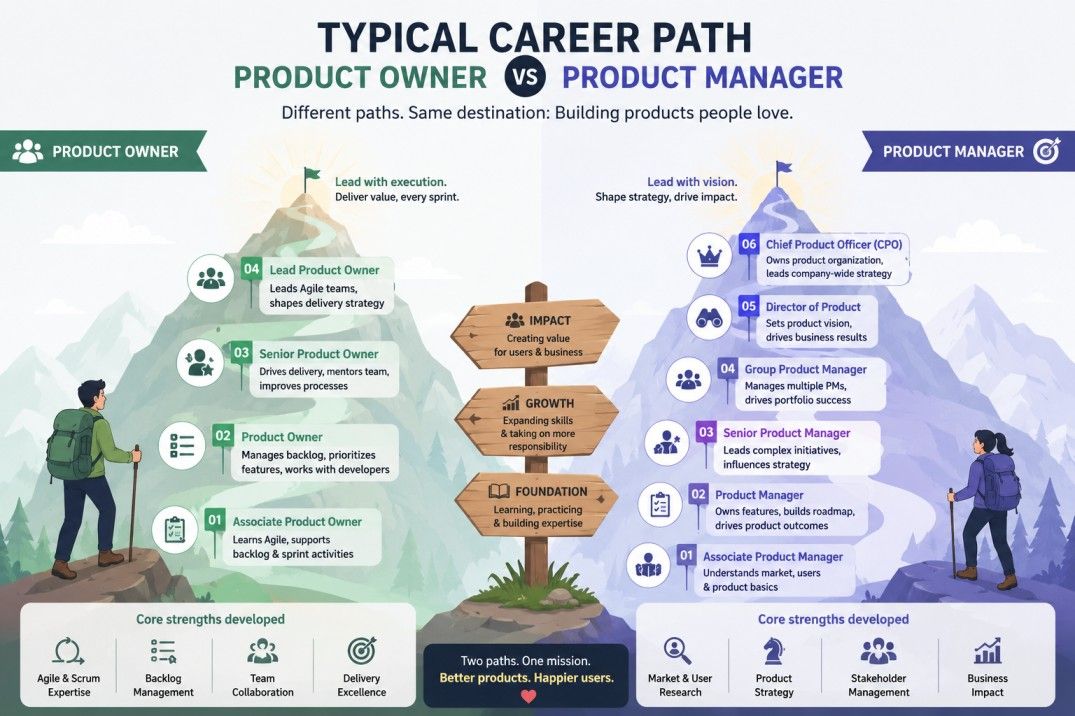
Career progression varies across organizations, but a common path includes Associate Product Owner, Product Owner, Senior Product Owner, Lead Product Owner, and Principal or Head of Product Ownership. Some experienced Product Owners also move into Product Manager or Product Director roles as they gain strategic experience.
It's possible, but it's rarely recommended in mature Scrum teams. A Product Manager focuses on product strategy and business priorities, while a Scrum Master protects the Agile process and coaches the team. Combining both responsibilities can reduce objectivity and create competing priorities.
Although structures differ, most product organizations have three broad leadership levels. They begin with individual contributors such as Product Managers or Product Owners, move to people managers like Group Product Managers or Directors of Product, and end with executive leaders such as Vice Presidents of Product or Chief Product Officers.
The right certification depends on your career path. If you're targeting a Product Owner role, certifications like Certified Scrum Product Owner (CSPO) or Professional Scrum Product Owner (PSPO) are widely recognized. For Product Managers, practical product management programs and hands-on project experience usually carry more weight than certifications alone.
1153 articles published
We are an online education platform providing industry-relevant programs for professionals, designed and delivered in collaboration with world-class faculty and businesses. Merging the latest technolo...
Speak with MBA expert
By submitting, I accept the T&C and
Privacy Policy
From MBA to Dream Job - Explore Our Alumni Success Stories
Top Resources
Master's Degree
13 Months
Master's Degree
12 Months
O.P.Jindal Global University
MBA (with Career Acceleration Program by upGrad)Become interview ready with Career Services
Master's Degree
12 Months