Branding vs Marketing: What's the Real Difference and Why It Matters
By upGrad
Updated on Jun 17, 2026 | 7 min read | 1.81K+ views
Share:

All courses
Certifications
More
By upGrad
Updated on Jun 17, 2026 | 7 min read | 1.81K+ views
Share:
Table of Contents
Branding represents the essence of your business, it shapes your identity, reflects your values, and creates an emotional bond with your audience. Marketing, in contrast, is the execution side, it focuses on promoting that identity through targeted campaigns and channels to increase visibility, generate leads, and drive sales.
Branding is who you are. Marketing is how you tell people about it.
This blog breaks down the real difference between branding vs marketing, shows you where they overlap, and helps you decide where to focus your effort and budget.
Explore upGrad's Digital Marketing programs to build practical skills in brand strategy, marketing communication, SEO, performance marketing, content marketing, social media marketing, consumer behavior, and data-driven campaign optimization.
Branding is the foundation. Marketing is what you build on top of it.
Your brand is your identity. It's your values, your visual style, your tone of voice, the feeling someone gets when they interact with your business. You don't create a brand through a single campaign. It builds over time, through every customer interaction, every product experience, every piece of content you put out.
Marketing is the set of activities that drive attention and action. It's the ads, the email campaigns, the social posts, the SEO strategy. Marketing puts your brand in front of people and pushes them toward a decision.
Here are the core differences between them:
Parameter |
Branding |
Marketing |
| Primary Purpose | Build identity and perception | Drive awareness, engagement, leads, and sales |
| Core Question | "Who are we?" | "How do we reach customers?" |
| Focus | Business image and reputation | Customer acquisition and revenue generation |
| Time Frame | Long-term and ongoing | Short-term, medium-term, and long-term |
| Goal | Create trust, loyalty, and recognition | Generate demand and encourage action |
| Outcome | Strong brand equity and customer connection | Increased traffic, leads, and conversions |
| Customer Impact | Shapes how people feel about the business | Influences what people do after seeing a message |
| Key Elements | Brand identity, values, voice, positioning | SEO, advertising, social media, email marketing |
| Success Metrics | Brand awareness, recall, sentiment, loyalty | Clicks, leads, conversions, ROI, sales |
| Consistency Requirement | Must remain relatively stable over time | Changes based on goals, audience, and campaigns |
| Communication Style | Defines tone, messaging, and personality | Delivers messages through various channels |
| Customer Relationship | Builds emotional connection | Initiates and nurtures customer interactions |
| Competitive Advantage | Creates differentiation beyond products and price | Highlights offers, benefits, and promotions |
Do read: Advantages of Branding in Marketing That Drive Brand Growth
Free Courses
Your brand includes your name, your visual identity (logo, colors, fonts), your brand voice, your positioning, your values, and the promise you make to customers. It's what people say about you when you're not in the room.
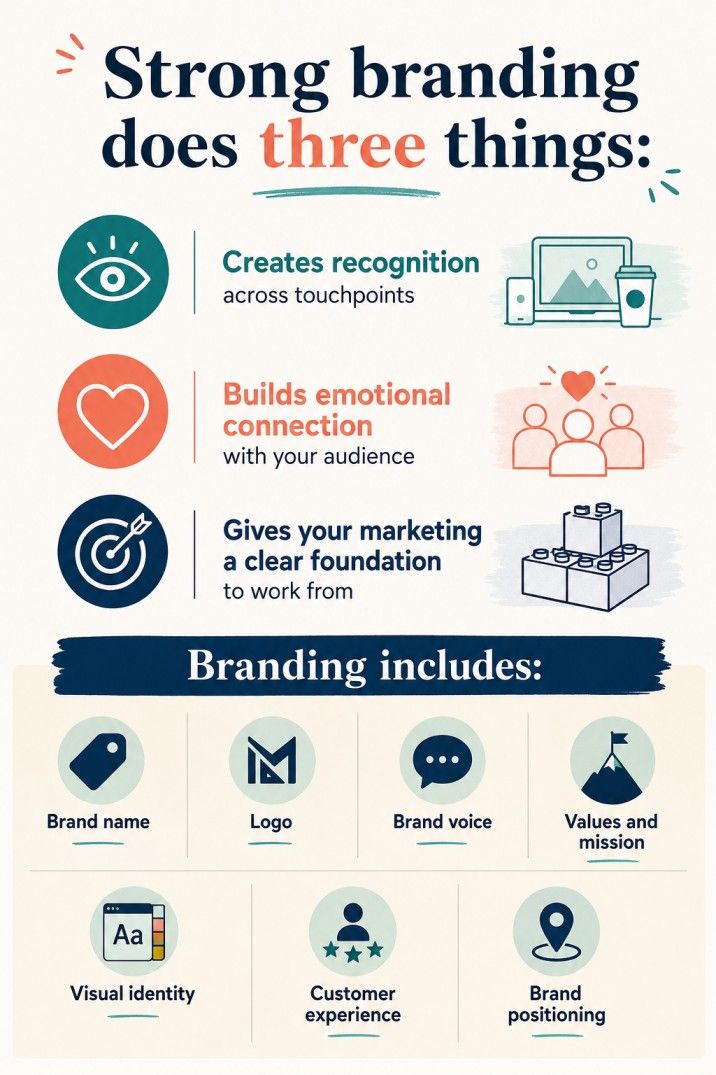
A brand without consistency is just noise. Think about companies you trust. You'd recognize their colors, tone, and messaging even without seeing their name. That's branding done right.
These two terms get mixed up constantly. Brand identity is what you put out, the intentional choices you make about how your company looks, sounds, and presents itself. Brand image is how the audience actually perceives you. Sometimes there's a gap between the two, and that gap is where a lot of businesses struggle.
If your brand identity says "we're approachable and affordable," but your customer service is cold and your pricing is confusing, your brand image will reflect reality, not your intentions.
Also read: Marketing Vs Advertising – Which is More Effective?
Digital Marketing Courses to upskill
Explore Digital Marketing Courses for Career Progression
MICA Executive Alumni Status
Marketing is not just running ads or posting on Instagram. Marketing covers research, strategy, content, paid campaigns, SEO, email, events, partnerships, and a lot more. It's the full system you use to attract, engage, and convert your target audience.
Here's what marketing typically involves:

Marketing is measurable in a way branding isn't. You can see how many people clicked an ad, how many converted, what your cost per acquisition looks like. That's both its strength and the reason companies over-invest in marketing while neglecting branding.
Must read: Marketing Communication: The Key to Brand Success Using IMC
They're not competing priorities. They're different layers of the same strategy.
Your brand sets the direction. Marketing executes it. Think of branding as the foundation and marketing as the engine that runs on top of it. When they're aligned, everything works better. Your ads feel consistent with your website. Your emails sound like your social posts. Customers recognize you across channels.
When they're misaligned, things get messy. You've probably experienced this as a customer yourself. You click an ad that feels exciting and urgent, then land on a website that looks outdated and reads like a corporate brochure. That disconnect kills conversions.
Here's how the two connect at each stage of growth:
Parameter |
Branding |
Marketing |
| Business Goal | Supports growth | Supports growth |
| Target Audience | Focuses on customers | Focuses on customers |
| Customer Understanding | Requires audience insights | Requires audience insights |
| Communication | Delivers brand messages | Delivers brand messages |
| Customer Experience | Shapes experiences | Influences experiences |
| Trust Building | Helps build trust | Helps build trust |
| Competitive Advantage | Strengthens differentiation | Highlights differentiation |
| Consistency | Needs consistency | Needs consistency |
| Business Strategy | Aligns with business goals | Aligns with business goals |
| Digital Presence | Uses digital channels | Uses digital channels |
| Customer Relationships | Builds relationships | Builds relationships |
| Long-Term Value | Contributes to business value | Contributes to business value |
Also read: How To Do Market Research – [Ultimate Guide]
It depends on where you are. If you're just starting out and haven't defined who you are yet, spend time on branding first. Get clear on your positioning, your audience, and what makes you different. Don't start spending on ads before you've answered those questions.
If you have a clear brand but you're not getting enough visibility or leads, that's a marketing problem. You need better distribution, better campaigns, or better targeting.
A useful exercise is to ask yourself this. If someone encounters your brand for the first time today, will they immediately understand what you do, who it's for, and why they should trust you? If the answer is no, fix the brand first.
The debate around branding vs marketing isn't about choosing one over the other. Branding defines who a business is and what it stands for. Marketing communicates that value to the right audience and encourages action.
Marketing can attract attention quickly. Branding builds trust over time. When both work together, businesses create stronger customer relationships, better recognition, and more consistent growth. That's why the most successful companies invest in both instead of treating them as competing priorities.
Ready to start your journey? Book a free consultation with upGrad today to find the best path for your career.
People often confuse branding and marketing because customers experience them together. An advertisement, social media post, or email campaign reflects both the brand and the marketing strategy. While marketing creates visibility, branding shapes how people interpret and remember those interactions over time.
In most cases, branding should come before marketing. A clear brand identity helps businesses create consistent messaging, stronger campaigns, and a better customer experience. Without defined positioning, values, and audience understanding, marketing efforts often become fragmented and less effective.
Neither is more important in every situation. A new business often needs branding first because customers need a clear reason to trust and remember it. Established businesses with strong brand recognition may benefit more from improving marketing efforts to increase reach, leads, and revenue.
The 4 C's of branding are commonly described as Clarity, Consistency, Credibility, and Competitiveness. Clarity helps customers understand what a brand stands for. Consistency builds recognition. Credibility develops trust, while competitiveness helps a brand stand out in crowded markets.
Yes, branding plays a major role in purchasing decisions, especially when customers compare similar products or services. A strong brand creates familiarity, trust, and credibility before a customer even evaluates pricing or features. In competitive markets, branding often becomes the deciding factor when options appear equally attractive.
The four commonly recognized types of branding are product branding, corporate branding, personal branding, and service branding. Product branding focuses on individual offerings, while corporate branding represents the entire organization. Personal branding builds an individual's reputation, and service branding highlights customer experience and expertise.
Yes, and it's more common than many businesses realize. A company may generate website traffic, leads, and sales through advertising, yet struggle with customer loyalty and differentiation. Without strong branding, customers often remember the offer or discount but forget the business behind it.
Strong brands stay memorable because branding creates mental associations that last beyond individual campaigns. Consistent messaging, customer experiences, visual identity, and brand positioning reinforce recognition over time. Marketing creates exposure, but branding is often what keeps a company top of mind long after the campaign ends.
Branding can improve SEO performance indirectly. Recognizable brands often attract more searches, backlinks, repeat visitors, and direct traffic. When users trust a brand, they're more likely to engage with content, spend time on the website, and return for future information or purchases.
There's no universal ratio because business goals and growth stages vary. Early-stage businesses often benefit from investing in foundational branding before increasing marketing spend. Once positioning and messaging are clear, marketing investments usually become more efficient because campaigns communicate a stronger and more consistent message.
A branding problem often shows up when people visit your website but don't understand what makes your business different. A marketing problem appears when very few people discover your business in the first place. Looking at traffic, conversions, customer feedback, and brand awareness can help identify the gap.
972 articles published
We are an online education platform providing industry-relevant programs for professionals, designed and delivered in collaboration with world-class faculty and businesses. Merging the latest technolo...
Get Free Consultation
By submitting, I accept the T&C and
Privacy Policy
Level Up Your Digital Marketing Career Today!
Top Resources
MICA
Advanced Certificate in AI-Powered Digital Marketing & Communication from MICAMICA Executive Alumni Status
Certification
5 Specialisation
Classroom
4 Months
Certification
2 Months