SEO vs SEM: What's the Difference and Which One Do You Need?
By upGrad
Updated on Aug 06, 2026 | 6 min read | 2.4K+ views
Share:

All courses
Certifications
More
By upGrad
Updated on Aug 06, 2026 | 6 min read | 2.4K+ views
Share:
Table of Contents
You've likely come across the debate around SEO vs SEM. SEO is the work you do to rank organically on Google without paying for ad placement, whereas SEM is a broader term that includes paid search ads.
This blog breaks down the SEO vs SEM difference clearly, from how each works to when you should use one over the other. You'll also find a direct comparison, real use cases, and answers to the most common questions people ask about this topic.
Explore upGrad's Digital Marketing programs to develop in-demand skills in SEO, SEM, content marketing, technical SEO, search advertising, and performance measurement.
SEO stands for Search Engine Optimization. SEM stands for Search Engine Marketing.
SEO, or Search Engine Optimization, focuses on improving a website's visibility in organic search results. You don't pay Google directly for each click. Instead, you optimize content, improve website performance, and build authority over time.
SEM, or Search Engine Marketing, is a broader strategy that includes paid search advertising. Businesses bid on keywords and pay when users click their ads. This model is commonly known as PPC or Pay-Per-Click advertising.
When someone searches "best project management tools," the results they see fall into two categories. The top few results with a small "Sponsored" label are SEM. The results below them, without any label, are SEO.
Here's the simplest way to remember it.
Aspect |
SEO (Search Engine Optimization) |
SEM (Search Engine Marketing) |
| Primary Focus | Improving organic visibility in search engine results | Driving traffic through paid search advertisements |
| Keyword Strategy | Researching keywords and optimizing website content around them | Bidding on keywords to display ads in search results |
| Content Role | Creating valuable content that matches user search intent | Writing compelling ad copy to attract clicks |
| Technical Work | Improving page speed, mobile usability, site structure, and crawlability | Setting up campaigns, tracking conversions, and optimizing ad performance |
| Link Building | Acquiring backlinks from authoritative websites to improve rankings | Not dependent on backlinks for ad visibility |
| Traffic Source | Organic (unpaid) search traffic | Paid search traffic |
| Cost Model | No cost per click, but requires ongoing optimization efforts | Pay-per-click (PPC) model where advertisers pay for each click |
The biggest practical difference is speed. SEM gets you to the top of search results within hours of launching a campaign. SEO takes months of consistent work before you see meaningful traffic.
That doesn't make one better than the other. It makes them useful for different situations.
Must read: 15 Best Keyword Research Tools for 2025
Free Courses
SEO is a process of making your website genuinely useful and technically sound, so Google chooses to show it to searchers. Google's algorithm looks at hundreds of signals when deciding which pages to rank. Content quality, page speed, backlink count, mobile experience, and search intent match are among the biggest ones. You don't pay Google to rank higher. You earn it.
SEO results don't show up overnight. A new blog post might take three to six months to rank on page one. But once it ranks, it can bring in traffic consistently without ongoing spending.
The limitation? You can't control Google's algorithm. A single update can shift your rankings significantly, and that's a real risk every SEO strategy carries.
Must read: 25+ Proven SEO Strategies to Master On and Off Page SEO Techniques in 2025
Digital Marketing Courses to upskill
Explore Digital Marketing Courses for Career Progression
MICA Executive Alumni Status
SEM, in the paid search sense, puts your website at the top of Google immediately. You create an ad, set a budget, choose your keywords, and Google shows your ad to people searching for those terms. You only pay when someone clicks. That's the pay-per-click or PPC model.
Some important terms to remember:
Term |
What It Means |
| CPC (Cost Per Click) | What you pay each time someone clicks your ad |
| CTR (Click-Through Rate) | The percentage of people who click after seeing the ad |
| Quality Score | Google's rating of your ad relevance and landing page experience |
| Impression Share | How often your ad shows compared to how often it could show |
| ROAS (Return on Ad Spend) | revenue earned for every rupee/dollar spent |
The Quality Score is not just about who bids the most. Google rewards ads that are relevant and lead to good landing page experiences. A well-optimised ad with a lower bid can outrank a poorly built ad with a higher one.
What makes SEM powerful for certain businesses is the intent targeting. When someone searches "buy noise-cancelling headphones online," they're close to a purchase decision. Showing an ad at that moment is worth paying for.
The catch is that it stops the moment your budget runs out. There's no residual benefit once you pause a campaign, unlike SEO content that continues to rank.
Also read: What is SEO Content Writing? A Beginner’s Guide to Writing for Search Engines
Here are some detailed comparisons between SEO vs SEM, to understand the key factor difference between SEO vs SEM in the long term, across various factors, to help you gain a more detailed understanding:
Factor |
SEO |
SEM |
| Cost Structure | Requires investment in content creation, SEO tools, technical improvements, and optimization efforts. No payment is required for individual clicks. | Requires ongoing advertising spend. Businesses pay each time a user clicks on an ad. |
| Content Creation | Essential for improving organic rankings and attracting relevant traffic. | Often used for landing pages and ad support, but not the primary ranking factor. |
| Technical Optimization | Includes page speed improvements, mobile usability, site architecture, and crawlability fixes. | Not required for ad visibility, although landing page quality can affect ad performance. |
| Ad Spend | No direct advertising costs. | Requires a dedicated advertising budget. |
| Per-Click Charges | No cost per click from search engines. | Advertisers pay for every click received through search ads. |
| Speed of Results | Takes time to build authority and rankings. Results may take several weeks or months. | Delivers immediate visibility and traffic once campaigns are launched. |
| Sustainability | Organic rankings can continue driving traffic for years with regular updates and maintenance. | Traffic stops when advertising spend is paused or exhausted. |
| Long-Term Value | Creates a long-term digital asset that compounds over time. | Provides short-term results but limited long-term value without continued spending. |
| Trust and Credibility | Users often perceive organic listings as more trustworthy and authoritative. | Effective for commercial searches, but some users may prefer organic results. |
| Click-Through Behavior | High-ranking organic results can generate strong click-through rates and consistent traffic. | Ads can attract clicks quickly, especially for high-intent keywords. |
| Measurement and Analytics | Tracks rankings, organic traffic, engagement metrics, and conversions over time. | Provides real-time performance data, including clicks, conversions, cost per click, and return on ad spend. |
| Optimization Speed | Changes may take weeks before measurable impact is visible. | Campaigns can be adjusted and optimized almost instantly based on performance data. |
| Control Over Visibility | Rankings depend on search engine algorithms and competition. | Advertisers have direct control over targeting, budgets, bidding, and ad placement. |
| Best For | Businesses focused on long-term growth, brand authority, and sustainable traffic. | Businesses seeking immediate traffic, lead generation, product launches, or seasonal promotions. |
Do read: How To Become a Google Ads Specialist: A Step-by-Step Guide
PPC (pay-per-click) is a type of advertising model. SEM is a channel. SEO is a separate channel entirely. PPC ads can run on Google Search, YouTube, display networks, and social media. When PPC runs on search engines specifically, that's the SEM part.
Think of it this way. Search marketing sits at the top. Under search marketing, you'll find SEO and SEM. Within SEM, PPC is one of the most common advertising models.
A simple hierarchy looks like this:
Search Marketing
↓
SEO
↓
SEM
↓
PPC Advertising
So when someone says "SEO vs SEM vs PPC," they're actually comparing two channels and one pricing model. Here's how they relate:
Term |
Type |
Paid or Free |
Where It Shows |
| SEO | Channel | Free (time-intensive) | Organic search results |
| SEM | Channel | Paid | Sponsored search results |
| PPC | Pricing model | Paid per click | Search, display, video ads |
Also read: A Complete Guide to Crafting an Impactful Digital Marketing Strategy
There's no universal answer here. The right choice depends on where you are as a business and what you're trying to achieve.
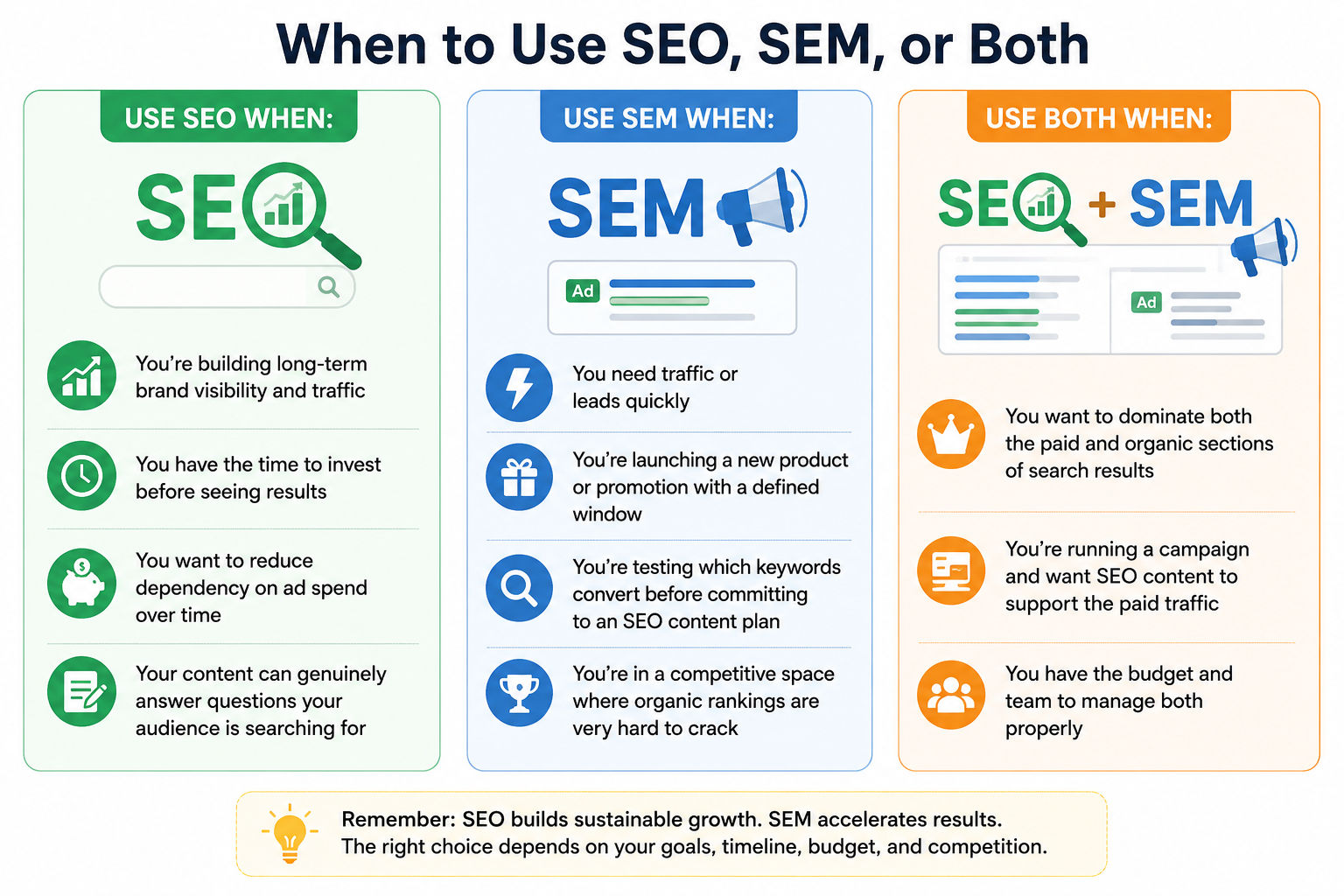
SEO and SEM solve different problems. SEO builds visibility you own over time. SEM buys visibility you rent by the click.
If you're trying to grow a digital presence that doesn't depend entirely on ad budgets, SEO is non-negotiable. If you need results now, SEM gets you there faster. The most effective marketing strategies don't pick one side. They use both, each doing what it does best.
Understanding the SEO vs SEM difference isn't just academic. It shapes where your time, budget, and team effort actually go.
Ready to start your journey? Book a free consultation with upGrad today to find the best path for your career.
The answer depends on your timeframe and goals. SEM can generate leads quickly, making it useful for short-term campaigns. SEO often delivers a higher return over time because traffic continues even after the initial investment. Businesses focused on sustainable growth usually benefit from combining both approaches.
Google Ads stop generating traffic when the budget runs out. SEO creates long-term visibility that can continue driving visitors for months or years. Many businesses use paid ads for immediate results while building organic rankings that reduce customer acquisition costs over time.
No. SEM includes paid search advertising across multiple search engines, including Google and Microsoft Bing. While Google Ads dominates the market, businesses often expand campaigns to other platforms depending on their audience, industry, and advertising goals.
Search intent plays a major role in both strategies. SEO content performs best when it answers informational or research-based queries. SEM often excels for transactional searches where users are ready to buy, subscribe, book, or request a service immediately.
Yes. Many brands intentionally do this. Appearing in both paid and organic results increases visibility, improves brand credibility, and can lead to higher overall click-through rates. This is one of the strongest use cases for combining SEO and SEM marketing efforts.
Many people assume SEO is free or that SEM guarantees sales. Neither is true. SEO requires ongoing investment in content and optimization, while SEM requires careful campaign management. Success depends more on strategy and execution than on the channel itself.
Generally, yes. Established websites with strong authority often find it easier to rank for new keywords because search engines already trust them. However, competition, content quality, and user experience still influence rankings, so ongoing optimization remains necessary.
AI search experiences are changing how users discover information. SEO remains important because AI systems often rely on authoritative sources when generating answers. SEM continues to matter because sponsored placements still provide visibility for businesses targeting high-intent searchers.
Yes. Local businesses frequently use SEM to appear for location-specific searches such as "dentist near me" or "best café nearby." Paid search allows businesses to target specific geographic areas and reach customers who are actively looking for nearby services.
Most beginners benefit from learning SEO fundamentals first because they develop an understanding of keywords, search intent, content strategy, and rankings. Once those concepts are clear, PPC and SEM become easier to understand and manage effectively.
Search behavior, competition, and algorithms change constantly. Most businesses should review performance monthly and conduct deeper strategy evaluations quarterly. Regular analysis helps identify new keyword opportunities, improve campaign efficiency, and adapt to changes in the search landscape.
964 articles published
We are an online education platform providing industry-relevant programs for professionals, designed and delivered in collaboration with world-class faculty and businesses. Merging the latest technolo...
Get Free Consultation
By submitting, I accept the T&C and
Privacy Policy
Level Up Your Digital Marketing Career Today!
Top Resources
MICA
Advanced Certificate in AI-Powered Digital Marketing & Communication from MICAMICA Executive Alumni Status
Certification
5 Specialisation
Classroom
4 Months
Certification
2 Months