What Is SERP in Digital Marketing? How It Works, Types & Features
By Sriram
Updated on Jul 24, 2026 | 8 min read | 7.15K+ views
Share:

All courses
Certifications
More
By Sriram
Updated on Jul 24, 2026 | 8 min read | 7.15K+ views
Share:
Table of Contents
Key Highlights
Take your SEO knowledge further with upGrad's Digital Marketing courses. Build practical skills in SEO, performance marketing, content strategy, and analytics through expert-led learning and real-world projects.
The SERP full form in digital marketing is Search Engine Results Page. It is the webpage displayed by a search engine after a user enters a query. Understanding what is SERP in digital marketing is essential because it explains how search engines present information and how websites gain visibility online.
A SERP is no longer just a list of website links. Depending on the user's search intent, Google displays different types of results to provide the most relevant answer.
Google doesn't display the same results for every search.It analyzes the user's search intent, location, language, device, and other contextual signals before deciding which webpages and SERP features to show. That's why two people searching the same keyword may notice slight differences in their results.
Term |
Meaning |
Why It Matters |
| SERP | Search Engine Results Page | Displays search results for every query |
| Organic Result | Unpaid search listing | Generates long-term traffic |
| Paid Result | Sponsored advertisement | Provides immediate visibility |
| SERP Feature | Enhanced result like a Featured Snippet or Local Pack | Improves visibility and clicks |
| Search Intent | The purpose behind a user's search | Helps Google deliver relevant results |
Knowing what is SERP in digital marketing helps marketers understand how Google organizes search results and why some pages receive more visibility than others. It also shows that ranking first isn't always enough. Features like AI Overviews, Featured Snippets, and the Local Pack can appear above organic listings, creating additional opportunities to attract users.
Learn more: Digital Marketing Tutorial: A Step-by-Step Guide To Become an Expert
Free Courses
Behind that quick response is a complex process that involves crawling, indexing, ranking, and displaying information. Once you understand how does SERP work, it becomes easier to see why some pages appear at the top while others remain hidden.
Google doesn't search the web every time you type a query. Instead, it searches through its own index, which contains billions of webpages collected over time.
The process follows four major stages.
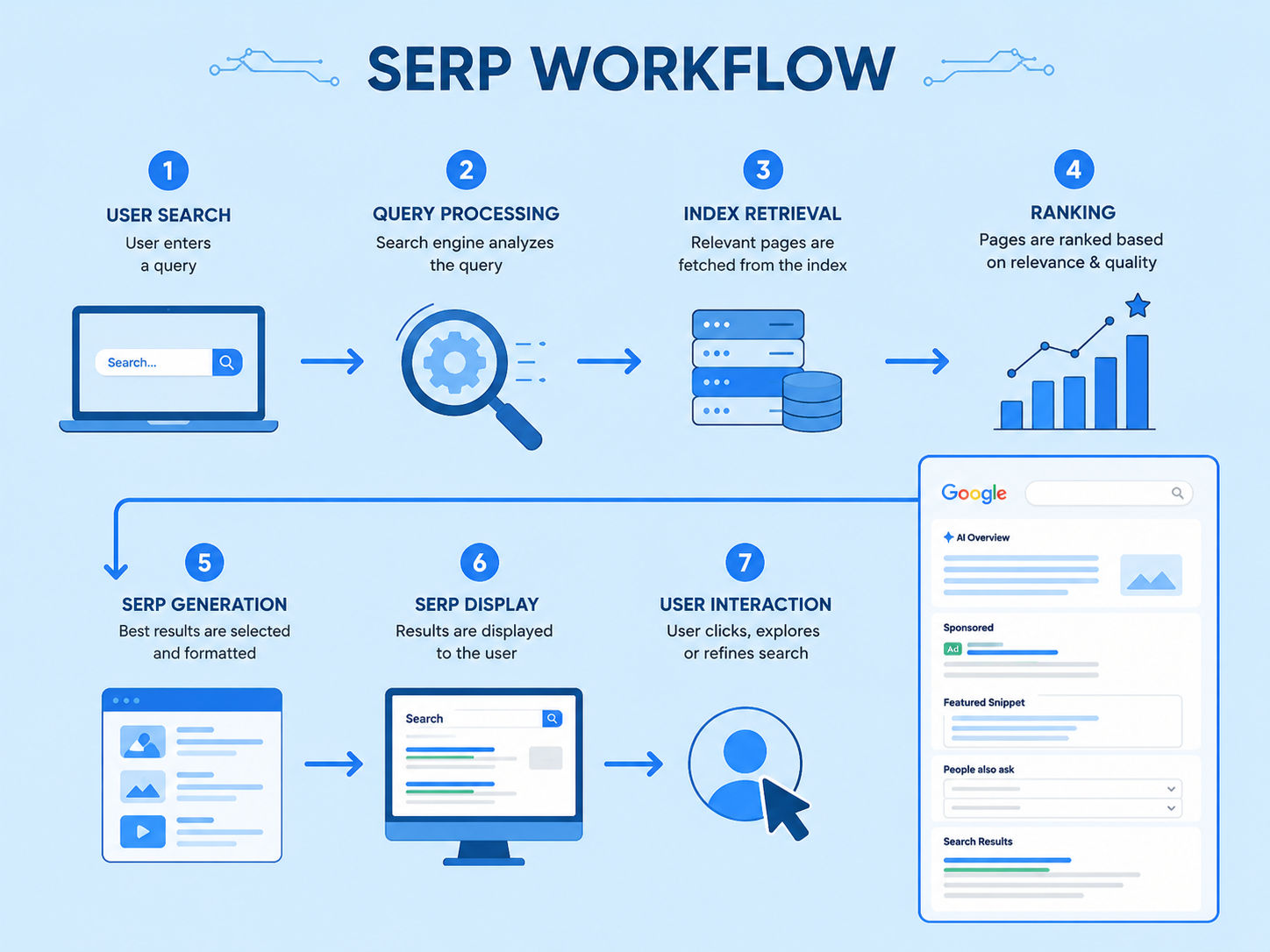
Here's a simplified workflow.
Search Query → Crawling → Indexing → Ranking → SERP Display → User Click
Must read: Digital Marketing Objectives: Full Guide with Types and Examples [2026]
A Google search results page is much more than a list of website links. Modern SERPs combine different result formats to help users find answers quickly based on their search intent. The exact layout changes with every query, making SERP in digital marketing more dynamic than ever.
The table below summarises the most common SERP components and when they typically appear.
SERP Component |
Purpose |
Common Search Intent |
| Organic Search Results | Unpaid website listings | Informational, Commercial |
| Paid Search Results | Sponsored advertisements | Commercial, Transactional |
| AI Overviews | AI-generated summaries | Informational |
| Featured Snippets | Direct answers | Informational |
| People Also Ask (PAA) | Related questions | Informational |
| Knowledge Panel | Entity information | Informational |
| Local Pack | Nearby business listings | Local |
| Image Results | Visual content | Informational |
| Video Results | Tutorials and reviews | Informational |
| Shopping Results | Product listings | Transactional |
Also read : Starting A Career In Digital Marketing: All You Need To Know
Having a website isn't enough if users can't find it. That's why SERP in digital marketing is important. A higher position on the search engine results page increases visibility, attracts relevant visitors, and creates more opportunities for clicks and conversions.
1. Improves Website Visibility
Most users click results on the first page of Google. Appearing in organic listings or SERP features like Featured Snippets, AI Overviews, and the Local Pack increases your chances of being noticed.
2. Drives Qualified Organic Traffic
Users who find your website through relevant search queries are more likely to engage with your content. Strong organic rankings also provide consistent, long-term traffic without ongoing advertising costs.
3. Builds Brand Trust
Websites that regularly appear on the first page are often seen as more trustworthy. Earning visibility through SERP features can further strengthen your brand's credibility.
4. Increases Click-Through Rates
A webpage can attract more clicks by appearing in multiple SERP features such as Featured Snippets, People Also Ask, image results, or video results, not just through organic rankings.
5. Supports Business Growth
Better SERP visibility can lead to more website traffic, qualified leads, brand awareness, and higher conversion opportunities over time.
Ready to master SEO, AI, and modern marketing strategies? Enroll in upGrad's Advanced Certificate in AI-Powered Digital Marketing & Communication from MICA and gain hands-on expertise in SEO, content, analytics, and AI-driven marketing.
Digital Marketing Courses to upskill
Explore Digital Marketing Courses for Career Progression
MICA Executive Alumni Status
Not every Google search produces the same results. The layout of a SERP in digital marketing changes based on the user's search intent. While some searches display standard website links, others include shopping results, AI summaries, or multimedia content.
The five main types of SERP results are explained below.
Organic results are unpaid website listings ranked by Google's algorithm based on relevance, content quality, and SEO signals. They are one of the most trusted and sustainable sources of website traffic.
Paid results are sponsored advertisements that appear through Google Ads. Businesses bid on keywords to display their ads for relevant searches and gain immediate visibility.
Rich results are enhanced search listings that provide additional information beyond a standard webpage link. They often include:
Google generates rich results using structured data added to webpages.
Universal Search combines different Google content types within a single SERP. Depending on the query, users may see:
These results help users access different content formats from one search.
AI-powered results provide AI-generated summaries that answer user queries directly while linking to relevant sources. They are becoming increasingly common for informational and conversational searches.
Quick view for Comparison of SERP Result Types:
SERP Result Type |
Description |
Best For |
| Organic Results | Unpaid SEO listings | Long-term traffic |
| Paid Results | Sponsored advertisements | Immediate visibility |
| Rich Results | Enhanced listings with extra information | Higher engagement |
| Universal Search Results | Mixed content like images, videos, and maps | Better content discovery |
| AI-Powered Results | AI-generated summaries with source links | Quick answers |
Each result type serves a different purpose, allowing Google to present the most relevant information based on what users are searching for.
Also read: What is SEO Content Writing? A Beginner’s Guide to Writing for Search Engines
Modern Google search results include more than standard website links. SERP features are enhanced elements that help users find information faster while giving websites additional opportunities to gain visibility beyond traditional organic rankings.
A featured snippet in SERP appears above the first organic result and provides a direct answer to a user's query. It may be displayed as a paragraph, list, table, or steps. Since it occupies a prominent position, it often receives higher visibility and click-through rates.
The People Also Ask in SERP section displays related questions that users commonly search for. Clicking a question expands a concise answer and reveals additional questions. It helps users explore a topic further and offers content creators ideas for answering common search queries.
A Knowledge Panel in SERP provides quick facts about businesses, people, places, products, or organizations. It typically includes images, descriptions, websites, and other key information collected from trusted sources, helping users find essential details without visiting multiple webpages.
The Local Pack in SERP appears for location-based searches such as restaurants, hospitals, or nearby stores. It usually displays a map with business listings, ratings, addresses, phone numbers, and directions, making it easier for users to find local businesses quickly.
The Image Pack displays a collection of relevant images for searches where visual information is useful. It commonly appears for products, recipes, travel destinations, fashion, and design-related topics. Optimized images with descriptive alt text have a better chance of appearing here.
The Video Carousel showcases videos related to tutorials, reviews, demonstrations, and educational content. Most results come from YouTube, although other websites may also appear. This feature helps users access visual explanations directly from the search results page.
The Top Stories section highlights the latest news articles for trending topics and current events. Google updates this feature regularly using content from trusted news publishers, allowing users to access recent developments directly from the search results.
Shopping Results display products with images, prices, ratings, seller information, and availability. They mainly appear for transactional searches where users are comparing products or planning a purchase, helping shoppers make quicker buying decisions directly from the SERP.
Also read : SEO Specialist Job Description: Salary, Top Companies, and Future
When you search on Google, you'll often see both organic and paid results on the same SERP. Although they may appear similar, they differ in how they earn visibility, generate traffic, and support business goals.
Understanding organic vs paid search results helps you choose the right strategy for improving online visibility, attracting the right audience, and achieving both short-term and long-term marketing objectives.
Here's a comparison.
Feature |
Organic Search Results |
Paid Search Results |
| Cost | Free clicks | Pay per click |
| Placement | Based on rankings | Sponsored positions |
| Visibility | Long-term | Immediate |
| Trust | Generally higher | Depends on ad relevance |
| Sustainability | Lasts with good SEO | Stops when budget ends |
Google ranks webpages based on how well they answer a user's search query. While its algorithm considers hundreds of ranking signals, a few key factors have the biggest impact on where a page appears in search results.
Key Ranking Factors
Also Read: How to do Competitor Analysis? Step by Step Guide
Improving your visibility on a SERP in digital marketing requires more than targeting keywords. Your content should match user intent, provide value, and offer a good user experience to increase its chances of ranking higher.
Follow these SEO best practices:
Understanding what is SERP in digital marketing helps you see how search engines display information and why some websites gain more visibility than others. From organic listings and paid ads to AI Overviews and Featured Snippets, every SERP element is designed to match user intent.
As Google continues to evolve, creating helpful, relevant, and user-focused content remains the key to success. A strong understanding of SERP in digital marketing helps you improve SEO, reach the right audience, and build long-term search visibility.
Ready to start your journey? Book a free consultation with upGrad today to find the best path for your career.
A SERP, or Search Engine Results Page, is the page displayed after a user searches for something on Google or another search engine. It contains organic listings, paid ads, and SERP features such as Featured Snippets and People Also Ask, helping users find the most relevant information for their query.
SEO is the process of optimizing a website to improve its search rankings, while a SERP is the page where those rankings appear. In simple terms, SEO is the strategy, and the SERP is the outcome users see after performing a search on Google.
If you search for "best smartphones under ₹30,000," Google may display sponsored ads, product listings, organic results, a People Also Ask section, reviews, and videos. This combination of search results is an example of a modern SERP designed to satisfy different user intents.
A SERP is used to present the most relevant information for a user's search query. It helps users discover websites, businesses, products, videos, news, and answers quickly, while helping businesses improve visibility through SEO, paid advertising, and optimized content.
After a user enters a search query, Google searches its index, evaluates relevant webpages using ranking algorithms, and displays the most useful results. The final SERP may include organic listings, paid ads, AI Overviews, Featured Snippets, and other search features depending on the query.
SERP analysis involves examining the top-ranking results for a keyword to understand search intent, content format, SERP features, competitors, and ranking patterns. This process helps marketers create content that better matches user expectations and improves their chances of ranking higher.
A SERP listing is an individual result that appears on a search engine results page. It can be an organic webpage, a paid advertisement, a Featured Snippet, a local business listing, or another SERP feature, depending on the search query.
The four primary types of SEO are on-page SEO, off-page SEO, technical SEO, and local SEO. Together, they help improve website visibility, user experience, search engine crawling, and local search performance, increasing the chances of appearing prominently on a SERP.
Yes. ChatGPT can assist with keyword research, content ideation, meta descriptions, blog outlines, FAQs, and content optimization. However, successful SEO still requires human expertise for search intent analysis, fact-checking, competitor research, and performance monitoring.
A search engine is the platform, such as Google or Bing, that processes search queries. A SERP is the results page generated by that search engine after a user submits a query. Simply put, the search engine creates the SERP users interact with.
Google customizes every SERP based on search intent, keyword type, location, device, and content relevance. Informational searches may display AI Overviews and Featured Snippets, while transactional or local searches often include Shopping results, paid ads, or the Local Pack, creating a unique experience for each query.
698 articles published
Sriram K is a Senior SEO Executive with a B.Tech in Information Technology from Dr. M.G.R. Educational and Research Institute, Chennai. With over a decade of experience in digital marketing, he specia...
Get Free Consultation
By submitting, I accept the T&C and
Privacy Policy
Level Up Your Digital Marketing Career Today!
Top Resources
MICA
Advanced Certificate in AI-Powered Digital Marketing & Communication from MICAMICA Executive Alumni Status
Certification
5 Specialisation
Classroom
4 Months
Certification
2 Months