Features of Digital Marketing: What Actually Makes It Work
By upGrad
Updated on Jun 09, 2026 | 9 min read | 1.76K+ views
Share:

All courses
Certifications
More
By upGrad
Updated on Jun 09, 2026 | 9 min read | 1.76K+ views
Share:
Table of Contents
The features of digital marketing define how brands connect with customers through online channels. These characteristics help businesses reach the right audience, monitor campaign performance, and improve results based on real data.
This blog breaks down the key features of digital marketing in plain terms. You'll understand what each feature does, why it matters, and how businesses actually use them. Whether you're just starting out or looking to sharpen your understanding, this is the complete picture.
Explore upGrad's Digital Marketing programs to build practical skills in SEO, SEM, keyword research, website analytics, performance marketing, content strategy, social media marketing, and data-driven campaign optimization.
The features of digital marketing are what make it different from traditional marketing methods such as newspapers, television, or billboards. Businesses today rely on digital channels because they offer better targeting, faster communication, measurable results, and greater flexibility.
Unlike traditional marketing, digital marketing allows businesses to interact with audiences in real time while measuring every important action.
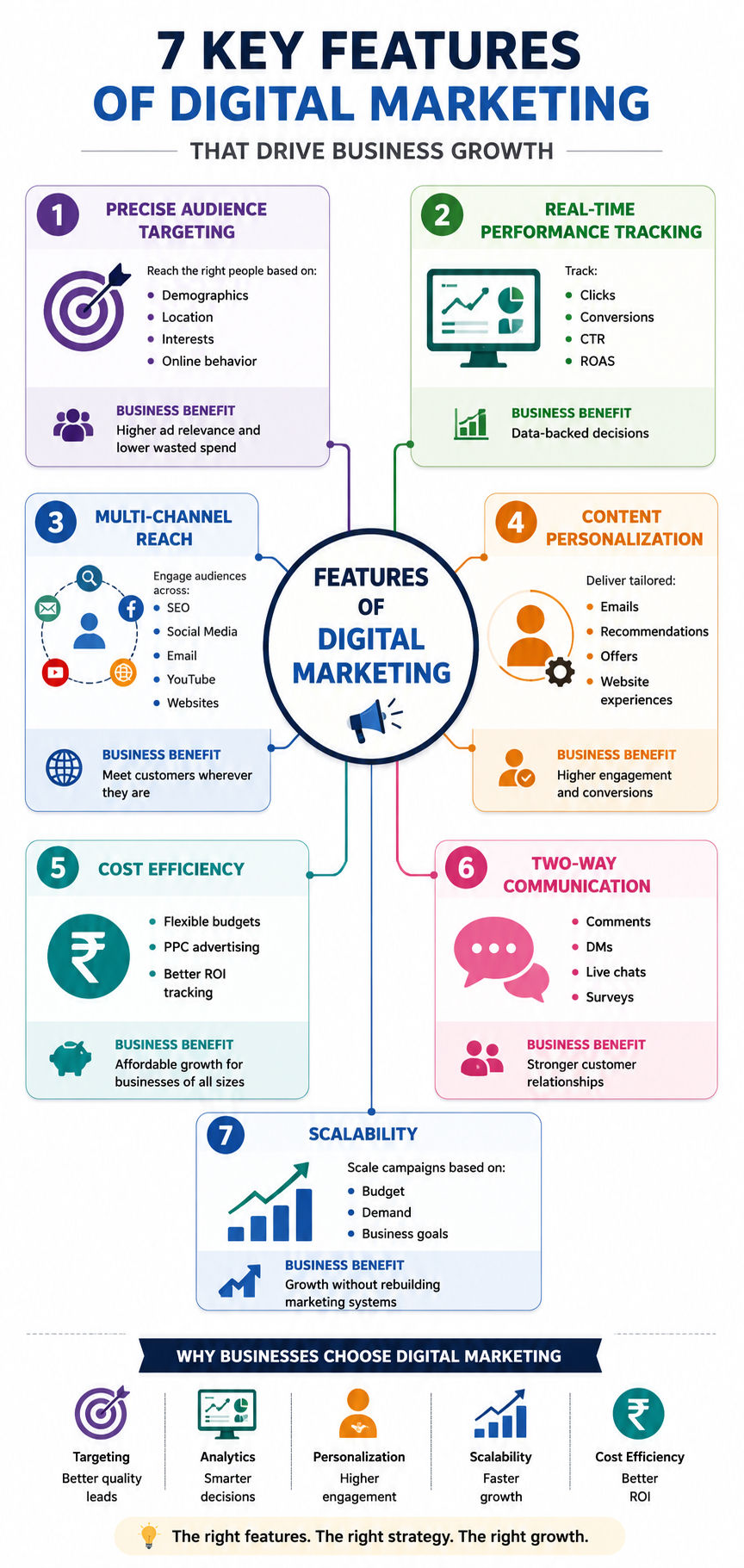
This is where digital marketing genuinely pulls ahead. You don't just put a message out and hope the right person sees it. You define who that person is, and the platform finds them.
Most digital channels let you target by:
Take a practical example. A coaching institute in Delhi can run ads on Google that only show to users aged 18 to 30, in Delhi NCR, who've recently searched for "online MBA programs." That's not luck. That's targeting.
The flip side? Getting to the wrong target burns money fast. It's one of the most powerful features of digital marketing, but it demands precision. A broad audience with a weak message performs poorly, and the data will tell you that quickly.
Targeting Type |
What It Does |
Common Platform |
| Demographic | Filter by age, gender, income | Google Ads, Meta |
| Geographic | Target by city, state, country | All major platforms |
| Interest-based | Target by hobbies or topics | Meta, YouTube |
| Behavioral | Target by browsing or purchase history | Google, Amazon Ads |
| Retargeting | Re-engage past website visitors | Google, Meta |
Do read: What is Digital Marketing?
Ask a brand manager how their TV commercial performed, and they'll give you an estimate. Ask the same question about a digital campaign, and you'll get exact numbers.
That's the difference between traditional and digital marketing.
Digital marketing gives you live data on what's working. You can check click-through rates, bounce rates, cost per lead, and conversion rates while the campaign is still running. You don't wait until it's over to learn something went wrong.
Key metrics you'll typically track:
Tools like Google Analytics 4, Meta Ads Manager, and HubSpot make this data available in real time. The honest reality is that most beginners ignore this data or don't know how to read it. That's a gap. Learning to interpret performance data is what moves someone from running campaigns to running good campaigns.
Digital marketing doesn't live on one platform. It's spread across search engines, social media, email inboxes, YouTube, mobile apps, and websites. Each channel reaches a different kind of user at a different stage of their journey.
Here's how the major channels break down by purpose:
Channel |
Best For |
User Intent |
| SEO | Long-term organic traffic | Research and discovery |
| Google Ads | Immediate search-based leads | High purchase intent |
| Social Media | Brand awareness and engagement | Browsing and entertainment |
| Email Marketing | Nurturing and retention | Existing relationship |
| Content Marketing | Authority building | Learning and comparison |
| YouTube Ads | Visual storytelling | Discovery and consideration |
The key is knowing which channel fits which goal. A brand launching a new product might use Instagram ads for awareness, Google Search ads for capturing intent, and email for converting trial users. These don't work in silos. They reinforce each other.
Don't try to be on every channel at once when you're starting out. Pick two or three that match your audience and your budget, and do them well.
Generic messaging doesn't convert, people respond when communication feels relevant to them.
Personalization is now a standard expectation. When someone opens an email that uses their name, recommends products based on past behavior, or shows content based on their location, that's personalization doing its job. It's one of the key features of digital marketing that directly impacts conversion rates.
How it works in practice:
A study by McKinsey found that personalization can drive a 10 to 15 percent increase in revenue. And the data to do this well already exists in most businesses. It's often just not being used due to lack of knowledge or resources.
The limitation worth knowing: personalization needs data, and collecting that data comes with privacy considerations. GDPR in Europe and similar frameworks elsewhere mean you can't just track everything without consent. Good personalization respects those boundaries.
Must read: Digital Marketing Objectives: Full Guide with Types and Examples [2026]
You don't need a large budget to start. That's one of the features of digital marketing that makes it accessible to businesses of all sizes.
Traditional advertising often requires large upfront commitments. A full-page newspaper ad or a 30-second TV spot isn't cheap, and you pay whether it works or not. Digital marketing flips that model.
With platforms like Google Ads or Meta, you can:
Small businesses and startups use this flexibility to compete with larger brands. A well-targeted Rs. 5,000 campaign on Google can outperform a Rs. 50,000 campaign that's poorly structured.
The catch? Low budget doesn't mean low effort. Good targeting, strong creative, and regular optimization are what make budget efficiency possible. The platform doesn't do that automatically.
Digital marketing lets audiences talk back.
A social media post isn't a one-way broadcast. Someone can comment, share, ask a question, or tag a friend. That feedback loop is valuable. Brands that respond to comments build trust. Brands that ignore them often lose it.
Interactivity shows up in several forms:
This feature also applies to explain the features of digital marketing in terms of community building. A brand that engages its audience builds loyalty that paid ads can't manufacture. It takes time, but it compounds.
What works for 500 customers can work for 50,000 with the right digital setup. That's scalability.
An email campaign sent to 1,000 people costs roughly the same as one sent to 100,000. The infrastructure is already there. A blog post that ranks on Google doesn't stop working after one reader finds it. A YouTube video can accumulate views for years without additional investment.
This is one of the features of digital marketing that makes it different from physical channels. A roadshow has a capacity limit. A webinar doesn't.
Scaling works best when:
Scaling a broken campaign just means losing money faster. Fix before you scale.
Also read: Top Digital Marketing Channels for Maximum Reach and ROI
Free Courses
Businesses face increasing competition across almost every industry. So, standing out requires smarter marketing, not just larger budgets.
Feature |
How It Benefits Businesses |
Example |
| Cost-Effective Marketing | Helps businesses reach targeted audiences without large advertising budgets. Digital campaigns often cost less than traditional channels while offering better targeting and tracking. | A startup can run social media ads to reach potential customers instead of investing heavily in TV or newspaper advertisements. |
| Better Decision-Making Through Data | Provides real-time insights into customer behavior, campaign performance, and audience demographics, helping businesses make informed decisions. | A company analyzes website traffic and conversion data to identify which marketing channels generate the most leads. |
| Scalability and Flexibility | Allows businesses to increase or decrease campaign budgets and activities based on changing goals, market conditions, or seasonal demand. | An e-commerce brand increases ad spending during a festive sale and reduces it once the campaign ends. |
| Competitive Advantage | Helps businesses understand customer preferences, track market trends, and improve customer experiences faster than competitors. | A retailer uses customer feedback and engagement data to launch products that better match consumer demand. |
| Improved Resource Allocation | Enables marketers to invest budget and effort in channels that deliver the highest returns. | A business shifts spending from low-performing ads to high-converting search campaigns. |
| Faster Market Response | Makes it easier to react quickly to industry changes, customer feedback, or emerging trends. | A brand creates a new social media campaign within days to capitalize on a trending topic. |
| Enhanced Customer Experience | Supports personalized communication and relevant content that improves customer satisfaction and loyalty. | An online store recommends products based on a customer's previous purchases and browsing history. |
Must read: Importance of Digital Marketing: 10 Key Benefits for Businesses
Digital Marketing Courses to upskill
Explore Digital Marketing Courses for Career Progression
MICA Executive Alumni Status
The features of digital marketing give businesses tools that didn't exist a generation ago. Targeting the right person. Measuring what works. Reaching them across channels. Doing all of this at a budget that fits the business.
That said, digital marketing isn't a shortcut. It rewards consistency, testing, and data literacy. The brands that do well aren't the ones with the biggest budgets. They're the ones who understand what each feature does and use it deliberately.
If you want to build those skills professionally, upGrad offers digital marketing programs like Advanced Certificate in AI-Powered Digital Marketing & Communication from MICA and many others are designed for working professionals and beginners alike. From SEO to paid ads to analytics, you'll get hands-on training backed by industry mentors.
The features of digital marketing have changed how businesses reach, engage, and retain customers. From targeted audience segmentation and measurable performance tracking to personalization and real-time optimization, these capabilities help marketers make smarter decisions and achieve better outcomes.
As customer behavior continues shifting toward digital channels, understanding the key features of digital marketing becomes increasingly important for businesses, marketers, and aspiring professionals. The more effectively these features are applied, the greater the opportunity to build meaningful customer relationships and drive sustainable growth.
Ready to start your journey? Book a free consultation with upGrad today to find the best path for your career.
Paid advertising usually delivers the fastest results because businesses can start reaching audiences immediately after launching a campaign. Search ads, social media ads, and retargeting campaigns can generate traffic, leads, or sales within hours. The speed depends on audience targeting, offer quality, and campaign setup.
Digital marketing platforms collect data on how users interact with websites, ads, emails, and content. Businesses can see what customers click, how long they stay on pages, what products they view, and where they leave the buying journey. These insights help improve marketing strategies and customer experiences.
Digital marketing works extremely well for local businesses because targeting can be narrowed to specific cities, neighborhoods, or even postal codes. A local clinic, restaurant, or coaching institute can reach nearby customers without spending large amounts on broad advertising campaigns that may not attract relevant audiences.
Personalization makes marketing messages more relevant to individual users. Instead of showing the same content to everyone, businesses can tailor recommendations, offers, and communications based on browsing behavior, purchase history, or interests. Relevant experiences often lead to higher engagement, better conversions, and stronger customer retention.
Traditional marketing often relies on estimates, while digital marketing tracks actual user actions. Marketers can monitor clicks, conversions, lead generation, revenue, and customer journeys in real time. This visibility helps businesses identify what is driving results and where improvements are needed.
Digital marketing can function with limited customer data, but its effectiveness may decrease. Features such as personalization, audience segmentation, and retargeting rely on data insights. Privacy regulations are also becoming stricter, so businesses must balance data collection with transparency and user consent.
Scalability allows businesses to expand marketing efforts without rebuilding their entire system. A successful campaign can often be increased through larger budgets, broader targeting, or additional channels. This flexibility helps businesses grow while maintaining efficiency and consistent messaging.
Having access to advanced tools doesn't automatically guarantee success. Poor audience targeting, weak content, inaccurate tracking, and misinterpreting data can reduce campaign effectiveness. Many businesses struggle not because tools are unavailable, but because they lack a clear strategy and optimization process.
Digital marketing isn't only focused on acquiring new customers. Features such as email automation, loyalty campaigns, personalized recommendations, and remarketing help brands stay connected with existing customers. Consistent engagement often increases repeat purchases and long-term customer value.
Almost every industry can benefit, but sectors such as e-commerce, education, healthcare, finance, real estate, and SaaS often see particularly strong results. Digital channels allow these businesses to educate prospects, generate leads, nurture relationships, and measure performance throughout the customer journey.
The best approach is to combine theory with practical experience. Running small campaigns, using analytics tools, studying customer journeys, and analyzing real business examples helps build understanding. Over time, beginners develop the ability to explain the features of digital marketing with clarity and confidence.
1283 articles published
We are an online education platform providing industry-relevant programs for professionals, designed and delivered in collaboration with world-class faculty and businesses. Merging the latest technolo...
Get Free Consultation
By submitting, I accept the T&C and
Privacy Policy
Level Up Your Digital Marketing Career Today!
Top Resources
MICA
Advanced Certificate in AI-Powered Digital Marketing & Communication from MICAMICA Executive Alumni Status
Certification
5 Specialisation
Classroom
4 Months
Certification
2 Months