CTR Meaning in Digital Marketing: What It Is and Why It Matters
By upGrad
Updated on Jun 05, 2026 | 6 min read | 1.9K+ views
Share:

All courses
Certifications
More
By upGrad
Updated on Jun 05, 2026 | 6 min read | 1.9K+ views
Share:
Table of Contents
The CTR meaning in digital marketing refers to Click-Through Rate. It is a metric that measures the percentage of people who click on a link, advertisement, email, or call-to-action after seeing it.
This blog breaks down the CTR meaning in digital marketing from the ground up. You'll learn how it's calculated, what counts as a good CTR, how it differs across channels, and what you can do to improve it.
Explore upGrad's Digital Marketing programs to develop job-ready skills in technical SEO, SEO strategy, SEM, website analytics, keyword research, and performance marketing.
If you've ever run a Google Ads campaign, published a marketing email, or tracked website performance, you've likely come across the term CTR. Understanding the CTR meaning in digital marketing is essential because it helps marketers measure how effectively their content, ads, and campaigns attract clicks from users.
CTR measures the ratio of clicks to impressions, which is how many times someone saw your content versus how many times they clicked it.
The formula is :
CTR = (Total Clicks / Total Impressions) x 100
So if your ad was shown 1,000 times and 30 people clicked it, your CTR is 3%.
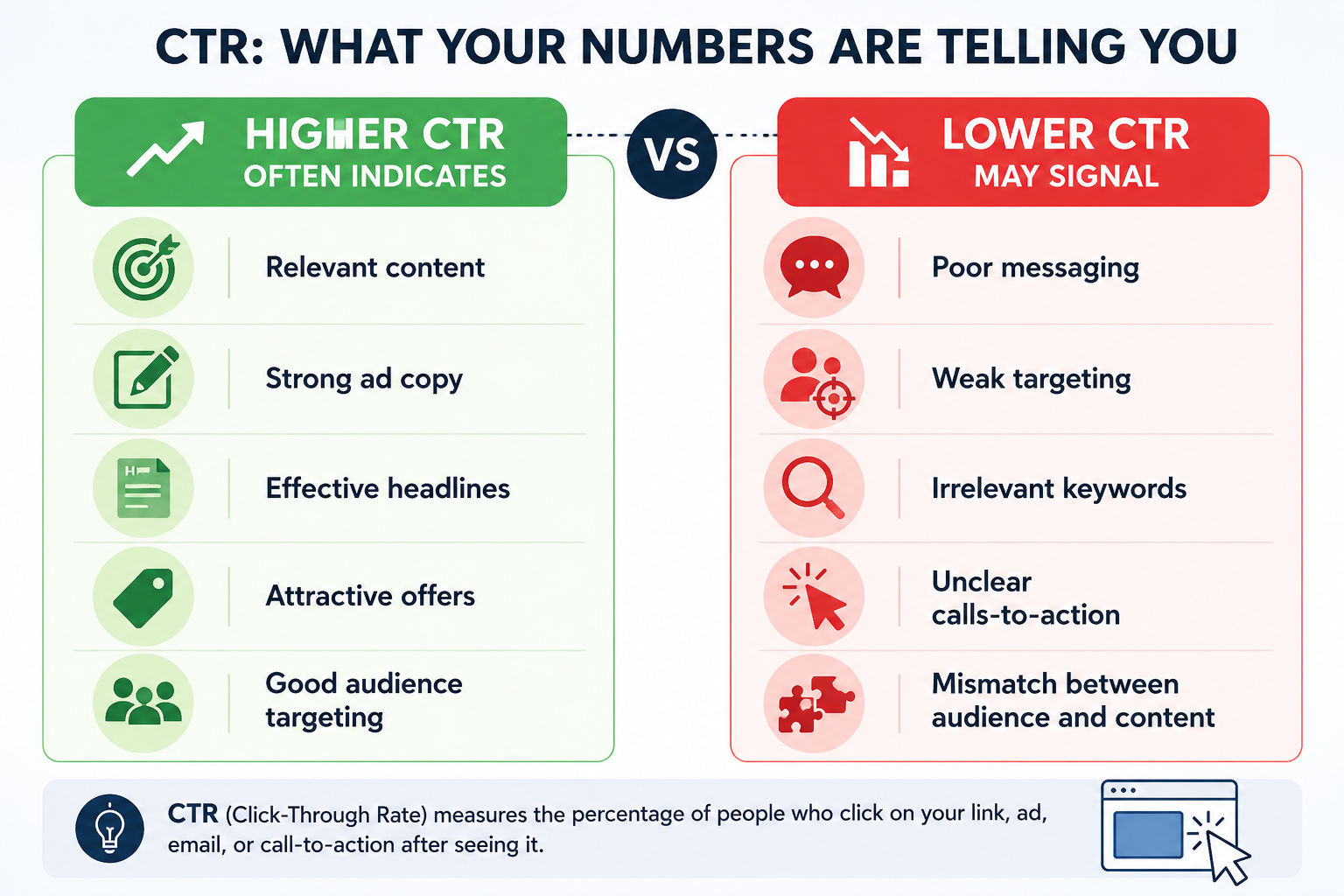
CTR tells you whether people find your content relevant enough to take action. A high CTR means your message is connecting with the right audience. A low CTR often signals a mismatch, whether that's the wrong audience, a weak headline, or an offer that doesn't land.
Here's a quick example across different channels:
Channel |
Clicks |
Impressions |
CTR |
| Google Search Ad | 150 | 5,000 | 3% |
| Display Ad | 20 | 10,000 | 0.2% |
| Email Campaign | 80 | 2,000 | 4% |
| Organic Search Result | 200 | 8,000 | 2.5% |
Each channel has its own benchmark. Don't compare your email CTR to your display CTR. They operate in different contexts and carry different intent.
Think about your own behavior online. You scroll through dozens of search results, ads, and social posts every day. Only a few grab your attention enough to earn a click. CTR captures that behavior numerically.
CTR appears across nearly every digital marketing channel.
Channel |
CTR Application |
| Google Ads | Ad performance |
| SEO | Search result clicks |
| Email Marketing | Email engagement |
| Social Media Ads | Campaign effectiveness |
| Display Advertising | Banner ad performance |
| YouTube Ads | Video ad engagement |
Free Courses
There's no universal "good" CTR. It depends on the channel, the industry, and even the device your audience is using.
That said, benchmarks help you understand where you stand.
The average CTR for Google Search Ads across industries sits around 2% to 5%. Industries like finance and legal tend to see lower CTRs because of heavy competition. Retail and e-commerce often see higher rates, sometimes above 6%, because users searching for products are closer to a buying decision.
Don't expect much here. The average display ad CTR hovers around 0.1%. That's not a failure. Display works on awareness, not clicks.
Email Marketing CTR varies widely based on your list quality and industry. A 2% to 5% CTR is considered solid for most B2C campaigns. B2B emails often land higher, especially for targeted lists.
For organic results, the first position on Google gets an average CTR of around 27% to 30%. Drop to position five and you're looking at roughly 7%. Position ten? Under 3%. This is why ranking matters so much in SEO.
Do read: SEO Optimization Tips: Tips , Tactics & Tricks
A few things affect CTR across all channels:
Don't obsess over hitting a benchmark. Track your own CTR over time and focus on improving it consistently.
Must raed: Top Applications of AI in Digital Marketing You Must Know
Digital Marketing Courses to upskill
Explore Digital Marketing Courses for Career Progression
MICA Executive Alumni Status
CTR isn't just a performance indicator. It's a signal.
In Google Search Ads, CTR directly affects your Quality Score. A higher Quality Score lowers your cost-per-click and improves your ad placement. So a better CTR doesn't just mean more traffic. It means cheaper traffic.
In organic SEO, Google uses CTR as one of the signals to understand whether your page is meeting search intent. If your page ranks third but earns a CTR higher than what's expected at that position, it tells Google your result is relevant and useful. That can push your ranking up over time.
Here's how CTR connects to the broader funnel:
Impressions → Clicks (CTR) → Conversions (CVR) → Revenue
Every step depends on the one before it. Weak CTR shrinks your conversion opportunities before you even get started.
A high CTR with poor conversion rate is a targeting problem. You're attracting the wrong people. A low CTR with high conversion rate means your ad or listing is selective, which isn't always bad, but it limits scale.
Also read: A Complete Guide to Crafting an Impactful Digital Marketing Strategy
You can improve CTR. It's one of the more actionable metrics in your toolkit.
Your headline is doing most of the heavy lifting. Ask yourself whether it's specific, whether it matches what the searcher actually wants, and whether it gives a reason to click. "Digital Marketing Course" is forgettable. "Digital Marketing Course with Placement Support" gives you something to act on.
Search intent matters a lot. If someone searches "best laptops under 50000," they want a comparison. Don't send them to a generic product page. Align your ad copy and landing page to what they're actually looking for.
Numbers in headlines outperform vague claims. "Increase CTR by 40%" is more clickable than "Improve Your CTR." Specificity builds credibility and curiosity.
Meta descriptions don't directly impact rankings, but they drive clicks. Write them like an ad. Include your keyword, highlight a benefit, and keep it under 160 characters.
Don't guess what works. Run two versions of your ad with different headlines or CTAs. Let the data decide. Even small improvements compound over time.
Sending the same email to your entire list is one of the fastest ways to drag down CTR. Segment by behaviour, interests, or stage in the funnel. Targeted emails get clicked more.
A quick checklist before any campaign goes live:
Small fixes often produce noticeable results.
Do read: How To Become a Google Ads Specialist: A Step-by-Step Guide
CTR means the same thing everywhere, but it's measured and used differently depending on where you're working.
CTR here affects your Quality Score, ad rank, and CPC. It's one of the core metrics Google uses to decide how relevant your ad is.
Meta platforms distinguish between link CTR (clicks that go to a destination) and all CTR (any click on the post, including likes or comments). Pay attention to link CTR when measuring actual traffic performance.
On YouTube, CTR measures how often viewers click on your video after seeing the thumbnail and title. The average YouTube CTR sits between 2% and 10%. A compelling thumbnail matters as much as the title.
Email CTR is calculated from the number of recipients who clicked a link divided by the number of emails delivered (or opened, depending on the platform). Most email tools report both, so check which definition your platform uses.
Google Search Console shows your CTR for organic results. It's one of the few places where you can see directly how your titles and descriptions perform in search.
Each platform gives you CTR data differently. Make sure you're comparing like with like before drawing conclusions.
Must read: 25+ Proven SEO Strategies to Master On and Off Page SEO Techniques
CTR meaning in digital marketing comes down to one question: are people interested enough to click? It's a direct measure of relevance between your message and your audience.
Track it. Break it down by channel. Improve it with sharper copy, better targeting, and consistent testing. A higher CTR won't fix a broken funnel, but it's almost always where better campaign performance begins.
Ready to start your journey? Book a free consultation with upGrad today to find the best path for your career.
CTR and CPC measure two completely different things. CTR shows how often people click after seeing your ad, while CPC measures how much you pay for each click. A campaign can have a high CTR and still be expensive if competition drives up CPC. Marketers usually analyze both metrics together to understand performance and cost efficiency.
Yes, CTR is one of the major factors that influences Google Ads Quality Score. When users frequently click your ads, Google sees them as relevant to search intent. Better Quality Scores often result in lower advertising costs, improved ad rankings, and greater visibility compared to competitors targeting similar keywords.
This usually indicates a mismatch between the ad and the landing page experience. People are interested enough to click, but something prevents them from completing the desired action. Common reasons include weak offers, slow-loading pages, poor user experience, pricing concerns, or unclear calls-to-action after the click.
Google has never officially confirmed CTR as a direct ranking factor. However, many SEO professionals monitor it closely because a search result that consistently attracts more clicks than expected may signal strong relevance. Improving titles and meta descriptions often increases traffic without changing rankings.
For active paid campaigns, checking CTR daily helps identify sudden changes in performance. For SEO and content marketing, weekly or monthly reviews are usually enough. Looking at CTR too frequently can lead to unnecessary adjustments based on short-term fluctuations rather than meaningful trends.
User behaviour differs significantly between industries. Someone searching for a product is often closer to making a decision than someone researching legal or financial services. Competition, search intent, audience awareness, and buying cycles all influence average CTR benchmarks within a specific industry.
Headlines often determine whether someone clicks or keeps scrolling. A clear headline that matches user intent generally performs better than one focused on creativity alone. Including specific benefits, numbers, or solutions to common problems can significantly increase engagement across search, email, and paid campaigns.
Yes, but it shouldn't be the only metric used to measure success. Brand awareness campaigns often focus on reach, impressions, and visibility rather than immediate clicks. A lower CTR isn't necessarily a problem if the campaign successfully increases brand recognition among the target audience.
Mobile users interact differently than desktop users. Smaller screens limit visible content, making headlines and calls-to-action even more important. In many industries, mobile searches generate higher CTRs because users are looking for quick answers, local information, or immediate solutions while on the move.
In email marketing, CTR measures the percentage of recipients who clicked a link within the email. It helps marketers evaluate whether the content, offer, and call-to-action were compelling enough to drive engagement. Strong email CTRs often indicate that audience segmentation and messaging are aligned.
Yes. While meta descriptions don't directly affect rankings, they strongly influence whether users click your result. A well-written description that clearly explains the page's value and matches search intent can improve visibility in search results and attract more qualified traffic over time.
1283 articles published
We are an online education platform providing industry-relevant programs for professionals, designed and delivered in collaboration with world-class faculty and businesses. Merging the latest technolo...
Get Free Consultation
By submitting, I accept the T&C and
Privacy Policy
Level Up Your Digital Marketing Career Today!
Top Resources
MICA
Advanced Certificate in AI-Powered Digital Marketing & Communication from MICAMICA Executive Alumni Status
Certification
5 Specialisation
Classroom
4 Months
Certification
2 Months