Influencer Marketing Platforms: How to Choose the Right One
By upGrad
Updated on Jul 20, 2026 | 6 min read | 1.87K+ views
Share:

All courses
Certifications
More
By upGrad
Updated on Jul 20, 2026 | 6 min read | 1.87K+ views
Share:
Table of Contents
Key Takeaways
This blog walks through what these platforms actually do, the different types available, their core features, and how much they typically cost.
Explore upGrad's Marketing programs to build practical skills in influencer marketing, creator partnerships, campaign strategy, audience targeting, performance analytics, and brand decision-making.
Different influencer marketing platforms are built for different business needs. Some specialise in creator discovery, while others focus on campaign management, ecommerce integrations, or enterprise-scale analytics. Choosing the right platform depends on your goals, budget, and team size.
Here's a look at some of the most popular influencer marketing platform examples and what they offer.
Platform |
Best For |
Key Features |
Pricing Model |
| CreatorIQ | Enterprise brands and global campaigns | AI-powered creator discovery, campaign management, analytics, workflow automation | Custom pricing |
| GRIN | Ecommerce and D2C brands | Creator relationship management, Shopify integration, product seeding, ROI tracking | Custom pricing |
| Upfluence | Ecommerce businesses and agencies | Influencer discovery, affiliate marketing, CRM, sales tracking | Custom pricing |
| Sprout Social Influencer Marketing (Tagger) | Mid-sized and enterprise brands | Creator discovery, campaign management, audience insights, reporting | Custom pricing |
| Modash | Small and mid-sized businesses | Influencer search, audience analytics, fake follower detection | Subscription plans |
| Heepsy | Startups and small businesses | Creator search, audience demographics, fraud detection | Free plan and paid subscriptions |
| Afluencer | Small businesses and startups | Creator marketplace, campaign listings, direct collaborations | Free and subscription plans |
Also read: Top 20 Careers in Digital Marketing: Ultimate Guide
Here are the influencer marketing platforms in detail:
This is best suited for enterprise brands and global campaigns. CreatorIQ offers AI-powered creator discovery, campaign management, workflow automation, and advanced analytics. Large organisations also benefit from its integrations with popular marketing tools, making it easier to coordinate campaigns across global teams. While its pricing is customised, the platform is well suited for businesses with dedicated influencer marketing budgets.
GRIN is one of the most popular choices for ecommerce and direct-to-consumer (D2C) brands. Rather than simply helping brands find influencers, it focuses on building long-term creator relationships through influencer CRM, product seeding, and campaign management tools. Its Shopify integration and ROI tracking capabilities make it especially valuable for brands that want to connect influencer campaigns directly to online sales and revenue.
Must read: How to become a successful Instagram influencer
Looking for a platform that combines influencer marketing with affiliate marketing? Upfluence does exactly that. It helps businesses discover creators, manage partnerships, track sales, and monitor campaign performance from a single dashboard. Agencies and growing ecommerce brands often use it to streamline multiple campaigns.
Previously known as Tagger, this platform is built for mid-sized and enterprise brands. It includes creator discovery, audience insights, campaign management, detailed reporting, and social media integrations to streamline influencer campaigns.
Also Read: How To Evaluate an Influencer Marketing Campaign?
Modash is ideal for small and medium-sized businesses that want an affordable yet feature-rich influencer marketing platform. It enables brands to search for creators across multiple social platforms while providing audience analytics, engagement insights, and fake follower detection. Its straightforward interface makes it easy for first-time marketers to discover authentic influencers without investing in expensive enterprise software.
Heepsy is a beginner-friendly platform that helps startups and small businesses discover influencers based on audience demographics, engagement rates, and location. It also includes fraud detection features to help brands avoid fake influencers.
Also read: Online Marketing Trends to Watch Out for
Afluencer works more like a marketplace where brands and creators can connect directly. Instead of managing complex enterprise workflows, it focuses on helping startups and small businesses launch collaborations quickly. Its campaign listings and affordable pricing make it a practical choice for brands with limited marketing budgets.
If you're looking for a micro influencer marketing platform, tools like Modash, Heepsy, and Afluencer are popular choices because they make it easier to discover niche creators with highly engaged audiences. These platforms prioritise affordability, creator discovery, and audience insights over advanced enterprise features, making them a practical option for businesses launching their first influencer campaigns.
For larger organisations running campaigns across multiple regions, platforms such as CreatorIQ, Sprout Social Influencer Marketing, GRIN, and Upfluence provide advanced reporting, workflow automation, integrations, and dedicated support to manage influencer marketing at scale.
Do read: The Secret to Becoming an Instagram Influencer in India!
Free Courses
Picking a platform isn't about finding the one with the most features. It's about matching capability to what your team can actually use.
Evaluation Factor |
What to Look For |
Why It Matters |
| Marketing Goals | Match the platform with your campaign goals, such as awareness or conversions. | Helps you choose a platform that fits your objectives. |
| Creator Discovery | Check if it has creators in your niche and target region. | Makes it easier to find the right influencers. |
| Analytics & Reporting | Look for insights on engagement, conversions, and ROI. | Helps you measure campaign performance. |
| Integrations | See if it connects with tools like Shopify, HubSpot, or your CRM. | Saves time by reducing manual work. |
| Ease of Use | Choose a platform with a simple and intuitive interface. | Makes it easier for your team to use. |
| Customer Support | Check the availability and responsiveness of support. | Helps resolve issues quickly during campaigns. |
| Scalability | Ensure it can support more campaigns as your business grows. | Prevents the need to switch platforms later. |
| Pricing & Budget | Compare pricing with the features offered. | Helps you get the best value for your budget. |
Decision Checklist
Evaluation Factor |
Questions to Ask |
| Goals | Does this platform support awareness or conversion campaigns better? |
| Discovery | Does the database cover my niche and target region? |
| Analytics | Can I get campaign-level and creator-level reporting? |
| Integrations | Does it connect with my existing marketing tools? |
| Usability | Will my team actually use this daily? |
| Support | What's the average response time for issues? |
| Scalability | Can this handle 10x my current campaign volume? |
Also read: The Complete Guide to User Generated Content Marketing Strategy
Digital Marketing Courses to upskill
Explore Digital Marketing Courses for Career Progression
MICA Executive Alumni Status
Influencer marketing platform India pricing is generally lower than on many global platforms, making it easier for startups and growing businesses to adopt influencer marketing software. However, advanced features such as AI-powered analytics, fraud detection, workflow automation, and CRM integrations are usually available only in higher-tier plans.
Here is the comparison between different pricing plans in influencer marketing platforms
Platform |
Starting Price (Approx.) |
Key Features |
| Heepsy | Free plan available, paid plans ₹7,000–₹9,000/month |
Influencer discovery, audience analytics, fraud detection |
| Modash | From ₹16,000–₹20,000/month |
Creator search, audience insights, campaign tracking |
| Afluencer | Free plan available, premium from ₹4,000–₹8,000/month |
Creator marketplace, campaign listings |
| Upfluence | Custom pricing (typically ₹80,000+/month) |
CRM, affiliate marketing, campaign management |
| GRIN | Custom pricing (typically ₹1 lakh+/month) |
Creator management, Shopify integration, ROI tracking |
| CreatorIQ | Custom enterprise pricing |
AI-powered discovery, analytics, workflow automation |
| Sprout Social Influencer Marketing (Tagger) | Custom enterprise pricing |
Campaign management, reporting, audience insights |
(Prices are approximate and may vary based on contract length, team size, and feature requirements.)
Before choosing a platform, compare more than just the subscription fee. Consider the size of the creator database, analytics capabilities, fraud detection, integrations, customer support, and the number of users included in the plan. If you're looking for the best influencer marketing platform in India, start with a free trial or product demo to evaluate whether the platform meets your campaign needs before committing to a long-term plan.
Pricing Model |
Typical Cost (India) |
Best For |
| Free Plan | ₹0 |
Testing the platform with basic features |
| Subscription | ₹5,000–₹25,000/month |
Startups and growing businesses |
| Professional Plan | ₹25,000–₹75,000/month |
Brands running regular influencer campaigns |
| Enterprise | ₹75,000–₹2 lakh+/month |
Large brands and agencies managing campaigns at scale |
| Custom Pricing | Quote-based |
Businesses with complex workflows or multiple markets |
Also read: 20 Benefits of Leveraging Influencers for Brand Promotion
Subscribe to upGrad's Newsletter
Join thousands of learners who receive useful tips
Here are the different types of influencer marketing platforms. Not all platforms do the same job. Picking the wrong type is one of the most common mistakes brands make, so it helps to know what each category actually offers before you commit.

A platform is only as good as the features behind it. Here's what actually matters when you're comparing options:
Feature |
Why It Matters |
Business Impact |
| Discovery Engine | Finds relevant creators fast | Saves hours of manual search |
| Audience Analytics | Confirms audience-brand fit | Reduces wasted campaign spend |
| Creator Verification | Filters out fraud | Protects budget and brand trust |
| Campaign Dashboard | Centralizes active work | Improves team coordination |
| Collaboration Tools | Streamlines communication | Speeds up content turnaround |
| Analytics & Reporting | Converts data into insight | Supports better campaign decisions |
| Payment Management | Automates financial tracking | Reduces admin overhead |
| Brand Safety Tools | Flags risky creator content | Lowers reputational risk |
Must read: What is a Social Media Influencer and What do they do?
Discovery filters narrow the pool using niche, location, and follower count. Audience demographics go further, checking age, gender, and geographic spread against your target market.
Engagement analysis looks at comment quality, not just volume. A post with five hundred generic "nice pic" comments scores lower than one with fifty genuine, on-topic replies. Fake follower detection uses pattern recognition to flag suspicious follower growth, like a sudden jump of ten thousand followers overnight with no matching content spike.
Authenticity verification cross-checks engagement against industry benchmarks for that creator's niche and follower count. Performance history rounds it out, pulling data from past sponsored posts to show how a creator's audience actually responds to branded content versus organic posts.
Factors Used to Rank Influencers
Verification is where platforms earn their keep. Fake follower detection uses pattern recognition to catch suspicious growth, like ten thousand new followers overnight with no content spike behind it.
Authenticity checks cross-reference engagement against industry benchmarks for that creator's niche and size. Performance history adds another layer, pulling data from past sponsored posts to show how an audience actually responds to branded content.
Explore upGrad's Advanced Certificate in AI-Powered Digital Marketing & Communication from MICA to build in-demand skills in influencer marketing, AI-powered campaign strategy, SEO, social media marketing, performance marketing, analytics, and creator-led brand growth.
Measurement ties the whole campaign back to business value. Awareness metrics like impressions and reach show how far the content traveled. Engagement metrics, likes, comments, shares, saves, show whether people actually cared.
Traffic metrics track clicks back to your site or landing page. Conversion metrics go one step further, measuring sign-ups, purchases, or downloads that resulted from the campaign. ROI measurement pulls it all together, comparing total spend against revenue or value generated.
Here is the Performance Metrics Table
KPI |
What It Measures |
Why It Matters |
| Reach | Number of unique viewers | Shows campaign visibility |
| Engagement Rate | Likes, comments, shares per post | Signals audience interest |
| Click-Through Rate | Clicks generated from content | Measures intent to act |
| Conversion Rate | Sign-ups or purchases | Ties content to business outcomes |
| ROI | Revenue vs spend | Justifies budget allocation |
Reach and engagement show resonance. Clicks and conversions show intent and action. ROI pulls it together, comparing spend against actual revenue generated, which is usually the number leadership cares about most.
Also read: What is a Social Media Influencer and What do they do?
An influencer marketing platform is software that helps brands find, vet, manage, and measure creator partnerships. Instead of manually searching social media, brands filter by niche, audience size, engagement rate, and location in seconds. The purpose is to cut the manual grunt work out of influencer marketing and replace it with data.
Brands and agencies use these platforms as the operational layer, while creators use them to get discovered and paid.
Manual outreach doesn't scale past a handful of creators, and it can't catch fake followers the way an algorithm can. A best influencer marketing platform will flag red flags like sudden follower spikes that a human eye might miss entirely.
Manual Influencer Outreach vs Influencer Marketing Platform
Aspect |
Manual Outreach |
Influencer Marketing Platform |
| Creator Discovery | Search social media manually, rely on referrals | Searchable database with filters for niche, location, audience size |
| Campaign Management | Spreadsheets, email threads, DMs | Centralized dashboard with tasks, approvals, and timelines |
| Analytics | Manual screenshot tracking | Automated real-time performance dashboards |
| Fraud Detection | Limited, based on manual judgment | AI-driven fake follower and engagement fraud checks |
| Payments | Manual bank transfers, no audit trail | Integrated payment processing with contracts |
| Reporting | Manually compiled reports, time-consuming | Auto-generated reports with exportable data |
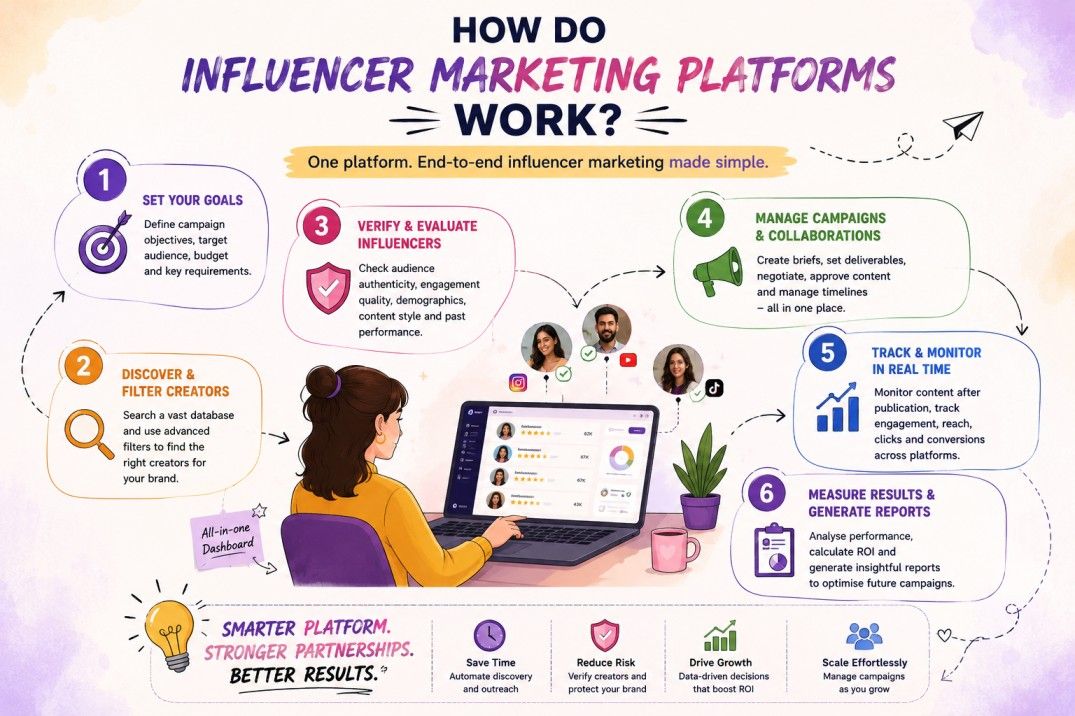
Most platforms follow a similar flow. Discovery starts with filters, niche, follower range, engagement rate, and location. Some platforms go deeper, filtering by audience demographics like city or age bracket. Next comes verification, checking engagement quality and past campaign performance.
Once creators are shortlisted, the platform handles outreach, contracts, and content approvals in one thread instead of scattered emails. The final step ties everything to results. Reach and engagement show if content landed. Clicks and conversions show if it drove action, and ROI ties spend to return.
Do read: How To Evaluate an Influencer Marketing Campaign?
Using influencer marketing platforms can simplify creator discovery, campaign management, and performance tracking, but the platform alone doesn't guarantee successful campaigns. The best results come from pairing the right tool with a clear strategy and avoiding common pitfalls. The table below highlights the key benefits, proven best practices, and mistakes to avoid so you can run more effective influencer marketing campaigns.
Benefits of influencer marketing platforms |
Best Practices of influencer marketing platforms |
| Faster influencer discovery | Define campaign goals before starting |
| Better creator matching using audience data | Prioritise audience quality over follower numbers |
| Centralised campaign management | Track meaningful KPIs such as conversions and ROI |
| Reduced fraud with authenticity checks | Verify creators before collaborating |
| Data-driven campaign decisions | Build long-term creator relationships |
Even the best influencer marketing platform can't deliver strong results without the right approach. Avoid these common mistakes to improve campaign performance and maximise your return on investment.
Choosing the right influencer marketing platforms can make creator collaborations more organised, measurable, and effective. From discovering the right influencers and managing campaigns to tracking performance and measuring ROI, these platforms help businesses save time while making smarter, data-backed decisions.
As influencer marketing continues to evolve, investing in the right platform can help you build stronger creator partnerships, optimise campaign performance, and scale your influencer marketing efforts with greater confidence.
Ready to start your journey? Book a free consultation with upGrad today to find the best path for your career.
An influencer marketing platform is software that helps businesses discover creators, manage campaigns, and track performance independently. An influencer agency, on the other hand, provides strategic services such as campaign planning, influencer outreach, content coordination, and campaign execution through a dedicated team. The right choice depends on your budget, internal expertise, and how much hands-on support you need.
Yes. Many platforms offer affordable plans designed for startups and small businesses. They simplify creator discovery, campaign management, and performance tracking without requiring a large marketing team. Starting with smaller campaigns also allows businesses to test different creators before increasing their investment.
Most platforms analyse audience quality using metrics such as engagement patterns, follower growth, audience activity, and bot detection. If unusual behaviour or artificially inflated engagement is detected, the platform flags those accounts. This helps brands choose authentic creators and reduce the risk of influencer fraud.
The right choice depends on your campaign goals. Macro influencers are useful for reaching larger audiences, while micro influencers often have higher engagement rates within niche communities. Businesses targeting specific customer segments frequently see better results by partnering with relevant micro influencers.
Yes. Most modern platforms support major channels such as Instagram, YouTube, TikTok, Facebook, LinkedIn, and blogs. However, platform coverage varies, so it's worth checking whether your preferred social networks are supported before making a decision.
Compare creator discovery capabilities, audience analytics, fraud detection, reporting features, integrations, ease of use, customer support, and pricing. A free trial or product demo is also a good way to evaluate whether the platform fits your team's workflow.
Absolutely. Many platforms store creator profiles, campaign history, communication records, and performance data in one place. This makes it easier to identify high-performing creators and build long-term partnerships that deliver more consistent campaign results.
Many platforms integrate with ecommerce platforms, CRM software, analytics tools, and social media management solutions. These integrations help businesses centralise campaign data and better understand how influencer marketing contributes to their overall marketing performance.
Influencer marketing platforms are widely used across ecommerce, fashion, beauty, travel, food, fitness, technology, education, and finance. As creator marketing continues to grow, businesses in many other industries are also using these platforms to reach highly targeted audiences.
Campaign performance should be monitored throughout the campaign rather than only after it ends. Regular reviews help identify optimisation opportunities, improve creator selection, adjust campaign strategies, and maximise return on investment before the campaign concludes.
For businesses running regular creator campaigns, influencer marketing platforms are often worth the investment. They reduce manual work, improve creator selection, streamline campaign management, and provide performance insights that help marketers make more informed, data-driven decisions.
1011 articles published
We are an online education platform providing industry-relevant programs for professionals, designed and delivered in collaboration with world-class faculty and businesses. Merging the latest technolo...
Get Free Consultation
By submitting, I accept the T&C and
Privacy Policy
Level Up Your Digital Marketing Career Today!
Top Resources
MICA
Advanced Certificate in AI-Powered Digital Marketing & Communication from MICAMICA Executive Alumni Status
Certification
5 Specialisation
Classroom
4 Months
Certification
2 Months