The Complete Guide to User Generated Content Marketing Strategy
By upGrad
Updated on May 07, 2026 | 0.5k+ views
Share:

All courses
Certifications
More
By upGrad
Updated on May 07, 2026 | 0.5k+ views
Share:
Table of Contents
User generated content marketing is the practice of using original, brand-specific content created by customers rather than the brand itself. This includes social media content strategy posts, reviews, videos, podcasts, and even blog comments.
In an era where consumers are skeptical of polished corporate advertisements, this strategy allows real people to advocate for your brand. It turns your audience into a powerful marketing force that builds credibility through authentic storytelling.
In this guide, we share the strategies from scratch. We will cover the core benefits of this approach, look at successful examples, and explore how it integrates with other digital tactics.
If you want to learn UGC marketing in detail, check out upGrad’s digital marketing courses to master the art of community-driven growth.
The core reason UGC marketing works is simple: people trust people.
When someone sees a real customer review, a candid photo, or an honest video about a product, it feels authentic. Traditional advertising often feels polished to the point of being unbelievable. User generated content feels like a conversation between friends.
Social proof is the key psychological force here. When people are unsure about a decision, they look at what others are doing. If hundreds of customers are posting positively about a brand, a new visitor is far more likely to convert.
This is why content marketing user generated content combinations outperform standalone brand campaigns. The brand content explains what the product does. The user content proves that it works.

The user-generated content isn't just for social media likes. It is a functional tool that solves different business problems at every step of the buyer's path.
The following comparison shows the key differences between professional production and community-sourced media to help you decide where you should allocate your resources:
| Factor | Brand Content | User Generated Content |
| Trust level | Moderate | High |
| Cost | High | Low to zero |
| Volume potential | Limited | Scalable |
| Authenticity | Perceived as promotional | Perceived as genuine |
| Engagement rate | Average | Often 4x higher |
Also read: Top 25 Social Media Projects for Students & Beginners
Free Courses
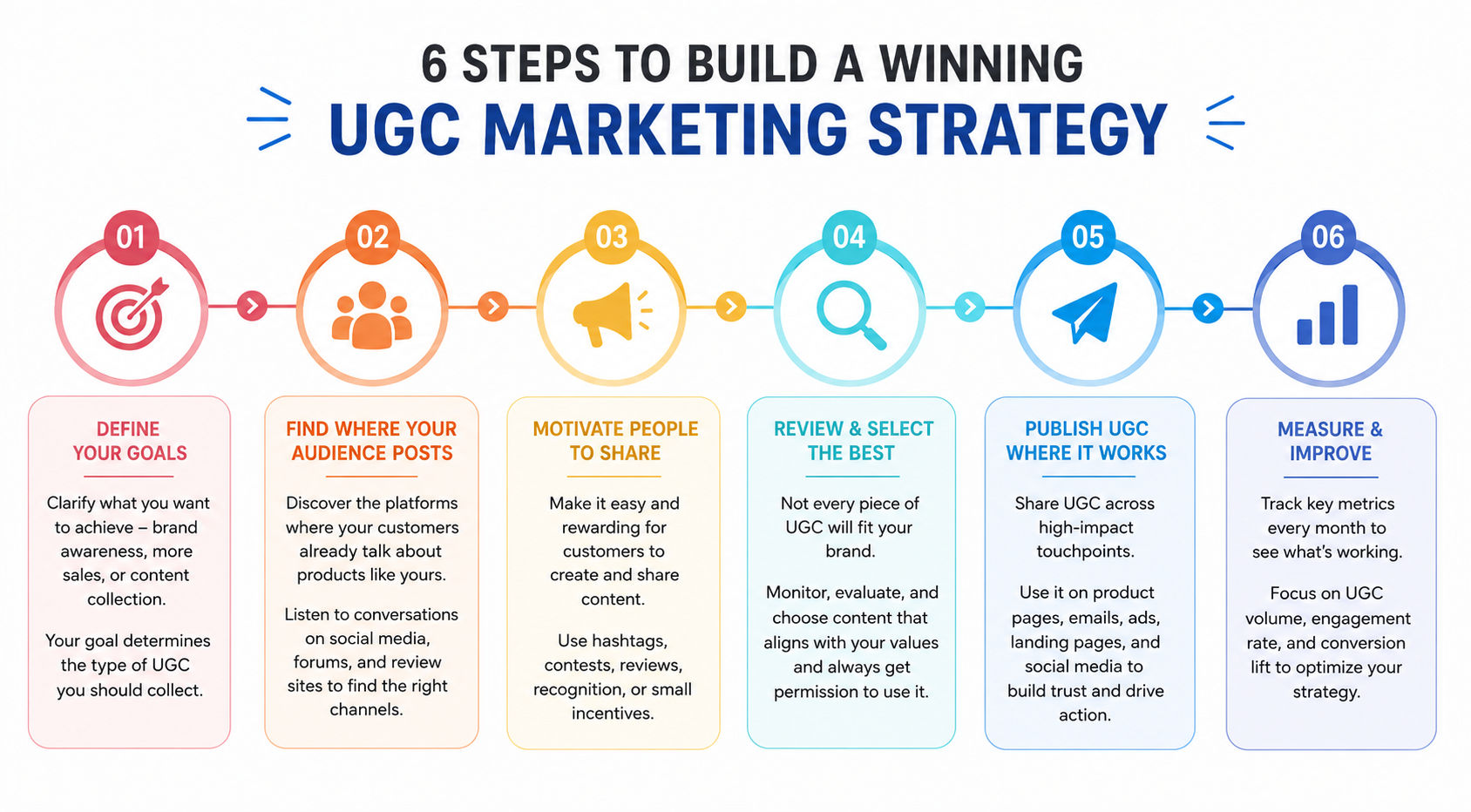
A strong user-generated content marketing strategy does not happen by accident. It requires clear goals, the right channels, and a repeatable process for collecting and using UGC. Below are the 6 steps in detail to help you understand each step clearly.
Are you looking to increase brand awareness? Do you want to boost sales for a specific product? Or are you trying to build a library of photos for your website?
Clear goals help you decide what kind of content to ask for. For example, if you want sales, focus on gathering video testimonials or "unboxing" clips.
You do not need to be on every platform. You need to be on the one where your customers are already talking about products like yours.
Search your brand name, product category, and competitor names on Instagram, YouTube, Reddit, and X. See where the conversations are happening organically. That is where you start.
| Channel | Best UGC Type |
| Photos, Reels, Stories | |
| YouTube | Review videos, tutorials |
| X | Opinions, reactions, quick feedback |
| In-depth discussions, community threads | |
| Amazon/Flipkart | Product reviews and ratings |
| Professional testimonials, case studies |
The simpler the contribution process, the more content you will get. Here are a few proven approaches:
Not all UGC is worth sharing. Once UGC starts coming in, you need a system to review it, otherwise content piles up, and nothing gets used. Set up 3o minutes for a curation process:
Collecting content is only useful if you deploy it in the right places. Here is where UGC drives the most impact:
You do not need a complex marketing analysis setup to know if your user generated content marketing strategy is working. Track these three numbers every month:
Must read: Best Instagram Practices to Increase Reach & Engagement
Digital Marketing Courses to upskill
Explore Digital Marketing Courses for Career Progression
MICA Executive Alumni Status
Looking at real-world examples is the fastest way to understand how this works in practice. Here are some of the most effective user-generated content marketing examples across industries.
GoPro built its entire content strategy around user generated content. The brand actively encourages customers to share adventure footage and regularly features the best submissions on its official channels.
This created a self-sustaining content engine. GoPro users became brand ambassadors without a formal program. The content is raw, exciting, and real, exactly what new buyers want to see.
What to learn: When your product creates experiences worth sharing, build a pipeline for that content.
Airbnb's social media presence relies heavily on photos taken by hosts and guests. Instead of professional shoots, the brand uses authentic images of real spaces and real trips.
This approach works because it shows exactly what a stay looks like, no filters, no staging. It answers the biggest buyer question: "What am I actually getting?"
What to learn: UGC reduces buyer uncertainty by showing reality, not aspiration.
In the Indian market, Zomato and Swiggy have turned customer reviews into a core content marketing user generated content loop. Star ratings, written reviews, and food photos from diners drive discovery and conversions directly inside the app.
Restaurants with more reviews and better photo content from users consistently see higher order volumes. The platform amplifies UGC as a ranking signal.
What to learn: Reviews are content. Treat them as such.
Also read: Instagram Influencer Salary in India 2026: Earnings & Insights
User generated content and influencer marketing sits at the intersection of two powerful strategies. Understanding how they overlap, and how they differ. This helps you distribute your budget and effort more effectively.
The lines between the two have blurred significantly. Today, many brands work with UGC creators. These are people who create content that looks and feels like organic UGC but is produced under a paid arrangement.
This is different from a traditional influencer marketing campaign. A UGC creator does not necessarily post to their own audience. Their job is to create the content itself. That could be a review video, an unboxing, or a "day in my life" featuring the product. The brand managing content then takes that content and uses it across its own channels and ads.
Both involve real people creating content, but the intent, cost, and reach are quite different. The table below breaks down the key differences across five factors.
| Factor | Traditional UGC | Influencer Marketing |
| Creator | Everyday customer | Paid or partnered creator |
| Cost | Usually free | Paid arrangement |
| Reach | Limited per post | Amplified through creator's audience |
| Authenticity | Very high | Variable |
| Control | Low | Moderate |
Subscribe to upGrad's Newsletter
Join thousands of learners who receive useful tips
A successful user-generated content marketing strategy relies on data to prove its worth. You should set up your tracking so you can see the difference between a standard professional shoot and a raw customer testimonial.
The following table breaks down exactly what to look for and how to interpret the data:
| Metric | What to Measure |
| UGC volume | How many customers created content about your brand this month |
| Engagement rate | Are UGC reposts getting more likes, saves, and comments than your branded posts |
| Conversion lift | Is the conversion rate higher on pages and ads that include UGC |
Also read: Social Media Advertising: Benefits, Strategies & How It Works
UGC marketing works because it is built on something advertising cannot buy, and that is genuine human trust. When real customers share real experiences, they create a level of credibility that branded content simply cannot match.
Start small by running one campaign and collecting feedback. Over time, your customers will become your most valuable marketing team.
If you want to build a career in digital marketing, book a free consultation call with upGrad today.
Ads are created and paid for by the brand. UGC comes from real customers with no direct brand involvement. This makes UGC feel more honest and trustworthy, which is why it often outperforms traditional ads in engagement and conversion rates.
Start by setting one clear goal, then identify where your customers already post. Create a simple way for them to contribute, such as a hashtag or a review request email. Collect the best content, get permission, and place it on product pages, ads, and social media.
Make it easy and give them a reason to post. Send a post-purchase email asking for a photo or review. Create a branded hashtag and promote it. Feature customer content on your page regularly because public recognition encourages others to participate.
A UGC creator is someone brands pay to produce authentic-looking content like reviews, unboxings, or product demos. Unlike influencers, they do not post to their own audience. The brand uses the content in its own ads and channels. A large following is not required.
Yes. Small businesses often benefit the most from UGC because it reduces content production costs. A simple post-purchase email asking for a review or photo is enough to get started. No large budget or team is required to run an effective UGC campaign.
Organic UGC costs very little because you are using content customers create for free. The main investment is time spent monitoring, curating, and managing permissions. Paid UGC creator campaigns cost more but are still significantly cheaper than traditional content production.
Common examples include customer review photos on product pages, unboxing videos on YouTube, Instagram posts with branded hashtags, and testimonials in email campaigns. Brands like GoPro, Glossier, and Airbnb have built entire content strategies around user generated content marketing.
Authenticity comes from real experience. Content created without heavy editing, professional lighting, or brand scripting tends to feel more genuine. Even a slightly imperfect photo from a real customer carries more credibility than a polished studio image because it reflects actual product use.
Track three core numbers each month: the volume of UGC created, the engagement rate on UGC posts compared to branded posts, and the conversion rate on pages or ads that include UGC. These three metrics give you a clear view of whether the campaign is delivering results.
Yes. Customer reviews add fresh, keyword-rich content to your website. UGC on product pages increases time-on-site and reduces bounce rates. Review schema markup helps star ratings appear in Google search results, which improves click-through rates and can boost overall search visibility.
You can earn by becoming a UGC creator. Brands pay people to produce authentic-looking content like reviews and unboxings for use in their ads and pages. You do not need a large following. Strong content quality and niche relevance matter more than follower count.
Always ask for explicit permission before reposting any customer content, even if it is publicly posted. A simple direct message is the minimum. For use in paid ads or commercial campaigns, a written agreement or formal rights request is strongly recommended to avoid legal issues.
987 articles published
We are an online education platform providing industry-relevant programs for professionals, designed and delivered in collaboration with world-class faculty and businesses. Merging the latest technolo...
Get Free Consultation
By submitting, I accept the T&C and
Privacy Policy
Level Up Your Digital Marketing Career Today!
Top Resources
MICA
Advanced Certificate in AI-Powered Digital Marketing & Communication from MICAMICA Executive Alumni Status
Certification
5 Specialisation
Classroom
4 Months
Certification
2 Months