Software Development Methodologies: Types, Examples, Comparison and How to Choose the Right One
By Sriram
Updated on Jul 16, 2026 | 10 min read | 4.49K+ views
Share:

All courses
Certifications
More
By Sriram
Updated on Jul 16, 2026 | 10 min read | 4.49K+ views
Share:
Table of Contents
TL;DR
This blog explains what software development methodology is, how it works, and how to choose the right approach for different software projects.
Understanding software development methodologies is just the beginning. Build practical software development and project management skills with upGrad's Management programs through flexible online learning.
Popular Management Programs
A software development methodology is a structured approach that guides how software is planned, designed, developed, tested, deployed, and maintained. It helps teams follow a clear process, improve collaboration, and deliver quality software efficiently.
Simply put, what is software development methodology? It's a framework that takes a software project from an initial idea to a finished product. Since every project has different goals and requirements, teams choose a methodology that best fits their needs.
Software projects involve multiple teams, evolving requirements, and tight deadlines. A well-defined software development methodology provides a structured framework that helps teams stay aligned, improve collaboration, and deliver high-quality software efficiently.
Without a structured approach, projects can face several issues:
A suitable methodology helps teams avoid these challenges by defining clear roles, responsibilities, and workflows.
Also Read: 8 Important Skills Every Project Manager Should Have
Free Courses
Every software project starts with an idea. Turning that idea into a reliable application requires much more than writing code.
That's where software development methodologies provide structure. They define how work moves from one stage to the next while helping teams stay organized, collaborate effectively, and maintain software quality throughout the project.
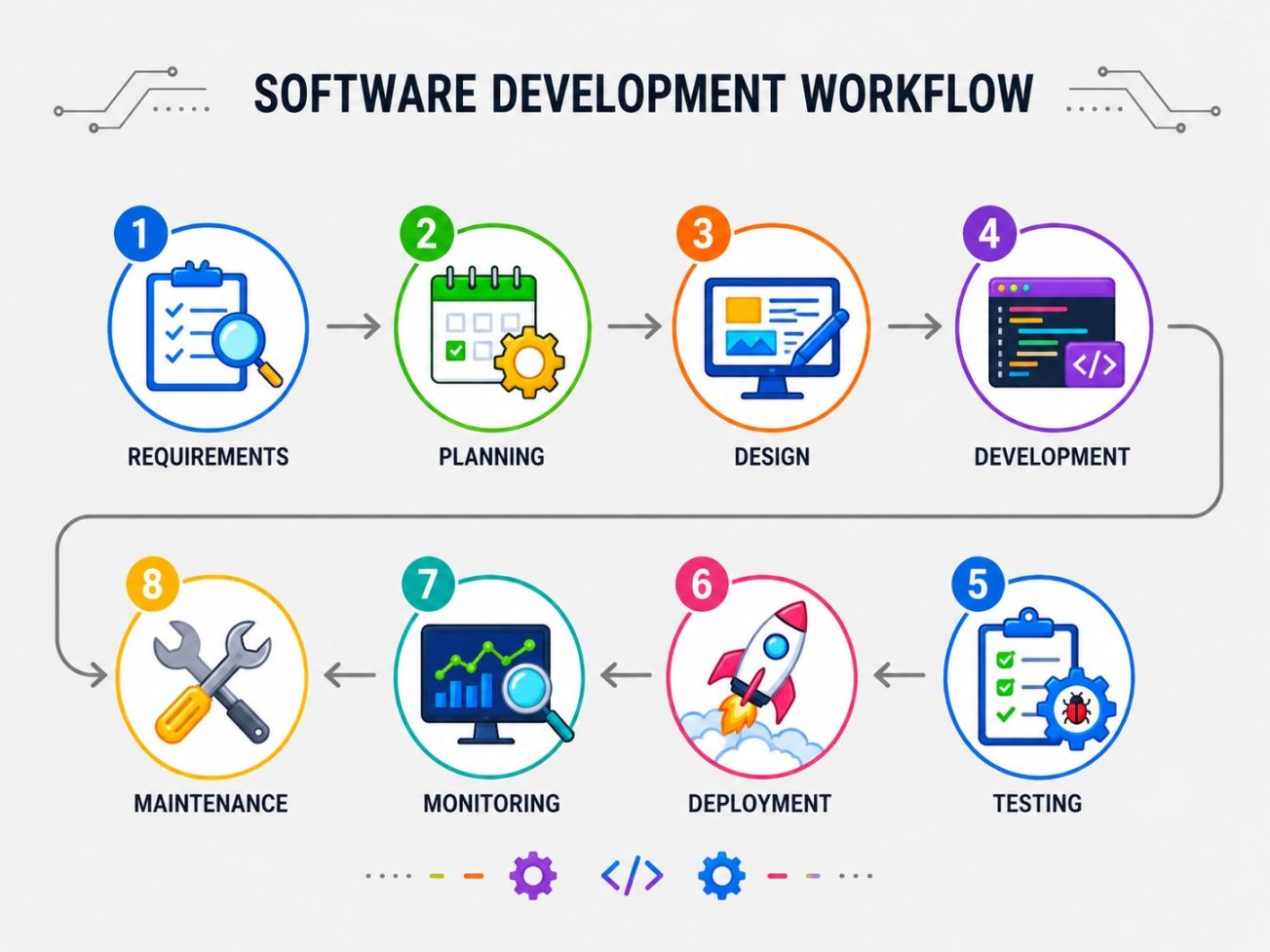
Although different methodologies follow different principles, most share a similar development journey.
The Typical Software Development Workflow
Management Courses to upskill
Explore Management Courses for Career Progression
IIIT-B & IIM, Udaipur
Chief Technology Officer & AI Leadership ProgrammeSuccessful software projects require more than technical expertise. Changing requirements, poor communication, and unclear priorities can quickly derail development. A software development methodology provides a structured framework that helps teams plan effectively, collaborate efficiently, manage risks, and deliver high-quality software on time.
An agile software development methodology is especially useful for projects where customer requirements evolve frequently, allowing teams to respond quickly without disrupting development.
Benefits briefly:
Benefit |
Business Impact |
| Better project planning | Clear roadmap and realistic timelines |
| Reduced project risks | Early issue detection and fewer delays |
| Improved collaboration | Stronger team communication |
| Higher software quality | Reliable and stable applications |
| Greater flexibility | Faster response to changing requirements |
| Better cost and time management | Reduced waste and predictable delivery |
Master software development methodologies and build industry-ready project delivery skills with upGrad's Chief Technology Officer & AI Leadership Programme . Learn Agile, DevOps, SDLC, risk management, software architecture, and modern development practices through hands-on projects, real-world case studies, and expert-led training.
Different projects require different software development methodologies. The right choice depends on factors such as project complexity, business goals, team size, customer involvement, and delivery timelines.
Below are the most widely used methodologies and their ideal use cases.
An agile software development methodology delivers software in short iterations (sprints), allowing teams to gather continuous customer feedback and adapt to changing requirements.
Also Read: Which of These Product Management Tools are You Already Using?
Waterfall follows a sequential process where each phase is completed before moving to the next.
Also Read: What is Project Management Process: Phases and Life Cycle
Spiral combines iterative development with continuous risk assessment, making it suitable for complex and high-risk projects.
Also Read: 12 Essential Time Management Tips for Employees
The V-Model pairs every development phase with a corresponding testing phase to ensure quality throughout the project.
A lean software development methodology focuses on maximizing customer value by eliminating waste and improving efficiency.
Also Read: Top 10 People Management Skills for Managers
An adaptive software development methodology embraces changing requirements through continuous learning, collaboration, and customer feedback.
RAD emphasizes rapid prototyping and frequent user feedback to accelerate development.
Incremental development delivers software in smaller functional releases, with each version adding new features.
The Iterative model continuously improves software through repeated development cycles based on user feedback.
DevOps integrates development and operations using automation, continuous testing, and continuous deployment to speed up software delivery.
Also Read: Kanban vs Scrum the difference between Kanban and Scrum
Choosing the right software development methodology depends on your project's complexity, flexibility, and delivery goals.
Here's a quick comparison of the four most widely used approaches.
Methodology |
Key Strength |
Best For |
| Agile | Flexible, iterative development with continuous feedback | Dynamic projects with changing requirements |
| Waterfall | Structured, sequential process with detailed planning | Projects with fixed scope and clear requirements |
| Spiral | Continuous risk assessment and iterative development | Large, complex, high-risk enterprise projects |
| DevOps | Automated development, testing, and deployment | Applications requiring frequent and reliable releases |
Consider these factors before making your decision:
Also Read: Ultimate Guide to Work with Excel Spreadsheets Using Python
These terms are frequently confused. They're connected, but they don't mean the same thing.
Understanding the difference makes it easier to choose the right approach for a software project.
Software Development Methodology |
Software Development Life Cycle |
| Defines the development approach | Defines the development stages |
| Guides project management | Guides software creation |
| Includes Agile, Waterfall, Lean, Spiral and others | Includes planning, design, development, testing, deployment and maintenance |
| Focuses on how work is completed | Focuses on what stages are completed |
| Varies depending on project needs | Present in every software project |
The Software Development Life Cycle (SDLC) defines the stages of software development, while a software development methodology determines how teams execute those stages.
Think of the SDLC as the roadmap and the methodology as the route taken to reach the destination. Organizations don't choose one over the other-they use both together. The SDLC provides structure, and the methodology ensures efficient project execution based on the project's goals and requirements.
The best software development methodology depends on your project's goals, complexity, team, and business requirements.
Instead of following trends, evaluate these key factors before making a decision.
Determine whether your requirements are fixed or likely to change. Structured methodologies like Waterfall suit stable projects, while Agile is ideal for evolving requirements.
Choose a methodology your team can execute effectively. Experienced teams can handle flexible approaches like Agile, whereas newer teams may benefit from more structured workflows.
If stakeholders expect regular feedback and feature updates, iterative methodologies are a better fit. Projects with fixed requirements require less ongoing customer involvement
Consider whether your priority is predictable delivery or faster releases. The right methodology should balance project deadlines, costs, and quality.
Projects in regulated industries often require detailed documentation and rigorous testing, while startups and innovation-driven projects usually prioritize speed and adaptability.
Also Read: Top 15 Project Management Tools For Your Business
Different projects require different approaches. The table below shows which methodology is best suited for common software development scenarios.
Project Scenario |
Recommended Methodology |
Why It's Suitable |
| Startup launching a mobile app | Agile | Supports frequent feature releases, customer feedback, and continuous improvements. |
| Banking or financial software | Waterfall / V-Model | Ensures strict documentation, compliance, and thorough testing before deployment. |
| Healthcare application | Spiral / V-Model | Prioritizes risk management, validation, and software reliability. |
| Enterprise ERP implementation | Incremental | Delivers the system module by module, reducing business disruption. |
| AI-powered product | Adaptive Software Development | Enables teams to respond quickly to evolving user needs and changing business requirements. |
Also Read: Why Organizational Skills Matter in the Workplace and How to Improve Them
Even the best software development methodology comes with challenges. Being aware of these issues helps teams plan and execute projects more effectively.
Also Read: 10 Most Popular Type of Management Style: Understanding and Choosing the Right Approach
Implementing a software development methodology is only the first step. Consistent execution, clear communication, and continuous improvement are essential to achieve better project outcomes and deliver high-quality software.
Teams following a lean software development methodology regularly review workflows to eliminate unnecessary activities and improve delivery efficiency.
To get the most value from a software development methodology, follow these best practices:
Also read : What is Supply Chain Management: Components, Process & Benefits
Software development methodologies continue to evolve with advancements in technology. Key trends include:
Choosing the right software development methodology helps teams improve planning, collaboration, risk management, and software quality. The best approach depends on your project's goals, complexity, team, and business requirements.
An agile software development methodology is ideal for projects that require flexibility and continuous feedback, while a lean software development methodology focuses on improving efficiency by eliminating waste. For projects with evolving requirements, an adaptive software development methodology enables teams to respond quickly to change and deliver greater business value.
Ready to start your journey? Book a free consultation with upGrad today to find the best path for your career.
A software development methodology is a structured framework that defines how software is planned, designed, developed, tested, deployed, and maintained. It helps teams organize tasks, improve collaboration, and deliver projects efficiently. Choosing the right methodology depends on the project's goals, complexity, and business requirements.
Software development methodologies provide a consistent process that improves planning, communication, and quality throughout a project. They help teams manage risks, allocate resources effectively, and respond to changing requirements. A well-chosen methodology also reduces rework, controls costs, and increases the chances of successful project delivery.
Start by evaluating your project's scope, timeline, team experience, customer involvement, and compliance requirements. Projects with changing requirements often benefit from Agile, while fixed-scope projects may be better suited to Waterfall. The best methodology is the one that aligns with your business objectives and delivery expectations.
The most widely used software development methodologies include Agile, Waterfall, Spiral, V-Model, Lean, DevOps, Rapid Application Development (RAD), Incremental, Iterative, and Adaptive Software Development. Each methodology follows a different development approach, making it suitable for specific project types, industries, and business needs.
Five of the most commonly adopted software development methodologies are Agile, Waterfall, Spiral, Lean, and DevOps. Agile emphasizes flexibility, Waterfall follows a sequential process, Spiral focuses on risk management, Lean eliminates waste, and DevOps integrates development with operations for continuous delivery and faster software releases.
The four popular Agile methodologies are Scrum, Kanban, Extreme Programming (XP), and Crystal. Scrum organizes work into short sprints, Kanban focuses on continuous workflow, XP emphasizes engineering best practices, and Crystal adapts processes based on project size and team requirements.
The seven commonly recognized SDLC models are Waterfall, Agile, Spiral, V-Model, Iterative, Incremental, and Big Bang. Each model defines how software moves through planning, design, development, testing, deployment, and maintenance. Organizations choose an SDLC model based on project complexity, risk level, and business objectives.
Yes. Many organizations use hybrid approaches by combining different methodologies to meet specific project needs. For example, development teams may follow Agile for feature development while using DevOps practices for deployment and automation. This combination provides greater flexibility, faster releases, and improved operational efficiency.
Startups often prefer an agile software development methodology because it supports rapid development, continuous customer feedback, and frequent feature releases. As products evolve, teams can quickly adjust priorities based on user insights, reducing development risks and accelerating time to market.
The Software Development Life Cycle (SDLC) defines the stages involved in building software, while a software development methodology determines how teams execute those stages. In simple terms, the SDLC explains what happens during development, whereas the methodology defines how the work is carried out.
Modern software development is evolving through AI-assisted coding, DevSecOps, hybrid methodologies, low-code platforms, and automation. Organizations are also adopting lean software development methodology practices to improve efficiency and an adaptive software development methodology to respond quickly to changing customer needs and business environments.
730 articles published
Sriram K is a Senior SEO Executive with a B.Tech in Information Technology from Dr. M.G.R. Educational and Research Institute, Chennai. With over a decade of experience in digital marketing, he specia...
Get Free Consultation
By submitting, I accept the T&C and
Privacy Policy
Top Resources
Certification
3 Months
Certification
6 Months
O.P. Jindal Global University
Masters in International Accounting and Finance (Accredited by ACCA, UK)Master's Degree
12 Months