RFP in Project Management: Complete Guide, Process, and Template
By upGrad
Updated on Jul 08, 2026 | 4 min read | 1.64K+ views
Share:

All courses
Certifications
More
By upGrad
Updated on Jul 08, 2026 | 4 min read | 1.64K+ views
Share:
Table of Contents
Key Takeaway
In this blog, you'll learn what this document includes, when you actually need one, how the process runs from start to finish, and how to write and evaluate one without wasting weeks on back and forth emails.
Explore upGrad's Management programs to build in-demand skills in project planning, procurement, stakeholder management, Agile and Scrum, risk management, budgeting, and vendor selection. Gain hands-on experience through real-world projects, industry case studies, and practical frameworks to confidently manage projects from planning to successful delivery.
Popular Management Programs
A Request for Proposal (RFP) is a formal document that organisations use to invite qualified vendors to submit proposals for a project. It outlines the project objectives, business requirements, scope of work, timelines, evaluation criteria, and submission guidelines, so every vendor responds to the same set of expectations.
Simply put, an RFP creates a fair and organized way to compare different solutions before making a purchasing decision.
Unlike an informal quotation request, an RFP doesn't focus only on price. It also evaluates a vendor's experience, technical capabilities, proposed approach, delivery timeline, and overall value. This makes it especially useful for projects that involve multiple stakeholders, higher budgets, or customized solutions.
An RFP sits between planning and execution in the procurement lifecycle.
Aspect |
Description |
| Purpose | Compare vendor solutions against a defined need |
| Used by | Project managers, procurement teams, IT and operations |
| When to use | Complex or high-value projects with multiple possible vendors |
| Expected outcome | A signed contract with a selected vendor |
If you already know exactly what product you want and need a price, you're looking at an RFQ(Request for Quotation) instead.
An RFP makes sense when:
Small internal projects rarely need this level of formality. A quick quote or a direct conversation with a known vendor often gets the job done faster. Save the formal process for decisions that actually carry risk.
Do read: What is Project Management Process: Phases and Life Cycle
A good RFP doesn't begin with writing the document. It starts much earlier when the project team understands the business problem and defines what success looks like. The RFP process in project management provides a structured path from identifying a requirement to selecting the right vendor.
The RFP process in project management follows a predictable path, even though the details shift by industry.
Step |
What Happens |
| Define project goals and requirements | Define objectives, scope, budget, and timeline. |
| Prepare the RFP document | Draft the RFP with key project details. |
| Identify and invite vendors | Shortlist and invite qualified vendors. |
| Handle vendor questions | Answer queries and share clarifications. |
| Receive proposals | Collect proposals before the deadline. |
| Evaluate proposals | Compare proposals using predefined criteria. |
| Select the vendor and award the contract | Negotiate terms and finalize the contract. |
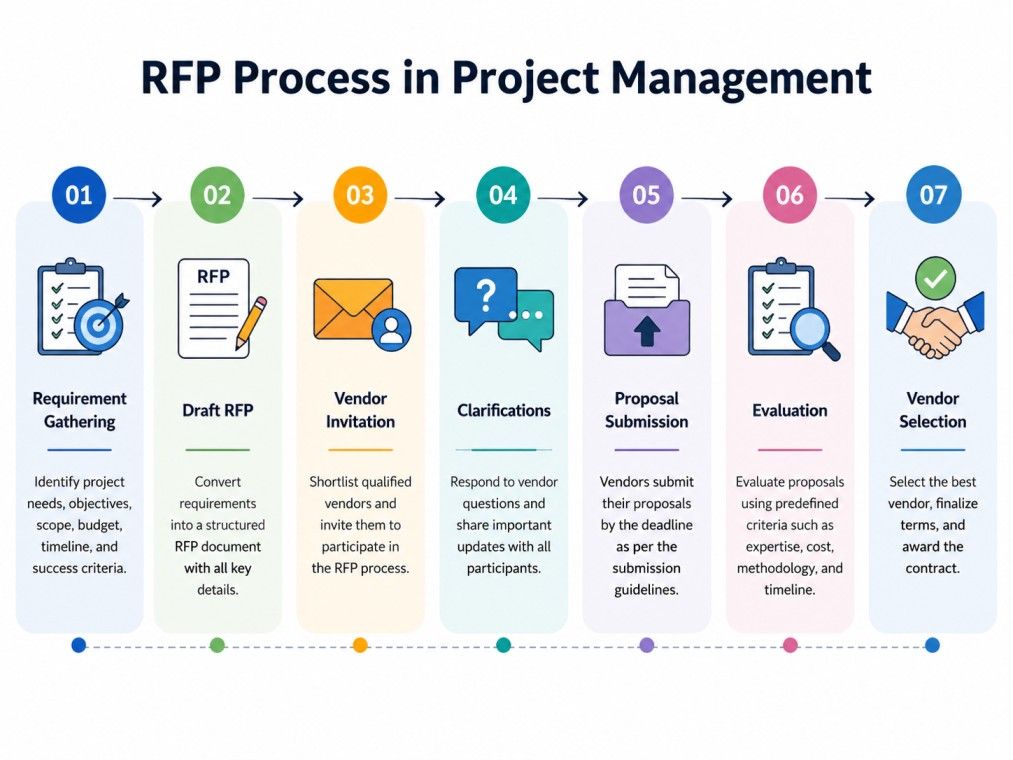
The RPF document includes a consistent set of sections that help vendors understand both the project and the client's expectations. Every section answers a question the vendor is likely to ask before preparing a proposal.
A strong RFP document covers these sections:
Some of these are non negotiable. Scope and evaluation criteria always need to be spelled out. Budget range is often optional, but including even a rough figure cuts down on wildly mismatched proposals.
Explore upGrad's Professional Certificate Programme in AI for Business Professionals with IIM Kozhikode to build practical skills in artificial intelligence, generative AI, AI strategy, prompt engineering, business transformation, and AI-driven decision-making. Gain hands-on experience through real-world business case studies, live learning, and industry-focused applications to confidently lead AI initiatives across modern organizations.
Management Courses to upskill
Explore Management Courses for Career Progression
IIIT-B & IIM, Udaipur
Chief Technology Officer & AI Leadership ProgrammeWriting one well is about being specific enough that a vendor doesn't have to guess. Start by pulling requirements from every stakeholder who'll touch the outcome. Define objectives you can actually measure, not vague goals. Keep the scope description tight. If it's too broad, vendors will price in uncertainty, and you'll pay for it.
Set your evaluation criteria before proposals arrive, not after, to prevent most of the bias complaints that come up during vendor selection.
Quick checklist before you publish:
Must read: Project Management Methodologies
Here's a reusable structure you can adapt for almost any project:
Project Overview
Objectives
Business Requirements
Scope of Work
Deliverables
Timeline
Budget
Evaluation Criteria
Submission Instructions
Terms & Conditions
Copy this into a doc, fill in each section with your project's specifics, and you've got a working RFP in under an hour.
Imagine a retail company planning to implement a new Customer Relationship Management (CRM) system to improve customer service and sales reporting.
Here's what a simplified RFP might look like
Section |
Example |
| Project | CRM System Implementation |
| Organization | ABC Retail Pvt. Ltd. |
| Objective | Replace the existing CRM with a cloud-based solution that improves customer support and reporting. |
| Scope | Software implementation, data migration, user training, and post-launch support. |
| Timeline | Six-month implementation with three milestone reviews. |
| Vendor Requirements | Minimum five years of CRM implementation experience and at least three similar projects completed. |
| Evaluation Criteria | Technical capability, implementation approach, pricing, support model, and client references. |
| Submission Deadline | 15 September 2026 |
The document doesn't tell vendors how to solve the problem. It explains the business's needs and lets vendors recommend the best approach. This encourages creative solutions while still keeping every proposal aligned with the project's goals.
An example like this makes it easier for first-time project managers to understand how different sections connect.
Do read: Types of Project Management: Methods, Industries, and Best Practices
Selecting the right vendor requires a structured evaluation process that balances technical capability, business value, project risk, and cost. Don't rely on price alone.
A cheaper proposal may require additional resources later, while a slightly higher-priced vendor could deliver faster implementation, stronger support, and lower long-term maintenance costs.
Start with the basics. Review whether each proposal follows the submission guidelines. Incomplete documents, missing certifications, or late submissions should be identified before technical evaluation begins.
This first screening saves time during detailed reviews.
Does the vendor understand your requirements? Look for evidence that they've completed similar projects and have the expertise needed to deliver the expected outcomes.
Consider factors such as:
Price matters. It just shouldn't be the only factor.
Compare:
A proposal with a lower initial price isn't always the most economical over the project's lifetime.
Every proposal carries some level of risk.
Review:
Vendors who openly discuss risks often demonstrate greater project maturity than those who promise a flawless implementation.
Past performance provides valuable insight. Speak with previous clients when possible. Ask about communication, delivery quality, adherence to timelines, issue resolution, and post-project support.
Also read: Project Manager Skills: The 8 Most Important Ones
Understanding RFP vs RFQ in project management and RFP vs RFI in project management side by side clears up most of the confusion teams have around procurement documents.
Feature |
RFI |
RFP |
RFQ |
| Purpose | Gather general information | Request a full solution | Request pricing only |
| Used when | Exploring the market | Solving a complex problem | Requirements are already fixed |
| Output | Vendor capabilities overview | Detailed proposal | Price quote |
| Pricing focus | Low | Medium | High |
If you're still figuring out what's even possible, start with an RFI. If you know the solution shape but need pricing, go RFQ. If you need vendors to propose an actual approach, that's your RFP.
Do read: Project Management Tools: Features, Types & Top Picks
Running this process the wrong way costs more than it saves. Here are a few mistakes that show up again and again:
Common Mistake |
Impact |
Solution |
| Vague scope | Inconsistent proposals | Define deliverables clearly |
| Unrealistic timelines | Poor vendor participation | Set practical deadlines |
| Too many requirements | Longer, weaker proposals | Keep requirements relevant |
| Changing evaluation criteria | Unfair vendor comparison | Finalize criteria before issuing the RFP |
| Ignoring vendor questions | Misunderstandings and confusion | Share timely clarifications |
Any one of these can quietly tank a procurement cycle. Fix the scope and timeline issues first. They cause the most damage.
An RFP in project management works best when it's treated as a planning tool, not paperwork you rush through to check a box. Get the scope and criteria right early, and the rest of the process runs a lot smoother.
Before you issue an RFP, run through this:
A successful procurement process starts long before vendors submit proposals. It begins with a clear understanding of project objectives and a well-prepared Request for Proposal. And that why knowing what is RFP in project management is very important.
Whether you're creating your first RFP in project management or refining an existing procurement process, investing time in defining requirements, documenting expectations, and evaluating proposals consistently can lead to better vendor partnerships and stronger project outcomes. A thoughtful RFP doesn't simply help you choose a vendor. It helps you choose the right solution.
Ready to start your journey? Book a free consultation with upGrad today to find the best path for your career.
Before you start thinking about how to write an RFP for a project, make sure the project objectives, scope, budget, timeline, and stakeholder expectations are clearly defined. A well-planned foundation results in better vendor proposals and reduces costly revisions during procurement.
A project charter authorizes a project and defines its high-level objectives, while an RFP in project management is a procurement document used to invite vendors to submit proposals. The charter is an internal document, whereas an RFP is shared with external suppliers during vendor selection.
A strong response should explain the proposed solution, implementation approach, project timeline, pricing, team structure, relevant experience, and risk management plan. Including client references or case studies also helps demonstrate credibility and makes how to evaluate RFP responses much easier.
Yes. Organizations can update an RFP if project requirements change or important information needs clarification. However, every modification should be shared with all participating vendors at the same time to maintain transparency and ensure a fair evaluation process.
There isn't a fixed number. Most private organizations invite three to five qualified vendors, while public sector projects may issue open invitations. The goal is to receive enough competitive proposals without making the evaluation process unnecessarily complex.
Understanding RFI and RFP in project management helps teams choose the right procurement document. An RFI gathers information about available solutions before requirements are finalized, whereas an RFP requests complete proposals after the project scope and objectives have been clearly defined.
The strongest vendor isn't always the cheapest. Most organizations compare technical expertise, implementation approach, pricing, timeline, support services, and client references using a weighted scoring matrix. This structured approach makes how to evaluate RFP responses more objective and easier to justify.
No. What is RFP in project management becomes most relevant for complex or high-value projects that require multiple vendor proposals. Small purchases with fixed specifications or existing suppliers can usually be handled through an RFQ or direct procurement process.
An RFP template should be updated whenever procurement policies, legal requirements, business objectives, or industry standards change. Reviewing templates after major projects also helps incorporate lessons learned and keeps future procurement documents relevant and effective.
If you're wondering what is RFP in project management, think of it as a structured way to compare vendor solutions before awarding a contract. It improves transparency, encourages fair competition, reduces misunderstandings, and helps organizations select vendors based on value instead of price alone.
What is an RFP in project management? It's a formal request that invites vendors to propose solutions for a defined project. First-time project managers should focus on clear objectives, realistic timelines, measurable evaluation criteria, and stakeholder input before drafting the document. A simple template and thorough planning often produce better results than lengthy, overly detailed RFPs.
945 articles published
We are an online education platform providing industry-relevant programs for professionals, designed and delivered in collaboration with world-class faculty and businesses. Merging the latest technolo...
Get Free Consultation
By submitting, I accept the T&C and
Privacy Policy
Top Resources
Certification
3 Months
Certification
6 Months
O.P. Jindal Global University
Masters in International Accounting and Finance (Accredited by ACCA, UK)Master's Degree
12 Months