What Are the Triple Constraints of Project Management? A Complete Guide
By Sriram
Updated on Jul 08, 2026 | 10 min read | 7.19K+ views
Share:

All courses
Certifications
More
By Sriram
Updated on Jul 08, 2026 | 10 min read | 7.19K+ views
Share:
Table of Contents
TL; DR
This blog explains the triple constraints of project management in simple terms. You'll learn what scope, time, and cost mean, how they work together, the importance of triple constraints in project management, and how to apply them through practical examples.
Understanding the triple constraints of project management is just the beginning. Strengthen your project management and leadership skills with upGrad's Management programs, designed to prepare you for real-world business challenges through flexible online learning.
Popular Management Programs
Every project has limits. You can't deliver unlimited work with unlimited time and unlimited money. To complete a project successfully, teams must balance three key factors known as the triple constraints of project management.
The three constraints are:
These constraints are closely connected. A change in one usually affects the other two. For example, if a client requests additional features, the project may require more time, a larger budget, or a reduction in other deliverables.
Triple Constraints at a Glance
Constraint |
Focus |
Key Question |
| Scope | Deliverables and requirements | What needs to be completed? |
| Time | Schedule and deadlines | When should it be completed? |
| Cost | Budget and resources | How much can be spent? |
Whether you're managing a software project, construction project, marketing campaign, or product launch, the triple constraints of project management help teams understand trade-offs, make informed decisions, and keep projects on track.
You may also hear the triple constraints of project management called the Project Management Triangle or the Iron Triangle. These terms refer to the same concept, showing that scope, time, and cost are interconnected. When one constraint changes, the other two must adjust to maintain project balance and achieve successful outcomes.
Also read : What is Product Management? A Beginner’s Guide
Free Courses
The triple constraints of project management consist of three interconnected elements: scope, time, and cost. While they seem straightforward, balancing them is one of the biggest challenges in project management.
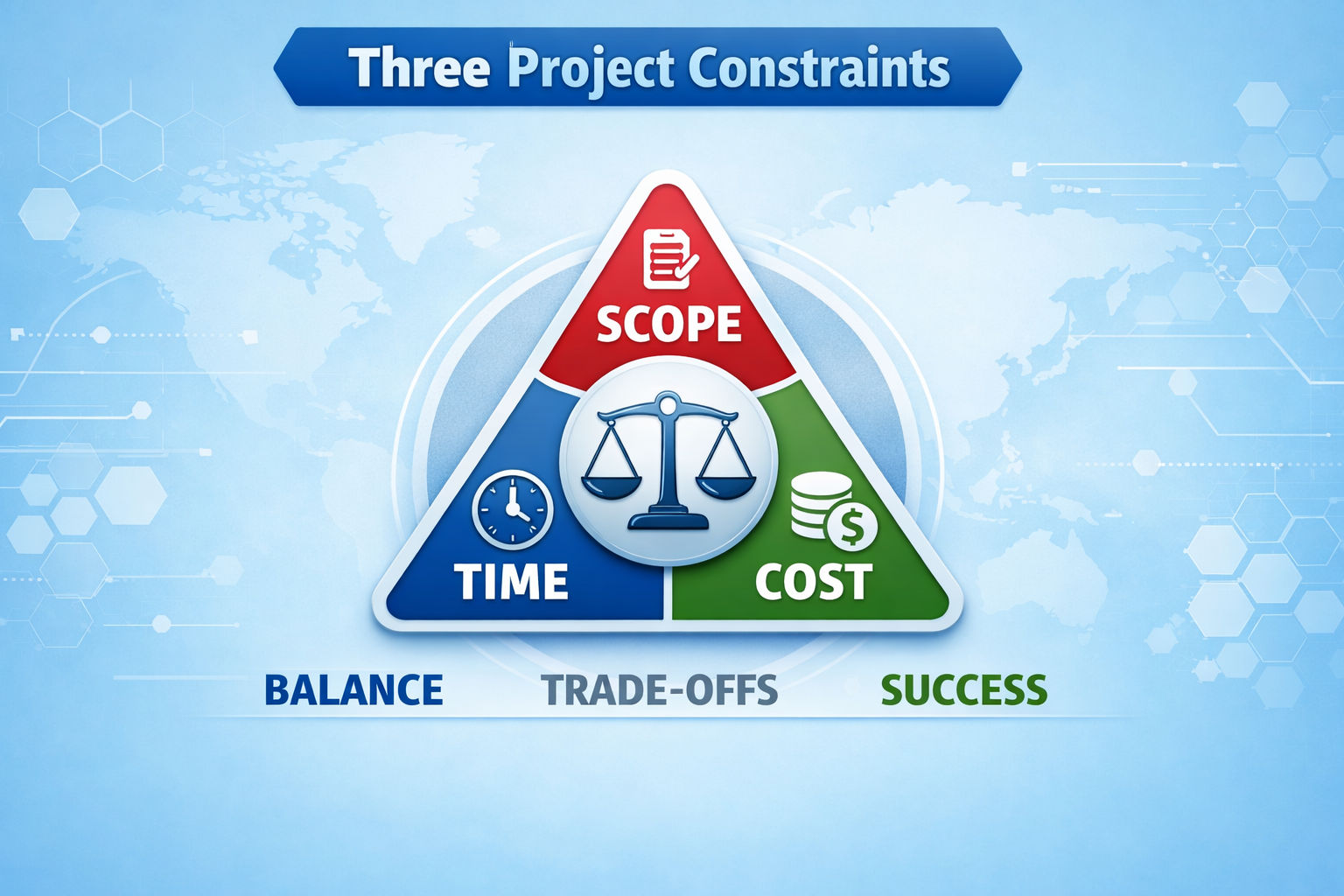
A change in one constraint almost always affects the other two, making careful planning and decision-making essential.
Scope defines everything the project is expected to deliver, including its objectives, features, deliverables, and success criteria. A well-defined scope keeps the project focused and reduces unnecessary changes.
For example, if a client requests additional features after development has started, the project may require more time, a larger budget, or the removal of existing deliverables. Managing such changes helps prevent scope creep.
Scope Element |
Example |
| Objectives | Launch a mobile app |
| Deliverables | User login, payment gateway |
| Success Criteria | Meets functional requirements |
Time refers to the schedule required to complete the project. It includes milestones, task durations, dependencies, and the final deadline.
If extra work is added without extending the schedule, teams may need additional resources or reduce the project scope to meet the deadline. A realistic timeline helps maintain productivity and quality.
Time Element |
Purpose |
| Milestones | Track project progress |
| Deadlines | Complete work on time |
| Dependencies | Manage task sequence |
| Buffer Time | Handle unexpected delays |
Cost represents the total budget needed to complete the project. It includes labor, materials, software, equipment, and other project expenses.
For instance, if material prices increase during a construction project, the project manager may need to increase the budget, reduce the scope, or extend the timeline. Effective cost management helps projects remain financially viable.
Cost Category |
Example |
| Labor | Salaries and contractors |
| Materials | Raw materials and supplies |
| Technology | Software and cloud services |
| Equipment | Hardware and machinery |
Understanding these three constraints helps project managers evaluate trade-offs, allocate resources effectively, and keep projects on track while meeting stakeholder expectations.
Management Courses to upskill
Explore Management Courses for Career Progression
IIIT-B & IIM, Udaipur
Chief Technology Officer & AI Leadership ProgrammeEach element of the triple constraint influences the others, making it a fundamental concept in project management. When scope, time, or cost changes, project managers must evaluate how the other two will be affected. For example, adding new features may require a larger budget, a longer timeline, or reduced functionality elsewhere. Understanding this relationship helps teams make realistic decisions and keep projects on track.
How One Constraint Influences the Others:
If This Changes |
Likely Effect |
| Scope increases | More time, higher cost, or both |
| Timeline is reduced | Higher costs or reduced scope |
| Budget is reduced | Smaller scope or longer schedule |
| Resources decrease | Longer completion time |
| Delivery date moves earlier | More spending or fewer deliverables |
Understanding these relationships is the foundation for applying the triple constraints of project management effectively. This also highlights the importance of triple constraints in project management when evaluating project changes and making informed decisions.
Quality is not traditionally considered a separate side of the project management triangle. Instead, it is the result of how well scope, time, and cost are balanced. When these three constraints are managed effectively, maintaining quality becomes much easier.
Each constraint has a direct impact on project quality:
Constraint |
Impact on Quality |
| Scope | Unclear or changing requirements can lead to missing, unnecessary, or incomplete features. |
| Time | Tight deadlines reduce time for testing, reviews, and issue resolution. |
| Cost | Limited budgets may restrict resources, tools, and quality assurance activities. |
Imagine a software company developing a mobile app. Near the end of the project, the client requests additional features but refuses to extend the deadline or increase the budget. To meet the schedule, the team skips some testing, resulting in bugs and a poor user experience. The quality suffers because the project constraints are no longer balanced.
Project managers can protect quality by:
Balancing scope, time, and cost helps teams deliver projects that meet both business objectives and quality expectations.
Also Read: Top 10 People Management Skills for Managers
The importance of triple constraints in project management lies in helping teams balance scope, time, and cost throughout the project. Instead of making decisions in isolation, project managers evaluate how every change affects the overall project, leading to better planning, smoother execution, and improved outcomes.
The triple constraint framework helps teams define realistic project goals, timelines, and budgets before work begins, making projects easier to plan and manage.
When project requirements change, managers assess the impact on scope, time, and cost before taking action. This helps avoid costly mistakes and keeps the project aligned with its objectives
Balancing the three constraints helps identify potential risks early. For example, reducing the budget without adjusting the scope can lead to delays or quality issues.
The framework makes it easier to explain how changes in project requirements affect deadlines and budgets, leading to clearer communication and realistic expectations.
A successful project delivers the agreed scope within the planned timeline and budget while maintaining quality. That's why the importance of triple constraints in project management extends beyond planning to every stage of the project lifecycle.
Also Read: A Comprehensive Guide to General Management: Roles, Skills, and Career Opportunities
A clear workflow helps project managers respond to changes without losing control of scope, time, or cost. Follow these simple steps to keep projects organized and balanced throughout their life cycle.
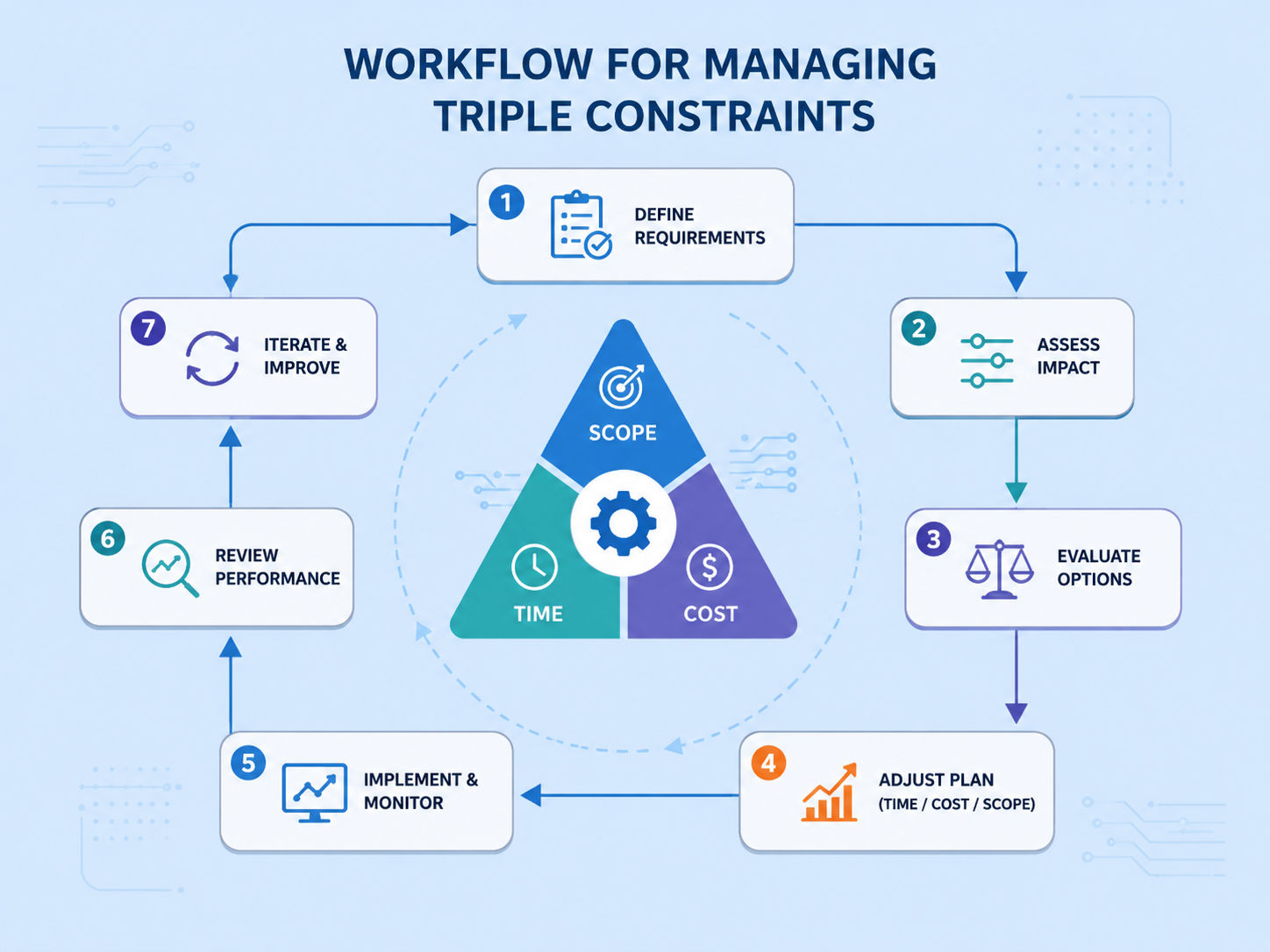
Understanding the concept is important, but real-world examples show how the triple constraints of project management influence project decisions. Whenever scope changes, project managers must adjust the timeline, budget, or both to keep the project on track.
A company is building an employee management system with a fixed budget and a six-month deadline. Midway through the project, the client requests additional payroll and attendance modules.
To accommodate the change, the project manager can:
A client requests an additional conference room after construction has begun. Since the project scope increases, the contractor must either allocate a larger budget, extend the completion date, or modify other planned work.
A company planning a product launch campaign decides to include influencer marketing and video advertisements just before launch. The team must either increase the budget, postpone the launch, or reduce other campaign activities.
These examples of triple constraints in project management highlight a common principle. When one constraint changes, project managers must rebalance the remaining constraints to achieve successful project outcomes.
Also read : What is Supply Chain Management: Components, Process & Benefits
Balancing the three constraints means making informed trade-offs whenever project priorities change. A small adjustment made early is often easier and less expensive than fixing problems later.
Also Read: 10 Most Popular Type of Management Style: Understanding and Choosing the Right Approach
Recognizing common challenges early helps project managers respond before they affect delivery.
Challenge and Solution Table :
Challenge |
Common Cause |
Practical Solution |
| Scope creep | Uncontrolled changes | Formal change approval |
| Budget overruns | Poor cost estimates | Regular budget tracking |
| Schedule delays | Task dependencies | Update project schedule frequently |
| Resource shortages | Limited availability | Reallocate resources based on priority |
Explore upGrad's Project Management programs Chief Technology Officer & AI Leadership Programme to develop practical skills in project planning, scope management, scheduling, budgeting, risk management, stakeholder communication, and industry-recognised project management frameworks through hands-on projects and real-world case studies.
You may come across different names while learning project management.The good news is they all describe the same core concept. The only real difference is the terminology used by different organizations, books, or professionals.
Term |
Meaning |
Difference |
| Triple Constraints | Scope, Time, and Cost | Standard project management term |
| Project Management Triangle | Visual representation of the three constraints | No functional difference |
| Iron Triangle | Traditional name for the same concept | Common in older project management literature |
Regardless of the name, the principle remains the same. If one constraint changes, at least one of the other two must also change to maintain project balance.
Also read : Best Business Management Courses in India [2026]
Project managers rarely make decisions based on one constraint alone.
This matrix provides a quick way to understand the likely impact of common project changes.
If This Happens |
Review |
Possible Response |
| Scope increases | Time and Cost | Extend schedule or increase budget |
| Budget decreases | Scope and Time | Reduce deliverables or extend timeline |
| Deadline moves earlier | Scope and Cost | Add resources or reduce project scope |
| New requirements appear | All three constraints | Perform impact analysis before approval |
| Resource availability drops | Time | Revise schedule or assign additional resources |
Also Read: What is Project Management Process: Phases and Life Cycle
Managing the triple constraints of project management becomes easier when consistent practices are followed throughout the project.
Some practical best practices include:
Small adjustments made throughout the project are often more effective than major corrections near the end.
Also Read: 4 Key Differences Between Leadership and Management
Changes in project scope almost always affect the project timeline and budget. Adding new features or requirements increases the amount of work, which may require more time, additional resources, or higher costs. If the schedule or budget cannot be adjusted, some deliverables may need to be reduced or postponed. Understanding this relationship helps project managers control scope changes and keep projects on track.
Every project operates within limits. The triple constraints of project management provide a practical framework for balancing scope, time, and cost while maintaining project quality.
No project remains unchanged from start to finish. Requirements evolve, budgets shift, and deadlines move. What separates successful projects from unsuccessful ones is not the absence of change but the ability to evaluate its impact and make informed decisions
Understanding these constraints helps project managers, team members, and stakeholders work toward realistic expectations, manage resources wisely, and deliver projects with greater confidence.
Ready to start your journey? Book a free consultation with upGrad today to find the best path for your career.
The triple constraints of project management are scope, time, and cost. These three elements define what a project will deliver, how long it will take, and how much it will cost. Since they are interconnected, changing one constraint usually affects the other two. Successful project managers balance all three to achieve project objectives.
The triple constraints provide a framework for making informed project decisions. They help project managers evaluate the impact of changes before approving them, reduce project risks, and set realistic stakeholder expectations. Maintaining the right balance also improves resource utilization and increases the likelihood of delivering successful projects.
Project success depends on balancing scope, time, and cost throughout the project lifecycle. Expanding the project scope without adjusting the schedule or budget can lead to delays, increased expenses, or lower quality. Managing these trade-offs helps teams meet business goals while satisfying stakeholder expectations.
The three constraints of project management are scope, time, and cost. Scope defines the project deliverables, time refers to the schedule, and cost represents the available budget. These constraints work together, requiring project managers to carefully evaluate how changes in one area affect the entire project.
While the traditional model focuses on scope, time, and cost, many organizations now consider quality and risk as additional project constraints. Together, these five constraints influence planning, execution, and project outcomes. Managing them effectively helps ensure projects meet business objectives without compromising performance.
he three primary project constraints are scope, time, and cost. Scope determines the amount of work required, time sets the project deadline, and cost defines the financial resources available. These constraints form the foundation of project planning and are considered during every major project decision.
The "3 C's" of project management do not have a single universal definition, but they commonly refer to Communication, Collaboration, and Coordination. These principles help teams share information, work efficiently, and align project activities. Strong communication and coordination also make it easier to manage scope, time, and cost successfully.
Yes, a project can still succeed when one constraint changes, provided the remaining constraints are adjusted appropriately. For example, adding new features may require a larger budget or a longer schedule. Careful planning and stakeholder approval allow teams to manage these trade-offs while maintaining project quality.
Agile projects treat scope as more flexible than traditional project management. Teams usually work within fixed budgets and timeframes while adjusting features based on customer feedback and business priorities. This iterative approach helps organizations deliver value continuously without losing control over project resources.
Quality is influenced by how well scope, time, and cost are balanced. Unrealistic deadlines, budget reductions, or uncontrolled scope changes can reduce testing, increase defects, and affect customer satisfaction. Managing the triple constraint effectively creates the conditions needed to achieve the desired quality standards.
Project managers balance the triple constraint by defining clear requirements, estimating realistic budgets and schedules, monitoring project performance, and managing change requests carefully. Regular communication with stakeholders and early risk identification also help teams make informed decisions while keeping projects aligned with their objectives.
730 articles published
Sriram K is a Senior SEO Executive with a B.Tech in Information Technology from Dr. M.G.R. Educational and Research Institute, Chennai. With over a decade of experience in digital marketing, he specia...
Get Free Consultation
By submitting, I accept the T&C and
Privacy Policy
Top Resources
Certification
3 Months
Certification
6 Months
O.P. Jindal Global University
Masters in International Accounting and Finance (Accredited by ACCA, UK)Master's Degree
12 Months