Project Cycle Management: A Complete Guide for Beginners
By upGrad
Updated on Jun 05, 2026 | 7 min read | 2.36K+ views
Share:

All courses
Certifications
More
By upGrad
Updated on Jun 05, 2026 | 7 min read | 2.36K+ views
Share:
Table of Contents
Project cycle management is a structural approach for managing a project. You plan to do what you said you would do, check to see if it is going well and then finish it. This helps people in charge use what they have, like money and time in a way. They can also deal with problems that might come up so they can achieve what they want to achieve with their project.
It does not matter what kind of project you are working on, like software, a new building, a new way to sell something, or a project to help people. Knowing how to manage a project cycle can make your project turn out better.
In this guide, you will learn what project cycle management is. You will also learn why it is important. We will look at its stages, common methods, advantages, problems, and tips. There will be examples that make it easy to understand. By the end, you will know how projects go from an idea to being completed.
Explore Management Courses from upGrad and discover what project cycle management is, why it matters, and how understanding each phase of the project lifecycle can make you a sharper, more dependable project leader.
Popular Management Programs
Project cycle management helps guide a project from start to finish. It starts with finding a need or opportunity. The project ends when it is evaluated and officially closed. The project cycle management process makes sure everything runs smoothly. It helps to identify a need or opportunity and then assess the project when it is finished.
The concept helps teams stay organized and work together. Instead of seeing projects as separate tasks, it gives a clear plan to reach goals.
Many professionals use the terms of project cycle management and project management life cycle interchangeably. Even though there are differences in some industries, both are about managing projects, through different stages.
Also Read: What is Project Management Process: Phases and Life Cycle
Most of the time when we do not know what we want to achieve when our project goals are not well defined, the projects do not go as planned, we might lack resources or teams are not communicating with each other properly. Having a cycle for projects really helps to reduce these problems. This structured cycle for projects is what helps reduce the risks that projects often have.
Benefits include:
Also Read: Top Project Management Case Studies with Real-World Solutions 2026
Free Courses
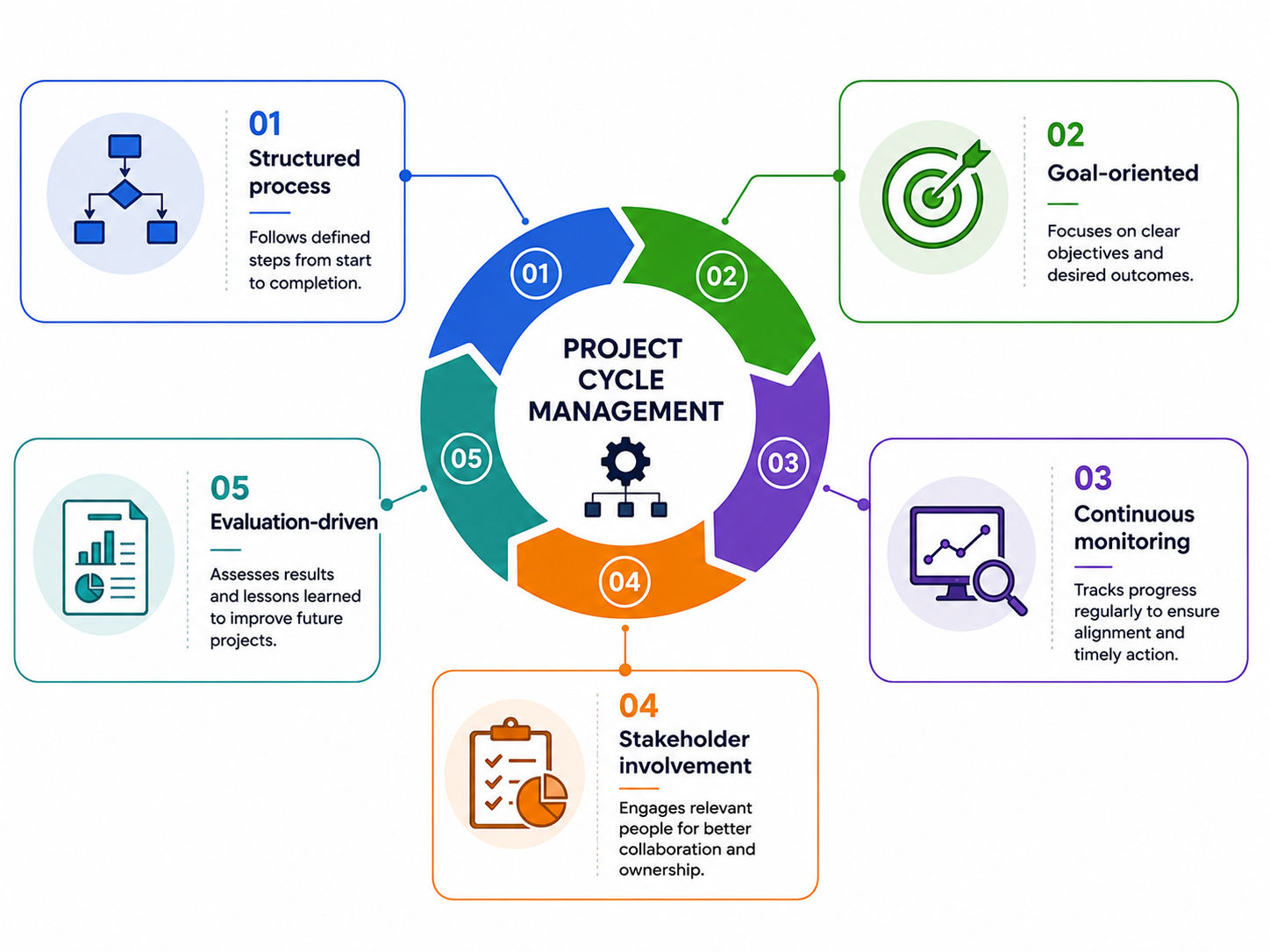
What makes project cycle management work is not just the process; it is the principles behind it. These five characteristics are really important because they help projects stay on track and consistently improve over time.
1.Structured process:
Structured process means you do not make decisions on the go; it gives every project a plan. This way teams know where they are, what they need to do next, and how to keep moving forward.
2. Goal-oriented:
Doing things without a goal is pointless. The Project and Campaign Management (PCM) method makes sure every decision is based on results. This ensures that the work done actually leads to results that people can see and evaluate.
3. Continuous monitoring:
Problems usually do not announce themselves. Checking performance helps catch small issues before they become big problems. This keeps projects on track throughout, not at the end.
4. Stakeholder involvement:
The best decisions usually come from a group of people. By involving stakeholders, throughout the project PCM builds a sense of ownership. It also helps identify issues and keeps teamwork at the center of project delivery.
5. Evaluation-driven:
Every project that is completed teaches a lesson. An evaluation-driven approach makes sure teams review what worked and what did not. They then use these insights to improve projects. So that, in this way, we always witness improvement.
Management Courses to upskill
Explore Management Courses for Career Progression
IIIT-B & IIM, Udaipur
Chief Technology Officer & AI Leadership ProgrammeIIM Kozhikode
PCP in AI for Business ProfessionalsEvery project has a start, a middle and an end. The project management life cycle is like a map that shows us this pattern. Different companies and industries do things a little differently. The basic idea is the same.
Most projects, like building roads launching things or making changes, go through five main steps. These steps tell us what to do, when to do it, and why we are doing it. The project management life cycle is about these steps. Every project follows the project management life cycle.
Understanding those phases is not just useful for project managers. It is the foundation of delivering anything with intention.
Before you start a task or set a deadline, someone has to ask if this project is really worth doing. The first part of the project is where people figure out the answer to this question.
People get together to talk about what the company needs, what it would mean to succeed, and who cares about the result. It is not so much about getting started. More, about making sure you are doing the right thing.
Key outputs:
If we start a project, we need to figure out if it should happen. Planning is where we decide how it will happen. This phase is really important. Often teams rush through it to get started.
The objective is; defined what the project will cover, set timelines, make a budget, assign resources, identify risks, and make a plan for communicating. A strong plan does not eliminate uncertainty, but it faces uncertainty far better prepared.
Focus areas:
This is the phase everyone pictures when they think about a project the moment when plans leave the page and real work begins. It is also where the majority of project resources, time, and energy are spent.
Teams work on their assigned work, coordinate across functions, manage stakeholder communication, and begin delivering outputs.
No project runs exactly as planned, and anyone who tells you otherwise has not managed many. This phase does not fix that reality. It ensures that when things drift, someone notices early enough to do something about it.
When managers are running projects, they need to keep an eye on things at the time. It helps managers see what is going on track, how things are going, and make sure they are not spending too much money. The managers can also find problems that might come up and deal with them beforehand.
This is all part of monitoring and control, which basically goes hand in hand with the project; it gives managers a lot of benefits, like managing risks that come up suddenly and solving problems before they become issues. It is the difference between steering a project and simply watching it unfold.
The closure phase is where the project is formally wrapped up, and some important work is done.
The team gets approvals, finishes the documentation, and let go of the resources. The most important thing the team does in the closure phase is that the team reflects on the project is reviewing the performance of the project and writing down the lessons learned from the project, so the knowledge the team gained from the project does not disappear when the project is over. Every closed project plant the seeds for the next one to get better.
Closure activities:
Also Read: What Is Project Planning? A Complete Guide to the Project Lifecycle and Planning Process (2025)
The project life cycle phases are key, to making sure everything goes smoothly from start to finish in a project. It helps teams keep their focus on what needs to be done throughout the whole project journey.
Strong projects begin with clear goals.
Objectives should be:
Ambiguous goals often lead to confusion later.
Every project involves stakeholders.
These may include:
Regular communication helps maintain alignment.
Resources include:
Project managers must balance these resources carefully.
Risk planning allows teams to respond faster when issues arise. No project is completely risk-free.
Common risks include:
Risk Type |
Example |
| Financial | Budget overruns |
| Technical | System failures |
| Operational | Resource shortages |
| External | Regulatory changes |
Project performance needs to be measured and tracked continuously.
Common metrics included in tracking are:
Also Read: What is the Product Life Cycle? Stages, Key Strategies and Effective Management Tips
Project cycle management has good points, but it also has some difficulties that teams need to handle.
Key Benefits:
Even well-structured projects run into trouble. These five challenges appear across industries and project types.
Understanding them is the first step to managing them:
Good project cycle management is about building habits that make every project sharper than the last. These five practices separate the teams that consistently deliver from the ones that consistently scramble.
Some tools are:
Project cycle management provides a practical framework for guiding projects from idea to completion. By understanding the project management life cycle, teams can plan more effectively, execute with greater confidence, and continuously improve their results.
As projects become increasingly complex, mastering project cycle management is no longer just a useful skill. It is becoming an essential capability for professionals across industries.
Want personalized guidance on Project Cycle Management? Speak with an expert for a free 1:1 counselling session today.
Project cycle management focuses on the stages a project moves through from start to finish. Project management is broader and includes leadership, communication, budgeting, and resource management. The cycle acts as the framework within which project management activities occur.
Modern projects involve multiple stakeholders, tight deadlines, and changing requirements. Project cycle management creates structure and helps teams stay aligned. It improves planning, monitoring, and decision-making throughout the project journey.
The five phases are initiation, planning, execution, monitoring and control, and closure. Together, these project management life cycle phases provide a systematic approach to managing projects and achieving objectives efficiently.
Risk management begins during planning and continues throughout the project. Teams identify potential issues early, assess their impact, and create response strategies. This proactive approach helps minimize disruptions and delays.
Yes. Small businesses often have limited resources, making structured project management even more important. Project cycle management helps prioritize tasks, control costs, and improve project success rates regardless of company size.
Organizations use tools like Microsoft Project, Asana, Jira, Trello, Monday.com, and ClickUp. These platforms support planning, scheduling, collaboration, reporting, and tracking throughout the project management life cycle.
Agile is a project management methodology that operates within the broader project life cycle. While Agile emphasizes iterative delivery and flexibility, projects still move through initiation, planning, execution, monitoring, and closure stages.
Common causes include unclear goals, poor communication, inadequate stakeholder involvement, unrealistic timelines, and weak risk management. A plan alone is not enough. Consistent execution and monitoring are equally important.
Absolutely. Construction, healthcare, education, manufacturing, consulting, and government sectors all use project cycle management. The framework is adaptable and works across industries and project types.
Project performance should be reviewed regularly throughout execution. Weekly or biweekly reviews are common. Frequent monitoring allows teams to identify issues early and make necessary adjustments before problems escalate.
Key skills include planning, communication, leadership, risk assessment, stakeholder management, budgeting, and problem-solving. Strong project managers combine technical knowledge with people management skills to guide projects successfully.
1283 articles published
We are an online education platform providing industry-relevant programs for professionals, designed and delivered in collaboration with world-class faculty and businesses. Merging the latest technolo...
Get Free Consultation
By submitting, I accept the T&C and
Privacy Policy
Top Resources
Certification
3 Months
Certification
6 Months
O.P. Jindal Global University
Masters in International Accounting and Finance (Accredited by ACCA, UK)Master's Degree
12 Months