Hofstede Cultural Dimensions: A Complete Guide for Beginners
By upGrad
Updated on Jun 19, 2026 | 5 min read | 3.04K+ views
Share:

All courses
Certifications
More
By upGrad
Updated on Jun 19, 2026 | 5 min read | 3.04K+ views
Share:
Table of Contents
The concept of Hofstede cultural dimensions helps explain why people from different cultures think, communicate, and make decisions differently. It provides a framework for understanding workplace behavior, leadership styles, communication patterns, and social values across countries.
Culture shapes how people think, communicate, and make decisions. Geert Hofstede's research gave us a structured way to compare these differences across countries, and the result is one of the most widely used frameworks in cross-cultural studies today.
This blog breaks down each of Hofstede's cultural dimensions, what they actually measure, and how you can apply them in real-world contexts like management, communication, and global business strategy.
Explore upGrad's Management and MBA programs to develop expertise in global leadership, cross-cultural management, organizational behavior, strategic decision-making, international business, and effective people management in diverse workplaces.
Popular upGrad Programs
Geert Hofstede was a Dutch social psychologist who worked at IBM in the 1970s. He surveyed over 100,000 IBM employees across 50 countries to understand how culture influences workplace values. That research became the foundation of Hofstede's cultural dimensions theory.
The idea is straightforward. Different societies don't just have different languages or cuisines. They carry deeply held values about hierarchy, individualism, risk, and gender roles. Hofstede's model puts numbers to those values so you can actually compare them.
The original model had four dimensions. A fifth was added later in collaboration with Michael Bond, and a sixth came from research by Michael Minkov. Each dimension is scored on a scale, typically 0 to 100, with countries sitting at various points along the spectrum.
Why does this matter? If you're working with a team from Japan, negotiating with a supplier in Brazil, or launching a product in Germany, cultural context changes everything. What reads as confident in one culture reads as rude in another.
Also read: What is Decision-making in Management: Explore Types, Tools, & Techniques
Free Courses
Key Insight |
Why It Matters |
| Hofstede identified six cultural dimensions | Helps compare national cultures |
| Culture influences communication and leadership | Important for global teams |
| The framework is widely used in business and research | Supports cross-cultural decision-making |
| No culture is better or worse | Dimensions describe tendencies, not individuals |
| Hofstede's model remains influential despite criticism | Still used in management and academia |
Recommended Courses to upskill
Explore Our Popular Courses for Career Progression
IIIT Bangalore
Executive Diploma in Machine Learning and AI360° Career Support
O.P.Jindal Global University
MBA from O.P.Jindal Global UniversityLive Case Studies and Projects
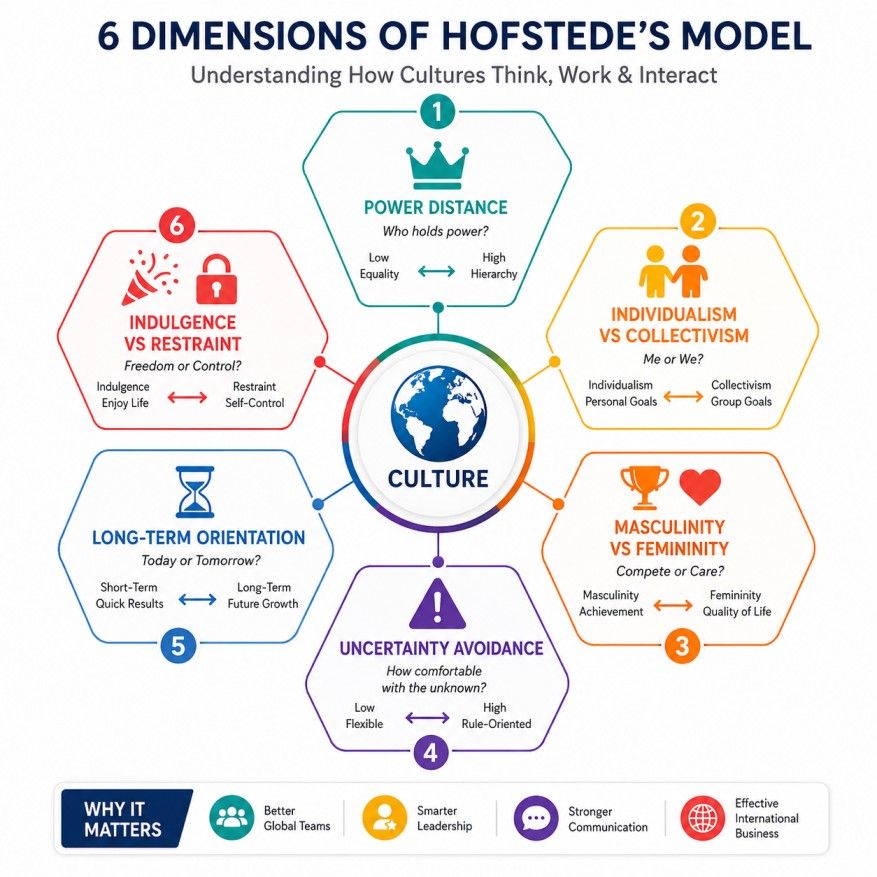
This dimension measures how much people in a society accept that power is distributed unequally.
High PDI countries (like Malaysia or the Philippines) have hierarchical structures where people don't question authority. Employees wait for direction. Decisions flow from the top.
Low PDI countries (like Denmark or Austria) expect more equality. People challenge their managers. Flat organizational structures feel natural here.
PDI Level |
What It Looks Like |
| High | Respect for hierarchy, limited upward feedback |
| Low | Open communication, employees challenge superiors |
If you're managing a team from a high PDI country, don't expect them to push back on your ideas even when they disagree. That silence isn't agreement. It's cultural conditioning.
This one's about whether people see themselves primarily as individuals or as part of a group.
The US scores very high on individualism. People are expected to take care of themselves, speak their mind, and prioritize personal goals. Collectivist societies like China, South Korea, or Colombia prioritize group harmony, family loyalty, and team reputation over individual achievement.
It isn't just a social preference. It affects how people negotiate, how they handle conflict, and whether they'll openly criticize a colleague in a meeting.
Must read: What is Conflict Management? Definition, Styles & Strategies
Despite the name, this dimension isn't really about gender. It measures whether a society values competition, achievement, and material success (masculine) or cooperation, quality of life, and care for others (feminine).
Japan scores extremely high on the masculine end. Sweden sits at the opposite side, with strong emphasis on work-life balance and social welfare.
This plays out in hiring. In masculine cultures, salary and status drive motivation. In feminine cultures, people often choose meaningful work or flexible hours over a higher paycheck.
Some cultures are comfortable with ambiguity. Others aren't.
High UAI societies (like Greece or Portugal) prefer clear rules, structured processes, and predictable outcomes. They don't like improvisation. Low UAI societies (like Singapore or Jamaica) are more open to change, ambiguity, and improvised decisions.
This dimension matters a lot in project management. If you're working with a high UAI team and you deliver vague instructions, expect frustration. They need clarity before they can move forward.
This dimension looks at how societies relate to time and planning.
Long-term oriented cultures (China, Japan, South Korea) invest in the future. They value perseverance, thrift, and delayed rewards. Short-term oriented cultures (US, UK, many African nations) focus more on immediate results, tradition, and quick wins.
You'll see this in business strategy. Long-term oriented companies are willing to sacrifice short-term profits for years to gain market position. Short-term oriented companies want returns this quarter.
Must read: What is Strategic Management? Why is it important?
This is the most recently added dimension. It measures how much a society allows people to enjoy life and have fun versus expecting them to suppress personal gratification.
Indulgent cultures (like Mexico or Australia) have high freedom of expression, leisure, and optimism. Restrained cultures (like Russia or China) are more controlled, regulated, and pessimistic about leisure.
This shows up in advertising, consumer behavior, and workplace culture.
Also read: Negotiation Skills: Definition, Process, Various Stages, Benefits [With Examples]
You don't need to be a researcher to use this framework. Here's where it actually helps.
Business Function |
Hofstede Insight |
Practical Impact |
| Management | Conflict vs harmony preferences | Better team decisions |
| Marketing | Individualist vs collectivist values | Stronger campaign resonance |
| Negotiations | Uncertainty avoidance levels | Right balance of speed and documentation |
| HR & Hiring | Power distance and masculinity differences | More effective onboarding, feedback, and rewards |
The Hofstede Insights website lets you compare countries across all six dimensions for free. That's a good place to start before any cross-cultural project.
No model covers everything. Hofstede's research is valuable, but it has real limitations you should know about.
The original data came from one company, IBM, which attracted a specific type of worker. That's not a random sample of any country's population.
Countries aren't monoliths. India has enormous regional variation. So does China. Assigning a single score to either country flattens that complexity.
Benefits |
Limitations |
| Easy cultural comparison | Based on IBM workforce data |
| Better global communication | Oversimplifies cultures |
| Supports international business | Ignores regional diversity |
| Improves cross-cultural teamwork | Cultural values change over time |
| Helps managers understand employees | Doesn't reflect every individual |
| Simple and widely used framework | Original research is decades old |
| Good starting point for analysis | Shouldn't be used as a stereotype tool |
Use Hofstede's dimensions as a starting point, not a final answer. They give you hypotheses to test, not stereotypes to confirm.
Also read: Workplace Communication: Key Types, Methods, and Its Importance
Hofstede isn't the only model out there. Here's a quick comparison.
Framework |
Key Focus |
Best Used For |
| Hofstede | Value-based cultural dimensions | Broad cross-cultural comparison |
| Trompenaars | 7 dimensions including time and relationships | Business and organizational culture |
| GLOBE Study | Leadership and cultural practices | Leadership development globally |
| Hall's Context Model | High vs. low context communication | Communication strategy |
Each framework offers something different. If you're working specifically on communication styles, Hall's model is sharper. If you need to compare national values at scale, Hofstede is still one of the best tools available.
Do read: How to Improve Communication Skills: The Ultimate Guide for Personal and Professional Growth
Hundreds of researchers have tested, challenged, and built on Hofstede's work since the 1970s. The fact that it's still being cited, taught, and used in business schools globally says something.
Cross-cultural competence is a real skill now. Companies that operate across borders need people who understand that culture isn't just background noise. It shapes decisions, relationships, and outcomes.
Hofstede's cultural dimensions give you a structured way to think about that. Not a perfect one. But a useful one.
The hofstede cultural dimensions framework remains one of the most influential models for understanding cultural differences across societies. Its six dimensions offer valuable insights into leadership, communication, teamwork, decision-making, and business practices around the world.
While the model has limitations, it provides a practical foundation for anyone working in international environments. Whether you're a manager, student, entrepreneur, or global professional, understanding hofstede cultural dimensions can help you navigate cultural differences with greater awareness and confidence.
Ready to start your journey? Book a free consultation with upGrad today to find the best path for your career.
Hofstede's cultural dimensions theory identifies broad cultural patterns at a national level. Stereotypes assume every individual behaves the same way. The framework helps explain tendencies within a society, while recognizing that personal experiences, education, age, and regional background can produce very different behaviors.
Countries such as the United States, Australia, and the United Kingdom rank among the highest for individualism. These societies often emphasize personal achievement, independence, and self-reliance. Understanding these scores helps organizations adapt leadership, communication, and employee engagement strategies when operating internationally.
Cultural values influence how people respond to advertisements, branding, and messaging. Individualistic cultures often respond better to personal benefits and self-expression, while collectivist cultures may prefer themes centered on family, community, and shared success. This insight helps brands create more relevant campaigns.
Yes. Many organizations use Hofstede cultural dimensions to improve collaboration across distributed teams. Understanding differences in communication styles, authority expectations, and decision-making preferences helps reduce misunderstandings and improves teamwork when employees are located in different countries and cultural environments.
Business schools continue teaching the framework because it offers a practical starting point for understanding cultural differences. Students learn how culture affects leadership, negotiations, teamwork, and management. Even when discussing its limitations, educators often use the model to introduce cross-cultural analysis concepts.
The scores remain useful for understanding long-term cultural patterns, but they shouldn't be treated as absolute truths. Economic growth, digital communication, migration, and generational change have influenced cultural values in many countries. Most experts recommend combining Hofstede's framework with current local insights.
Industries with international operations gain the most value. These include consulting, technology, manufacturing, education, human resources, and global marketing. Organizations working across multiple countries often use cultural analysis to improve communication, leadership effectiveness, and customer engagement strategies.
Negotiation styles vary significantly across cultures. Some cultures prefer direct discussions and quick decisions, while others prioritize relationship-building and consensus. Understanding these differences helps negotiators adjust their approach, avoid misunderstandings, and build stronger business relationships across borders.
Yes, although globalization has increased cultural interaction, national values still influence workplace behavior, leadership expectations, and consumer decisions. The framework remains useful because cultural differences haven't disappeared. They've simply become more important to understand in an interconnected business environment.
Critics argue that national cultures are too complex to be represented by a single score. Others point out that the original research relied heavily on IBM employees and may not represent entire populations. Despite these concerns, the framework remains one of the most referenced cultural models.
Several alternatives exist, including Trompenaars' Seven Dimensions, the GLOBE Study, and Hall's Context Theory. Each focuses on different aspects of culture. Hofstede remains popular for broad country comparisons, while other frameworks may provide deeper insights into leadership, communication, or organizational behavior.
1171 articles published
We are an online education platform providing industry-relevant programs for professionals, designed and delivered in collaboration with world-class faculty and businesses. Merging the latest technolo...
Get Free Consultation
By submitting, I accept the T&C and
Privacy Policy
Top Resources
Certification
3 Months
Certification
6 Months
O.P. Jindal Global University
Masters in International Accounting and Finance (Accredited by ACCA, UK)Master's Degree
12 Months