Operational Risk Management: A Complete Guide for Beginners
By upGrad
Updated on Jun 05, 2026 | 7 min read | 2.41K+ views
Share:

All courses
Certifications
More
By upGrad
Updated on Jun 05, 2026 | 7 min read | 2.41K+ views
Share:
Table of Contents
Operational risk management is something that companies do to identify, assess, monitor, and control risks that arise from an organization's day-to-day operations. The problems can come from the people who work at the company, process, systems, technology failures, external events, or human error.
Every kind of business faces operational risks whether it is a startup, a multinational company, a bank, or a healthcare provider.
In this guide, you will learn everything that you need to know about risk management in a way that is easy to understand, what operational risk management is, how companies use it, examples of how it works in real life and how new software is helping companies watch for risk.
Explore Management Courses from upGrad and learn what operational risk management is, its key frameworks, core principles, and the practical tools that help professionals identify, assess, and mitigate risks before they impact the business.
Popular Management Programs
To understand how to manage risk, you need to know what operational risk is. Operational risk is when the company loses money because something inside the company does not work right, it could be human error, technology breakdowns, fraud, cyberattacks, or external disruptions
Operational risk management is more than just preventing issues; it is about setting up systems and processes which help organizations predict risks before they turn into problems. It helps companies avoid incidents by being proactive and identifying risks. This way organizations can take steps to prevent or minimize them.
It involves a lot of planning and analysis, requires an understanding of the organization's operations, by anticipating risks, companies can also save time, money, and reduce the impact of incidents.
For example, operational risk management helps organizations prepare for these situations, such as:
Businesses today work in a world where everything is connected. A small problem with operations can quickly turn into a big financial or reputation issue.
According to the European Banking Authority, banks reported around 3.1 million risk events in 2024. Even though total losses went down, the number of incidents kept going up. This shows how important it is for businesses to manage risks before they happen.
Also Read: Top 21+ Risk Management Projects: The 2026 Master List
Common Sources of Operational Risk explain in table
Risk Source |
Example |
| Human error | Data entry mistakes |
| Technology failure | System outages |
| Cybersecurity threats | Data breaches |
| Process failures | Incorrect approvals |
| External events | Natural disasters |
| Third-party risks | Vendor disruptions |
Free Courses
When people ask, "What is a risk management framework?" They are referring to the simple steps that organizations follow to deal with risks. Organizations implement this risk management framework to handle risks in a smart way.
The operational risk management framework is like a plan that helps organizations stay safe from problems.
Most frameworks include:
Also Read: Risk Management Framework (RMF): A Complete Guide to Managing Organizational Risk
Imagine an online retailer during a major sales event. If its payment system crashes, customers cannot complete purchases. Revenue is lost immediately. The company may also suffer reputational damage.
A good risk management plan would spot this risk early, set up backup systems. This way a company can prepare for issues and have plans in place to keep things running smoothly. Thus, a strong operational risk management program is key to achieving this.
Having this proactive mindset is really what makes some companies strong and able to handle problems. This is what separates companies that're resilient, from those that just react to things.
Management Courses to upskill
Explore Management Courses for Career Progression
IIIT-B & IIM, Udaipur
Chief Technology Officer & AI Leadership ProgrammeIIM Kozhikode
PCP in AI for Business Professionals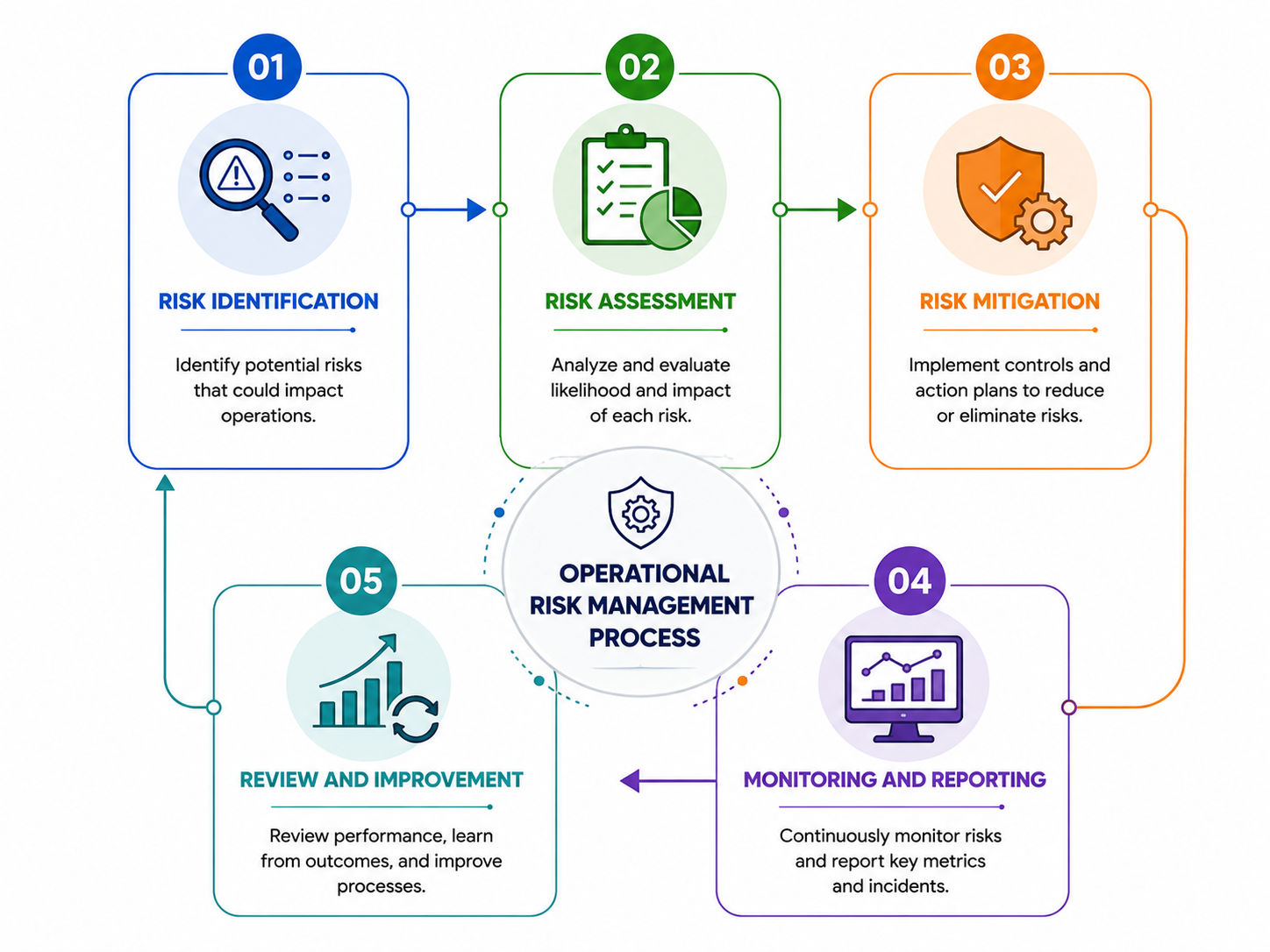
A successful operational risk management program has a plan. Even though different businesses might use words to describe it, the main steps are pretty much the same, for operational risk management. Operational risk management is something that needs to be done in an order.
Identifying potential risks is the first step, and the goal is to have a complete inventory of operational risks that will help us understand what operational risks they are there and how can affect our company.
Organizations look at:
Some risks are more important than others.
Organizations assess:
This is useful because it helps us decide how to use our resources.
| Likelihood | Impact | Priority |
| High | High | Critical |
| High | Medium | High |
| Medium | Medium | Moderate |
| Low | Low | Low |
When organizations figure out which risks are important, they come up with ways to control these risks. They do this by developing controls for the risks that really matter. Organizations develop controls for these risks so they can deal with them.
Examples include:
Risk management is not something you do once.
Industry experts increasingly recommend continuous monitoring because operational environments change rapidly due to technology adoption, vendor dependencies, and evolving threats.
Organizations continuously monitor:
Risk programs should evolve over time.
Organizations regularly:
Also Read: Top 10 Risk Management Strategies You Need to Follow for Success!
Organizations invest heavily in operational risk management because the benefits extend beyond compliance.
Organizations become more resilient during disruptions.
Examples include:
Operational failures can be expensive.
Recent industry research suggests that unplanned downtime costs large organizations billions annually, with downtime expenses continuing to rise across industries.
Risk insights help leaders make more informed decisions.
Instead of reacting to problems, they can anticipate them.
Many industries face strict regulatory requirements.
Operational risk programs help organizations:
Customers expect reliability.
When organizations manage risks effectively, they are more likely to maintain customer confidence during challenging situations.
Also Read: What Is Operations Management? Why It’s So Important for Companies
Despite its benefits, implementing operational risk management is not always easy.
| Challenge | Impact |
| Poor data quality | Weak risk insights |
| Limited resources | Delayed implementation |
| Siloed departments | Poor coordination |
| Legacy systems | Technology constraints |
| Evolving threats | Constant adaptation required |
Modern organizations face new challenges. A recent survey by PwC found that many risk leaders struggle to secure funding for advanced monitoring and risk assessment capabilities despite recognizing their importance.
These include:
Technology is reshaping how organizations manage risk. Manual spreadsheets and periodic reviews are gradually being replaced by integrated platforms and real-time monitoring systems.
Operational risk management software helps organizations automate and centralize risk-related activities.
These platforms support:
Organizations use operational risk management software because it helps them:
Organizations are increasingly viewing operational risk management as a strategic capability rather than simply a compliance requirement. The shift is important because today's risks are more interconnected than ever before.
Several trends are shaping the future of operational risk management such as:
Operational risk management helps organizations identify potential threats, reduce disruptions, and build long-term resilience. From human error and technology failures to cyberattacks and vendor risks, operational challenges can affect every aspect of a business.
A structured approach to risk identification, assessment, monitoring, and mitigation enables organizations to respond proactively rather than reactively. Organizations that combine strong governance, effective processes, and modern operational risk management software will be better prepared to navigate uncertainty and maintain operational stability.
Want personalized guidance on Operational Risk Management? Speak with an expert for a free 1:1 counselling session today.
An operational risk management program is a structured system used to identify, assess, monitor, and control operational risks across an organization. It combines policies, processes, controls, and reporting mechanisms to reduce disruptions and support business objectives.
The operational risk management meaning refers to managing risks that arise from everyday business activities. These risks may come from employees, systems, processes, technology failures, or external events that affect business operations.
Financial risk is linked to market movements, investments, or funding challenges. Operational risk comes from failures in internal operations, technology systems, processes, or people. Both can impact business performance, but their causes are different.
Banking, healthcare, insurance, manufacturing, telecommunications, retail, and government organizations all use operational risk management. Any industry that depends on people, technology, and processes can benefit from a structured risk framework.
Examples include system outages, cybersecurity incidents, employee mistakes, fraud, supply chain disruptions, compliance failures, and vendor issues. These risks can lead to financial losses, service interruptions, and reputational damage.
Most organizations perform formal assessments annually or quarterly. However, many companies now supplement these reviews with continuous monitoring to address emerging risks more quickly and maintain a current risk profile.
Operational risk management software helps organizations automate risk tracking, incident management, reporting, compliance monitoring, and control testing. It provides centralized visibility into risk activities and supports faster decision-making.
Yes. Small businesses often have fewer resources to absorb unexpected disruptions. A simple operational risk management process can help identify vulnerabilities early and improve overall business resilience without significant investment.
Cybersecurity is a major component of operational risk management. Risk frameworks help organizations identify cyber threats, implement controls, monitor vulnerabilities, and prepare response plans for potential security incidents.
Professionals often need analytical thinking, problem-solving abilities, regulatory knowledge, communication skills, risk assessment expertise, and familiarity with operational risk management software and governance frameworks.
Current trends include AI-powered monitoring, predictive analytics, operational resilience programs, continuous risk assessment, third-party risk management, and stronger integration between cybersecurity and operational risk functions.
1283 articles published
We are an online education platform providing industry-relevant programs for professionals, designed and delivered in collaboration with world-class faculty and businesses. Merging the latest technolo...
Get Free Consultation
By submitting, I accept the T&C and
Privacy Policy
Top Resources
Certification
3 Months
Certification
6 Months
O.P. Jindal Global University
Masters in International Accounting and Finance (Accredited by ACCA, UK)Master's Degree
12 Months