Risk Management Framework (RMF): A Complete Guide to Managing Organizational Risk
By upGrad
Updated on Sep 16, 2026 | 7 min read | 2.46K+ views
Share:

All courses
Certifications
More
By upGrad
Updated on Sep 16, 2026 | 7 min read | 2.46K+ views
Share:
Table of Contents
A Risk Management Framework (RMF) is a structured process organization for use to identify, assess, mitigate, and monitor risks across digital, operational, and strategic environments. By integrating security and privacy controls into the system development life cycle, it ensures that risk management becomes a continuous, organization-wide discipline rather than a one-time exercise.
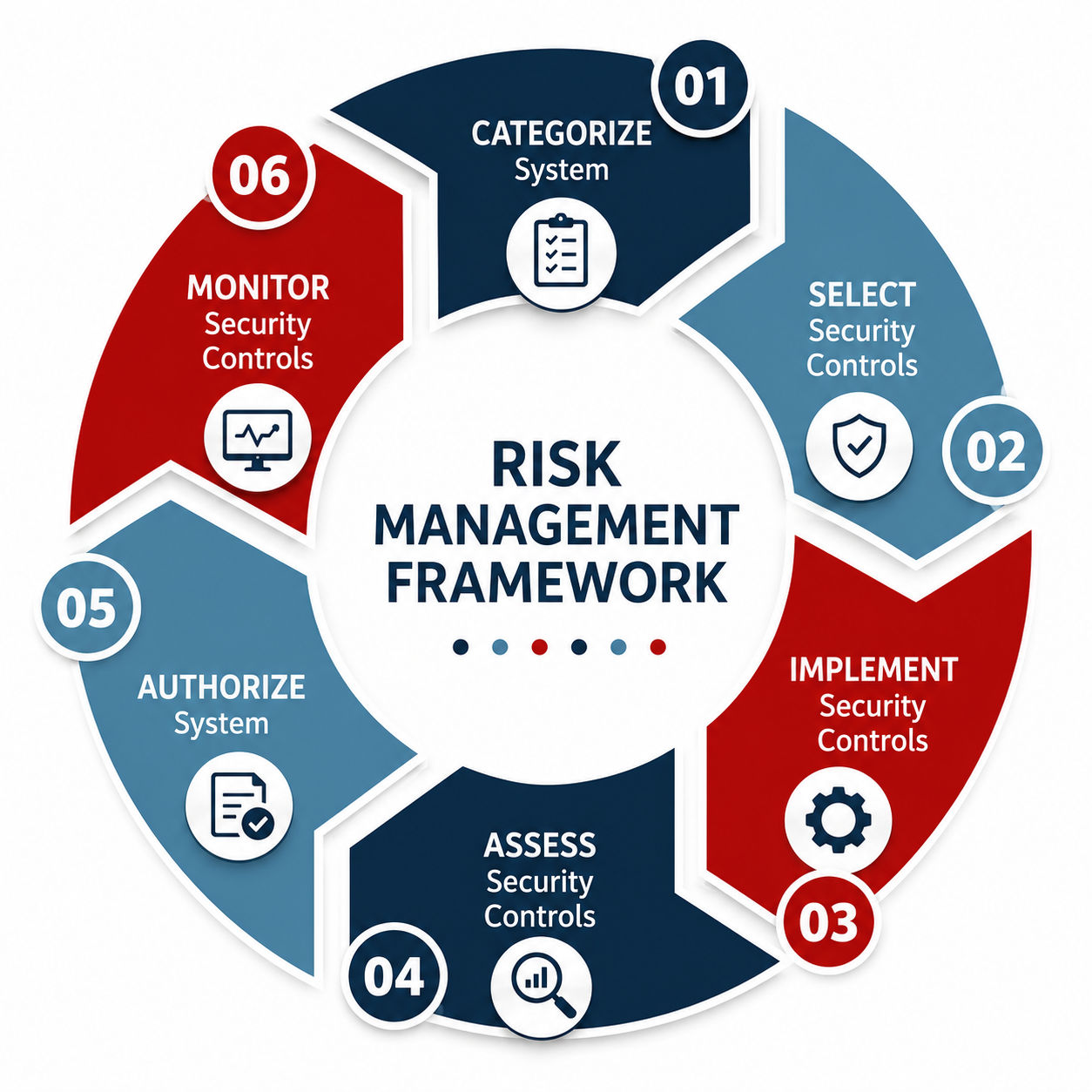
Popularized by NIST, the RMF follows a repeatable 7-step process that helps businesses maintain compliance, protect critical assets, and make informed, data-driven decisions; making it an essential tool for modern risk governance.
In this guide, you will learn what a risk management framework is, why it matters, how it works, and how organizations implement it successfully. You will also understand the key components, common challenges, practical examples, and best practices. Whether you are a student, business professional, or beginner in cybersecurity or governance, this blog will give you a complete understanding of the topic in simple language.
Explore Management Courses to understand risk management frameworks and build the leadership skills needed to implement and oversee effective risk management frameworks successfully.
Popular Management Programs
Every organization faces different types of risks. Without a proper framework, organizations often react to problems too late. A risk management framework creates a proactive process that improves preparedness
Also Read: Top 10 Risk Management Strategies You Need to Follow for Success!
A risk management framework ensures:
Free Courses
Management Courses to upskill
Explore Management Courses for Career Progression
IIIT-B & IIM, Udaipur
Chief Technology Officer & AI Leadership ProgrammeMany organizations adopt established standards to provide structured guidance for managing risk effectively. Below are some of the most widely used frameworks:
Also Read: Cybersecurity Frameworks: Types, Benefits, and Best Practices
What is a Cyber Security Framework: Types, Implementation Strategies, and More
Implementing a risk management framework requires careful planning, clear communication, and continuous improvement. Organizations must align the framework with business goals, security needs, and compliance requirements. A successful implementation helps businesses reduce risks, improve decision-making, and strengthen operational stability.
The first step is to clearly define what the organization wants to achieve through the risk management framework. These objectives guide the overall strategy and help teams prioritize the most critical risks.
Organizations usually focus on the following areas:
Businesses identify their key operational and strategic goals. This may include:
Organizations define the security outcomes they want to achieve. Common security goals include:
Every industry has legal and regulatory obligations. Organizations often focus on:
Clear objectives help organizations build a focused and effective risk management strategy. Businesses identify operational challenges that may disrupt daily activities. Examples include:
After identifying risks and critical systems, organizations implement controls to reduce vulnerabilities and improve protection.
This stage transforms the framework into a structured, comprehensive process that organizations use to identify, assess, mitigate, and monitor risks, often integrating security and privacy controls into the system development life cycle.
Common security controls include:
Firewalls monitor and control incoming and outgoing network traffic. They help organizations:
Access controls ensure that only authorized users can access specific systems or data. Organizations often use:
Endpoint protection secures devices such as laptops, desktops, and mobile phones. It helps reduce risks related to:
Employees play a major role in organizational security. Strong security controls reduce the likelihood of cyber incidents and operational disruptions. Training programs help staff:
Risk management is an ongoing process. Organizations must continuously monitor systems, threats, and compliance requirements to stay protected against evolving risks.
Continuous monitoring focuses on the following areas:
Organizations track new and emerging cyber threats. This helps teams:
Regular vulnerability assessments help identify security weaknesses before attackers exploit them. Monitoring may include:
Organizations monitor user activity to detect suspicious actions. Examples include:
Regulations and industry standards change frequently. A regular monitoring strengthens the overall effectiveness of the risk management framework and helps organizations respond quickly to new challenges. Continuous monitoring helps organizations:
Also Read: Top 21+ Risk Management Projects: The 2026 Master List
Today, many businesses see risk management as more than just a compliance requirement. Instead, they treat it as a strategic function that supports long-term stability and growth.
A mature risk management framework provides a structured and comprehensive method for identifying, evaluating, mitigating, and monitoring risks. It often incorporates security and privacy controls throughout the system development life cycle, helping organizations adapt to evolving business and operational conditions.
Successful organizations typically prioritize:
Also read: What Is Enterprise Risk Management? A Complete Guide
Many industries depend on formal risk management practices to maintain security and operational resilience. By implementing strong risk management frameworks, organizations can reduce uncertainty, strengthen resilience, and improve overall operational stability.
Industry |
Common Risks |
| Healthcare | Data privacy and patient information breaches |
| Banking | Financial fraud and regulatory risks |
| Retail | Payment and transaction security threats |
| Manufacturing | Supply chain interruptions and operational delays |
| Technology | Cybersecurity attacks and data compromise |
A risk management framework helps organizations identify threats, reduce vulnerabilities, improve compliance, and strengthen business continuity. It creates a systematic approach for managing uncertainty across operations, technology, and security.
As businesses become more dependent on digital systems and cloud technologies, risk management continues to grow in importance. Organizations that adopt a proactive approach can reduce financial losses, improve customer trust, and respond faster to emerging threats.
Most importantly, a risk management framework is not only about preventing problems. It is about helping organizations make smarter decisions, adapt to change, and build long-term resilience in an increasingly complex business environment.
The purpose of a risk management framework is to help organizations identify, assess, mitigate, and monitor risks systematically. It improves decision-making, strengthens security, and reduces operational disruptions. Businesses use it to maintain stability and meet compliance requirements while managing uncertainty effectively.
A risk management framework improves cybersecurity by identifying vulnerabilities and implementing security controls before attacks occur. It supports continuous monitoring, incident response planning, and employee awareness. This structured process reduces the chances of data breaches and operational downtime.
The main steps include risk identification, assessment, mitigation, monitoring, and reporting. Organizations first identify threats, then evaluate their impact and likelihood. After implementing controls, they continuously monitor risks to ensure ongoing protection and compliance.
Continuous monitoring helps organizations detect new threats and system vulnerabilities in real time. Risks constantly evolve because of changing technology and cyber threats. Regular monitoring ensures businesses can quickly respond to incidents and improve security controls when needed.
Industries such as healthcare, banking, technology, manufacturing, and retail heavily use risk management frameworks. These sectors manage sensitive data, financial transactions, and critical operations. Strong frameworks help reduce compliance risks, operational disruptions, and cybersecurity threats.
Risk assessment focuses on analyzing the likelihood and impact of risks. Risk mitigation involves applying controls and strategies to reduce risks. Assessment helps organizations prioritize threats, while mitigation helps lower the potential damage or probability of occurrence.
The NIST Risk Management Framework provides standardized guidelines for managing cybersecurity risks. It helps organizations integrate security and privacy controls into systems and operations. Many government agencies and enterprises use NIST to strengthen compliance and cybersecurity resilience.
Yes, small businesses can benefit greatly from a risk management framework. Even basic processes for identifying and reducing risks improve operational stability. Small businesses often use simplified frameworks to manage cybersecurity, financial risks, and compliance obligations effectively.
Organizations commonly face budget limitations, lack of skilled professionals, and resistance to change during implementation. Complex regulations and evolving cyber threats also create challenges. Continuous training and executive support help businesses overcome these issues successfully.
Organizations should review and update their framework regularly, especially after major business or technology changes. Many companies perform quarterly or annual reviews. Frequent updates help businesses address emerging threats, regulatory changes, and operational risks more effectively.
Modern businesses understand that risk management supports long-term growth and resilience. A proactive framework reduces uncertainty, protects assets, and improves customer trust. It also helps organizations make informed business decisions in rapidly changing market conditions.
Online risk management courses teach skills like risk assessment, compliance, cybersecurity, project risk analysis, and business continuity planning. Platforms like upGrad offer management and certification programs with practical case studies, industry projects, and real-world frameworks aligned with modern organizational risk management needs.
1008 articles published
We are an online education platform providing industry-relevant programs for professionals, designed and delivered in collaboration with world-class faculty and businesses. Merging the latest technolo...
Get Free Consultation
By submitting, I accept the T&C and
Privacy Policy
Top Resources
Certification
3 Months
Certification
6 Months
O.P. Jindal Global University
Masters in International Accounting and Finance (Accredited by ACCA, UK)Master's Degree
12 Months