Knowledge Management: The Complete Guide to Building a Smarter Organization
By upGrad
Updated on May 07, 2026 | 447 views
Share:

All courses
Certifications
More
By upGrad
Updated on May 07, 2026 | 447 views
Share:
Table of Contents
Knowledge management is the structured practice of capturing, organizing, and distributing organizational knowledge, so the right information reaches the right people at the right time. It bridges the gap between raw information and actionable insight.
A strong knowledge management strategy typically involves three core components: a knowledge management system (the technology layer), a knowledge base (the content repository), and governance processes that keep knowledge correct and accessible over time.
Whether you are defining knowledge management for the first time, evaluating knowledge management tools, or building a company-wide strategy from scratch, this guide covers everything in one place.
Looking to build a stronger knowledge management strategy for your organization? Explore upGrad's management programs to develop practical skills and create a culture where information flows freely and drives better business decisions.
Popular Management Programs
Knowledge management means coming down to one idea: making sure the right people have access to the right information at the right time. To fully understand what knowledge management is, it helps to distinguish between three layers:
Most KM definitions skip this, but understanding these two types is critical to building an effective system:
Also read: Wealth Management Salary in India (2026): Complete Guide
Free Courses
The explosive growth reflects how organizations are waking up to the strategic value of managing knowledge effectively. Here is what poor knowledge management costs:
Also read: Top Productivity Hacks to Boost Efficiency and Success
Management Courses to upskill
Explore Management Courses for Career Progression
IIIT-B & IIM, Udaipur
Chief Technology Officer & AI Leadership ProgrammeA robust KM strategy does not rest on technology alone. It stands on four pillars, and knowledge management pillars also include people and culture, which are often underestimated.
1. People
People are the starting point of all knowledge. They create it, hold it, share it, and apply it. A KM strategy that ignores human behavior will fail regardless of how sophisticated the technology is.
Key actions under this pillar:
2. Culture
Culture is the environment in which people either share knowledge freely or protect it. Many organizations implement knowledge management tools and then wonder why no one uses them. The answer is almost always cultural.
A knowledge-sharing culture is built when:
3. Processes
Processes define how knowledge flows through an organization. Without standardized processes, knowledge creation and sharing happen randomly, or not at all.
Critical KM processes include:
4. Technology
Technology is the enabler, and it makes the other three pillars scalable. A knowledge management system (KMS) is the digital infrastructure that stores, organizes, and surfaces knowledge across an organization.
Modern KMS platforms typically include:
Also read: Top 20 Career Options in India: Best Career Options To Choose in 2026
A knowledge management system is a technology platform that supports the full KM lifecycle, from creation to application. It is not simply a document storage folder or an intranet. A true KMS makes knowledge discoverable, contextual, and actionable.
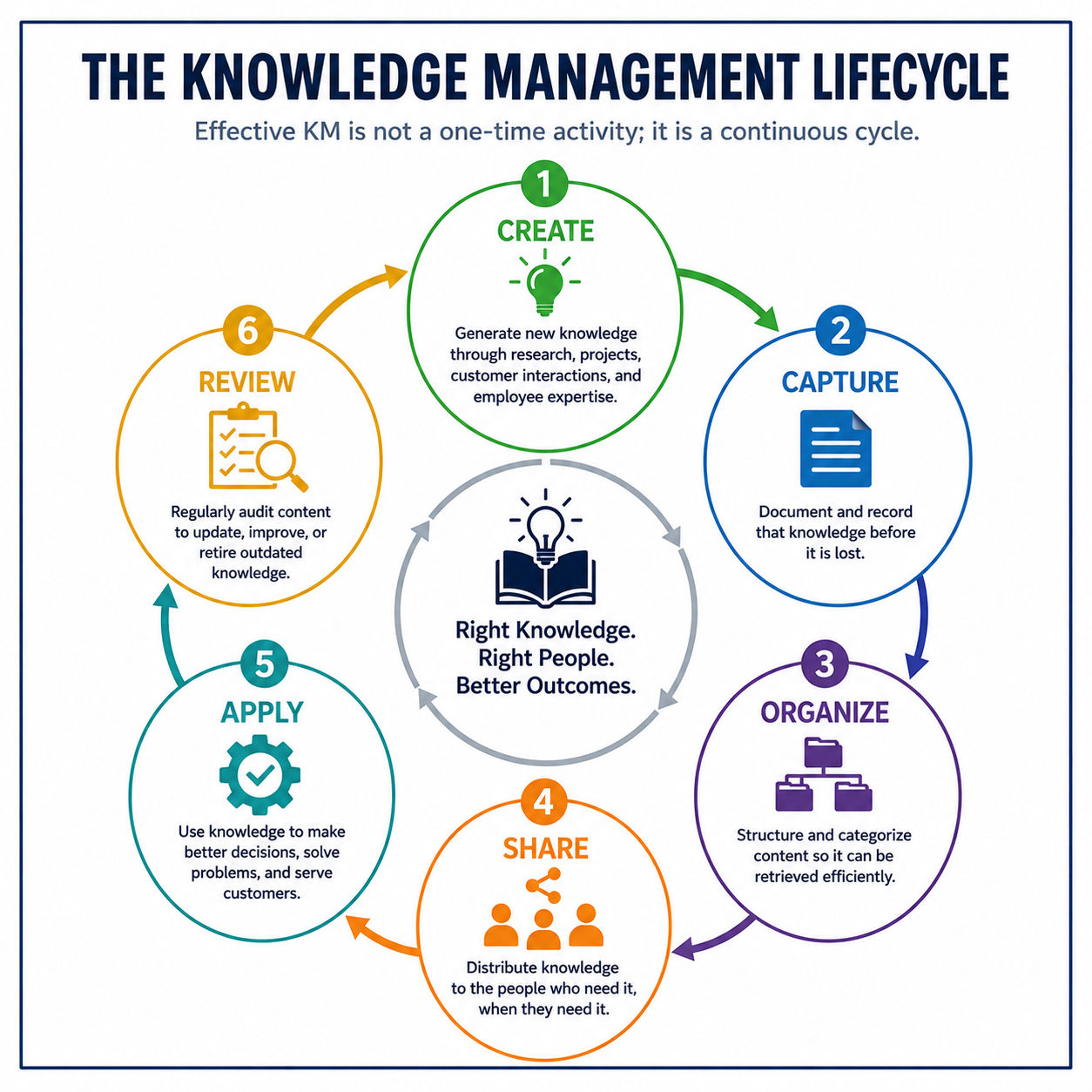
This is another area most top-ranking articles gloss over. Effective KM is not a one-time activity; it is a continuous cycle:
Artificial intelligence is rapidly transforming what a KMS can do. AI-powered systems can now:
However, AI is only as good as the knowledge it is fed. Poorly structured, outdated, or incomplete knowledge bases produce inaccurate AI responses, making strong KM foundations more important, not less, in an AI-enabled workplace.
Also read: How to Improve Career Skills for Success & Employability 2026
Most articles on this topic focus entirely on best practices. But understanding where organizations go wrong is equally valuable:
Also read: SWOT Analysis: Meaning, Examples & Guide
Knowledge management is not a back-office function or an IT initiative; it is one of the highest-leverage investments an organization can make. When knowledge flows freely, decisions improve, onboarding accelerates, customers receive consistent experiences, and innovation compounds over time.
The organizations that will lead in the coming decade are not those with the most data. They are those that turn their collective knowledge into a strategic, living asset. One that grows smarter over time is accessible to everyone who needs it and does not disappear when people leave.
Want personalized guidance on courses and upskilling opportunities? Connect with upGrad’s experts for a free 1:1 counselling session today!
The 5 C's are Capture, Curate, Connect, Communicate, and Culture. Together they form a cycle that ensures knowledge is collected, refined, linked to the right people, shared effectively, and supported by an environment that encourages open collaboration.
The 5 P's are People, Process, Platform, Purpose, and Performance. They represent the key dimensions an organization must align to build a knowledge management strategy that is practical, sustainable, and measurable in terms of business outcomes.
Information management deals with organizing and storing data and documents. Knowledge management goes further by focusing on how people understand, apply, and share that information to make decisions and solve real business problems effectively.
The SECI model by Nonaka and Takeuchi describes four knowledge conversion modes: Socialization, Externalization, Combination, and Internalization. It explains how tacit and explicit knowledge interact and transform within an organization to drive continuous learning and innovation.
A knowledge audit is a systematic assessment of what knowledge exists in an organization, where it is stored, who holds it, and where critical gaps exist. It is the essential first step before designing or improving any knowledge management system.
Knowledge management is a shared responsibility. However, a dedicated knowledge manager or Chief Knowledge Officer typically leads the strategy, while department heads, team leads, and designated knowledge champions ensure consistent implementation across the organization.
A knowledge base is a repository of documented information, essentially a searchable library. A knowledge management system is broader and includes the tools, processes, and workflows that govern how knowledge is created, maintained, shared, and continuously improved.
Communities of practice are groups of people who share a common domain of expertise and meet regularly to share knowledge, solve problems, and develop best practices. They are one of the most effective mechanisms for transferring tacit knowledge across an organization.
Knowledge hoarding occurs when employees withhold expertise to protect job security or competitive advantage. Organizations can prevent it by building psychological safety, recognizing knowledge sharing behavior, and embedding collaboration into performance evaluation frameworks.
A strong knowledge management system gives new hires immediate access to documented processes, FAQs, training resources, and institutional context. This reduces dependence on colleagues for basic orientation and significantly shortens the time it takes to reach full productivity.
Leadership sets the tone for knowledge sharing culture. When leaders actively contribute to knowledge systems, recognize contributors, and prioritize KM initiatives with budget and time, employee adoption increases significantly across all levels of the organization.
Key metrics include search success rate, average time to find information, reduction in repeated support queries, employee satisfaction with knowledge access, and onboarding time reduction. Volume of articles alone is not a reliable indicator of KM effectiveness.
973 articles published
We are an online education platform providing industry-relevant programs for professionals, designed and delivered in collaboration with world-class faculty and businesses. Merging the latest technolo...
Get Free Consultation
By submitting, I accept the T&C and
Privacy Policy
Top Resources
Certification
3 Months
Certification
6 Months
O.P. Jindal Global University
Masters in International Accounting and Finance (Accredited by ACCA, UK)Master's Degree
12 Months