SWOT Analysis: Meaning, Examples, and Complete Guide (2026)
By Faheem Ahmad
Updated on May 05, 2026 | 8 min read | 2.6K+ views
Share:

All courses
Certifications
More
By Faheem Ahmad
Updated on May 05, 2026 | 8 min read | 2.6K+ views
Share:
Table of Contents
A SWOT analysis is essentially a strategic "reality check" that breaks a business or project down into four quadrants:
In this guide, you’ll learn the SWOT analysis meaning, full form, examples, and step-by-step usage, all explained in simple, practical language.
Looking to apply workplace efficiency concepts like SWOT analysis in real business settings? Explore upGrad’s management programs to build practical leadership, operations, and process improvement skills.
Popular Management Programs
SWOT Analysis is a strategic planning framework used to identify Strengths, Weaknesses, Opportunities, and Threats related to a business, project, or individual.
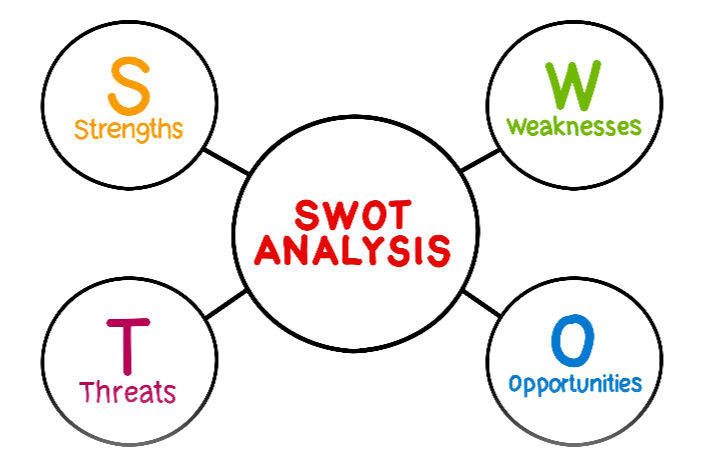
The SWOT analysis full form is:
It helps analyze both internal factors (strengths & weaknesses) and external factors (opportunities & threats) to improve decision-making and strategy.
In simple terms, if you’re wondering what is SWOT analysis, it’s a structured way to understand where you stand and what actions to take next.
A well-executed SWOT Analysis helps you:
Also Read: 16 Top Time Management Techniques And Tools: Features And Benefits
Free Courses
Before you start using a SWOT framework, it’s important to understand what each part actually means. The four components work together to give you a clear picture of your current situation, what’s working, what’s not, and what you should focus on next.
Strengths are the internal advantages that help you succeed. These are things you already do well and can use to your benefit. These factors give you a competitive edge in the market. If you know your strengths clearly, you can use them to grab more opportunities and stand out from others.
Examples:
Weaknesses are internal limitations that can slow you down or hold you back. These are areas where improvement is needed. Identifying weaknesses is important because it helps you fix problems early. Once you know what’s not working, you can take steps to improve and avoid bigger issues later.
Examples:
Opportunities are external conditions that you can take advantage of to grow. These are usually outside your control, but you can still use them smartly. These factors create chances for growth and innovation. If you stay aware of opportunities, you can act at the right time and move ahead faster.
Examples:
Threats are external risks that could cause problems or affect your progress. These also come from outside, so you need to be prepared. Recognizing threats early helps you plan better. You might not control them, but you can reduce their impact if you’re ready for them.
Examples:
Also Read: Top 10 Management Skills Required to Become a Successful Manager
Management Courses to upskill
Explore Management Courses for Career Progression
IIIT-B & IIM, Udaipur
Chief Technology Officer & AI Leadership ProgrammeTo really understand how this works, it helps to look at a simple real-life example. Let’s take a small coffee shop and break it down using SWOT. This makes it easier to see how each part connects and helps in decision-making.
Example: SWOT for a Small Coffee Shop
Strengths |
Weaknesses |
| High-quality coffee | Limited budget |
| Prime location | Small team |
Opportunities |
Threats |
| Growing cafe culture | Strong competitors |
| Online delivery expansion | Rising costs |
This SWOT analysis example shows how a business can think clearly about its situation. For example, the shop can use its high-quality coffee and good location to attract more customers, especially as cafe culture is growing. At the same time, it needs to be careful about competition and rising costs.
Students can use SWOT analysis examples for students to evaluate academic or career goals.
Example: Student SWOT Analysis
Strengths
Weaknesses
Opportunities
Threats
Also Read: Marketing Management Explained with Examples
Doing a SWOT is not complicated, but you need to be a bit thoughtful while filling each part. The idea is to get a clear picture, not just write random points. Let’s go step by step in a simple way.
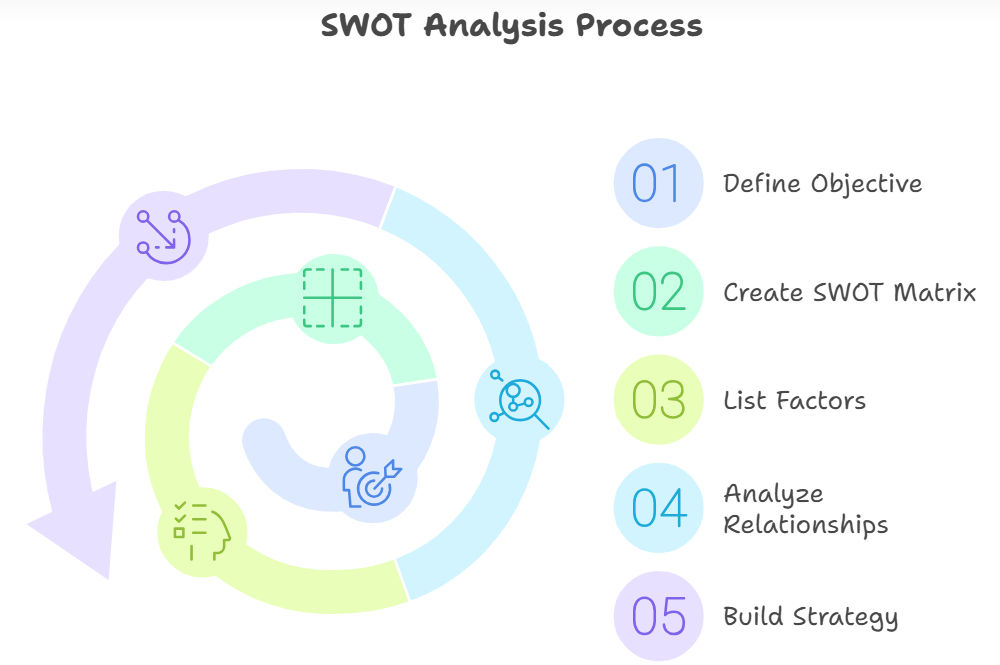
First, be clear about what you are analyzing. It could be a business, a new product, your career, or even a college decision.
For example, instead of saying “I want to grow,” be specific like:
Now draw a simple box and divide it into four parts. Each part will represent:
Start filling each section honestly.
This is where things get interesting. Don’t just list points, connect them.
Ask questions like:
For example:
If your strength is “good online presence” and an opportunity is “growing online demand,” you can focus more on digital marketing.
Now turn your insights into action. This is the main goal of the whole exercise.
Let’s say you are running a small coffee shop.
What you can do:
You can use your strong coffee quality to attract online customers through delivery apps. At the same time, you keep costs low because of your limited budget and try to build a loyal customer base to compete with bigger brands.
Also check out: 20+ Essential Finance Skills You Need to Succeed in 2026
SWOT is popular for a reason, it’s simple, practical, and works in many situations. You don’t need any special tools or training to get started, which makes it useful for beginners as well as professionals.
Do Read: Best Business Management Courses in India [2026]
Even though SWOT is useful, it’s not perfect. You should know its limits so you don’t rely on it too much.
Also Read: What Is a Business Management Degree and How Can It Benefit Your Career in 2026?
SWOT analysis is useful in many situations, especially when you need clarity before making a decision. It helps you slow down a bit and look at things from all angles instead of jumping in blindly.
You should use SWOT Analysis when:
Situation |
Use of SWOT Analysis |
| Launching a new business | Identify strengths & risks |
| Planning a strategy | Improve direction & focus |
| Evaluating competition | Find gaps & position better |
| Making career decisions | Assess skills & opportunities |
| Starting a project | Prepare for challenges |
A SWOT analysis works best when it’s done thoughtfully. Just filling the boxes is not enough, you need to make it useful.
Also Read: Techniques of Decision-Making: 15+ Tools & Methods for Success in 2026
SWOT Analysis remains one of the most powerful and widely used strategic tools in 2026. By understanding its structure and applying it correctly, you can make smarter decisions, reduce risks, and unlock growth opportunities.
Whether you're a student, business owner, or professional, mastering what is SWOT analysis gives you a strong competitive advantage.
Ready to start your journey? Book a free consultation with upGrad today to find the best path for your career.
A SWOT analysis is a simple method used to understand a situation by looking at strengths, weaknesses, opportunities, and threats. It helps you clearly see what’s working, what needs improvement, and what actions you should take next.
The 4 parts of SWOT analysis are strengths, weaknesses, opportunities, and threats. Strengths and weaknesses are internal factors, while opportunities and threats come from outside. Together, they give a complete view of your current situation.
Start by defining your goal clearly. Then divide your page into four sections and list strengths, weaknesses, opportunities, and threats. Keep points specific and honest, and use them to guide your next steps or decisions.
No, SWOT analysis is not limited to businesses. Students, professionals, and even individuals can use it for personal growth, career planning, or decision-making. It works anywhere you need clarity and better understanding of a situation.
A basic SWOT analysis can take around 30 minutes, but a detailed one may take a few hours. It depends on how deep you go and whether you include research or input from others.
Yes, SWOT analysis works well for small decisions too. It helps you quickly organize your thoughts and look at both positives and risks, making even simple choices more clear and practical.
The main goal of SWOT analysis is to improve decision-making. It helps you understand your current position, identify key factors, and choose actions that make the most of your strengths while reducing risks.
SWOT analysis can be done alone or in a team. However, doing it with others often gives better results, as different perspectives can highlight points you might miss on your own.
You should update your SWOT analysis whenever your situation changes, such as a new goal, project, or market condition. Regular updates help keep your insights relevant and useful for better decisions.
Avoid being too vague or overly positive. Don’t ignore weaknesses or threats. Also, don’t treat SWOT as a one-time task, review it regularly to make sure your analysis stays accurate and useful.
Yes, SWOT analysis is helpful for long-term planning. It allows you to prepare for future opportunities and challenges while staying realistic about your strengths and limitations, making your plans more practical and achievable.
79 articles published
Faheem Ahmad is an Associate Content Writer with a specialized background in MBA (Marketing & Operations). With a professional journey spanning around a year, Faheem has quickly carved a niche in the ...
Get Free Consultation
By submitting, I accept the T&C and
Privacy Policy
Top Resources
Certification
3 Months
Certification
6 Months
O.P. Jindal Global University
Masters in International Accounting and Finance (Accredited by ACCA, UK)Master's Degree
12 Months