Change Management Framework: A Complete Guide to Leading Successful Organizational Transitions
By upGrad
Updated on May 12, 2026 | 9 min read | 2.45K+ views
Share:

All courses
Certifications
More
By upGrad
Updated on May 12, 2026 | 9 min read | 2.45K+ views
Share:
Table of Contents
A change management framework is a structured, step-by-step approach that helps organizations navigate transitions smoothly, minimizing disruption while maximizing adoption. By combining planning, execution, and reinforcement, it ensures that change is implemented consistently, and that people, not just processes, remain at the center of every transformation.
Popular models such as ADKAR and Kotter's 8-Step Process equip leaders with proven tools to align stakeholders, overcome resistance, and embed lasting change across teams and departments making them indispensable in today's fast-evolving business landscape.
Explore Management Courses to understand change management frameworks and build the leadership skills needed to plan, implement, and sustain successful organizational transitions effectively.
Also Read: Change Management: Meaning, Process & Models (2026)
Popular Management Programs
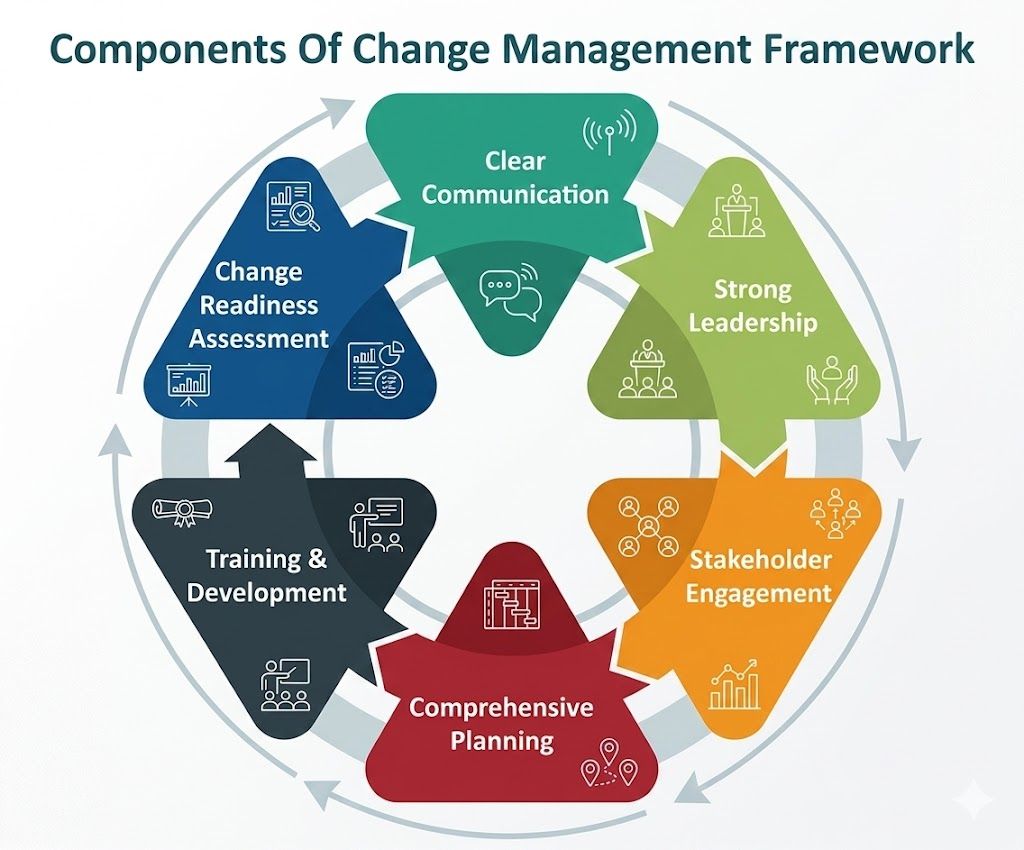
A successful change management framework includes several important elements that help organizations manage transitions smoothly and improve employee adoption.
Free Courses
Businesses use change management frameworks in a wide range of organizational changes to ensure smoother transitions and better employee adoption. An effective change management framework follows a clear and organized process that helps businesses manage transitions with less disruption. By focusing on planning, execution, communication, and reinforcement, organizations can improve adoption rates and maintain operational stability during periods of change.
Some of the most common situations include:
Management Courses to upskill
Explore Management Courses for Career Progression
IIIT-B & IIM, Udaipur
Chief Technology Officer & AI Leadership ProgrammeMost organizations follow a series of structured stages when implementing a change management framework. These stages help businesses manage transitions in a more organized, controlled, and effective way.
A strong framework typically uses a clear process that focuses on planning, communication, implementation, and long-term reinforcement to reduce disruption and improve employee adoption.
Also Read: 4 Inspiring Ways You Can Improve Your Employee Development Methods
The first step is to recognize why change is required within the organization. During this stage, leadership teams define the goals, objectives, and expected outcomes of the change initiative.
Businesses may identify challenges such as:
Planning lays out the groundwork for successful execution. A detailed plan helps organizations stay aligned and avoid confusion during implementation.
This stage usually involves:
Effective communication is a critical part of every change management framework. Employees should clearly understand:
Managers and leadership teams should closely monitor progress and address issues quickly during this stage. This phase focuses on putting the planned changes into action.
Implementation activities may include:
Finally, at this stage, it will help ensure that employees fully adopt new processes and avoid returning to previous ways of working. Long-term success depends on continuous reinforcement after implementation.
Organizations should focus on:
Organizations use different change management models to handle transitions more effectively. Each framework follows a unique approach, but the main goal remains the same: helping businesses manage change smoothly while improving employee acceptance and reducing resistance.
Created by John Kotter, this framework focuses heavily on leadership involvement and employee engagement during organizational change. This model is commonly used for large-scale business transformations and long-term strategic changes.
Step |
Objective |
| Create Urgency | Highlight the need for change |
| Build a Guiding Coalition | Strengthen leadership support |
| Develop a Vision | Set a clear future direction |
| Communicate the Vision | Share goals and expectations |
| Remove Obstacles | Address barriers to progress |
| Create Short-Term Wins | Build confidence and momentum |
| Sustain Acceleration | Continue driving improvements |
| Anchor the Change | Make the change part of company culture |
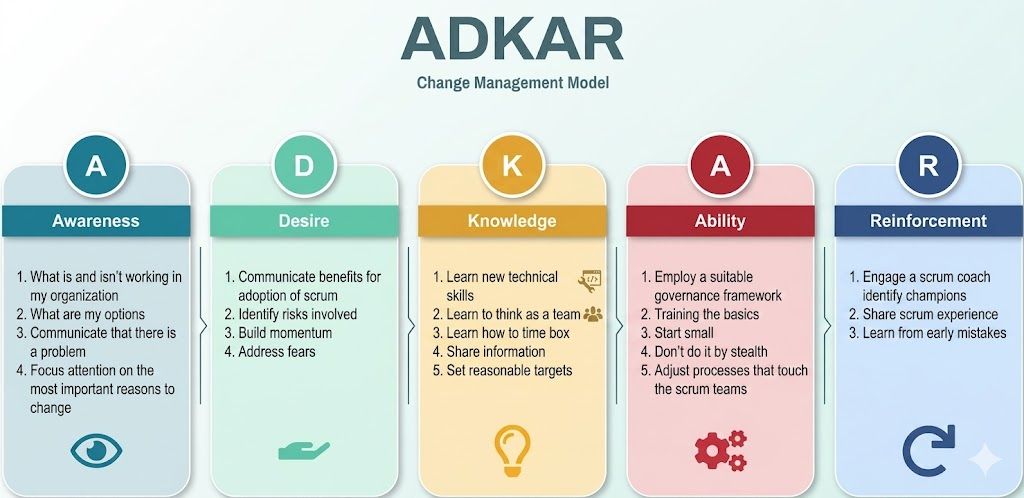
The ADKAR model focuses on helping individuals adapt to organizational change successfully. This framework emphasizes that successful organizational transformation depends on employee understanding, participation, and long-term adoption.
The acronym ADKAR stands for:
Also Read: What is Agile Project Management? Everything You Need to Know
Kurt Lewin’s model is one of the simplest and most widely used frameworks for managing change. Because of its simplicity, this framework is often preferred for smaller businesses or less complex transitions.
Three Stages of Lewin’s Model
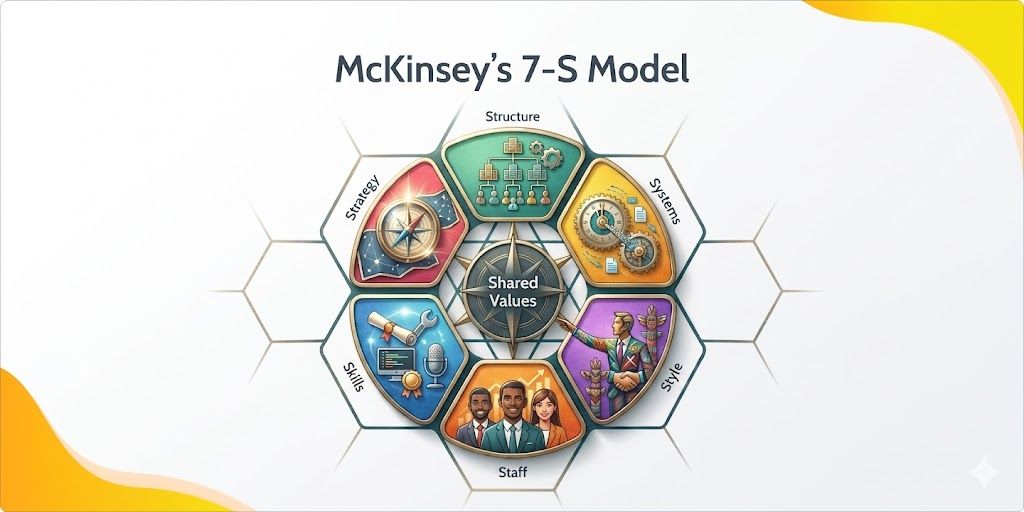
The McKinsey 7-S Framework helps organizations maintain alignment during periods of change by focusing on seven interconnected business elements. The framework is useful for organizations undergoing operational, cultural, or structural transformation.
These elements include:
No matter which models an organization chooses, successful implementation usually follows a clear and organized process focused on planning, communication, execution, and reinforcement. This structured approach helps businesses manage transitions more effectively while minimizing disruption and improving long-term adoption.
The best framework depends on several organizational factors, such as:
Organizations can improve the success of their change initiatives by following practical and people-focused strategies throughout the transition process.
Explore this courses: Change Management Certification
A change management framework helps organizations manage transitions in a clear, organized, and people-focused way. It reduces confusion, improves employee adoption, and increases the chances of successful transformation.
Whether a business is implementing new technology, restructuring teams, or changing operational processes, having a framework creates stability during uncertain periods. The best frameworks focus not only on systems and processes but also on communication, leadership, and employee support.
Most successful organizations rely on a structured, step-by-step approach often involving planning, execution, and reinforcement, designed to guide organizations through transitions, minimizing disruption and maximizing adoption. By following a well-defined framework, businesses can handle change more effectively and achieve long-term growth.
A change management framework helps organizations manage transitions in a structured and organized way. It reduces confusion, improves communication, and helps employees adapt to new systems or processes more effectively. The framework also increases the chances of long-term success during organizational change.
Most frameworks include planning, communication, implementation, and reinforcement stages. These stages help organizations manage change step by step while minimizing disruption. The process also ensures employees receive proper guidance and support throughout the transition.
The Lewin Change Management Model is often considered beginner-friendly because it uses a simple three-stage process. The ADKAR model is also popular because it focuses on individual employee adaptation and practical implementation strategies.
Many initiatives fail due to poor communication, lack of leadership support, unrealistic timelines, and employee resistance. Organizations that skip planning or fail to involve employees early often struggle to achieve successful adoption and long-term sustainability.
Clear communication helps employees understand why change is happening and how it affects their roles. It reduces uncertainty, builds trust, and encourages participation. Frequent updates also help organizations address concerns before they become larger problems.
Project management focuses on completing tasks, timelines, and deliverables. Change management focuses on helping people adapt to the changes created by the project. Both functions work together to ensure successful business transformation.
Yes, small businesses can benefit greatly from structured change management processes. Even simple frameworks help improve communication, reduce resistance, and organize implementation efforts during business transitions or technology upgrades.
The timeline depends on the size and complexity of the change. Small projects may take a few weeks, while large digital transformation initiatives can take several months or even years to fully implement and reinforce.
Important skills include communication, leadership, problem-solving, stakeholder management, and strategic planning. Professionals should also understand employee behavior and organizational culture to guide teams through transitions successfully.
Organizations often measure adoption rates, employee feedback, productivity improvements, training completion, and operational performance. Tracking these metrics helps businesses understand whether the framework is delivering the expected results.
Yes, digital transformation often changes workflows, tools, and employee responsibilities. A change management framework helps organizations introduce technology smoothly while ensuring employees understand, accept, and effectively use the new systems.
1008 articles published
We are an online education platform providing industry-relevant programs for professionals, designed and delivered in collaboration with world-class faculty and businesses. Merging the latest technolo...
Get Free Consultation
By submitting, I accept the T&C and
Privacy Policy
Top Resources
Certification
3 Months
Certification
6 Months
O.P. Jindal Global University
Masters in International Accounting and Finance (Accredited by ACCA, UK)Master's Degree
12 Months