OKRs vs KPIs: Understanding the Difference and How to Use Both
By upGrad
Updated on May 13, 2026 | 9 min read | 2.62K+ views
Share:

All courses
Certifications
More
By upGrad
Updated on May 13, 2026 | 9 min read | 2.62K+ views
Share:
Table of Contents
OKRs and KPIs are two of the most powerful performance frameworks in modern business, but they serve distinct purposes. OKRs (Objectives and Key Results) define ambitious, forward-looking goals designed to drive change, innovation, and strategic growth across teams.
KPIs (Key Performance Indicators), on the other hand, track the ongoing health and efficiency of business operations. Together, they form a complementary system of OKRs to tell you where to go, while KPIs ensure the business is running correctly along the way.
Understanding OKRs and KPIs starts with the right foundation. Exploring a Management Courses From upGrad can equip you with the frameworks to set meaningful goals, track performance, and drive measurable organizational success.
Also Read: Performance Management: Definition, Process, Benefits & Best Practices (2026 Guide)
Popular Management Programs
OKRs are mainly used to achieve specific goals and drive growth or change within an organization. They are usually short-term, often set quarterly, and follow a structure that combines objectives with measurable key results. Since OKRs are designed to push teams toward ambitious outcomes, they are generally more aggressive and focused on growth.
KPIs, on the other hand, are used to track ongoing performance and maintain operational stability. They focus on monitoring business health through measurable metrics such as revenue, customer retention, or efficiency levels. Unlike OKRs, KPIs are usually continuous and long-term. Their primary purpose is to ensure that day-to-day operations remain consistent and effective.
This is why many businesses use both frameworks together. While OKRs help organizations move toward strategic goals and innovation, KPIs ensure operational performance stays on track.
To understand the difference between okrs vs kpis, it is important to first understand what each framework means.
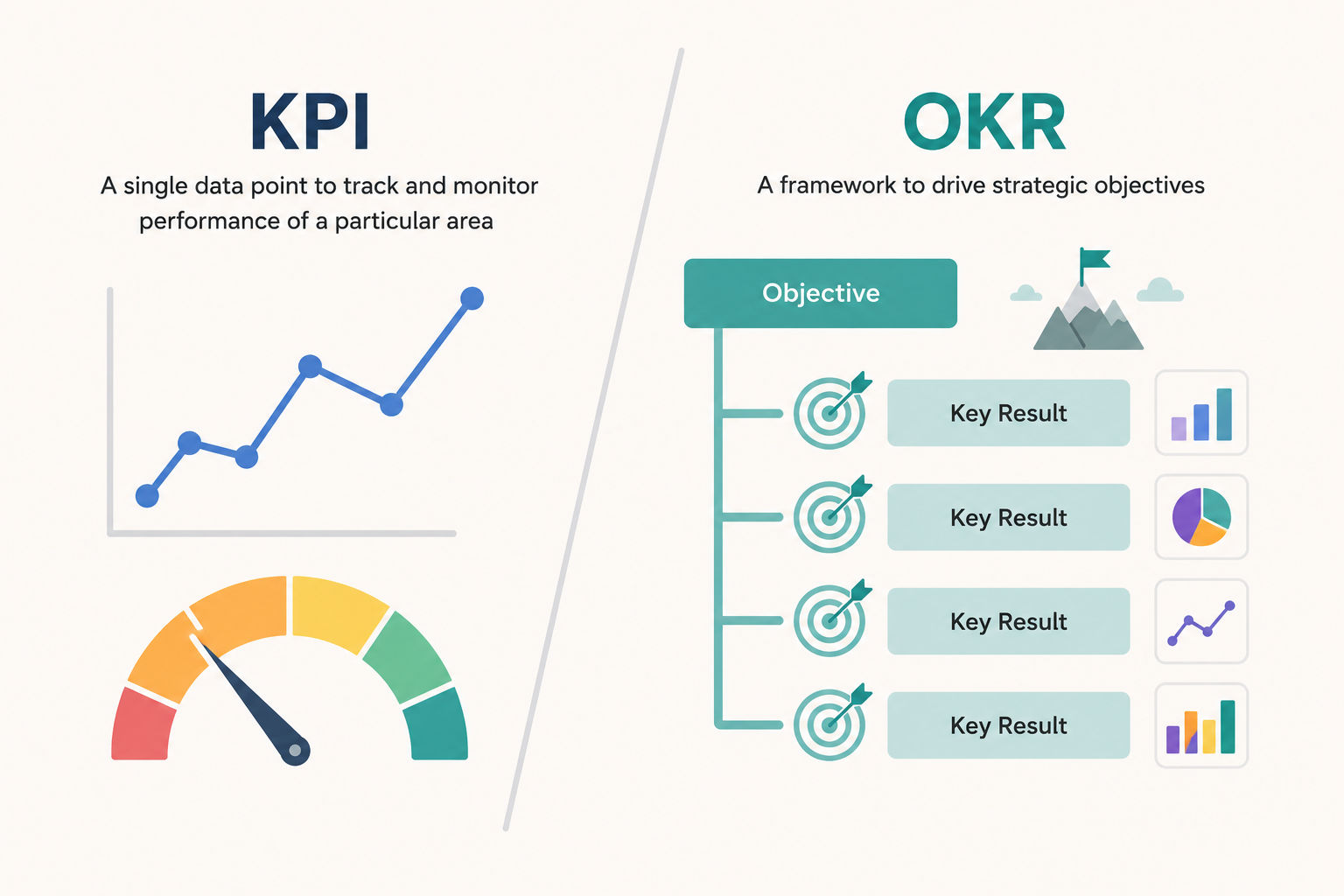
OKR stands for Objectives and Key Results. Organizations use OKRs to set clear goals and track how successful those goals are achieved. Its objective is the goal a team or company wants to achieve. Specific outcomes are used to measure progress toward that goal
Objective: Enhance customer experience
Key Results:
OKRs are generally:
KPI stands for Key Performance Indicator. Businesses use KPIs to measure the ongoing performance of teams, employees, departments, or the organization as a whole.
KPIs are mainly focused on maintaining operational efficiency and tracking business health over time. Unlike OKRs, KPIs are usually long-term metrics that are tracked consistently.
A sales team may monitor metrics such as:
KPIs help businesses:
Free Courses
Keeping goals simple and measurable is the best approach. When comparing okrs vs kpis, companies often make these mistakes:
Also Read: Everything You Need to Know About Performance Marketing
Management Courses to upskill
Explore Management Courses for Career Progression
IIIT-B & IIM, Udaipur
Chief Technology Officer & AI Leadership ProgrammeUnderstanding when to use okrs vs kpis depends entirely on what your business is trying to achieve. Some goals require innovation and rapid growth, while others focus on maintaining stable and consistent performance.
Different departments can use OKRs based on their priorities. For example, a product team may focus on launching AI-powered features, while a marketing team may aim to increase brand awareness. HR teams may use OKRs to improve employee engagement, and sales teams may focus on expanding into new regions.
Because of their growth-oriented nature, OKRs are especially effective for startups and fast-scaling companies.
OKRs are best suited for situations where a company wants to create change, pursue ambitious goals, or align teams around a larger vision. Businesses commonly use OKRs when they plan to:
KPIs are more suitable when the goal is to monitor performance and maintain operational efficiency; OKRs set ambitious, forward-looking goals to drive change, while KPIs track ongoing operational health, performance, and metrics. For example, sales teams may track monthly revenue, HR teams may monitor employee turnover rate, marketing teams may focus on cost per lead, and customer support teams may measure ticket resolution time.
Businesses use KPIs to:
Also Read: Digital Marketing KPIs: What to Track and Why It Actually Matters
Many successful organizations combine OKRs and KPIs instead of choosing one over the other.
For example: The OKR defines the strategic goal, while the KPIs measure the ongoing performance needed to achieve it.
OKR: Increase customer retention by 20%
Supporting KPIs:
This combination of using both frameworks together helps businesses balance long-term growth with operational stability.
Several advantages are:
Many organizations use dedicated software tools to manage goals, monitor metrics, and improve collaboration. These tools make it easier for teams to stay aligned, monitor performance in real time, and track progress more efficiently.
Some widely used platforms include:
Learning the difference between okrs vs kpis is important but implementing them correctly is what truly drives results. Poorly defined goals often lead to confusion, weak execution, and lack of accountability across teams.
Strong OKRs should be:
Component |
Example |
| Objective | Improve mobile app experience |
| Key Result 1 | Increase app retention by 30% |
| Key Result 2 | Reduce crash rate to below 1% |
| Key Result 3 | Improve app rating to 4.7 stars |
Well-written OKRs help teams stay focused on meaningful growth and strategic improvements. To make OKRs more effective:
KPIs should focus on measurable business performance and operational success. The goal is to track metrics that directly impact business outcomes.
A good KPI should be:
Business Function |
KPI Example |
| Finance | Net profit margin |
| Marketing | Website conversion rate |
| Operations | Order fulfillment time |
| Customer Support | First response time |
Using structured frameworks like SMART helps businesses create KPIs that are practical, measurable, and aligned with company goals.
Many organizations use the SMART method to create effective KPIs.
SMART Element |
Description |
| Specific | Clearly defined goal |
| Measurable | Can be tracked with data |
| Achievable | Realistic and attainable |
| Relevant | Connected to business objectives |
| Time-bound | Includes a target timeline |
Understanding okrs vs kpis is essential for modern businesses that want both growth and operational efficiency. While OKRs help teams focus on ambitious strategic goals, KPIs ensure daily performance stays healthy and measurable.
The biggest takeaway is simple: OKRs set ambitious, forward-looking goals to drive change, while KPIs track ongoing operational health, performance, and metrics. They are not competitors. They work best together.
Businesses that combine both frameworks effectively gain better alignment, stronger accountability, clearer priorities, and improved performance tracking. Whether you run a startup or manage a large enterprise team, using OKRs and KPIs together can help drive long-term success.
The main difference between okrs vs kpis is their purpose. OKRs are strategic and growth-oriented, while KPIs are operational and performance-based. Most companies use both together for better alignment and measurement.
Yes, a KPI can sometimes become a key result if it directly supports a strategic objective. For example, customer retention rate may be a KPI but also serve as a measurable key result inside an OKR.
Startups often prefer OKRs because they help teams focus on growth, innovation, and rapid execution. Startups usually work in changing environments where ambitious goals are necessary for scaling quickly. However, KPIs are still important to track operational health such as revenue, customer acquisition cost, and churn rate.
OKRs are usually reviewed quarterly because they are short-term strategic goals. Weekly or biweekly progress check-ins are also common for better alignment. KPIs are monitored continuously. Many businesses track KPIs monthly, weekly, or even daily depending on the metric and business needs.
Companies combine both systems because they solve different problems. OKRs help teams achieve strategic change, while KPIs ensure the business continues performing efficiently during that process. Using both frameworks creates a balance between innovation, growth, and operational stability.
A marketing OKR could increase brand awareness in a new market. The key results may include increasing website traffic by 40% or generating 1,000 qualified leads. Marketing KPIs may include conversion rate, click-through rate, cost per lead, and customer acquisition cost.
Yes, small businesses can benefit greatly from both frameworks. OKRs help define business direction and growth priorities, while KPIs help monitor performance and maintain operational consistency. Even simple goal tracking systems can improve focus and accountability for small teams.
Industries such as technology, SaaS, healthcare, finance, retail, and education commonly use OKRs. Companies like Google popularized the framework because it supports innovation and team alignment. Today, organizations across many industries use OKRs to improve execution and transparency.
A good KPI is measurable, specific, relevant, and actionable. It should clearly reflect business performance and support decision-making. Strong KPIs are easy to track and directly connected to business outcomes like revenue, customer satisfaction, or operational efficiency.
Yes, many organizations assign both individual OKRs and KPIs to employees. Individual OKRs align personal goals with company strategy, while KPIs measure day-to-day performance and productivity. This creates accountability and helps employees understand how their work contributes to larger business goals.
OKRs can feel challenging initially because they require clear goal setting and alignment across teams. Many organizations struggle when objectives are vague or too ambitious. However, with proper planning, communication, and regular reviews, OKRs become easier to manage and highly effective over time.
1038 articles published
We are an online education platform providing industry-relevant programs for professionals, designed and delivered in collaboration with world-class faculty and businesses. Merging the latest technolo...
Get Free Consultation
By submitting, I accept the T&C and
Privacy Policy
Top Resources
Certification
3 Months
Certification
6 Months
O.P. Jindal Global University
Masters in International Accounting and Finance (Accredited by ACCA, UK)Master's Degree
12 Months