SWOT Analysis Marketing: How to Use It to Strengthen Your Strategy
By upGrad
Updated on May 13, 2026 | 9 min read | 2.38K+ views
Share:

All courses
Certifications
More
By upGrad
Updated on May 13, 2026 | 9 min read | 2.38K+ views
Share:
Table of Contents
SWOT Analysis Marketing is a strategic framework that helps businesses assess internal strengths and weaknesses alongside external opportunities and threats. It gives marketers a structured lens to evaluate brand positioning, refine campaign strategies, and anticipate potential risks before they escalate.
By analyzing all four dimensions, companies can leverage their core strengths to seize market opportunities while building defenses against competitive threats. The result is a more focused, data-informed marketing strategy that drives consistent growth and long-term brand resilience.
Building a strong marketing strategy starts with the right foundation. Exploring Management Courses from upGrad can equip you with the frameworks to conduct effective SWOT analyses, sharpen brand positioning, and craft data-driven campaigns that deliver measurable, sustainable marketing success.
Popular Management Programs
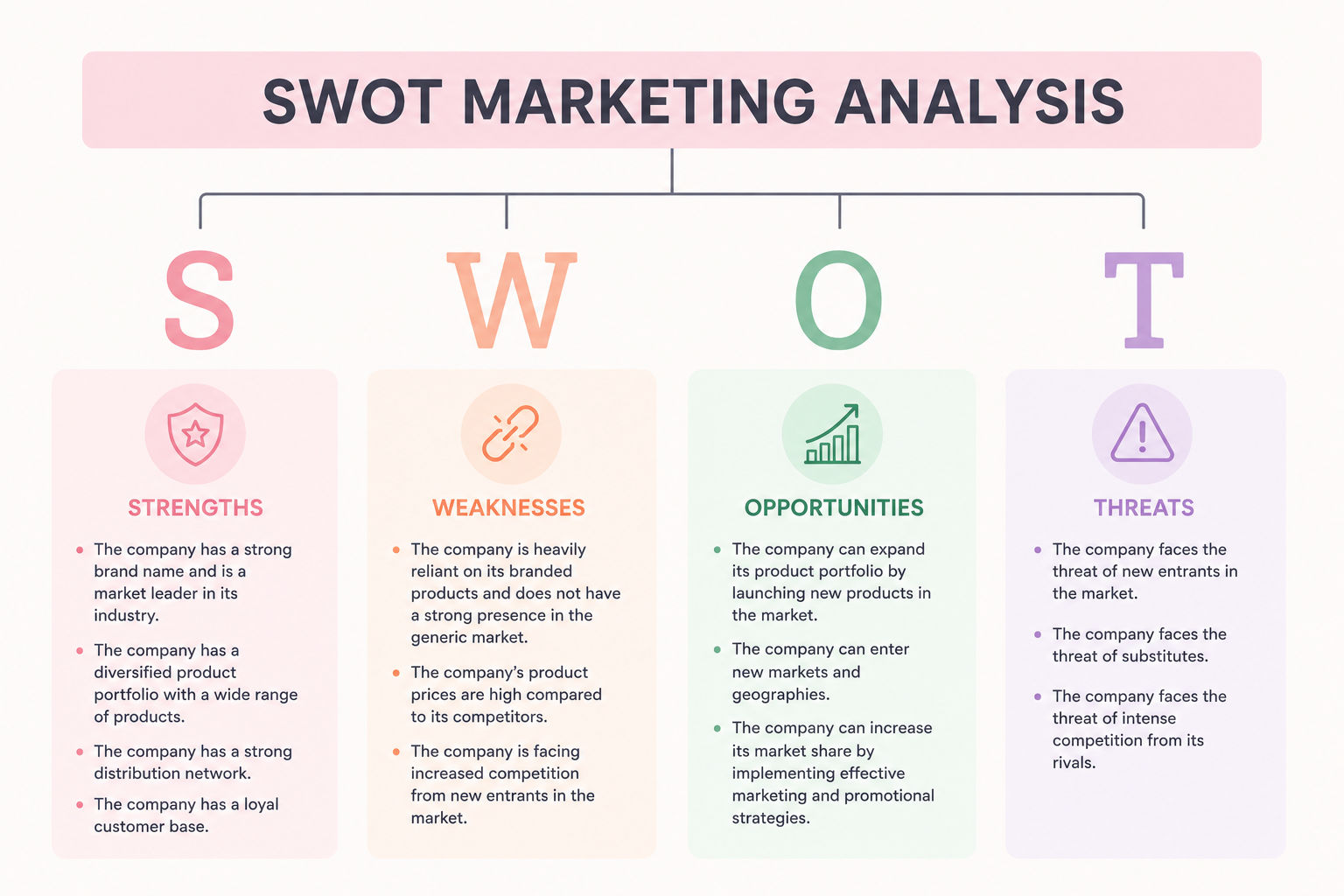
SWOT Analysis Marketing is a strategic planning technique that helps businesses evaluate both internal and external factors before making marketing decisions. SWOT Analysis Marketing is widely used to understand a company’s current position in the market. It is a strategic framework assessing internal Strengths and Weaknesses alongside external Opportunities and Threats to guide business strategy. Companies use this approach to improve marketing campaigns, analyze competitors, launch products more effectively, and build long-term business plans.
The word SWOT represents four key areas:
SWOT Element |
Meaning |
| Strengths | Internal advantages that support business growth |
| Weaknesses | Internal areas that need improvement |
| Opportunities | External factors that can create growth potential |
| Threats | External challenges that may affect performance |
Free Courses
Marketing changes constantly. Customer preferences shift fast. Competitors introduce new strategies regularly. Search engines and social media platforms frequently update their algorithms, making it harder for businesses to stay competitive.
It is also a strategic framework assessing internal Strengths and Weaknesses alongside external Opportunities and Threats to guide business strategy. Because of this, SWOT analysis is useful for startups, growing businesses, and large organizations across different industries.
This is where SWOT Analysis Marketing becomes valuable. It helps businesses evaluate their current position and prepare market changes more effectively.
With SWOT Analysis Marketing, businesses can:
Also Read: Threats in SWOT Analysis: What They Mean and How to Identify Them
Management Courses to upskill
Explore Management Courses for Career Progression
IIIT-B & IIM, Udaipur
Chief Technology Officer & AI Leadership ProgrammeAlso Read: SWOT Analysis: Meaning, Examples, and Complete Guide (2026)
Creating a SWOT analysis marketing report becomes easier when businesses follow a clear process. The goal is to identify insights that improve marketing performance and business growth.
SWOT analysis marketing is a strategic framework assessing internal Strengths and Weaknesses alongside external Opportunities and Threats to guide business strategy. Each section should be evaluated carefully for better decision-making.
Start by identifying the purpose of the analysis. A clear objective keeps the analysis focused.
Common goals include:
Strengths are areas where the business performs well.
Strength |
Marketing Impact |
| Strong SEO rankings | Higher organic traffic |
| Loyal customers | Better retention |
| Active social media presence | Increased visibility |
Weaknesses are areas that need improvement. Honest evaluation is essential in SWOT analysis of marketing.
Common weaknesses include:
Opportunities are external factors that can support growth. This step helps businesses identify future growth possibilities.
Examples include:
Threats are external challenges that may impact performance.
Threat |
Possible Impact |
| Strong competitors | Reduced market share |
| Rising advertising costs | Lower ROI |
| Negative online reviews | Brand reputation damage |
A structured action plan helps businesses apply SWOT analysis to marketing more effectively. The final step is turning insight into action.
SWOT Finding |
Marketing Action |
| Strong SEO performance | Invest more in content marketing |
| Weak social engagement | Improve social media strategy |
| Growing video trends | Focus on video marketing |
Also Read: SWOT Analysis in Strategic Management: A Complete Guide
SWOT analysis marketing is popular because it simplifies complex business decisions. However, like every framework, it has both strengths and limitations.
Understanding both sides helps marketers use the model more effectively.
One major advantage is simplicity. Even small businesses with limited resources can perform SWOT analysis of marketing without advanced tools or software.
It is a strategic framework assessing internal Strengths and Weaknesses alongside external Opportunities and Threats to guide business strategy. This allows businesses to align marketing activities with business goals.
SWOT analysis helps brands compare themselves against competitors.
Businesses can identify:
Marketing teams can reduce risks before launching campaigns.
Different departments contribute insights during SWOT analysis of marketing sessions. This improves communication and planning quality.
Market conditions change rapidly. Regular SWOT analysis helps companies respond quickly to:
Although useful, SWOT analysis of marketing also has limitations.
1. Can Be Subjective: Different people may interpret strengths or weaknesses differently. Without proper data, decisions may become biased.
2. Lacks Prioritization: SWOT analysis identifies factors but does not rank them automatically. Businesses must decide which issues matter most.
3. May Oversimplify Complex Problems: Some business challenges require deeper analysis beyond SWOT.
For example:
4. Results Can Become Outdated Quickly: Market trends change constantly. A SWOT report prepared six months ago may no longer reflect current conditions.
The Best Practices is When Combine SWOT With Other Tools.
Businesses often use SWOT with:
Tool |
Purpose |
| PESTLE Analysis | External environment analysis |
| Porter’s Five Forces | Industry competition study |
| Customer Personas | Audience understanding |
Since it is a strategic framework assessing internal strengths and weaknesses alongside external opportunities and threats to guide business strategy, it remains highly relevant in digital marketing today.
Modern marketers use SWOT analysis for:
Also Read: SWOT Analysis Examples for Students
SWOT analysis of marketing is a powerful planning tool that helps businesses make smarter marketing decisions. It allows brands to understand their strengths, improve weaknesses, identify opportunities, and prepare for threats in a competitive market.
Because it is a strategic framework assessing internal Strengths and Weaknesses alongside external Opportunities and Threats to guide business strategy, businesses of all sizes can use it effectively. Whether you run a startup, an eCommerce store, or a large enterprise, SWOT analysis helps improve strategic planning and marketing performance.
The key is to keep the analysis practical, data-driven, and action-oriented. Businesses that regularly review SWOT insights are better prepared to adapt, compete, and grow in changing markets.
SWOT analysis of marketing is used to evaluate a company’s internal strengths and weaknesses along with external opportunities and threats. It helps businesses improve marketing strategies, understand competitors, and identify growth opportunities. Many companies use it before launching campaigns or entering new markets.
SWOT analysis helps digital marketers identify what works well and what needs improvement. It supports better planning for SEO, content marketing, social media, and paid advertising. Businesses can also identify external threats like rising competition or changing search trends.
The four elements are Strengths, Weaknesses, Opportunities, and Threats. Strengths and weaknesses are internal factors controlled by the business. Opportunities and threats are external factors influenced by market conditions, competitors, and customer behavior.
Small businesses use SWOT analysis of marketing to understand their market position and improve their strategy. It helps them identify low-cost marketing opportunities, customer needs, and competitive advantages. The framework is simple and works well even with limited resources.
SWOT analysis focuses on strengths, weaknesses, opportunities, and threats affecting a business. PESTLE analysis studies broader external factors such as political, economic, social, technological, legal, and environmental conditions. Businesses often use both together for better planning.
Businesses should perform SWOT analysis regularly, especially before major campaigns, product launches, or market expansions. Many companies review it every quarter or annually. Frequent analysis helps businesses adapt to changing market trends and competitor activity.
Yes, SWOT analysis marketing can improve SEO by identifying keyword opportunities, content gaps, and competitor strengths. It helps marketers focus on areas that drive traffic and improve rankings. Businesses can also identify threats such as algorithm changes or stronger competitors.
Common mistakes include using vague statements, ignoring market research, focusing only on internal factors, and failing to take action. Businesses should use real data and prioritize important insights. A SWOT report becomes valuable only when businesses apply the findings.
Yes, startups benefit greatly from SWOT analysis marketing because it helps them understand competition, market opportunities, and resource limitations. It also supports smarter budgeting and strategic planning. Startups can use the framework to build stronger market positioning.
SWOT analysis helps businesses compare their strengths and weaknesses against competitors. It reveals market gaps, customer expectations, and areas where competitors perform better. This allows marketers to create stronger campaigns and differentiation strategies.
Almost every industry uses SWOT analysis of marketing, including retail, education, healthcare, finance, technology, and hospitality. Since it is a strategic framework assessing internal Strengths and Weaknesses alongside external Opportunities and Threats to guide business strategy, it works across different business models and market conditions.
972 articles published
We are an online education platform providing industry-relevant programs for professionals, designed and delivered in collaboration with world-class faculty and businesses. Merging the latest technolo...
Get Free Consultation
By submitting, I accept the T&C and
Privacy Policy
Top Resources
Certification
3 Months
Certification
6 Months
O.P. Jindal Global University
Masters in International Accounting and Finance (Accredited by ACCA, UK)Master's Degree
12 Months