SWOT Analysis in Strategic Management: A Complete Guide
By upGrad
Updated on May 07, 2026 | 8 min read | 1.69K+ views
Share:

All courses
Certifications
More
By upGrad
Updated on May 07, 2026 | 8 min read | 1.69K+ views
Share:
Table of Contents
A SWOT analysis in strategic management is a structured framework that evaluates internal capabilities alongside external environmental factors to help leaders make informed, data-driven decisions for long-term growth. Applying this tool effectively requires a deep look at how specific variables interact to create a competitive advantage in a crowded market.
This blog covers everything you need to know about SWOT analysis in strategic management: what it is, how it works inside a strategic management process, how to build one from scratch, and where it tends to fall short. By the end, you'll know how to use it practically, not just theoretically.
Want to move beyond theory and use tools like ‘SWOT analysis in strategic management’ for strategic planning and market positioning in real business situations? Explore upGrad’s management and Marketing programs to build strong skills in Marketing, leadership, decision-making, and process improvement so you can turn analysis into action.
Popular Management Programs
SWOT stands for Strengths, Weaknesses, Opportunities, and Threats. It's a planning tool that helps organizations understand both their internal situation and the external environment they operate in.
These are internal. You've got direct control over these elements because they exist within your office walls or digital systems. For example, your proprietary software or your highly skilled marketing team represents a strength. On the flip side, a high employee turnover rate or outdated hardware is a weakness you need to fix. Organizations that ignore these internal realities often find themselves struggling to execute even the most brilliant external plans.
These are external. You can't control the global economy or a competitor's sudden price drop. You can only react to them. An opportunity might be a new trade agreement that opens a foreign market, while a threat could be a change in government regulations that makes your current production method more expensive. By mapping these out, you prepare your business to pivot when the world changes.
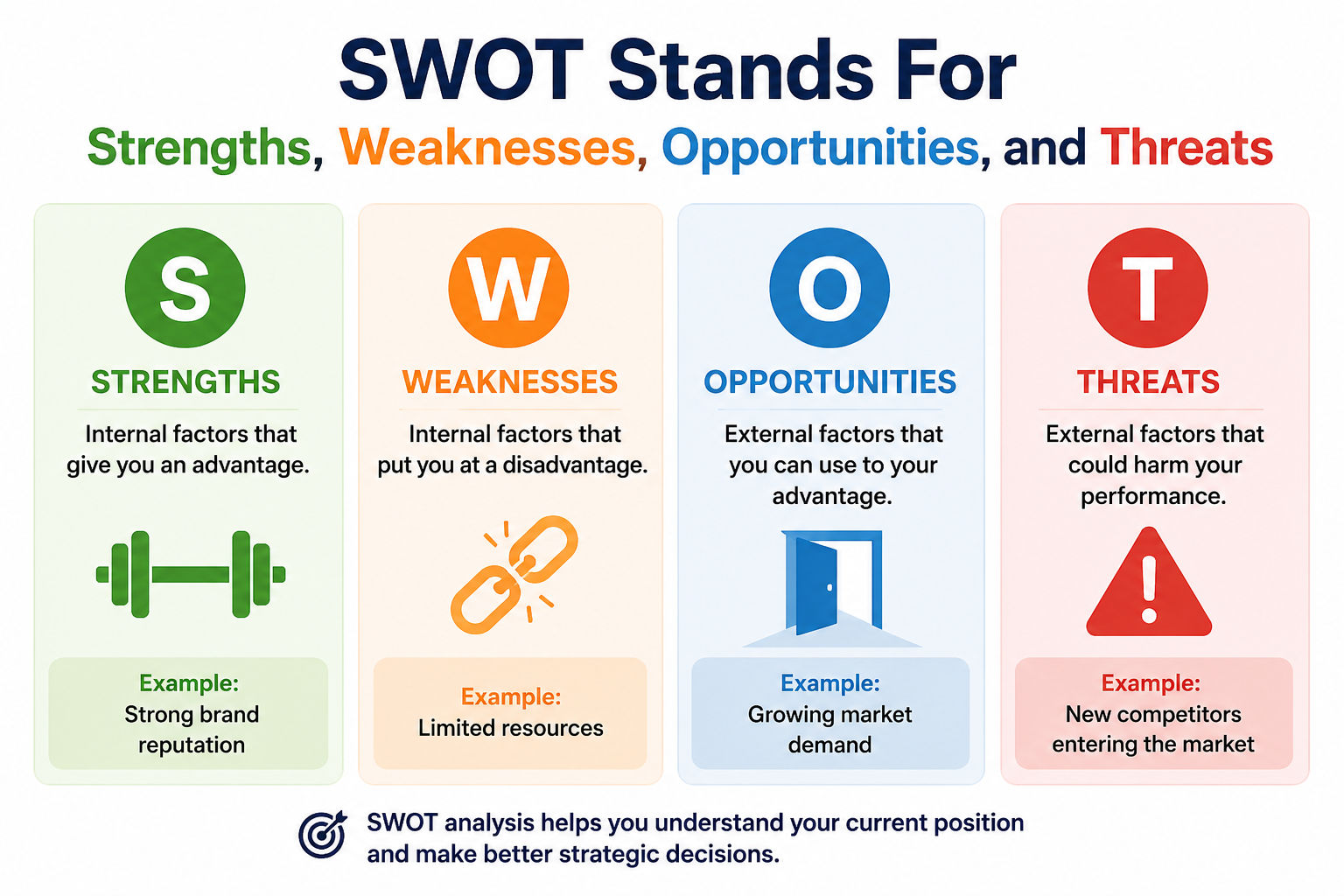
Why does this matter? Without a formal SWOT analysis in strategic management, your strategy is based on vibes rather than evidence. Don't let your business become a victim of its own blind spots. Leaders who use this tool properly can align their internal resources with external possibilities to create a path that's both ambitious and realistic.
Do read: Techniques of Decision-Making: 15+ Tools & Methods for Success in 2026
Let's do a SWOT analysis on Netflix in India. The market is crowded, price-sensitive, and content-driven. Global muscle alone doesn’t win here. Swot analysis in strategic management helps break down where Netflix stands right now and what it needs to do next.
| Strengths | Weaknesses
|
Premium feel. Clear positioning.
|
Pricing hurts reach.
|
| Opportunities | Threats |
Growth lies beyond the metros.
|
The pressure is constant.
|
Must Read: Top 20+ Business Analysis Techniques to Learn in 2026
Free Courses
You don’t need any fancy tools, you just need honest thinking. You don't just sit in a room and shout out ideas to finish a SWOT analysis in strategic management effectively.
| Analysis Step | Action Item | Goal |
| Internal Audit | Review assets and liabilities | Identify S and W |
| Market Research | Analyze competitors and trends | Identify O and T |
| Prioritization | Rank factors by impact | Focus on key issues |
| Strategy Mapping | Match strengths to opportunities | Create action plan |
It's a collaborative effort that requires data from every department in your company. Start by gathering a diverse team. Your sales reps see different problems than your accounting team does. If you only listen to executives, you'll miss the ground-level issues that eat away at your profit margins over time.
Step 1: Define the Objective
Are you evaluating a new product launch? Reviewing your annual strategy? Responding to a competitor's move? The objective shapes what counts as relevant. A SWOT done for a product launch looks different from one done for an organizational restructure. Keep it focused.
Step 2: Assemble the Right People
You need perspectives from different parts of the business. Finance, operations, sales, product, and sometimes customer-facing staff all see different things. A leadership-only SWOT tends to be optimistic about strengths and blind to operational weaknesses. Bring in people who'll challenge the comfortable assumptions.
Step 3: Gather Data First
Don't walk into the room empty-handed. Collect customer feedback, competitor analysis, financial performance data, and employee surveys before the session. SWOT is only as good as the information feeding it. Opinions are useful. Data-backed opinions are far more useful.
Step 4: Fill Each Quadrant
Use a 2x2 grid. Work through each quadrant with the group. For strengths and weaknesses, ask what the data shows, not just what people feel. For opportunities and threats, look at industry reports, competitor moves, and regulatory changes. Aim for specificity.
Step 5: Prioritize and Act
Not every item in your SWOT deserves equal attention. Rank them by impact and urgency. Then build your strategy around the top items, specifically around using strengths to capture opportunities and using resources to address critical threats. A SWOT that doesn't end with action items is just a list.
Also Read: How to do Competitor Analysis? Step by Step Guide
Benefits |
Limitations |
| Clarity in decision-making: Gives a complete view of internal and external factors, helping teams see the full picture and avoid blind spots while making strategic choices. | Subjective nature: Relies heavily on opinions, so bias can influence what is listed, leading to an incomplete or skewed analysis. |
| Better resource allocation: Helps identify where time, money, and effort should go, so resources are not wasted on low-impact areas. | Lack of prioritization: Does not rank factors, so everything appears equally important, making it harder to focus on what truly matters. |
| Improved strategic planning: Grounds plans in real insights rather than assumptions, making strategies more practical and achievable. | Static view: Represents a single point in time and can quickly become outdated in fast-changing markets. |
| Early risk detection: Identifies threats early, allowing businesses to prepare and reduce potential damage before it happens. | No direct solutions: Highlights issues but does not provide clear answers or action steps, requiring further analysis. |
| Team alignment: Brings different teams to a shared understanding, helping everyone move in the same direction and improving execution speed. | Over-simplification: Breaks complex realities into four boxes, which can hide deeper insights or overlapping factors. |
| Encourages honest discussions: Creates space to openly address weaknesses and challenges, leading to better internal awareness and growth. | Data dependency: Needs accurate data to be useful, otherwise it turns into assumptions instead of meaningful insights. |
| Versatile across use cases: Works for startups, large companies, students, and marketers, making it a flexible and widely applicable tool. | Misuse in isolation: When used alone without other frameworks, it leads to shallow insights and incomplete strategies. |
Management Courses to upskill
Explore Management Courses for Career Progression
IIIT-B & IIM, Udaipur
Chief Technology Officer & AI Leadership ProgrammeA SWOT analysis is like a static framework, use it as a dynamic, data-backed thinking tool that drives real decisions. A powerful SWOT is about thinking critically and acting decisively. Encourage discussion, question assumptions, and constantly refine your perspective. Here’s how to make it more effective:
SWOT analysis is evolving from a static, once-a-year exercise into a dynamic, data-driven tool. With real-time data integration, businesses can continuously update their SWOT using automated dashboards, allowing faster and more proactive decision-making.
Overall, the future of SWOT lies in automation, real-time updates, deeper insights, and continuous strategic thinking, shifting from a reactive tool to a proactive, always-evolving framework.
SWOT analysis in strategic management doesn't give you answers. It gives you the right questions. It forces a team to pause before acting, to look inward and outward at the same time, and to surface assumptions that often stay hidden. Most strategic failures don't happen because organizations lack intelligence. They happen because they didn't ask the right questions at the right time. Run it regularly. Update it when conditions change. Don't treat it as a one-time exercise. And make sure every SWOT session ends with a decision, not just a document.
Ready to start your journey? Book a free consultation with upGrad today to find the best path for your career.
Similar Reads
Digital Marketing Tutorials: A Complete Guide
Digital Marketing Eligibility: Who Can Apply and What You Need to Know
How To Boost Your Career With Digital Marketing Certification?
upGrad Learning Centre: Transform Your Career with Digital Marketing Courses
Mica Digital Marketing Syllabus – Advanced Certificate Digital Marketing and Communication
Top 10 Digital Marketing Certifications To Enhance Your Skills in 2026
What is MBA in Digital Marketing? Scope, Career option and Salary
The main goal is to create a clear match between what a business can do and what the market demands. It helps identify internal strengths and weaknesses while scanning external opportunities and threats. This clarity allows teams to focus on actions that drive long-term success.
It brings structure to decisions. Instead of relying on instinct, teams evaluate choices based on strengths, weaknesses, opportunities, and threats. This reduces guesswork and helps businesses choose actions that align with their capabilities and current market conditions.
Internal factors are within the company’s control, such as resources, processes, and skills. External factors come from the outside environment, like market trends, competition, and regulations. Understanding this difference helps in making better strategic choices.
A SWOT works best when multiple perspectives are included. Teams from sales, marketing, operations, and finance should contribute. Including customer-facing roles adds real insights. A diverse group leads to a more accurate and balanced analysis.
Common errors include being too vague, not using data, and listing too many factors without prioritizing them. Another big mistake is stopping at analysis without linking it to action, which makes the entire exercise ineffective.
SWOT can be subjective and doesn’t prioritize factors. It also captures a moment in time, so it can become outdated quickly. It highlights issues but doesn’t explain causes or provide direct solutions, which limits its depth.
SWOT looks at both internal and external factors but stays broad. PESTLE focuses only on external forces and goes deeper into areas like political, economic, and social factors. Many teams use PESTLE to strengthen the opportunities and threats in SWOT.
A TOWS matrix builds on SWOT by turning insights into strategies. It connects strengths with opportunities and weaknesses with threats to define clear actions. This makes the analysis more practical and useful for execution.
It should be reviewed regularly. Many organizations update it annually or during major changes like market shifts, new launches, or competitive moves. Keeping it updated ensures the analysis stays relevant and useful.
Yes, it works well for individuals. You can assess your skills as strengths, identify gaps as weaknesses, explore career opportunities, and consider risks in your field. This helps in making better career decisions.
Yes, it remains widely used because it’s simple and flexible. While advanced tools exist, SWOT still provides a strong starting point. When combined with other frameworks and data, it continues to support effective strategic planning.
972 articles published
We are an online education platform providing industry-relevant programs for professionals, designed and delivered in collaboration with world-class faculty and businesses. Merging the latest technolo...
Get Free Consultation
By submitting, I accept the T&C and
Privacy Policy
Top Resources
Certification
3 Months
Certification
6 Months
O.P. Jindal Global University
Masters in International Accounting and Finance (Accredited by ACCA, UK)Master's Degree
12 Months