Value Chain Analysis: What It Is and How to Use It
By upGrad
Updated on Jun 19, 2026 | 6 min read | 1.7K+ views
Share:

All courses
Certifications
More
By upGrad
Updated on Jun 19, 2026 | 6 min read | 1.7K+ views
Share:
Table of Contents
Value chain analysis is a strategic tool used to evaluate all business activities involved in creating, delivering, and supporting a product or service. The goal is to identify areas where value can be increased and costs can be reduced.
The concept was introduced by Michael Porter in 1985 through his book Competitive Advantage.
At its core, value chain analysis revolves around understanding how each activity contributes to customer value and business profitability.
This blog covers what value chain analysis means, how it works in strategic management, the key components, and how to actually run one.
Explore upGrad's Management and MBA programs to develop expertise in strategic management, operations, supply chain management, financial analysis, process optimization, and business decision-making.
Popular upGrad Programs
Every business does a series of activities to deliver a product or service to customers. Value chain analysis is the process of breaking down those activities to figure out where value is created, where costs are too high, and where you have a real competitive advantage.
Michael Porter introduced this concept. His idea was that a business isn't just one big operation. It's a chain of linked activities, and each one either contributes to the final value a customer receives or it doesn't.
When you run a value chain analysis, you're asking two things: where do we create value, and where do we waste it?
The answer shapes decisions on pricing, operations, outsourcing, and long-term strategy. That's why it's become a core part of value chain analysis in strategic management.
Also read: What is Supply Chain Management: Components, Process & Benefits
Free Courses
Porter divided business activities into two categories. Understanding both is essential before you start any analysis.
Basis |
Primary Activities |
Support Activities |
| Purpose | Directly create and deliver value to customers | Support and improve value-creating activities |
| Impact on Product/Service | Direct involvement in production, delivery, and service | Indirect involvement through resources and systems |
| Customer Visibility | Usually visible to customers | Mostly happens behind the scenes |
| Examples | Operations, Marketing & Sales, Service | HR Management, Procurement, Technology Development |
| Main Goal | Generate customer value and revenue | Improve efficiency and business performance |
Don't underestimate support activities. A slow procurement process or poor HR practices can drag down the entire chain even if your core operations are solid.
Do read: What is Logistics Management? Understanding Its Types, Functions, Processes, and More
Recommended Courses to upskill
Explore Our Popular Courses for Career Progression
IIIT Bangalore
Executive Diploma in Machine Learning and AI360° Career Support
O.P.Jindal Global University
MBA from O.P.Jindal Global UniversityLive Case Studies and Projects
It helps organizations see how every activity contributes to costs, customer satisfaction, and profitability. Instead of making decisions based on assumptions, leaders can identify exactly where improvements will have the greatest impact.
A well-executed value chain analysis can help businesses:
It also helps businesses prioritize investments. Rather than improving every process at once, companies can focus on the activities that have the biggest influence on business performance.
Do read: Financial Supply Chain Management: A Comprehensive Guide to Processes and Trends
To measure whether improvements are working, businesses often track key performance indicators (KPIs).
KPI |
Why It Matters |
| Gross Profit Margin | Shows how efficiently value is created |
| Operating Margin | Measures profitability after operating costs |
| Cost per Unit | Helps identify cost-saving opportunities |
| Customer Acquisition Cost (CAC) | Tracks the cost of gaining new customers |
| Customer Lifetime Value (CLV) | Measures long-term customer value |
| Inventory Turnover | Indicates inventory efficiency |
| Return Rate | Highlights quality or service issues |
These metrics help connect value chain improvements to real business outcomes.
Must read: Role of Logistics in Supply Chain Management: A detailed study
It's not complicated. But it does require honest data and clear thinking.
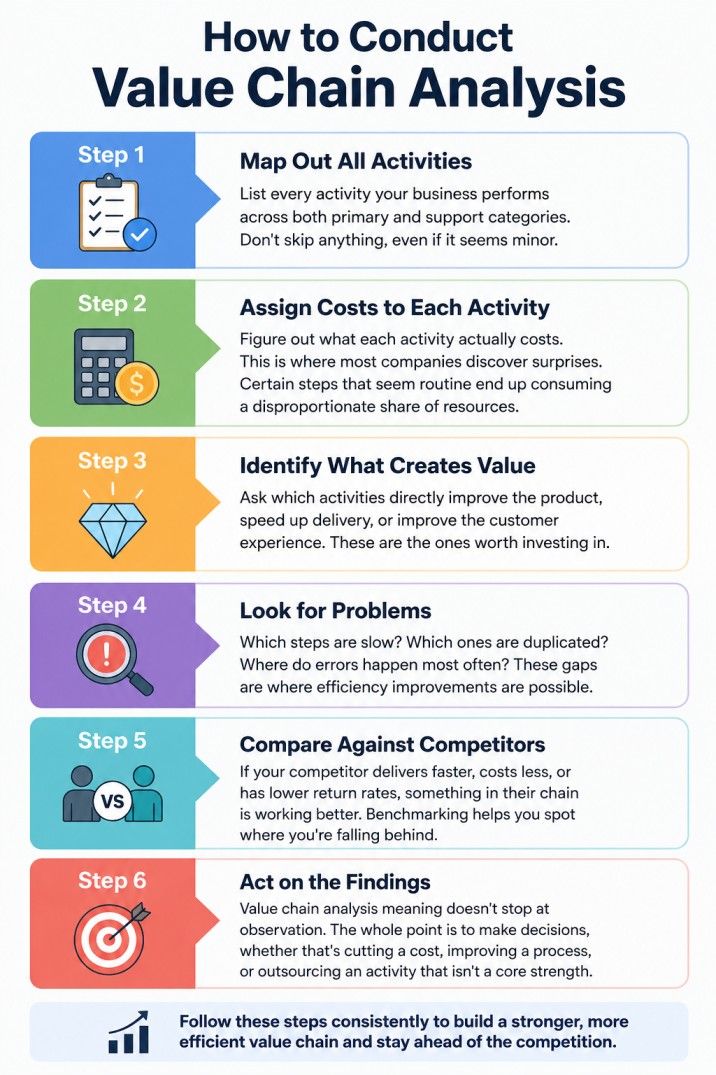
Also read: What Is Operations Management? Why It’s So Important for Companies
This is where the tool gets really useful. In strategic management, the goal isn't just to run a business efficiently. It's to build a position that competitors can't easily copy. Value chain analysis helps you figure out whether your competitive advantage comes from cost leadership or differentiation.
If you can do the same things as competitors at a lower cost, you win on price. Retailers that run incredibly tight supply chains are a classic example. Every link in the chain is optimized to shave cost, and the savings get passed to the customer or kept as margin.
Some companies don't compete on price at all. They compete on quality, speed, customer experience, or brand. Their value chain is designed to deliver something better, not cheaper. The operations cost more, but customers pay more too.
Value chain analysis in strategic management also helps with make-or-buy decisions. Should you handle logistics in-house or outsource it? Should you build your own tech or buy software? The analysis gives you the data to answer those questions without guessing.
One thing to keep in mind is that value chain analysis works best when it's specific. Generic observations like "our operations need improvement" aren't useful. You need to get specific about which activities, which costs, and which outcomes.
You can make this section much tighter without losing value.
Must read: Top Types of Strategic Management Explained
Value chain analysis helps businesses understand how they compete. Most companies win through either lower costs or greater customer value.
Basis |
Cost Advantage |
Differentiation Advantage |
| Focus | Lower costs | Unique customer value |
| Goal | Compete on price | Compete on quality, service, or experience |
| Customer Choice | Affordability | Premium value |
| Profit Strategy | Efficiency and scale | Premium pricing |
| Example | Discount retailers | Premium brands |
The right approach depends on your market, customers, and business goals. Value chain analysis helps identify which strategy your operations support best.
Do read: What Is Inventory Management? A Guide to Benefits, Careers, and Challenges
Value chain analysis delivers the most value when used before problems become serious.
Business Situation |
Why Use Value Chain Analysis? |
| Shrinking profit margins | Identify activities driving up costs |
| Rising operational costs | Find inefficiencies and waste |
| Declining customer satisfaction | Improve value-creating activities |
| Competitors gaining market share | Uncover competitive gaps |
| Entering new markets | Evaluate operational readiness |
| Adopting new technology | Assess process improvement opportunities |
| Supply chain disruptions | Identify vulnerabilities and bottlenecks |
It's also useful during mergers, acquisitions, and major operational changes.
Businesses that review their value chain regularly are often better equipped to respond to changing customer expectations and market conditions.
Do read: What is Quality Control (QC)? How Does QC Works?
Take an example of a company that makes and sells sports shoes.
Their inbound logistics involve sourcing materials from multiple suppliers. Operations are split between two factories. Outbound logistics go through a third-party courier. Marketing runs mostly on social media. Customer service handles returns through a chat tool.
When they run a value chain analysis, they find:
These three findings are specific. They can be fixed. Factory quality control needs review. The logistics partner contract should be renegotiated or replaced. One marketing channel gets cut.
That's what explain what value chain analysis really means in practice. It's a structured way to find and fix what's actually broken.
Like any business framework, value chain analysis offers advantages and challenges. Understanding both helps organizations use it effectively.
Benefits |
Limitations |
| Identifies cost-saving opportunities | Requires accurate cost data |
| Improves operational efficiency | Time-intensive data collection |
| Highlights competitive advantages | Difficult to measure intangible value |
| Enhances customer value creation | Less effective for complex service or platform businesses |
| Supports strategic decision-making | Provides only a point-in-time view |
| Improves resource allocation | Results depend heavily on data quality |
| Encourages continuous improvement | Doesn't directly reveal customer preferences |
Use it as one input in your strategic decisions, not the only one.
Value chain analysis helps businesses understand how value is created at every stage of operations. By examining primary and support activities, organizations can uncover inefficiencies, improve customer experiences, and strengthen profitability.
The framework remains one of the most practical tools for identifying competitive advantages and making smarter strategic decisions. Businesses that review their value chain regularly are better positioned to adapt, improve, and stay ahead in competitive markets.
Ready to start your journey? Book a free consultation with upGrad today to find the best path for your career.
Value chain analysis examines internal business activities to identify where value is created and where costs can be reduced. SWOT analysis looks at strengths, weaknesses, opportunities, and threats at a broader strategic level. Many businesses use both tools together to make better operational and strategic decisions.
Yes. Small businesses often benefit because they have fewer processes to evaluate and can implement improvements more quickly. Even simple changes in supplier management, customer service, or inventory handling can improve profitability and create a better customer experience without significant investment.
Most organizations review their value chain annually, but fast-growing businesses may do it more frequently. Changes in customer expectations, supplier costs, technology, or competition can quickly affect performance. Regular reviews help businesses identify new opportunities and respond before inefficiencies become larger problems.
Manufacturing is the most commonly cited example, but retail, healthcare, logistics, software, consulting, and financial services also use it extensively. Any industry with multiple activities contributing to customer value can benefit from understanding which processes create advantages and which create unnecessary costs.
One common mistake is focusing only on cost reduction while ignoring customer value. Another is analyzing departments in isolation rather than evaluating how activities connect. Businesses also struggle when data is incomplete, making it difficult to identify the real causes of inefficiency.
Technology helps businesses automate repetitive tasks, improve data visibility, reduce errors, and speed up decision-making. Tools such as ERP systems, analytics platforms, artificial intelligence, and workflow automation software can strengthen multiple activities across the value chain and improve overall efficiency.
Value chain analysis in strategic management helps organizations identify activities that contribute most to competitive advantage. Leaders use the findings to prioritize investments, improve operational performance, strengthen differentiation strategies, and make informed decisions about resource allocation and business growth.
Businesses pursuing cost leadership use value chain analysis to identify activities with high operating expenses and limited customer impact. By improving efficiency, negotiating better supplier agreements, or automating processes, companies can reduce costs while maintaining product quality and customer satisfaction.
Customer expectations help determine which activities create the most value. Faster delivery, better product quality, responsive support, and convenience often influence purchasing decisions. Understanding what customers value allows businesses to focus resources on improvements that have the greatest business impact.
Yes. Businesses increasingly use value chain analysis to identify waste, reduce energy consumption, optimize transportation, and improve sourcing practices. These improvements can lower operating costs while supporting environmental goals, making sustainability efforts more practical and measurable across operations.
Success is typically measured using key performance indicators such as production costs, delivery times, customer satisfaction scores, defect rates, profit margins, and employee productivity. Tracking these metrics over time helps organizations determine whether changes are delivering meaningful business results.
972 articles published
We are an online education platform providing industry-relevant programs for professionals, designed and delivered in collaboration with world-class faculty and businesses. Merging the latest technolo...
Get Free Consultation
By submitting, I accept the T&C and
Privacy Policy
Top Resources
Certification
3 Months
Certification
6 Months
O.P. Jindal Global University
Masters in International Accounting and Finance (Accredited by ACCA, UK)Master's Degree
12 Months