Porter's Five Forces: What It Is and How to Use It
By upGrad
Updated on Jun 17, 2026 | 7 min read | 2.01K+ views
Share:

All courses
Certifications
More
By upGrad
Updated on Jun 17, 2026 | 7 min read | 2.01K+ views
Share:
Table of Contents
Porter’s Five Forces is a strategic analysis model created by Michael Porter to assess the competitive dynamics and profitability of an industry. It examines five critical factors, such as, the intensity of competition among existing firms, the risk of new competitors entering the market, the bargaining power of buyers, the bargaining power of suppliers, and the threat posed by substitute products or services.
This blog breaks down Michael Porter's five forces model in plain language. You'll learn what each force means, how to apply porter's five forces analysis to a real industry, and where the model has limits.
Explore upGrad's MBA and Management programs to build practical skills in business strategy, competitive analysis, strategic decision-making, market assessment, leadership, and industry analysis using frameworks such as Porter's Five Forces, SWOT, and Business Model Canvas for real-world business challenges.
Popular upGrad Programs
Porter's Five Forces is a business strategy framework developed by Harvard professor Michael Porter in 1979. It helps businesses evaluate the competitive intensity of an industry and identify factors that influence profitability.
The model doesn't just look at direct competitors. That's what makes it different. It examines five distinct pressures that shape how much control any business actually has in its market.
Here are the five forces:
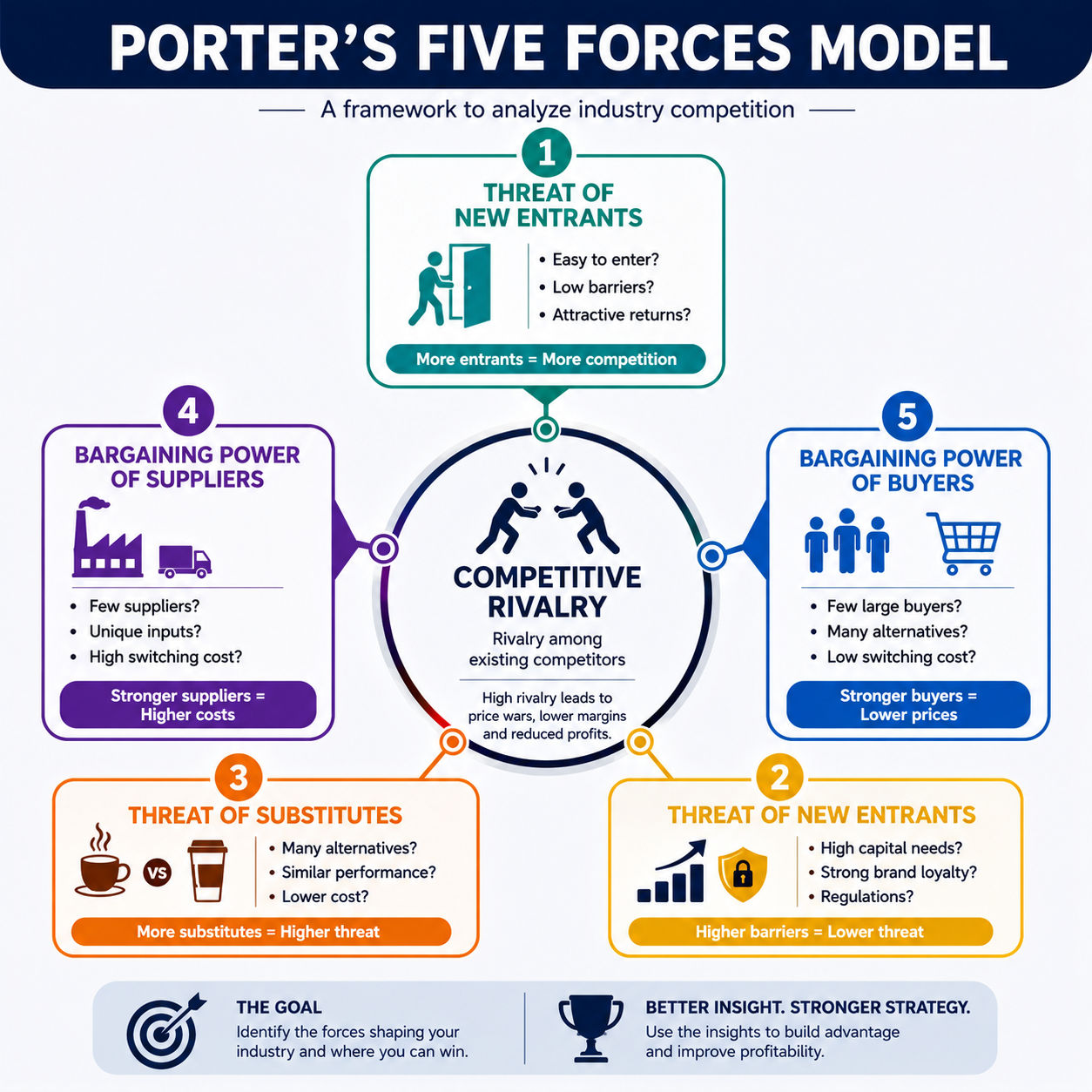
Together, these five forces tell you whether an industry is worth entering, where you're vulnerable, and where you have some advantage. A startup entering a market with all five forces working against it is walking into a tough situation, even with a great product.
The model works across industries. You can apply it to retail, banking, healthcare, software, or manufacturing. The questions it asks are universal.
Free Courses
The strength of porter's five forces analysis lies in examining competition from multiple angles rather than focusing only on rival companies.
Let's look at each force in detail.
This force looks at how intense the competition is among existing players in the industry.
High rivalry means businesses constantly undercut each other on price, ramp up marketing, or race to release new features. This results in margins shrinking and customers gaining more options. It becomes harder to differentiate.
What drives high rivalry:
Think about the airline industry. Dozens of carriers operate similar routes, prices are publicly visible, and passengers switch based on a few hundred rupees difference in fare. That's high rivalry in action.
When rivalry is low, businesses have more pricing power and customers have fewer alternatives. Fewer competitors means less pressure.
Ask yourself: how easy is it for a new competitor to enter your industry?
If entry is easy, new players will keep arriving whenever the industry looks profitable. That constant threat keeps existing businesses from getting comfortable.
Barriers to entry reduce this threat. These include:
The pharmaceutical industry has high entry barriers. Regulatory approvals take years and cost crores. A new entrant can't just decide to compete and show up next month.
Compare that to food delivery apps in India a few years ago. Low technology barriers meant dozens of players entered quickly, and the market got crowded fast.
A substitute isn't just a direct competitor. It's anything that fulfills the same need differently.
Customers don't always switch to a rival product. Sometimes they find a completely different solution. That's what makes this force tricky.
Examples of substitution:
The threat of substitutes is high when the alternative is cheaper, more convenient, or solves the problem well enough. You don't have to be worse than the substitute. You just have to feel less worthwhile at your price point.
Also read: Brand Positioning – A Focal Point of All Marketing Efforts
Suppliers have power when a business depends heavily on them and can't easily switch.
If a single supplier controls a critical raw material, they can raise prices or reduce quality, and you don't have many options. That squeezes your margins from the supply side.
High supplier power occurs when:
Semiconductor manufacturers hold significant power over electronics companies. When chip supply tightens globally, even the largest phone makers adjust their production timelines. Supplier power is very real.
Buyers have power when they can push prices down, demand better terms, or walk away without much cost.
A business that sells to a small number of large buyers is in a weak position. If one buyer accounts for 40% of your revenue and threatens to leave, you're negotiating from a place of anxiety.
Buyer power is high when:
This is why retail chains can negotiate hard with FMCG brands. They represent access to millions of customers. That leverage is real, and suppliers know it.
Must read: Importance of Business Environment: Definition, Elements and Types
Recommended Courses to upskill
Explore Our Popular Courses for Career Progression
IIIT Bangalore
Executive Diploma in Machine Learning and AI360° Career Support
O.P.Jindal Global University
MBA from O.P.Jindal Global UniversityLive Case Studies and Projects
Running a porter's five forces analysis isn't complicated. But it does require honest thinking, not optimistic guessing.
A vague scope gives vague results. Are you analyzing the Indian edtech market broadly, or online upskilling for working professionals specifically? The narrower and more specific, the more useful your analysis.
For each of the five forces, decide whether the pressure is low, medium, or high. Back your rating with specific evidence, not assumptions.
Five forces with high pressure means the industry is tough to make money in. Three low-pressure forces with two manageable ones might indicate a more attractive opportunity.
The point isn't just to map the forces. It's to decide what to do about them. Can you build switching costs to reduce buyer power? Can you lock in supplier relationships to reduce that risk?
Here's a simplified view of what high vs. low pressure means:
Force |
High Pressure |
Low Pressure |
| Competitive Rivalry | Many similar players, frequent price wars, limited differentiation | Few competitors, strong differentiation, stable market positions |
| Threat of New Entrants | Easy market entry, low capital requirements, minimal barriers | High capital investment, strict regulations, strong brand loyalty |
| Threat of Substitutes | Many alternative products or services available at similar costs | Few substitutes, unique offerings, high customer dependence |
| Supplier Power | Few specialized suppliers, limited alternatives, high switching costs | Many supplier options, competitive supply market, low switching costs |
| Buyer Power | Few large buyers, strong negotiating power, low switching costs | Many buyers, fragmented customer base, high switching costs |
Also read: Complete Guide to the Business Model Canvas
Porter's five forces model works best when industry boundaries are clear. But in practice, industries blur. Is Netflix competing in streaming, or entertainment broadly, or even social media? The lines aren't clean.
Advantages |
Limitations |
| Structured framework for analyzing competition | Static view of the market at a single point in time |
| Helps with strategic planning and market entry decisions | Doesn't consider internal strengths like talent or execution |
| Applicable across multiple industries | Limited coverage of digital platforms and network effects |
| Supports better decision-making with industry insights | May oversimplify market relationships |
| Identifies competitive risks and opportunities | Focuses more on competition than collaboration |
| Easy to understand and apply | Gives limited attention to economic, political, and social factors |
| Useful for comparing industries | Requires accurate data for meaningful results |
Use it as a starting point. Combine it with other tools like SWOT analysis or PESTLE to get a fuller picture.
Do read: What is Design Thinking: Definition, Career & Scope
The model is over four decades old. Why does it still appear in MBA curriculam, consulting decks, and board-level strategy discussions?
Because the core insight holds. Profitability in any industry isn't random. It's shaped by structural forces. Understanding those forces helps you see where the pressure is coming from and what you can realistically do about it.
Students studying business strategy, managers evaluating new markets, and founders assessing competitive risk all benefit from running a proper porter's five forces analysis. It doesn't give you all the answers. But it asks the right questions.
If you want to go deeper into business strategy frameworks and apply them to real-world scenarios, upGrad's MBA and management programs cover tools like what is porter's five forces and how to use them in decision-making contexts. The programs are built for working professionals who want applicable knowledge, not just theory.
Porter's Five Forces cuts through the noise. It stops you from only watching direct competitors and forces you to see the bigger picture of competitive pressure in any industry.
Each force tells a different part of the story. Suppliers, buyers, newcomers, substitutes, and rivals all shape the space you're operating in. When you understand how strong each one is, you stop making strategy based on gut feel and start making it based on structure.
That's the real value of Michael Porter's five forces model. Not the diagram. The thinking behind it.
Ready to start your journey? Book a free consultation with upGrad today to find the best path for your career.
Despite being developed in 1979, Porter's Five Forces remains relevant because the core drivers of competition haven't disappeared. Businesses still face pressure from competitors, customers, suppliers, substitutes, and new entrants. The framework provides a structured way to evaluate industry attractiveness before making strategic decisions or investments.
Yes. Startups can use Porter's Five Forces to understand the challenges they may face before entering a market. The framework helps founders identify barriers to entry, customer bargaining power, competitive intensity, and potential threats that could affect growth and profitability in the early stages.
Porter's Five Forces focuses on external industry competition and market structure. SWOT analysis examines a company's internal strengths and weaknesses along with external opportunities and threats. Businesses often use both frameworks together because they answer different strategic questions and provide complementary insights.
An industry is generally considered attractive when competitive pressures are low. This means limited rivalry, weak substitute threats, manageable buyer and supplier power, and high barriers to entry. When most forces are strong, businesses usually face lower margins and greater operational challenges.
Industries with clear competitive structures often benefit the most. Examples include banking, retail, manufacturing, healthcare, telecommunications, and education. The framework is particularly useful when companies are evaluating expansion opportunities, launching new products, or assessing long-term market potential.
Porter's Five Forces analysis goes beyond studying direct competitors. It helps businesses understand all sources of competitive pressure within an industry. This broader perspective allows organizations to identify risks that traditional competitor analysis may overlook, such as supplier influence or substitute products.
Yes, but with some limitations. Digital platforms often benefit from network effects, data advantages, and ecosystem-based growth that aren't fully captured by the original framework. Many organizations combine Porter's Five Forces model with modern digital strategy tools for a more complete analysis.
Industries where customers can easily switch to alternative solutions usually face a high substitute threat. Examples include streaming services, transportation, food delivery, and fitness businesses. Companies in these sectors must continuously demonstrate value to prevent customers from choosing alternatives.
Most organizations review industry forces annually or whenever significant market changes occur. Major events such as new regulations, technological disruptions, economic shifts, or the entry of powerful competitors can alter industry dynamics and require a fresh strategic assessment.
One common mistake is treating the framework as a one-time exercise. Another is relying on assumptions instead of market data. Businesses also make errors when they define industries too broadly, which can lead to inaccurate conclusions about competitive pressures and profitability.
Absolutely. Understanding Michael Porter's Five Forces model is a core business strategy skill taught in MBA programs worldwide. It helps students and professionals evaluate industries, assess competitive risks, analyze market opportunities, and make more informed strategic recommendations in real-world business situations.
972 articles published
We are an online education platform providing industry-relevant programs for professionals, designed and delivered in collaboration with world-class faculty and businesses. Merging the latest technolo...
Get Free Consultation
By submitting, I accept the T&C and
Privacy Policy
Top Resources
Certification
3 Months
Certification
6 Months
O.P. Jindal Global University
Masters in International Accounting and Finance (Accredited by ACCA, UK)Master's Degree
12 Months