Asset Liability Management: Meaning, Process, and Role in Banks
By Sriram
Updated on Sep 13, 2026 | 4.21K+ views
Share:

All courses
Certifications
More
By Sriram
Updated on Sep 13, 2026 | 4.21K+ views
Share:
Table of Contents
Learn practical management skills that can help you lead teams, handle projects, and advance your career with online MBA programs.
Popular MBA Programs
Asset liability management is management of an organisation’s assets and liabilities in a manner that allows it to meet its financial obligations and manage financial risks.
In short, assets are what the organisation owns, and liabilities are what it owes. In the case of a bank, the former consists of loans, investments, cash, and deposits with other banks, while the latter comprises customer deposits and borrowings.
The objective of asset liability management is to avoid an untenable situation where the organisation's liabilities outweigh its assets.
A bank, for instance, cannot take deposits from customers that it expects to pay back quickly while using the money for long-term loans to businesses since doing so would leave it short on cash if too many clients demanded to withdraw their deposits at once.
An effective approach considers factors such as:
The main objective is not simply to make assets equal liabilities. Instead, the focus is on maintaining a suitable balance between returns, liquidity, and risk.
The major objectives include:
Managing liquidity: This entails guaranteeing sufficient liquidity or cash and cash equivalents in the organization.
Controlling interest rate risks: This is achieved by minimizing the extent to which interest rates fluctuate and affect the income and value of assets.
Managing maturity mismatches: Identifying and addressing differences between the maturity dates of assets and liabilities.
Improving financial stability: This is maintained by ensuring that there is a stable balance on the liability and asset side of the balance sheet.
Supporting profitability: Managing risks without unnecessarily reducing the returns generated by assets.
Free Courses
Banks are one of the key users of asset liability management because their operations take from depositors’ funds and pay them out upon loan repayment or withdrawal.
A bank’s balance sheet typically comprises assets and liabilities net of equity, with assets and liabilities having different cash-flow characteristics, interest rates, and maturity dates. This discrepancy between assets and liabilities is the basis for liability management and is a critical aspect of banking risk management.
Bank assets are resources that can generate income or provide financial value. Common examples include:
Loans are particularly important because they can generate interest income for the bank. However, they may also tie up funds for long periods.
Liabilities represent amounts that a bank must repay or obligations it must meet. Common examples include:
Deposits are a major source of funding for banks. Although a bank may expect deposits to remain for a certain period, customers can change their balances or withdraw funds based on their needs.
Consider a bank that receives large amounts of short-term deposits and uses part of that money to issue long-term loans.
The loans may generate interest income over many years, but the depositors may ask for their money much earlier. This difference creates a maturity mismatch.
The bank must therefore ensure that it has sufficient liquidity and suitable funding arrangements to handle its obligations. At the same time, it needs to manage changes in interest rates that could affect the income earned on loans and the cost of its deposits or borrowings.
This is where asset liability management in banks becomes important. It provides a framework for monitoring these differences and taking corrective action when risks become significant.
Banks generally pay close attention to several risks while managing their balance sheets.
Liquidity risk occurs when a bank cannot obtain enough funds to meet its obligations when they become due.
Interest rate risk arises when changes in market interest rates affect a bank's income, expenses, asset values, or overall financial position.
Funding risk can arise when a bank depends heavily on particular funding sources that may become expensive or unavailable.
Maturity risk occurs when the timing of cash inflows from assets does not match the timing of cash outflows required for liabilities.
Managing these risks requires continuous monitoring rather than a one-time decision.
MBA Courses to upskill
Explore MBA Courses for Career Progression
O.P.Jindal Global University
MBA (with Career Acceleration Program by upGrad)Become interview ready with Career Services
PSB MBA + IIML Certification
MBA from Paris School of Business with Certification from IIM LucknowThe asset liability management process involves several connected steps. Banks review their balance sheets, identify potential mismatches, measure risks, develop appropriate strategies, and continuously monitor the results.
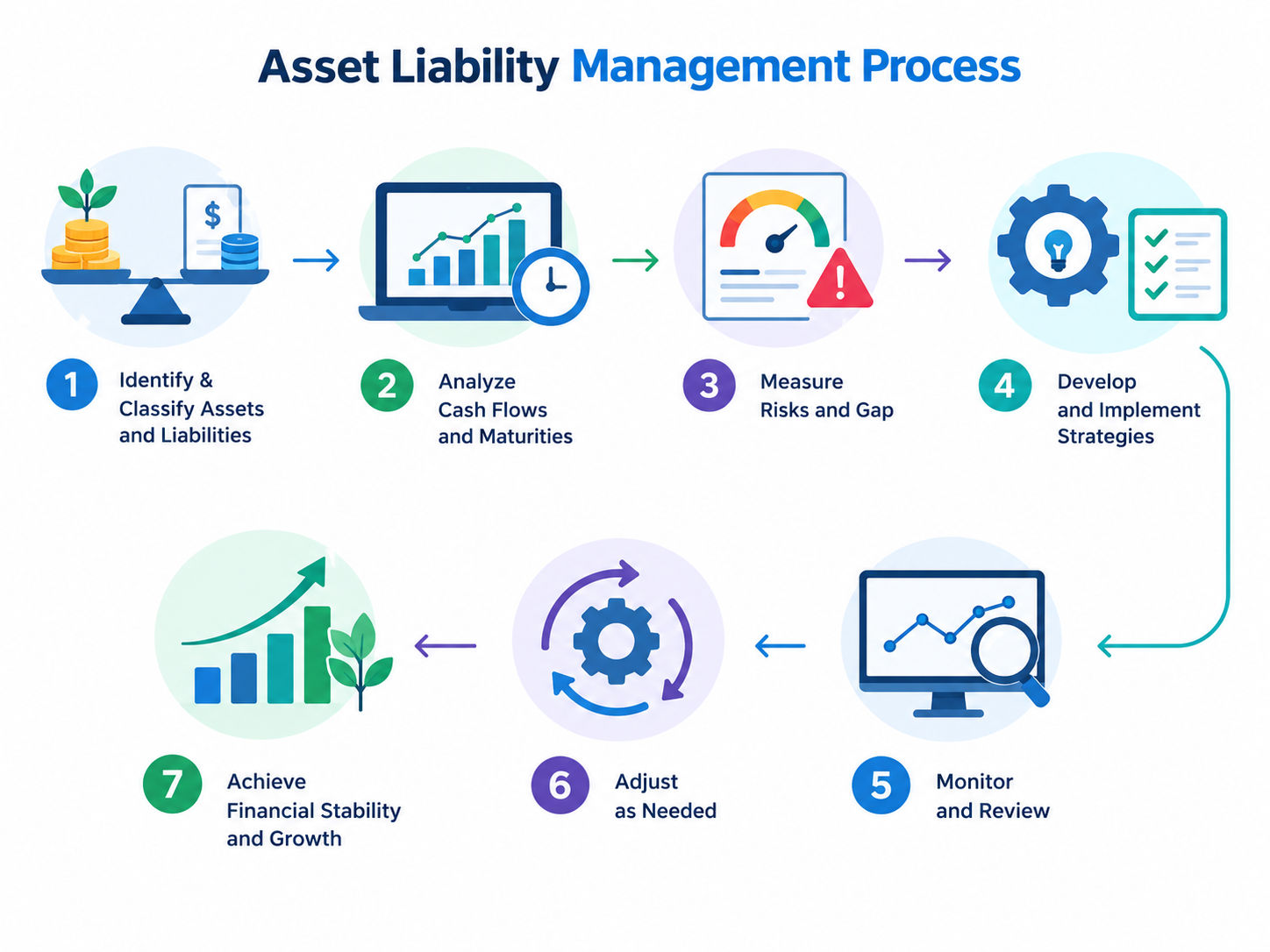
The first step is to understand what the institution owns and what it owes.
The bank reviews its loans, investments, cash balances, deposits, borrowings, and other financial positions. It also examines when money is expected to come in and when payments are due.
The review may consider:
This creates a clearer picture of the institution's financial position.
After identification of asset and liability items, a bank compares cash-flow and maturity characteristics of assets with those of liabilities.
For example, if a bank holds many long-term loans, but the majority of its liabilities are short-term deposits, the bank faces the risk that deposit inflows will be insufficient to meet loan outflows.
By analysing asset-liability mismatches, a bank can identify gaps before they become serious problems.
A bank can classify its assets and liabilities into different maturity categories (such as short-term, medium-term, and long-term) to identify time intervals during which funding gaps might arise.
The next stage is to measure the risks associated with identified mismatches.
For liquidity risk, the institution assesses whether it can meet expected and unexpected cash requirements.
For interest rate risk, it examines how changes in interest rates could affect income and the value of assets and liabilities.
Banks may use techniques such as:
These methods allow management to understand how the balance sheet might be affected at different levels of financial conditions.
The course of action open to a financial institution after risk identification and measurement is to determine what it wishes to do to mitigate the risk.
For example, a bank may decide to diversify its sources of funds, alter the maturity structure of its investment portfolio, change loan rates, hold more liquid assets, or use any other hedging instruments to offset the risk. The action to be taken depends on the nature and magnitude of the risk exposed.A bank does not necessarily try to eliminate every mismatch. Some mismatches may be acceptable if the expected return justifies the associated risk and adequate safeguards are in place.
Financial conditions can change quickly. Interest rates may rise, deposit behaviour may change, and market liquidity can weaken.
Therefore, asset liability management is an ongoing process.
Banks regularly monitor:
If the risk profile changes, the bank can revise its strategy accordingly.
Also Read: Complete Guide to Product Management Career: Skills and Opportunities for Growth
A bank can have a profitable loan portfolio and still face financial pressure if it cannot meet its obligations when they are due. This makes balance-sheet management an important part of banking operations.
Banks need funds to honour withdrawals, settle payments, and meet other obligations. Effective management helps maintain adequate liquid resources without keeping excessive funds idle.
Interest rates influence both the income generated by assets and the cost of liabilities. Monitoring these exposures helps banks understand how rate changes could affect profitability.
A mismatch between the maturity of assets and liabilities can create funding pressure. Identifying these gaps allows banks to take action before they become difficult to manage.
Understanding expected inflows and outflows makes it easier to plan funding requirements and allocate available resources.
A well-managed balance sheet can help an institution withstand unexpected changes in market conditions, funding availability, or customer behaviour.
Risk management and profitability need to work together. Holding too much cash may reduce potential returns, while taking excessive risk can threaten financial stability. A balanced approach helps management make more informed decisions.
Also read: What is Project Management Process: Phases and Life Cycle
Consider a bank with ₹500 crore in customer deposits. It uses:
The bank earns returns from its loans and investments, but there is a timing gap. Customers may withdraw their deposits sooner, while home loans may be repaid over several years.
If withdrawals increase suddenly, the bank could face a cash shortage. Asset liability management helps it spot this gap early and respond by maintaining enough liquid funds, adjusting investments, or arranging additional funding.
Interest rates can create another challenge. If borrowing and deposit costs rise faster than loan income, the bank may need to review its loan rates, investments, and funding mix.
The example shows why banks must manage both the amount and timing of their assets and liabilities.
Also read: Top 10 Types of Project Management Organizational Structures
Managing assets and liabilities can become difficult when financial conditions change unexpectedly.
Interest rates can affect borrowing costs, deposit rates, investment returns, and loan income. Sudden changes can alter the expected profitability of different financial positions.
Customers may withdraw deposits faster than expected, particularly during periods of economic uncertainty. Banks need sufficient liquidity to respond to such situations.
Long-term assets funded by short-term liabilities can create pressure when funding needs arise before assets generate sufficient cash.
Changes in bond prices, currency values, credit conditions, and other market factors can affect the value and risk profile of assets.
Deposit patterns and borrowing demand do not always follow forecasts. Changes in customer preferences can affect funding and liquidity plans.
Financial institutions operate within regulatory frameworks that require them to maintain appropriate liquidity, capital, and risk-management practices. Changes in regulations can require adjustments to existing strategies.
Future loan repayments, withdrawals, investment returns, and funding costs cannot always be predicted accurately. Banks therefore need to consider different possible scenarios rather than relying on a single forecast.
Also read: Top Project Management Case Studies with Real-World Solutions 2026
The Asset Liability Management Committee (ALCO) is responsible for overseeing important balance-sheet and risk-management decisions in many banks and financial institutions.
The committee typically brings together senior members from areas such as treasury, finance, risk management, lending, and business operations.
Its responsibilities may include:
For example, if a bank expects a significant funding gap in a particular period, ALCO can review the situation and consider appropriate funding or investment actions.
The committee also helps connect day-to-day financial decisions with the institution's broader risk and profitability objectives.
Asset liability management can be defined as a management method used to balance an institution’s assets, liabilities, inflows of cash, outflows of cash, and risks. This management practice is especially essential for financial institutions to estimate the connection between their liabilities and assets on a given date.
Banks’ deposits, loans, investments, and borrowings have different maturity dates and attract or provided differing interest rates. A bank’s ALM framework helps it balance its liquidity needs and control interest rate risks as well as avert negative mismatches between its assets and liabilities. It also allows the bank to make wise financial choices.
A bank must constantly assess and update its ALM practices. For example, a bank’s ALM framework is always in the process of reviewing and renewing its balance sheet to adapt to new risks and exposures that emerge as a result of its day-to-day operations and macroeconomic trends.
Ready to start your journey? Book a free consultation with upGrad today to find the best path for your career.
Asset liability management means managing an organisation's assets and liabilities together to maintain liquidity, control financial risks, and support stable returns. It involves reviewing cash flows, maturity periods, interest rates, and funding requirements so the organisation can meet its obligations without taking unnecessary financial risks.
Banks accept deposits and use funds to provide loans and make investments. These assets and liabilities can have different maturity periods and interest rates. ALM helps banks manage these differences, maintain sufficient liquidity, control interest rate exposure, and reduce the possibility of financial stress.
The main objectives are to maintain adequate liquidity, manage interest rate risk, control maturity mismatches, improve cash-flow planning, and support financial stability. It also helps banks balance risk and return when making decisions about lending, investments, deposits, and other funding sources.
The major risks include liquidity risk, interest rate risk, funding risk, and maturity risk. These risks can affect a bank's ability to meet financial obligations or maintain expected earnings. Monitoring the timing and characteristics of assets and liabilities helps identify and manage these exposures.
An asset-liability mismatch occurs when the timing, maturity, interest rate, or cash-flow characteristics of assets differ significantly from those of liabilities. For example, a bank may use short-term deposits to fund long-term loans. Such differences can create liquidity or interest rate risks if not properly managed.
ALM helps banks forecast cash inflows and outflows, identify potential funding gaps, and maintain appropriate liquid resources. Banks can also diversify funding sources and adjust investment or lending strategies. These actions help them meet withdrawals and other obligations even when actual cash requirements differ from forecasts.
ALM examines how changes in interest rates can affect the income and value of assets and liabilities. Banks compare interest-sensitive positions and use techniques such as gap analysis and scenario testing to understand potential effects. They can then adjust pricing, funding, investments, or other positions.
ALCO, or the Asset Liability Management Committee, oversees important balance-sheet and risk-management decisions. It reviews liquidity, interest rate exposure, funding requirements, and asset-liability gaps. The committee helps senior management decide whether changes are needed to maintain an appropriate balance between risk, liquidity, and profitability.
An ALM framework generally includes balance-sheet analysis, liquidity management, interest rate risk management, maturity-gap analysis, cash-flow forecasting, stress testing, and ongoing monitoring. The exact framework can differ between institutions depending on their size, business model, risk profile, and regulatory requirements.
No. Although banks are major users, other financial institutions can also use ALM. Insurance companies, pension funds, investment organisations, and other institutions with significant assets and financial obligations may use similar approaches to manage liquidity, interest rate exposure, cash flows, and balance-sheet risks.
Asset management focuses mainly on how an organisation manages the resources it owns or invests. Liability management focuses on obligations and funding sources. ALM considers both sides together, helping an institution understand how its assets and liabilities interact and whether their cash flows, maturities, and risks are appropriately balanced.
727 articles published
Sriram K is a Senior SEO Executive with a B.Tech in Information Technology from Dr. M.G.R. Educational and Research Institute, Chennai. With over a decade of experience in digital marketing, he specia...
Speak with MBA expert
By submitting, I accept the T&C and
Privacy Policy
From MBA to Dream Job - Explore Our Alumni Success Stories
Top Resources
Master's Degree
13 Months
Master's Degree
12 Months
Master's Degree
15 Months