Talent Management: Meaning, Strategies, Process and Career Scope
By Faheem Ahmad
Updated on May 07, 2026 | 10 min read | 2.5K+ views
Share:

All courses
Certifications
More
By Faheem Ahmad
Updated on May 07, 2026 | 10 min read | 2.5K+ views
Share:
Table of Contents
Talent management is a continuous, strategic approach to attracting, recruiting, developing, engaging, and retaining skilled employees to support business objectives. It aims to optimize every stage of the employee lifecycle, from hiring to succession planning, helping organizations build a strong, competitive, and high‑performing workforce.
In this guide, you will learn the talent management meaning, why it is important, key components, process, strategies, models, benefits, challenges, tools, and career opportunities in talent management.
Looking to apply workplace efficiency concepts like talent management in real business settings? Explore upGrad’s management programs to build practical leadership, operations, and process improvement skills.
Popular Management Programs
Talent management is a strategic process of hiring, developing, managing, and retaining employees with the right skills to support business goals. It goes beyond recruitment and includes workforce planning, employee development, performance management, succession planning, engagement, and retention.
Modern talent management focuses on continuous learning, leadership development, and creating a strong workplace culture for long-term organizational growth.
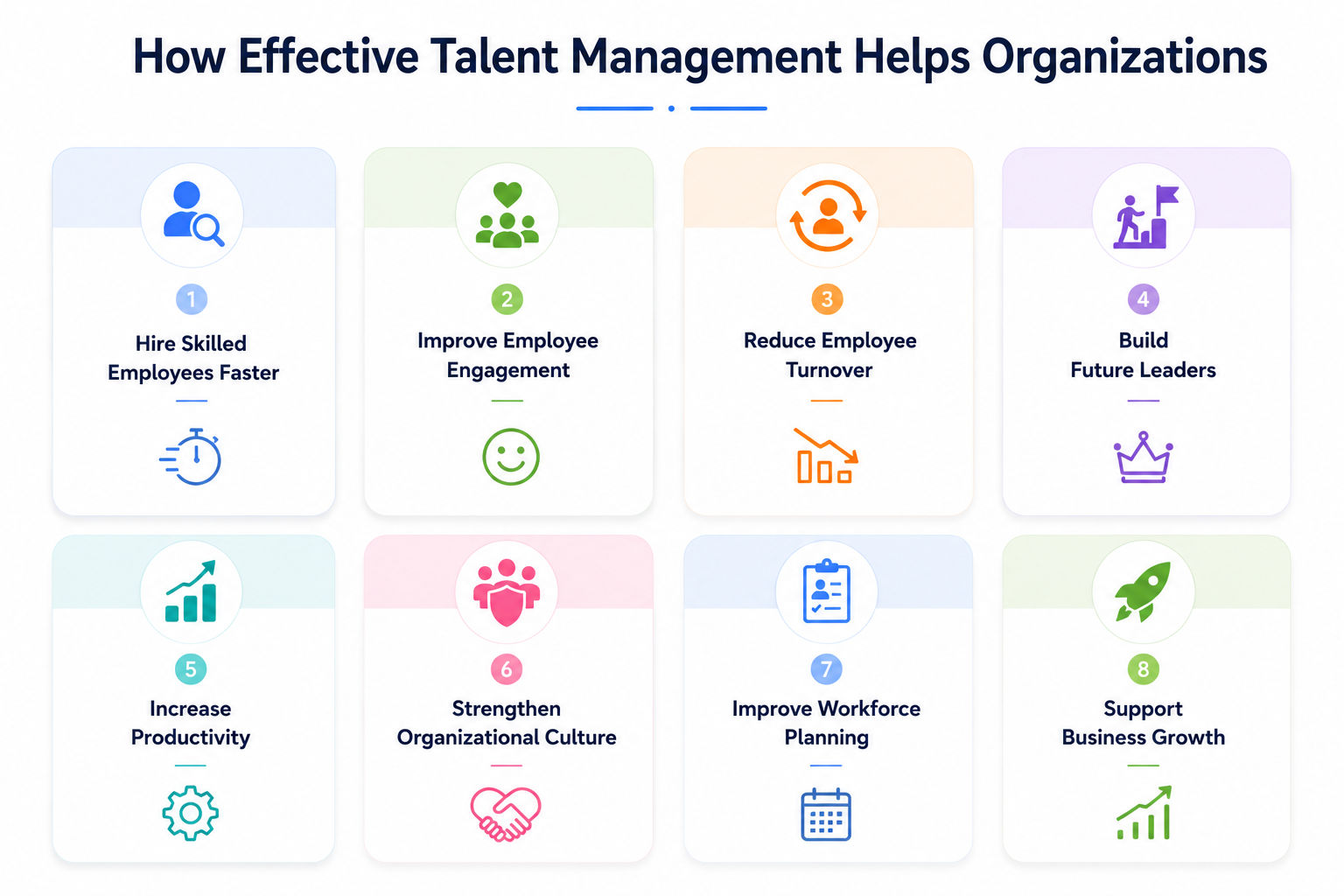
Every organization depends on people to achieve business success. Effective talent management ensures employees remain productive, motivated, and aligned with company goals.
Free Courses
Organizations implement talent management strategies to build a high-performing workforce and support long-term business growth.
Also Read: Talent Acquisition Manager Job Description: Salary, Top Companies, and Future
Management Courses to upskill
Explore Management Courses for Career Progression
IIIT-B & IIM, Udaipur
Chief Technology Officer & AI Leadership ProgrammeSuccessful talent management depends on multiple interconnected components working together effectively.
Talent acquisition involves identifying, attracting, and hiring suitable candidates for organizational roles.
It includes:
Onboarding helps new employees understand company culture, processes, and job expectations.
Effective onboarding improves:
Learning and development programs help employees improve technical, managerial, and leadership skills.
Organizations commonly use:
Performance management evaluates employee contributions and supports continuous improvement.
This includes:
Employee engagement focuses on creating a positive work environment where employees feel valued and motivated.
Common engagement strategies include:
Succession planning ensures organizations are prepared for future leadership transitions.
It involves:
Most organizations follow a structured talent management process to manage workforce performance and long-term business growth effectively.
Organizations first analyze current workforce capabilities and future business requirements.
Managers identify:
The next step involves sourcing, evaluating, and hiring qualified candidates.
Recruitment methods may include:
Once employees are hired, onboarding programs help them integrate into the organization quickly.
Strong onboarding improves employee engagement and early productivity.
Organizations provide continuous learning opportunities to help employees improve skills and adapt to changing industry requirements.
Managers monitor employee performance through reviews, feedback sessions, and goal tracking systems.
Performance evaluations help organizations:
Organizations focus on retaining high-performing employees and preparing future leaders through mentoring, growth opportunities, and leadership programs.
Also Read: Techniques of Decision-Making: 15+ Tools & Methods for Success in 2026
Organizations use different talent management strategies depending on industry requirements, workforce size, and business goals.
Employer branding helps companies build a strong reputation as desirable workplaces.
Businesses improve employer branding through:
Many organizations now prioritize skills and practical capabilities over traditional qualifications alone. Skills-based hiring improves workforce flexibility and expands talent pools.
Internal mobility allows employees to move across roles or departments within the organization.
Benefits include:
Leadership development programs prepare employees for managerial and executive positions.
These programs often include:
Modern organizations are replacing annual performance reviews with continuous feedback systems.
Regular feedback improves communication, performance improvement, and employee engagement.
Diverse workplaces improve innovation, collaboration, and decision-making.
Talent management strategies increasingly focus on:
Different organizations use different talent management models depending on business objectives and workforce structure.
Also Read: Human Resources Specialist Job Description
Modern businesses use talent management software to automate recruitment, performance tracking, learning, and employee engagement processes.
Tool |
Best Used For |
Key Features |
| Workday | Enterprise talent management | HR analytics, workforce planning, recruitment |
| SAP SuccessFactors | Large workforce management | Performance management, learning systems |
| Oracle HCM Cloud | Global HR operations | Talent acquisition, succession planning |
| BambooHR | Small and mid-sized businesses | Employee records, onboarding, reporting |
| Cornerstone OnDemand | Learning and development | Online learning, skill tracking |
| LinkedIn Talent Solutions | Recruitment and employer branding | Candidate sourcing, recruitment marketing |
These tools improve workforce visibility, reduce manual processes, and support data-driven decision-making.
Also Read: What Are the Levels of Management: A Comprehensive Guide
Strong talent management systems provide long-term advantages for both organizations and employees.
Do Read: What are Problem Solving Skills? Definition, Examples and Steps to learn
Despite its benefits, organizations often face multiple talent management challenges.
Also Read: 15 Ways to Improve Your Time Management Skills
Talent management offers strong career opportunities across industries such as IT, healthcare, finance, retail, manufacturing, consulting, and education.
Popular Job Roles |
Important Skills for Talent Management Professionals |
| Talent Acquisition Specialist | Communication |
| HR Manager | Leadership |
| Talent Management Consultant | Recruitment expertise |
| Learning and Development Manager | Workforce analytics |
| Employee Engagement Specialist | Problem-solving |
| Workforce Planning Analyst | Employee relationship management |
| HR Business Partner | Strategic planning |
| Organizational Development Manager | Performance management |
Professionals with expertise in talent management are increasingly valuable because organizations now consider workforce strategy a critical business function.
Talent management helps organizations attract, develop, and retain skilled employees to support long-term business growth. It improves productivity, employee engagement, leadership development, and workforce performance through strategic hiring, learning, and succession planning.
As AI, hybrid work, and digital transformation reshape workplaces, effective talent management will remain essential for building adaptable teams, improving employee satisfaction, and maintaining a competitive advantage in 2026 and beyond.
Ready to start your journey? Book a free consultation with upGrad today to find the best path for your career.
Talent management is the process of attracting, developing, managing, and retaining employees to improve organizational performance. It focuses on ensuring businesses have skilled professionals in the right roles while supporting employee growth, engagement, productivity, and long-term workforce planning for sustainable business success.
The main purpose of talent management is to build a capable workforce that supports business growth and operational efficiency. Organizations use structured hiring, learning, and development strategies to improve productivity, prepare future leaders, reduce turnover, and maintain a competitive advantage in changing market conditions.
Human resource management handles employee administration, compliance, payroll, and workplace policies, while talent management focuses more on attracting, developing, and retaining high-performing employees. It emphasizes workforce planning, leadership development, performance improvement, and employee engagement to support long-term organizational growth and stability.
Talent management is important in 2026 because organizations face rapid digital transformation, evolving employee expectations, and increasing skill shortages. Businesses need adaptable, future-ready teams to remain competitive. Strong workforce strategies help companies improve retention, productivity, innovation, and leadership development in modern workplaces.
The key stages of talent management include workforce planning, recruitment, onboarding, employee training, performance management, engagement, retention, and succession planning. These stages help organizations manage employees effectively, improve productivity, identify future leaders, and align workforce capabilities with long-term business goals.
Talent management tools are digital platforms that help organizations manage recruitment, employee development, performance reviews, learning programs, and workforce analytics. These systems improve efficiency by automating HR processes, tracking employee progress, supporting workforce planning, and helping businesses make data-driven talent decisions more effectively.
AI improves talent management by automating repetitive HR tasks such as resume screening, candidate matching, and workforce analytics. It also helps organizations predict employee turnover, identify skill gaps, personalize training programs, and improve hiring decisions, making workforce management faster, smarter, and more accurate.
Talent management professionals require skills such as communication, leadership, recruitment expertise, workforce analytics, strategic planning, and employee relationship management. Strong problem-solving and interpersonal abilities are also important for handling workforce challenges, improving employee engagement, and supporting organizational development and business growth effectively.
Almost every industry uses talent management to improve workforce performance and employee retention. Sectors such as IT, healthcare, finance, education, manufacturing, retail, logistics, and consulting rely on structured talent strategies to manage hiring, employee development, leadership planning, and long-term organizational growth successfully.
Common challenges in talent management include skill shortages, employee burnout, high turnover, changing workforce expectations, and difficulty measuring employee performance fairly. Organizations may also struggle with leadership gaps, resistance to change, and maintaining employee engagement in remote or hybrid work environments.
Yes, effective talent management can improve employee retention by creating better career growth opportunities, learning programs, recognition systems, and positive workplace culture. Employees are more likely to stay in organizations that support professional development, work-life balance, engagement, and long-term career progression opportunities.
Succession planning is a strategy used to identify and develop employees who can fill critical leadership or business roles in the future. It ensures organizational continuity, reduces disruptions during leadership transitions, and helps businesses prepare skilled professionals for long-term management and operational responsibilities.
79 articles published
Faheem Ahmad is an Associate Content Writer with a specialized background in MBA (Marketing & Operations). With a professional journey spanning around a year, Faheem has quickly carved a niche in the ...
Get Free Consultation
By submitting, I accept the T&C and
Privacy Policy
Top Resources
Certification
3 Months
Certification
6 Months
O.P. Jindal Global University
Masters in International Accounting and Finance (Accredited by ACCA, UK)Master's Degree
12 Months