Resource Management: Meaning, Importance, Types, Process, and Career
By Faheem Ahmad
Updated on May 07, 2026 | 10 min read | 2.74K+ views
Share:

All courses
Certifications
More
By Faheem Ahmad
Updated on May 07, 2026 | 10 min read | 2.74K+ views
Share:
Table of Contents
Resource management involves planning, assigning, and scheduling an organization’s resources such as people, budgets, and equipment to achieve goals efficiently. It focuses on matching available capacity with actual demand to prevent overload, unnecessary spending, and misused effort. When done effectively, it improves return on investment and supports consistent, on‑time project delivery.
In this guide, you will understand the meaning of resource management, its importance, major types, core components, process, techniques, tools, benefits, challenges, and career opportunities.
Looking to apply workplace efficiency concepts like resource management in real business settings? Explore upGrad’s management programs to build practical leadership, operations, and process improvement skills.
Popular Management Programs
Resource management refers to the process of planning, scheduling, allocating, and monitoring resources to complete projects or business operations efficiently. These resources can include employees, budgets, machinery, software, infrastructure, workspace, or time.
The primary objective of resource management is to maximize productivity while minimizing waste and operational inefficiencies.
Good resource management helps organizations:
For example, if a company launches a mobile application project, managers need to decide:
Without proper resource management, projects can quickly become disorganized and expensive.
Also Read: Complete Guide to Resource Management Projects: Key Steps, Tools, and Strategies
Every organization works with limited resources. Effective resource management helps businesses achieve better results without unnecessary waste.
Here is a simple comparison:
Poor Resource Management |
Effective Resource Management |
| Budget overruns | Better cost control |
| Employee overload | Balanced workloads |
| Project delays | Predictable timelines |
| Idle resources | Maximum utilization |
| Poor communication | Better coordination |
Also Read: An Introduction to Principles of Management
Free Courses
Different industries use different forms of resource management depending on business requirements and operational goals.
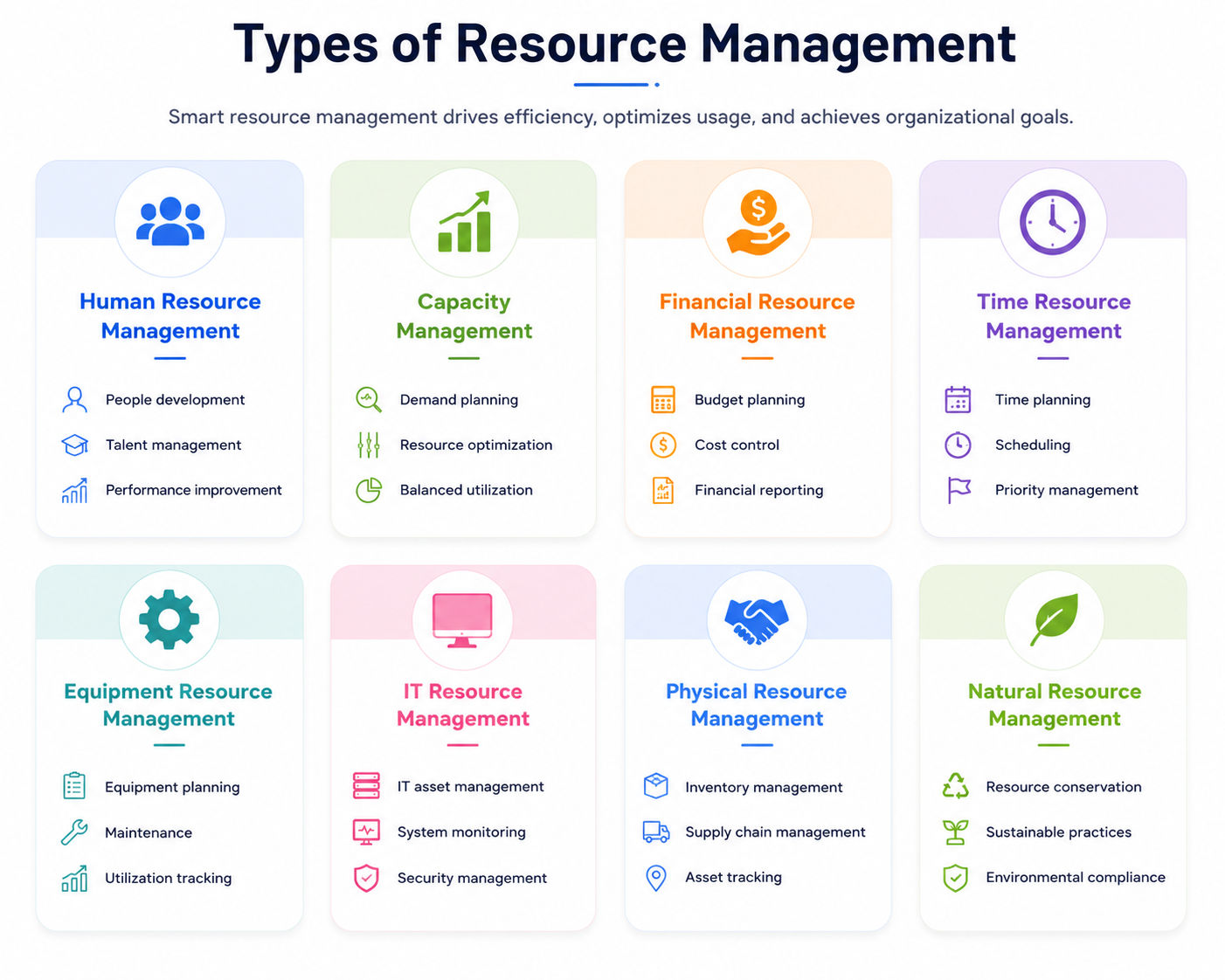
Human resource management focuses on managing employees, schedules, skills, and workloads effectively.
It includes:
This type of resource management is widely used in industries such as IT, healthcare, consulting, education, and marketing.
Financial resource management focuses on controlling budgets, investments, expenses, and operational costs.
Organizations use it to:
Time is one of the most valuable organizational resources. Time resource management helps teams complete work efficiently without missing deadlines.
Common methods include:
Industries like construction, manufacturing, logistics, and healthcare depend heavily on equipment management.
This includes:
Modern businesses depend heavily on technology infrastructure. IT resource management ensures systems remain secure, scalable, and operational.
IT teams manage:
Also Read: Techniques of Decision-Making: 15+ Tools & Methods for Success in 2026
Management Courses to upskill
Explore Management Courses for Career Progression
IIIT-B & IIM, Udaipur
Chief Technology Officer & AI Leadership ProgrammeSuccessful resource management depends on several core components working together efficiently.
Resource planning is the foundation of resource management.
It involves:
Resource allocation means assigning resources to projects or tasks based on:
Scheduling ensures resources are available at the right time.
This includes:
Tracking allows organizations to monitor how resources are being utilized.
Managers track:
Resource optimization focuses on improving overall efficiency.
This may include:
Most organizations follow a structured resource management process to improve operational efficiency and project success.
The first step is understanding which resources are currently available.
This includes:
Managers determine:
Resources are assigned based on:
Organizations use tracking systems and dashboards to monitor utilization levels and performance.
Resource management is an ongoing process. Managers continuously adjust schedules, workloads, and allocations based on project changes and business priorities.
Must Read: Human Resource Management Process: Meaning, Importance, Steps and Tools
Organizations use multiple resource management techniques to improve efficiency and productivity.
Resource allocation ensures teams receive the right people, budgets, and tools to complete tasks effectively.
Benefits include:
Resource leveling balances workloads when resources become overloaded.
Managers may:
Resource smoothing optimizes resource usage without changing project deadlines. The goal is to maintain efficiency while preserving timelines.
Capacity planning helps organizations determine whether they have enough resources for upcoming projects.
It helps prevent:
Forecasting predicts future resource demand using historical data and business trends.
Organizations use forecasting to:
Also Read: Techniques of Decision-Making: 15+ Tools & Methods for Success in 2026
Modern businesses use resource management tools to plan workloads, monitor team capacity, manage budgets, and improve project execution. These platforms provide better visibility into resources, reduce scheduling conflicts, and improve operational efficiency across departments.
Tool |
Best Used For |
Key Features |
| Microsoft Project | Enterprise project and resource planning | Project scheduling, resource tracking, budget management, timeline planning |
| Jira | Agile and software development teams | Sprint planning, task tracking, workflow automation, team collaboration |
| Monday.com | Team and workload management | Workload tracking, task planning, collaboration dashboards, automation |
| Smartsheet | Resource tracking and reporting | Spreadsheet-style management, reporting, workflow tracking, project visibility |
| Asana | Team coordination and task management | Task assignment, workflow management, deadline tracking, collaboration tools |
Also Read: What Are the Levels of Management: A Comprehensive Guide
Resource management improves productivity, controls operational costs, and helps businesses complete projects efficiently. However, organizations also face several challenges while managing teams, workloads, and budgets.
Strong resource management creates long-term business advantages by improving efficiency and reducing operational waste.
Even experienced organizations face resource management challenges.
Do Read: Best Business Management Courses in India [2026]
Resource management offers strong career opportunities across multiple industries.
Popular job roles include:
Important skills for resource management professionals include:
Industries hiring resource management professionals include:
Also Read: Facility Management: Meaning, Types, Roles, Benefits, and Career Scope
Resource management helps businesses use people, time, budgets, and tools efficiently to reduce waste and improve productivity. It supports timely project delivery, balanced workloads, smoother collaboration, and better cost control while improving employee and customer experience.
As automation, AI, hybrid work, and digital transformation grow, resource management will become even more critical in 2026 and beyond. Organizations that manage resources well will stay more competitive, productive, and prepared for future challenges.
Ready to start your journey? Book a free consultation with upGrad today to find the best path for your career.
Resource management metrics measure how well resources are being used. Common metrics include utilization rate, capacity variance, billable vs non‑billable time, and resource availability. These metrics help teams identify inefficiencies and make data‑based planning decisions.
Common challenges include inaccurate forecasting, sudden scope changes, limited visibility into workloads, and skill mismatches. Remote work and cross‑functional teams can further complicate planning if systems and communication are not aligned properly.
In agile teams, resource management focuses more on capacity and skill availability than fixed schedules. Instead of long‑term allocation, teams plan resources sprint by sprint, adjusting workloads based on velocity, priorities, and real‑time feedback.
Resource forecasting predicts future resource needs based on upcoming demand, historical data, and business goals. It helps organizations prepare in advance, avoid last‑minute hiring, and ensure the right skills are available when needed.
Remote work increases the need for clear visibility, accurate tracking, and strong communication. Managers must account for time zones, availability differences, and digital collaboration tools to ensure resources remain balanced and productive.
Useful qualifications include degrees in management, operations, or engineering, along with project or operations experience. Certifications related to project management, analytics, or workforce planning can further strengthen a resource management career.
AI helps automate forecasting, optimize schedules, and identify workload risks early. Modern systems use data patterns to recommend resource adjustments, improving accuracy and helping managers respond faster to changing demand.
Yes. Balanced workloads, fair allocation, and predictable schedules reduce stress and burnout. When people feel their time and skills are respected, job satisfaction improves, which directly supports higher retention rates.
Capacity planning focuses on what resources are available, while demand planning focuses on future work requirements. Resource management connects both by matching capacity with demand in a realistic and sustainable way.
Resource management applies beyond projects. Operations, support teams, sales, and administrative functions also rely on structured planning to manage time, staffing, and workload efficiently across daily and long‑term responsibilities.
Results often appear within a few planning cycles. Improved visibility, better workload balance, and fewer conflicts can be seen quickly, while cost savings and productivity gains become clearer over several months of consistent practice.
79 articles published
Faheem Ahmad is an Associate Content Writer with a specialized background in MBA (Marketing & Operations). With a professional journey spanning around a year, Faheem has quickly carved a niche in the ...
Get Free Consultation
By submitting, I accept the T&C and
Privacy Policy
Top Resources
Certification
3 Months
Certification
6 Months
O.P. Jindal Global University
Masters in International Accounting and Finance (Accredited by ACCA, UK)Master's Degree
12 Months