Facility Management: Meaning, Types, Roles, Benefits, and Career Scope
By upGrad
Updated on May 07, 2026 | 469 views
Share:

All courses
Certifications
More
By upGrad
Updated on May 07, 2026 | 469 views
Share:
Table of Contents
Facility management is the discipline of keeping a building and its supporting services running smoothly. It covers everything from fixing a broken air conditioner to making sure emergency exits are clear, and fire systems are tested on schedule. Every time you walk into a well-lit, clean, and safe office or hospital, facility management is working quietly behind the scenes.
This guide covers everything you need to know: what facility management means, how it works, the types involved, its core functions, why it matters to businesses, and how you can build a career in this field. By the end, you will have a clear picture of this profession and how it shapes the spaces we work and live in.
If you want to build management skills and explore career opportunities in this field, check out the management programs.
Popular Management Programs
Facility management is the practice of coordinating people, processes, and technology to ensure that physical spaces function effectively. It goes beyond basic maintenance. It’s about creating environments that support business goals, employee comfort, and long-term sustainability.
FM is used across almost every industry, and some of these are as follows:
Free Courses
Modern organizations treat their buildings as strategic assets rather than just overhead costs. Effective management leads to better energy efficiency and a smaller carbon footprint, which is essential for meeting modern ESG (Environmental, Social, and Governance) goals.
Feature |
Without Management |
With Facility Management |
| Asset Lifespan | Short (Reactive repairs) | Long (Preventive maintenance) |
| Operational Costs | Unpredictable and high | Optimized and budgeted |
| Safety Compliance | High risk of violations | Strict adherence to codes |
| Workplace Morale | Low (Poor environment) | High (Comfortable space) |
A useful way to understand the functions of facility management is to divide them into two broad groups:
Management Courses to upskill
Explore Management Courses for Career Progression
IIIT-B & IIM, Udaipur
Chief Technology Officer & AI Leadership Programme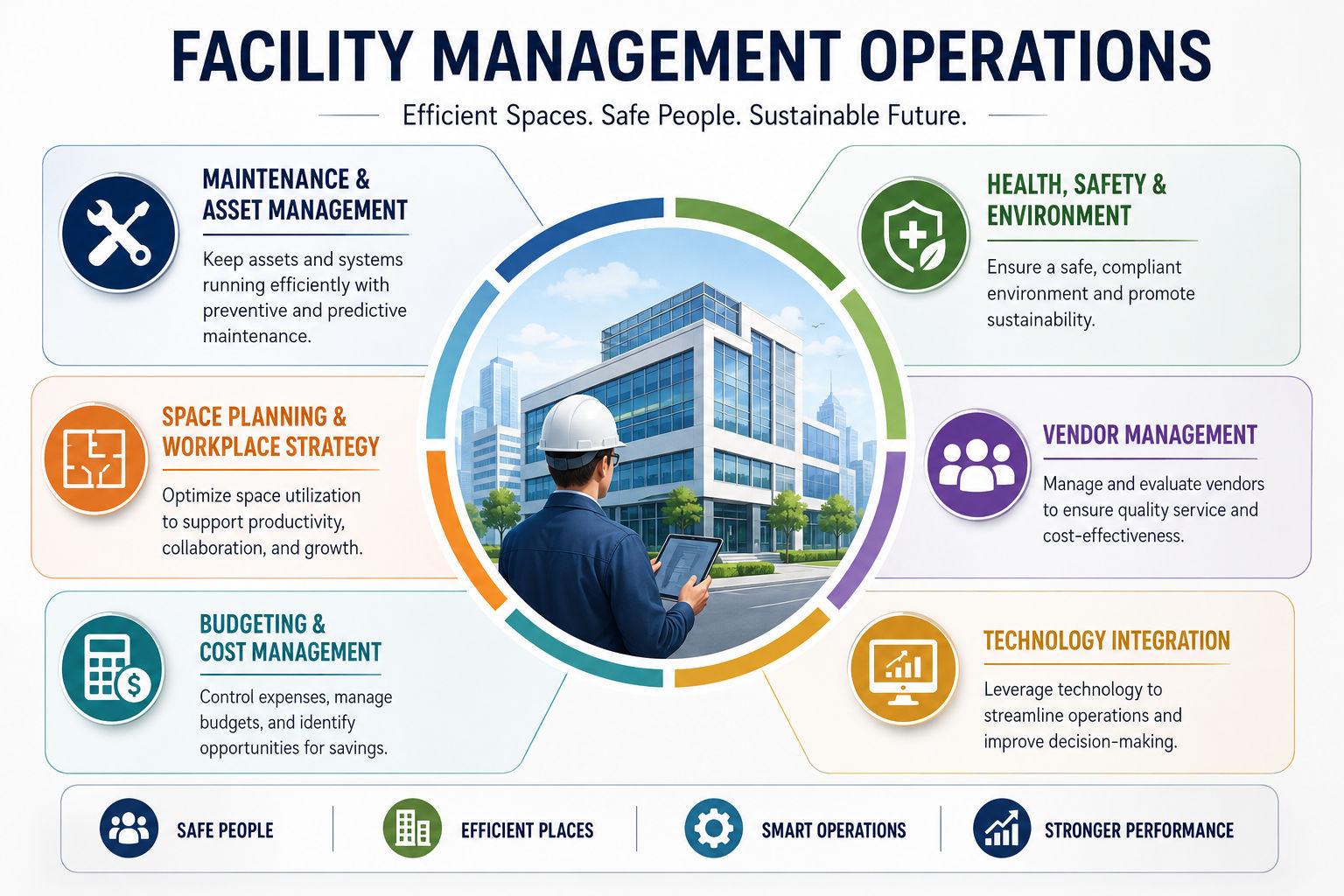
To excel in facility management, one must juggle various technical and administrative tasks. The role is multifaceted, requiring a mix of engineering knowledge, financial planning, and people's management skills. The process is continuous, involving daily inspections and long-term strategic planning to keep a facility at its peak performance level.
The most visible part of the job is maintaining physical building. This includes everything from the roof to the basement. Managers use a mix of three maintenance styles to keep things running:
A major part of facility management involves keeping people safe. Managers must ensure the building complies with fire safety laws, air quality standards, and accessibility requirements. In the event of an emergency, such as a fire or a natural disaster, the facility manager is responsible for the evacuation plans and the safety of everyone on-site. This responsibility extends to environmental sustainability, where managers find ways to reduce waste and lower electricity consumption.
As the nature of work changes, so does the need for space. A facility manager analyzes how office space is used and suggests ways to optimize it. This might involve moving desks to foster better collaboration or repurposing storage rooms into "quiet zones" for focused work. By maximizing the use of every square foot, facility management helps an organization avoid the high cost of renting unnecessary additional space.
The industry is currently undergoing a digital transformation. Gone are the days of tracking building repairs on paper or simple spreadsheets. Today, facility management relies on sophisticated software and hardware to monitor building health in real-time. This digital shift allows managers to be proactive rather than waiting for someone to report a broken lightbulb or a leaking pipe.
A CMMS is the "brain" of a modern facility. This software allows managers to track every asset in a building, from a single air conditioning unit to a complex elevator system. When a piece of equipment needs servicing, the system automatically alerts the team. This ensures that facility management remains organized and that no task falls through the cracks. It also provides a digital paper trail for safety inspections and audits.
IoT devices have revolutionized how buildings are monitored. Sensors can now detect if a room is empty and automatically turn off the lights or adjust the temperature. In facility management, these sensors provide data on how the building is actually performing. For example, vibration sensors on a water pump can alert a manager that the motor is starting to wear out weeks before it breaks down.
BIM is a digital representation of the physical and functional characteristics of a facility. It provides a 3D model that includes information about every pipe, wire, and duct in the building. For facility management professionals, having access to a BIM model means they don't have to guess where a leak is coming from behind a wall; they can see the exact layout of the plumbing on their screen.
| Technology | Function | Primary Benefit |
| CMMS | Work order tracking | Organization and history |
| IoT Sensors | Real-time monitoring | Energy and cost savings |
| BIM | 3D building mapping | Fast and accurate repairs |
The demand for skilled professionals in facility management is growing rapidly as buildings become more complex and "smart." This is no longer a career restricted to those with a background in manual labor or janitorial services. It is a high-tech field that requires an understanding of data analytics, sustainable engineering, and corporate strategy.
Education and Certification
Most modern roles in this field require a degree in business, engineering, or a dedicated program in facility management. Many professionals also seek certifications like the FMP (Facility Management Professional) or the CFM (Certified Facility Manager). These credentials prove that a manager understands the global standards for safety, finance, and operations. As businesses expand globally, having a standardized approach to managing their offices is a major advantage.
Sustainability and Green Building
One of the biggest trends in the industry is the "Green Building" movement. Governments around the world are passing laws to force buildings to be more eco-friendly. Consequently, facility management is now at the forefront of the fight against climate change. Managers are being tasked with installing solar panels, implementing zero-waste recycling programs, and finding ways to reuse greywater for landscaping.
The Rise of the Hybrid Workplace
The shift toward remote and hybrid work has forced a rethink of how we manage buildings. Since offices are no longer full every day, facility management must become more flexible. This involves using "hot-desking" apps and adjusting climate control based on the number of people in the building. The focus has shifted from managing a static space to managing a dynamic, flexible environment that responds to the needs of the workforce.
Facility management is one of those fields that people rarely notice when it is working well and immediately feel when it is not. It is the backbone of every functional workplace, hospital, school, or commercial space.
For businesses, it is a strategic function that protects assets, ensures compliance, controls costs, and creates better environments for people. For professionals, facility management offers a growing, well-paying career path with opportunities across every industry.
Want personalized guidance on courses and upskilling opportunities? Connect with upGrad’s experts for a free 1:1 counselling session today!
A facility manager oversees the day-to-day operations of a building or group of buildings. On any given day, they might schedule maintenance checks, manage vendor contracts, inspect safety systems, review energy consumption reports, handle complaints from staff, and ensure the building meets all compliance requirements. It is a mix of technical, operational, and administrative work.
Integrated facility management is a model where a single provider or team manages all FM services, both hard and soft, under one contract. Rather than dealing with multiple vendors for maintenance, cleaning, and security, an organization uses one FM partner for everything. This approach reduces complexity, improves accountability, and often leads to cost savings.
Most entry-level roles in facility management require a degree in engineering, business, hospitality, or architecture. For career advancement, certifications like CFM (Certified Facility Manager) from IFMA or IWFM qualifications are highly regarded. Practical experience in operations, maintenance, or property management is also very valuable in this field.
CAFM stands for Computer-Aided Facility Management. It is a software platform that helps facility management teams plan, manage, and report on all FM activities in one place. It tracks maintenance schedules, space utilisation, work orders, asset data, and compliance records.
The global facility management market is growing steadily. Increasing urbanization, the rise of smart buildings, growing focus on workplace wellbeing, and stricter ESG requirements are all driving demand for professional FM services. The market is expected to cross USD 1 trillion in value in the coming years, with strong growth across Asia-Pacific, the Middle East, and North America.
Facility management plays a central role in helping organizations meet their sustainability targets. FM teams manage energy and water consumption, implement waste reduction programmes, oversee green building certifications like LEED, and ensure compliance with environmental regulations.
No, they are related but different. Property management focuses on the business and legal aspects of owning or leasing buildings, such as rent collection, tenant agreements, and property valuation. Facility management focuses on the operational side: keeping the building running, maintaining systems, and ensuring a safe and functional environment for occupants.
It saves money by implementing preventive maintenance programs that extend the life of expensive assets like HVAC systems and elevators. By catching small problems before they lead to major equipment failures, a company avoids costly emergency repairs and operational downtime.
No, every physical space used by an organization requires some level of management. This includes hospitals, retail stores, manufacturing plants, universities, and even sports stadiums. While specific tasks might change, for example, a hospital requires stricter sterilization protocols than an office.
TFM is a strategy where an organization outsources all its facility-related needs to a single external service provider. Instead of hiring different companies for cleaning, security, and repairs, the organization deals with one partner who handles everything.
The job market is very positive and expected to grow as buildings become more complex. The rise of smart cities and the global focus on carbon neutrality mean that experts who can manage high-tech, sustainable buildings will be in high demand. Organizations realize that facility management is a key part of employee retention.
987 articles published
We are an online education platform providing industry-relevant programs for professionals, designed and delivered in collaboration with world-class faculty and businesses. Merging the latest technolo...
Get Free Consultation
By submitting, I accept the T&C and
Privacy Policy
Top Resources
Certification
3 Months
Certification
6 Months
O.P. Jindal Global University
Masters in International Accounting and Finance (Accredited by ACCA, UK)Master's Degree
12 Months