Agile Sprint: Definition, Process, Planning, Examples and Benefits
By Sriram
Updated on Sep 07, 2026 | 11 min read | 4.25K+ views
Share:

All courses
Certifications
More
By Sriram
Updated on Sep 07, 2026 | 11 min read | 4.25K+ views
Share:
Table of Contents
Key Highlights
Want to strengthen your management and leadership skills? Explore MBA Certification Courses Online from upGrad and gain practical skills in managing projects, teams, and business goals.
Popular MBA Programs
An Agile sprint refers to time-boxed iterations within which an Agile team works on a set of tasks and delivers a shippable product increment. In this methodology, developing a product is not a linear process but involves working on it in cycles to achieve the end goal. Each of these cycles is called a sprint. To put it another way, an Agile project is divided into several smaller projects, each of which has to be delivered by the teams at the end of every cycle. Teams practicing the Scrum framework use sprints to create a certain product increment every few weeks or months.
The purpose of a sprint is to enable teams to accomplish big goals in small steps. A sprint creates a focal point that allows the group to finalize a specific aspect of work related to a given purpose. In Scrum, this is referred to as the Sprint Goal that all team members should strive to meet during the process.
For instance, if an IT team develops an online marketplace solution and decides to establish a product search tool during a given sprint, they will focus on the achievement of this objective.. It is essential to note that multiple sprints can be required to build a single product feature.
This approach allows teams to:
An agile sprint has several characteristics which define it apart from other processes namely,
Fixed duration – this is a timeboxed commitment
Clear goal – each sprint has a sprint goal to explain to the stakeholders at any given time, what the purpose of the work is.
Selected backlog items – for the period of the sprint, the team selects, based on their capacity and business priorities, items to work on from the project backlog.
Team Collaboration – the team members collaborate with one another throughout the life of the sprint.
Usable increment – there should be some output from the sprint that is useful and valuable to the stakeholders.
Regular inspection – the process should be regularly inspected and its quality evaluated by the team and stakeholders.
Continuous improvement – the lessons identified during inspection should be used to improve subsequent sprints.
A sprint can last up to a month but in most cases, sprints are held and completed within a consistently short time frame which is normally a week or two. I think a shorter time frame helps the team to be more inspectable and adaptable hence allowing the team to improve on a regular basis. The length of a sprint determines how long a team can commit to delivering value which is based on a number of factors including complexity of the product, team experience and size and the level of uncertainty
Sprints allow companies and teams to create products iteratively. This means that instead of developing the product for several months and then showing it to the client, the team will be able to release updates and improvements constantly. Each iteration will be based on feedback from previous versions of the product. In addition, a company can change course during a sprint or abandon some features that the client does not need.
Therefore, an agile sprint is ideal when project requirements frequently change or are initially unclear.
Read :DevOps v Agile
Free Courses
An agile sprint provides a specific working framework (mostly in the case of Scrum). In this case, a team defines goals that it will deliver and move toward them intensively in development.
Sprint Planning, Daily Scrum, Sprint Review, and Sprint Retrospective are the key events of a Scrum process, and development is considered to be in the center of a Sprint.
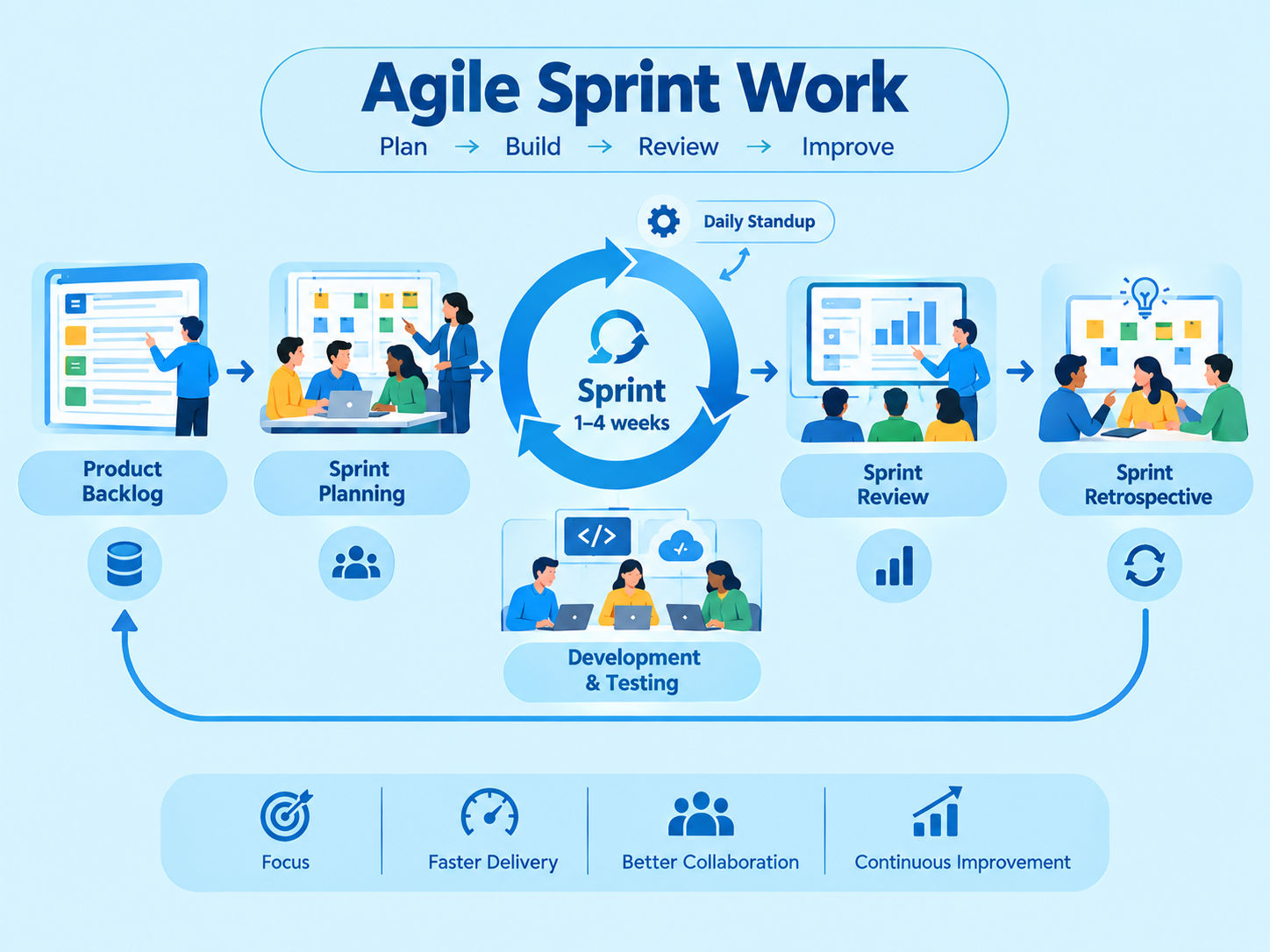
Sprint Planning occurs at the start of the Sprint. The team decides what is to be achieved and selects Product Backlog items that can contribute towards this goal.
The activities include:
Good agile sprint planning ensures that your team commits to just enough work not to waste the time of the whole team during the Sprint. Usually, teams do not try to fill the Sprint with as much work as possible. Instead, they come up with a feasible plan.
Also check: Scrum Master Salary in India
Having planned the Sprint, developers focus on the chosen items and implement them in the product in various ways, depending on the project’s requirements. They could design, code, test, document, integrate, or refine the software features.
During development, people communicate any project’s impediments and resolve them, instead of ignoring them.
The Daily Scrum is a short event used by developers to inspect progress toward the Sprint Goal and decide what adjustments are needed.
It provides an opportunity to identify:
The Daily Scrum is not meant to be a lengthy status meeting. Its purpose is to help developers coordinate their work effectively.
At the Sprint Review, the team examines the outcome of the Sprint and discusses the product increment with stakeholders.
The team can demonstrate completed work, discuss progress, and gather useful feedback. Stakeholder input may influence future Product Backlog priorities.
Read : What is Agile Project Management? Everything You Need to Know
The Sprint Retrospective focuses on how the team worked during the Sprint.
Team members discuss what went well, what caused problems, and what could be improved. They then agree on practical changes that can be tried in the next Sprint.
These events are Scrum practices associated with the formal implementation of Sprints. Agile teams outside Scrum may organise short work cycles differently.
Take your management knowledge further with MBA from LBS with IIMU Certification - upGrad and develop practical skills for better business decisions, process improvement, and leadership.
MBA Courses to upskill
Explore MBA Courses for Career Progression
O.P.Jindal Global University
MBA (with Career Acceleration Program by upGrad)Become interview ready with Career Services
PSB MBA + IIML Certification
MBA from Paris School of Business with Certification from IIM LucknowSprint Planning in Agile is the process where the Scrum team decides what to do and how to do it during the upcoming Sprint. It is where the team comes together to form an initial plan for delivering a product increment.
Good agile sprint planning aligns business priorities with the team’s capacity. It is not a matter of deciding what features to build and then who will build them.
The purpose of Sprint Planning is to establish a clear direction for the Sprint.
During the session, the team considers:
Sprint Planning involves the Scrum Team.
The team works together rather than having one person decide the entire Sprint workload.
The Sprint Goal gives the Sprint a clear purpose.
For example, instead of setting a goal such as “complete five tickets,” a team could define its goal as:
“Enable customers to find restaurants and add meals to their cart.”
This gives the team a useful outcome to work toward. It can also help developers make decisions when they encounter unexpected technical issues.
The team works together to review the items in the Product Backlog and selects those that will help the team achieve the Sprint Goal.
The team considers such factors as capacity, past performance, dependencies, and complexity when choosing how many items to adopt. Too many items may overwhelm the team and result in incomplete work.
The Sprint backlog is made up of the chosen items from the Product Backlog plus the plan for delivering them.
Developers can further decompose any item in the Sprint backlog into smaller deliverables as needed. The backlog can also be updated throughout the sprint based on what the team learns.
Consider a team developing a food-delivery app.
The Sprint Goal is:“Enable users to search restaurants and add meals to their cart.”
The team may select:
During agile sprint planning, the team checks whether these items are realistic for the Sprint. Developers then discuss the technical work involved and create a practical plan.
During the time of the project planning, the team starts working on the product development. They should involve all activities to achieve the result that contributes to the project's success.
The sprint goal is an essential aspect of project development, and team members should always focus on it. In this case, developers try to reach the goal and make all decisions that help achieve it. The sprint goals help workers determine the priority of their tasks and make the right choice if one activity takes more time than expected.
Problems are normal during product development. A technical dependency, unclear requirement, testing issue, or external delay can affect progress.
The team should identify such blockers early and work together to resolve them. Regular communication makes it easier to spot issues before they seriously affect the Sprint.
An agile sprint is not a period where everyone works independently until the deadline.
Developers collaborate on technical decisions, testing, reviews, and problem-solving. As the team gains new information, it can adjust its day-to-day approach while keeping the Sprint Goal in focus.
4. Build and Test the Product Increment
The team develops and tests the selected functionality throughout the Sprint.
Testing should not simply be left until the final day. Finding issues while development is underway makes it easier to fix them and maintain the quality of the product increment.
5. Prepare for the Sprint Review
Near the end of the Sprint, the team ensures that completed work is in a usable state and ready for inspection.
The team can then demonstrate the product increment during the Sprint Review and discuss what was learned.
A practical example makes the idea of an agile sprint easier to understand. Suppose a company is developing a food-delivery application. The complete product may include restaurant discovery, menus, shopping carts, payments, order tracking, notifications, and customer reviews. Instead of developing everything simultaneously, the team can deliver these capabilities over several Sprints.
For one Sprint, the team sets the following goal:
“Enable users to search restaurants and add meals to a cart.”
The goal is specific enough to guide the team's work while still producing a useful product increment.
The team selects the following items:
The developers then break the work down further if necessary.
During the Sprint, developers build the restaurant search and listing features first. They then work on menu pages and the cart functionality.
Testing happens alongside development. For example, testers may check whether search results appear correctly, whether users can open a restaurant menu, and whether selected meals are added to the cart correctly.
If the team finds a technical problem, it discusses the issue and adjusts its plan where necessary.
At the end of the Sprint, the team demonstrates the completed functionality.
Stakeholders may find that the search works well but suggest adding filters for cuisine type and delivery time.
The team can consider this feedback when updating the Product Backlog.
The outcome is not the complete food-delivery app. Instead, users now have a working part of the product, and the team has useful information for the next Sprint.
Read : Agile Methodology Steps & Phases: Complete Explanation
These three terms are connected, but they do not mean the same thing.
Concept |
What it means |
| Agile | A broader approach based on iterative development, customer feedback, collaboration, and adapting to change |
| Scrum | An Agile framework with defined accountabilities, events, artefacts, and rules |
| Sprint | A fixed-length period in Scrum during which the team works toward a Sprint Goal and creates a usable product increment |
Agile: Agile is a broader approach to product development. Emphasizing the delivery of value, responding to change, collaborative work with customers and teams and continuous improvement.
Agile itself does not require that all teams adopt Sprints.
Scrum: Scrum is a framework for implementing Agile. It offers a defined structure for product development, including Product Backlog management, Sprint Planning, Daily Scrums, Sprint Reviews, and Sprint Retrospectives.
Sprint: A Sprint is a specific part of Scrum. It is a fixed-length period in which the team works toward a Sprint Goal and strives to create a usable product increment.
So, the relationship can be summarized in short:
Agile = broader approach → Scrum = framework → Sprint = fixed work cycle within Scrum
This distinction is useful because people sometimes use the terms Agile, Scrum, and Sprint interchangeably even though they refer to different things.
An agile sprint allows project teams to manage complex work and deliver valuable products in smaller cycles. Proper planning of an agile sprint establishes an outcome and a realistic amount of work. Understanding what are sprints in Agile can help project teams see how Scrum practices Sprints to adapt to evolving requirements, receive feedback, and continuously improve the product during development.
Ready to start your journey? Book a free consultation with upGrad today to find the best path for your career.
An Agile Sprint is a fixed period during which a team works toward a specific product goal. It is most closely associated with Scrum and is used to create a usable product increment while giving the team regular opportunities to inspect progress and improve its way of working.
A Sprint can last up to one month, although many teams choose shorter and consistent durations. One- or two-week Sprints are common in software development because they provide frequent opportunities to review progress, gather feedback, and adjust upcoming work without waiting for a long development cycle.
During an Agile Sprint, developers work toward the Sprint Goal by developing, testing, integrating, and refining selected product work. They coordinate regularly, handle blockers, and inspect progress. Toward the end, the team prepares the completed increment for review and gathers information that can guide future work.
Agile is a broader approach to product development based on iterative delivery, collaboration, feedback, and adapting to change. A Sprint is a fixed-length work cycle used by Scrum. Therefore, Agile does not require Sprints, while Sprints are a fundamental part of how Scrum organises product development.
Scrum is an Agile framework that provides a structure for developing products, while a Sprint is one component of that framework. Scrum includes accountabilities, events, artefacts, and rules. A Sprint provides the fixed period in which the Scrum Team works toward a specific Sprint Goal
Sprint Planning establishes the purpose and initial plan for an upcoming Sprint. The team discusses product priorities, defines the Sprint Goal, selects suitable Product Backlog items, and considers how the work can be completed. The outcome is a Sprint Backlog that gives developers a practical starting point.
A Sprint Goal is a short statement describing the main objective of a Sprint. It gives the team a shared direction instead of making the Sprint a simple collection of unrelated tasks. It can also help developers make sensible trade-offs when unexpected issues arise during development.
Yes. Agile is a broader approach and does not require teams to use Sprints. Scrum uses Sprints as part of its framework, but other Agile approaches may use continuous flow or different planning methods. Teams can therefore apply Agile principles without following the Scrum Sprint structure.
Sprints are used to divide product development into manageable work cycles, particularly within Scrum. They help teams focus on a specific goal, produce usable increments, receive feedback, and learn from each development cycle. This can make complex and changing product work easier to manage.
Agile sprint planning helps a team agree on what it wants to achieve and what work can realistically support that goal. It brings product priorities and team capacity together before development begins, reducing confusion and helping developers start the Sprint with a shared understanding of the intended outcome.
No. Sprints are not a requirement for every Agile team. They are specifically central to Scrum. Some Agile teams use continuous-flow methods such as Kanban, where work moves through the system as capacity becomes available rather than being organised into fixed Sprint periods.
699 articles published
Sriram K is a Senior SEO Executive with a B.Tech in Information Technology from Dr. M.G.R. Educational and Research Institute, Chennai. With over a decade of experience in digital marketing, he specia...
Speak with MBA expert
By submitting, I accept the T&C and
Privacy Policy
From MBA to Dream Job - Explore Our Alumni Success Stories
Top Resources
Master's Degree
13 Months
Master's Degree
12 Months
O.P.Jindal Global University
MBA (with Career Acceleration Program by upGrad)Become interview ready with Career Services
Master's Degree
12 Months