Types of Planning in Management: Definition, Examples, and Importance
By Sriram
Updated on Aug 06, 2026 | 7 min read | 7.08K+ views
Share:

All courses
Certifications
More
By Sriram
Updated on Aug 06, 2026 | 7 min read | 7.08K+ views
Share:
Table of Contents
Key Highlights
Ready to build practical management skills? Explore upGrad's Management Courses to learn strategic decision-making, leadership, and business planning from industry experts and accelerate your career growth.
Popular Management Programs
While these plans have different purposes, they often work together. A strategic plan sets the direction, a tactical plan translates it into departmental goals, and an operational plan turns those goals into daily actions.
Understanding these relationships is essential when studying the types of planning in management process because planning doesn't happen in isolation. Every planning type supports a different stage of decision-making.
Strategic planning focuses on the organisation's long-term vision. It is prepared by top management and guides major business decisions over several years.
These plans answer questions like
Key characteristics
Also read: Top 4 Functions of Management Process Explained
Tactical planning converts strategic goals into departmental action plans. Middle managers create these plans to help teams contribute to organizational objectives.
Suppose a company wants to increase online sales by 30%. The marketing department may launch digital campaigns, while the sales team improves customer engagement.
Key characteristics
Operational planning focuses on everyday business activities. It's the most detailed planning level and is managed by supervisors and frontline managers.
Think about a restaurant. Daily staff schedules, inventory management, and customer service routines all rely on operational planning.
Key characteristics are
Things do not always go according to plan. That's where contingency planning becomes valuable.
This planning type prepares an organization for unexpected situations such as economic downturns, cyberattacks, equipment failures, or natural disasters. Instead of reacting under pressure, businesses already have predefined actions.
For example, a manufacturing company maintains backup suppliers to avoid production delays during supply chain disruptions.
Key characteristics
Corporate planning focuses on the organization as a whole. It helps senior leadership determine long-term priorities, allocate resources, and coordinate multiple business units.
Unlike departmental plans, corporate planning considers the company's overall direction.
Example like A diversified company plans to invest in renewable energy while expanding its healthcare business.
Every department has its own responsibilities. Functional planning helps individual departments achieve their specific goals while supporting organizational objectives.
Examples include:
Each department prepares plans that align with the broader business strategy.
Some business decisions are repeated every day. Standing plans provide consistency by establishing standard guidelines for recurring activities.
Common standing plans include:
These plans reduce confusion and help employees make consistent decisions.
Not every activity repeats. Some projects require one-time planning.
Single-use plans are created for unique objectives and are usually discarded once completed.
Examples include:
These plans focus on achieving a specific goal within a defined period.
Also Read: An Introduction to Principles of Management
Free Courses
Planning is the primary function of management. This is about deciding what an organization wants to achieve, and how best to achieve those goals. Rather than responding to situations as they occur, managers plan ahead to minimize uncertainty, allocate assets efficiently, and steer teams towards intended results.
Planning gives a clear direction whether a business is launching a new product, expanding into a new market, or improving daily operations. It also links all other functions of management such as organising, staffing, leading, and controlling. It is an integral part of the effective management of a business.
Planning is the setting of objectives, the identification of actions to achieve the objectives, and the determination of the use of resources. This enables managers to anticipate future opportunities and challenges, while also providing a roadmap to achieving organizational goals. Management planning is not a one-time activity, but it is an ongoing activity.
Plans are reviewed and updated to keep the organization on track as business conditions change.
Planning helps organisations move toward clear, measurable objectives. The main objectives of it include:
Planning provides a structured approach to managing business activities. Without a plan, organizations may struggle with unclear priorities, poor coordination, and inefficient use of resources.
Some key reasons why planning is important in management include:
Read: Henri Fayol's 14 Principles of Management with Examples
Effective planning helps organizations stay focused, adapt to change, and achieve their goals.
The following characteristics make planning practical and effective.
Characteristics of Effective Planning:
Characteristic |
Why It Matters |
| Goal-oriented | Provides clear direction |
| Future-focused | Prepares for future opportunities |
| Continuous | Supports continuous improvement |
| Flexible | Adapts to changing conditions |
| Decision-oriented | Improves decision-making |
| Integrated | Aligns organizational efforts |
Take the next step with upGrad's Certificate Programme in General Management for Young Leaders (YLP) from IIM Bangalore (IIMB). Learn core management concepts, strengthen your decision-making and leadership skills, and gain industry-relevant knowledge to accelerate your career.
Management Courses to upskill
Explore Management Courses for Career Progression
IIIT-B & IIM, Udaipur
Chief Technology Officer & AI Leadership ProgrammePlanning responsibilities vary across different management levels. Every level contributes to organizational success, but each focuses on different objectives and decision-making responsibilities.
The levels of planning in management create a clear connection between long-term strategy and day-to-day execution.
Senior executives develop top-level plans that shape the organization's future. These decisions influence investments, expansion, market positioning, and overall business direction.
The planning horizon is usually long term, often extending beyond three years.
Typical responsibilities
Middle managers bridge the gap between strategy and execution.Their plans convert organizational objectives into departmental initiatives that teams can implement effectively.
For example, if senior management plans international expansion, the marketing department may prepare regional campaigns while HR develops hiring strategies.
Also Read: Importance of Management in Every Organization
Lower-level managers focus on operational efficiency.
Their planning covers routine activities such as work schedules, inventory management, production targets, and quality control.
These plans are highly detailed and frequently updated.
Planning Levels briefly
Management Level |
Planning Focus |
Example |
| Top Level | Strategic Planning | Market expansion |
| Middle Level | Tactical Planning | Department action plans |
| Lower Level | Operational Planning | Weekly production schedule |
Learn More: How to Build a Successful Marketing Strategy
Knowing different planning types is only part of the picture. Managers also need a structured approach to develop effective plans. That's why understanding the planning process in management is equally important.
The types of planning in management process become meaningful only when managers follow a logical sequence that transforms ideas into measurable actions.
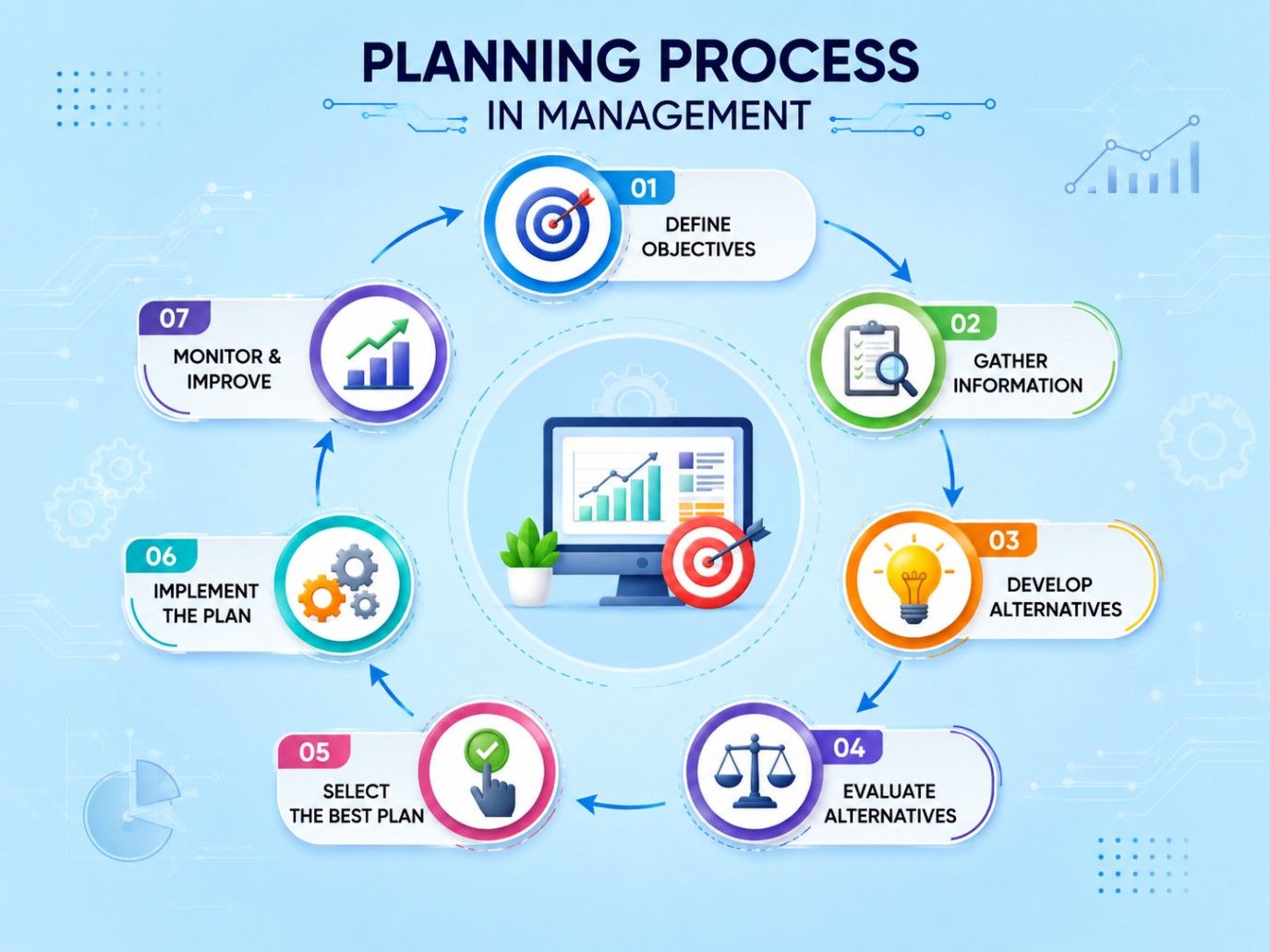
Planning doesn't work alone. It supports every other management function.
Here's how they connect.
Management Function |
Relationship with Planning |
| Organizing | Allocates resources based on plans |
| Staffing | Identifies workforce requirements |
| Leading | Guides employees toward planned objectives |
| Controlling | Measures actual performance against planned goals |
This connection explains why planning is widely regarded as the foundation of effective management. When planning is done well, every other management function becomes more focused, coordinated, and efficient.
Also read : strategic management
The table below shows how different planning types are applied in business and manufacturing. It illustrates how organizations combine multiple planning approaches to achieve strategic and operational goals.
Planning Type |
Business Management Example |
Manufacturing Example |
| Strategic Planning | Expanding into three new cities over the next five years | Investing in new machinery to increase production capacity |
| Tactical Planning | Developing regional marketing campaigns to support expansion | Preparing employee training and production improvement plans |
| Operational Planning | Scheduling hiring, store setup, and daily operations | Managing daily production schedules and equipment maintenance |
| Functional Planning | Marketing and finance departments prepare function-specific plans | Production and quality control teams develop workflow and quality plans |
| Contingency Planning | Creating backup plans for supply chain disruptions or market changes | Maintaining alternate suppliers and emergency production plans |
Also read : Management process: Definition, Features & function
Effective planning strengthens an organization's ability to achieve its goals by improving decision-making, coordination, and resource management.
It also helps businesses adapt to change and sustain long-term growth.
Also read : Nature and Scope of Management: Meaning, Functions & Importance
Selecting the right planning type depends on your organization's goals, timeline, available resources, and management level. Matching the planning approach to your business needs leads to better execution and improved results.
Here is the quick view :
Management Level |
Recommended Planning Type |
| Top Management | Strategic Planning |
| Middle Management | Tactical Planning |
| Supervisory Management | Operational Planning |
Also read : Top 4 Functions of Management Process Explained
Even experienced managers make planning mistakes. Recognizing these challenges early helps organizations create more practical and realistic plans.
Some of the most common planning mistakes include:
These issues often lead to delays, budget overruns, and poor decision-making.
Strong planning follows a few simple principles.
Following these practices helps organizations remain flexible while maintaining focus on long-term objectives.
Planning is the foundation of effective management. Understanding the types of planning in management helps organizations choose the right approach for setting goals, allocating resources, managing risks, and improving day-to-day operations. Each planning type serves a specific purpose and supports better decision-making at different management levels.
As business needs evolve, planning should evolve too. Regularly reviewing and adapting plans allows organizations to stay focused, respond to change, and improve organizational performance while achieving both short-term objectives and long-term business goals.
Ready to start your journey? Book a free consultation with upGrad today to find the best path for your career.
The four primary planning types are strategic, tactical, operational, and contingency planning. Together, they help organizations define long-term goals, translate them into departmental actions, manage daily operations, and prepare for unexpected situations. Each serves a distinct purpose within the overall management framework.
The different types of planning in management are interconnected rather than independent. Strategic planning sets the direction, tactical planning converts goals into departmental actions, operational planning manages execution, and contingency planning prepares for risks. Using them together improves coordination and business performance.
Many management textbooks describe seven common planning types, including strategic, tactical, operational, contingency, corporate, functional, and financial planning. The exact list may vary across institutions, but these planning approaches collectively support long-term strategy, departmental objectives, and day-to-day business operations.
Some academic frameworks expand the list to eight planning types by including strategic, tactical, operational, contingency, corporate, functional, standing, and single-use planning. The additional categories help explain how organizations manage both recurring activities and one-time projects through structured planning.
Managers consider business goals, planning duration, available resources, organizational structure, and potential risks before selecting a planning approach. The choice also depends on whether the objective involves long-term growth, departmental improvements, or routine operational activities requiring regular monitoring.
The types of planning in management process support different stages of organizational decision-making. Strategic planning establishes direction, tactical planning coordinates departments, and operational planning focuses on execution. Together, these planning types help managers organize resources and monitor progress effectively.
The four P's of planning commonly refer to Purpose, People, Process, and Performance. Purpose defines the objective, people identify responsibilities, process outlines the required actions, and performance measures whether the planned goals have been successfully achieved.
The 4 C's often include Communication, Coordination, Collaboration, and Control, while the 4 P's represent Purpose, People, Process, and Performance. Together, these concepts provide a practical framework for improving planning, teamwork, execution, and performance evaluation within organizations.
The four pillars of strategy generally include vision, strategic objectives, resource allocation, and execution. These pillars help organizations establish a clear direction, prioritize investments, coordinate business activities, and measure progress toward long-term goals while adapting to changing business environments.
Yes. Organizations rarely depend on a single planning approach. Large businesses often combine strategic, tactical, operational, and contingency planning to manage long-term growth while maintaining efficient daily operations. This integrated approach helps align departments and improve overall organizational effectiveness.
Business conditions, customer expectations, technology, and market competition continue to evolve. Reviewing plans regularly helps organizations identify gaps, respond to new challenges, update priorities, and improve execution. Continuous evaluation keeps planning relevant and supports sustainable business growth over time.
727 articles published
Sriram K is a Senior SEO Executive with a B.Tech in Information Technology from Dr. M.G.R. Educational and Research Institute, Chennai. With over a decade of experience in digital marketing, he specia...
Get Free Consultation
By submitting, I accept the T&C and
Privacy Policy
Top Resources
Certification
3 Months
Certification
6 Months
O.P. Jindal Global University
Masters in International Accounting and Finance (Accredited by ACCA, UK)Master's Degree
12 Months