Business Research Methods:Types, Process, and Examples
By Sriram
Updated on Sep 13, 2026 | 11 min read | 4.22K+ views
Share:

All courses
Certifications
More
By Sriram
Updated on Sep 13, 2026 | 11 min read | 4.22K+ views
Share:
Table of Contents
Ready to take your research skills to the next level? Explore upGrad's Doctorate of Business Administration programs and build the expertise to lead high-impact, real-world research.
Popular upGrad Programs
Business research methods can be described as activities and techniques used in gathering and analyzing information on a specific issue. This is important for the business researcher since it enables him to have knowledge on matters relating to the subject under study including market, consumer, employee, and business research among others.
Business research methods can be categorized into different types depending on the criteria used for classification. Some of these categories are based on type of data generated and this includes quantitative research, qualitative research and mixed research.
Quantitative research uses numerical data to measure patterns, behaviours, opinions, or relationships. Researchers usually collect information from a relatively large group and analyse it using statistical techniques.
For example, a company may survey 1,000 customers to determine how many are satisfied with its new product.
Key characteristics include:
Helps identify patterns and relationships
Common data collection techniques include such methods as online surveys, questionnaires, experiments, and analysis of existing numerical data.
Example- A retail company asks their customers to indicate their satisfaction with a rating between 1-5. This information can be utilized by the company to determine their average level of satisfaction and recognize what they need to improve upon.
Qualitative research emphasizes on opinions, expectations, perception and motives of respondents. In other words, it explores reasons and possibilities rather than counting numbers though there may be some elements of quantitative research.
Qualitative research is a method that is generally chosen by businesses to understand customers’ experience and attitudes towards a company’s product or service. Its main features are listed below.
Key characteristics include:
Common techniques include interviews, focus groups, observations, and open-ended questions.
Example- A smartphone company interviews customers to understand why some users find its new interface difficult to navigate. The responses can reveal specific problems that a numerical survey may not fully explain.
Mixed-methods research involves the combination of both quantitative and qualitative into one study where both elements are present. Therefore, it uses both measurements and insights to fully grasp the situation at hand.
An example of such research would be for a company to perform a customer satisfaction survey, and then interview some of the customers that participated in it to explain their satisfaction levels. This allows businesses to fully understand the issues that they encounter. The same applies to any other field that requires such data.
Free Courses
Another way to classify types of business research methods is by their goal. Businesses usually perform research to explore a new issue, describe some parameters of a study, find cause-and-effect relationships, or predict future trends.
Exploratory research is conducted to formulate the problem or develop hypotheses. It is used by businesses to find out some general ideas or facts related to a certain issue.
Businesses may apply exploratory research to interview potential customers, focus groups, library or Internet research, or case analysis.
Example- A food producing company has found that sales of a certain product have declined, but it does not know why.
Example- A food company notices that sales of one product have declined but does not know why. It may interview customers and sales staff to explore possible reasons before conducting a larger study.
Descriptive research aims to identify and describe a market, group of people, behaviour, or business situation. They usually answer questions such as what, who, where, when, and how many.
For example, a company can use descriptive research to determine the age structure of the customers, their preferred way of shopping, or how often they buy a specific product.
Various survey research, questionnaires, or existing data can be used for descriptive research.
Causal research explores a cause-and-effect relationship between factors. It is an appropriate type of survey, which helps a business understand the connection between two variables.
For example, a company, specializing in e-commerce, can make a change to its checkout page and examine how this change affects the conversion rate.
Such methods as experiments and controlled tests are used in surveys, which aim at identifying cause-effect relationships.
A predictive research method uses collected and historical data to make predictions about future outcomes. This type of survey can help a firm predict certain results and create a strategy, which will yield positive outcomes.
For instance, a retail store can analyze the collected data and make forecasts about the demand for a particular product during a holiday season.
However, it is important to remember that while predictive research can make accurate predictions about future outcomes, they are not set in stone and can be altered by various circumstances.
Recommended Courses to upskill
Explore Our Popular Courses for Career Progression
IIIT Bangalore
Executive Diploma in Machine Learning and AI360° Career Support
O.P.Jindal Global University
MBA from O.P.Jindal Global UniversityLive Case Studies and Projects
Business research methodology refers to the overall framework and reasoning used to conduct a research study. It explains how a researcher approaches the research problem, selects data sources, chooses methods, analyses information, and reaches conclusions.
A research method is a specific technique used to collect or analyse information. Surveys, interviews, experiments, and observations are examples of research methods.
A research methodology is broader. It explains why particular methods are appropriate for the research question and how they fit into the overall study.
For example, a researcher studying customer satisfaction may choose a quantitative methodology and use an online survey as the research method. Another researcher studying customer experiences in detail may use a qualitative methodology with in-depth interviews.
Understanding this difference is important when selecting among the types of business research methods because the right method depends on the research objective and the type of information required.
Ready to convert artificial intelligence leadership into measurable organizational success? Check out upGrad's Chief Technology and AI Officer Program to master driving enterprise-wide technological evolution.
Data collection is the most significant aspect of business research methods. The type of data collection techniques to be applied depends on several factors, including research questions, target audience, time, resources, and type of data needed.
This data collection method requires survey questions to gather data from targeted sample groups. It is convenient to use surveys when there is a need to obtain information from a high number of respondents in a short period.
Most organizations use surveys to collect feedback from clients and staff, determine brand image, employee satisfaction, and market research data.
An interview is a type of survey that is conducted face-to-face. Unlike surveys, interviews require high preparation skills. Interviews can be structured, semi-structured, or unstructured.
Interviews are useful when there is a need to collect in-depth information from respondents. They are appropriate for qualitative and quantitative studies. This method is more effective when a researcher has limited experience and less time to complete a project.
A focus group typically involves a small number of participants who meet together to talk about a particular product, service, idea or topic.
Businesses can use focus groups to obtain information on how their advertisement, packaging, product or overall brand can be received by customers.
Observation refers to watching and recording behaviours either in a natural or artificial setting.
For example, a supermarket can decide to watch and record how individuals move along a certain area of the store which will later help the business decide on what product placement or layout would be most suitable for the store.
Experiments test how changes in one factor affect another. They are particularly useful for causal research.
An online business, for instance, may show two versions of a landing page to different groups of visitors and compare conversion rates.
Secondary data is information that has already been collected by another source or for another purpose. It may include government reports, industry studies, company records, research papers, sales data, or market reports.
Using secondary data can save time and provide useful background information before collecting new data.
A case study typically involves an in-depth examination of a particular business, organisation, event, product, or situation.
By conducting a case study on a particular business, companies can learn about possible pitfalls and lessons that could be implemented in similar businesses.
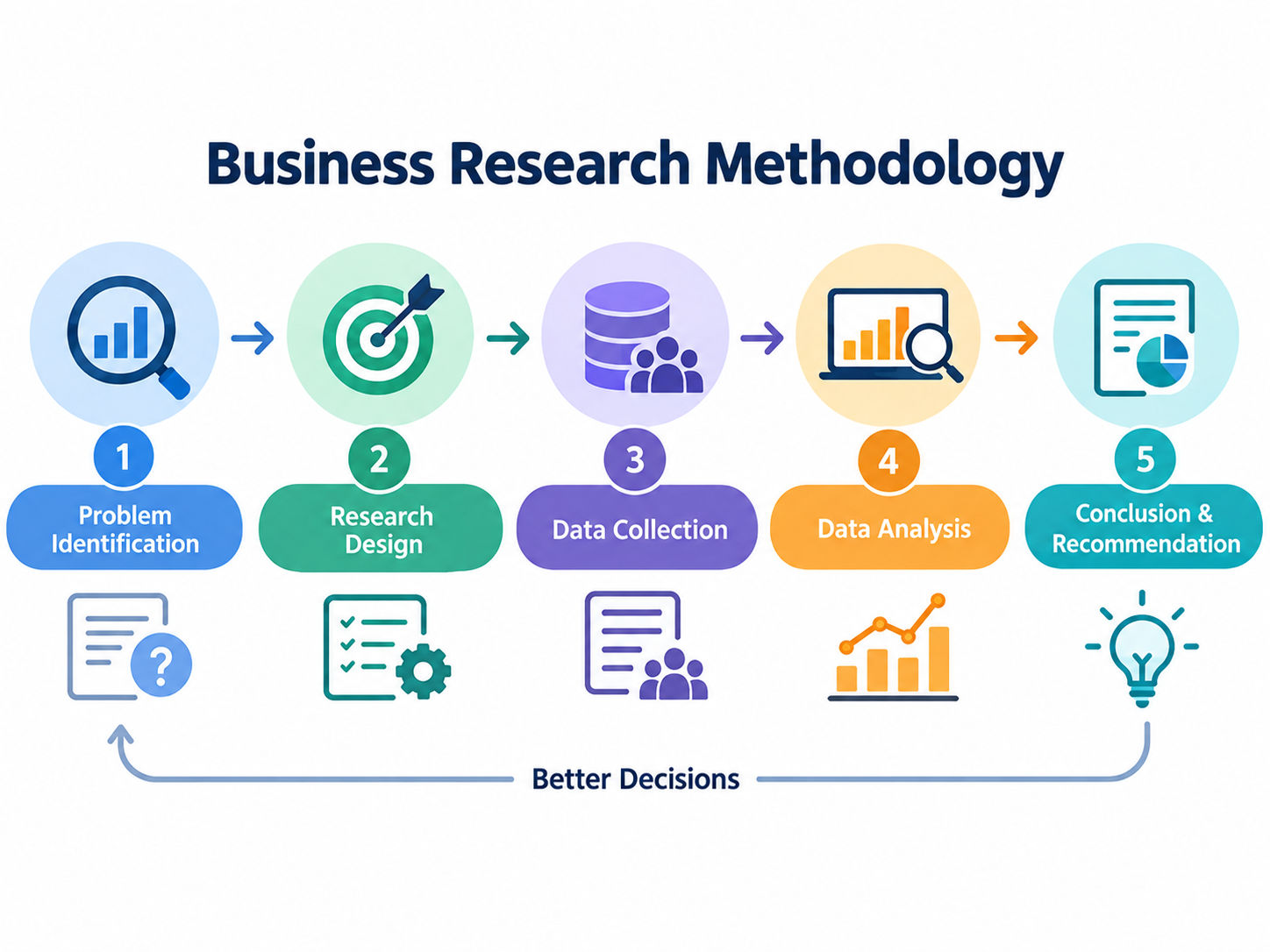
A series of steps can guide researchers through the process of taking a business conundrum through to a stage of viable insight. Although there can be variation, the process usually consists of the following steps:
The first step involves taking the initial research problem and defining it more specifically. For example, a business might state its research problem as poor sales, but it could narrow this down to the specific problem of poor first-time customer sales.
Research objectives explain what the study aims to achieve. Clear objectives keep the research focused and help determine which data needs to be collected.
Researchers examine existing reports, studies, company records, market information, and other relevant sources. This helps them understand what is already known about the problem.
Research questions identify what the study needs to answer. In some studies, researchers may also develop hypotheses that can be tested using collected data.
The researcher selects an appropriate methodology based on the research objective, type of data needed, target population, resources, and expected outcome.
The researcher gathers primary or secondary data using appropriate techniques such as surveys, interviews, observations, experiments, or existing records.
Collected information is organised and examined to identify patterns, relationships, differences, or important themes.
Quantitative data may be analysed using statistical techniques, while qualitative information may be reviewed for recurring themes and insights.
Researchers interpret the results in relation to the original research questions. The aim is to understand what the findings mean for the business rather than simply presenting data.
Findings can be presented through reports, presentations, charts, dashboards, or other formats. A clear presentation helps decision-makers understand the main conclusions.
The final step is to use research findings to support practical decisions. Depending on the results, a business may change its product, pricing, marketing strategy, customer service, or operational processes.
Also read: Exploratory Research: Definition, Methods, Types, Process and Examples
Subscribe to upGrad's Newsletter
Join thousands of learners who receive useful tips
Choosing from different types of business research methods requires consideration of several factors.
Research objective: The method should be decided by the research objectives that the business wants to achieve through the research. Exploratory questions require qualitative research while the one that seeks to measure something needs a quantitative study.
Type of information required: The information that the business wants to gather will determine the type of study to conduct. The business should decide whether it wants to collect quantitative data, qualitative data, behavioural data, or a combination of these.
Available data: The type of data available can determine whether there is a need to gather more information or not.
Target audience: The size, features, availability, and proximity of the target audience may determine the type of research method to use.
Time and budget: A survey may be cost-effective when contacting a large group of people. However, conducting a detailed interview may take a lot of time.
Required level of accuracy: Research intended to support major business decisions may require a carefully designed sample and stronger data collection procedures.
Also read: Understanding and Conducting a Market Research like Experts
Businesses across different industries use business research methods for a wide range of decisions.
Companies can study market size, customer segments, competitors, trends, and demand before entering a market or launching an offering.
Research can help businesses understand purchasing habits, preferences, satisfaction levels, and reasons behind customer decisions.
Businesses can collect customer feedback to identify product requirements, test concepts, and improve existing products.
Research helps organisations understand competitor offerings, pricing, positioning, strengths, and weaknesses.
Organisations can study employee satisfaction, engagement, workplace experiences, training needs, and retention factors.
Businesses can use research and market data to evaluate opportunities, assess risks, and support investment decisions.
Research provides evidence that can help organisations identify opportunities, understand challenges, and develop strategies based on market conditions.
Businesses can examine brand awareness, customer perception, campaign performance, and communication preferences.
Using structured research can provide several benefits to organisations.
However, research is only as useful as the quality of its design and data. Poor sampling, unclear questions, biased responses, or incorrect analysis can produce misleading conclusions.
Also read: Exploratory Research: Definition, Methods, Types, Process and Examples
Practical examples make it easier to understand how different research approaches work in real business situations.
1.Customer satisfaction survey: A hotel sends a questionnaire to recent guests to measure satisfaction with rooms, food, service, and facilities.
2. Customer interviews before a product launch: A technology company interviews potential users to understand their expectations before developing a new application.
3. Competitor analysis: A company studies competitors' products, prices, customer reviews, and marketing activities before entering a new market.
4. Testing two marketing campaigns: A business runs two versions of an online advertisement and compares their click-through or conversion rates to determine which performs better.
5. Analysing sales data: A retailer examines historical sales data to identify seasonal patterns and estimate future demand.
These examples show why businesses need to match the research approach to the question they are trying to answer.
Business research methods give organisations a structured way to collect and evaluate information before making important decisions. Quantitative, qualitative, and mixed-methods research can address different information needs, while exploratory, descriptive, causal, and predictive research serve different purposes.
The right approach depends on the research problem, objectives, data requirements, audience, resources, and expected outcome. When planned and conducted carefully, research can help businesses understand customers, identify opportunities, reduce uncertainty, and make more informed decisions.
Ready to start your journey? Book a free consultation with upGrad today to find the best path for your career.
Business research methods are systematic techniques used to collect, analyse, and interpret information for business decisions. They include surveys, interviews, observations, experiments, case studies, and secondary data analysis. Businesses use these methods to understand customers, markets, competitors, employees, and operational challenges.
Four common types are exploratory, descriptive, causal, and predictive research. Exploratory research investigates unclear problems, descriptive research explains existing situations, causal research examines cause-and-effect relationships, and predictive research uses data to estimate future outcomes.
Business research methodology is the overall framework used to plan and conduct a research study. It explains the research approach, data sources, methods, analysis techniques, and reasoning behind methodological choices. It provides a structured path for answering research questions and reaching reliable conclusions.
Research methods are specific techniques used to collect or analyse data, such as surveys, interviews, or experiments. Research methodology is the broader framework that explains how and why those methods are selected and used to address a particular research problem.
The three commonly discussed types based on data are quantitative, qualitative, and mixed-methods research. Quantitative research focuses on numerical information, qualitative research explores experiences and opinions, and mixed-methods research combines both approaches to provide a broader understanding of a business problem.
Quantitative research methods collect numerical data that can be measured and statistically analysed. Qualitative research methods collect detailed information about experiences, opinions, motivations, or perceptions. Businesses may use either approach independently or combine them when both measurable results and deeper insights are needed.
Common data collection methods include surveys, questionnaires, interviews, focus groups, observations, experiments, secondary data analysis, and case studies. The appropriate technique depends on the research objective, type of information required, target audience, available resources, and desired level of detail.
Business research methods help organisations make decisions using relevant evidence rather than assumptions alone. They can help businesses understand customers, evaluate markets, identify opportunities, assess competitors, improve products, reduce uncertainty, and develop strategies that respond to actual business conditions.
Businesses choose a research method based on the research objective, type of data required, target audience, available resources, time, budget, and desired accuracy. A company may use quantitative research for measurable results, qualitative research for deeper insights, or mixed methods when both are required.
A retailer analysing customer purchase data to identify popular products is an example of business research. Similarly, a company conducting customer surveys before launching a product or comparing two advertisements to measure campaign performance is using research to support a business decision.
727 articles published
Sriram K is a Senior SEO Executive with a B.Tech in Information Technology from Dr. M.G.R. Educational and Research Institute, Chennai. With over a decade of experience in digital marketing, he specia...
Get Free Consultation
By submitting, I accept the T&C and
Privacy Policy
Top Resources
Certification
3 Months
Certification
6 Months
O.P. Jindal Global University
Masters in International Accounting and Finance (Accredited by ACCA, UK)Master's Degree
12 Months