Risk Management Tools: Types, Examples, and How They Work
By Sriram
Updated on Sep 16, 2026 | 10 min read | 4.25K+ views
Share:

All courses
Certifications
More
By Sriram
Updated on Sep 16, 2026 | 10 min read | 4.25K+ views
Share:
Table of Contents
Key Highlights
Build practical management skills and strengthen your decision-making with upGrad’s Management Certification Courses.
Popular Management Programs
There are several ways of managing risks. These methods are; risk assessment matrix, SWOT analysis, risk register, decision tree analysis and bow-tie analysis.
A risk assessment matrix is a risk management tool that involves assessing the risks on the basis of their likelihood and impact. In this case, the team addresses a risk and tries to come up with the possible consequences of the risk. Then, they come up with the likelihood of it happening. All these are combined to come up with the probable risk outcome.
Probability |
Impact |
Overall Risk |
| Low | Low | Low |
| Medium | Medium | Moderate |
| High | High | High |
Example
A construction project may face a risk of material delivery delays. If the probability is high and the delay could significantly affect the project schedule, the risk would receive a high priority.
A risk matrix is particularly useful when teams need a quick visual overview of which risks require attention first.
SWOT stands for Strengths, Weaknesses, Opportunities and Threats. It is usually applied to business planning and analysis, but it can also be used to highlight potential pitfalls.
Strengths and Weaknesses are factors inherent to the entity, whereas Opportunities and Threats are associated with the external environment.
Therefore, when developing a business plan for entering a new market, one might list the following:
The threats and weaknesses can point out the areas in which there may be difficulties whereas the strengths and opportunities can help the organisation to tackle these issues.
SWOT analysis is a very simple method that can be used in the initial stage of planning to get an overview about the internal and external factors.
Also Read: Top 21+ Risk Management Projects: The 2026 Master List
A risk register is a central record containing information about identified risks. It allows teams to document risks and monitor them throughout a project or business activity.
A typical risk register may include:
Example
A software development project can have a risk identified that its essential attribute will be slower than the baseline. The project manager can delegate an owner, define the impact, suggest a risk mitigation strategy and plan, and document the risk.
A risk register is different from a single risk evaluation because it can be updated.
Decision tree analysis is used when a decision involves multiple possible outcomes. It represents choices, uncertainties, probabilities, and potential results in a tree-like structure.
For example, a company may need to decide whether to launch a product immediately or conduct additional market research.
The decision tree could show:
Decision → Possible outcome → Probability → Financial or business impact
If additional research costs ₹5 lakh but could significantly reduce the possibility of a costly failed launch, the decision tree can help compare the possible outcomes.
This method is useful when organisations need to compare different options under uncertain conditions.
Bow-tie analysis is a visual method used to understand the relationship between the causes of a risk, the risk event, and its consequences.
It generally places the main risk event in the centre. The causes appear on one side, while potential consequences appear on the other.
Controls are then added to show how the organisation can:
For example, in an industrial environment, equipment failure could be the central risk event. Preventive maintenance may reduce the chance of failure, while emergency procedures can reduce its consequences.
Bow-tie analysis is particularly useful for safety, operational, engineering, and high-risk environments.
Also Read: An Introduction to Principles of Management
Using appropriate risk management tools can make it much easier to approach the problem of risk assessment. The tools can be used to take the guesswork out of the process and standardize it.
These tools can help organisations:
For example, a project team may use a risk register to document risks and a risk matrix to determine which risks deserve immediate attention. Using the two together can provide a clearer picture of the project's risk position.
Also Read: Top 10 Risk Management Strategies You Need to Follow for Success!
The best risk management tools depend on the type of risk, the purpose of the assessment, and the amount of information available.
Some widely used options include:
There is no single tool that works equally well in every situation. For a small project, a risk register and risk matrix may be enough. A complex engineering or financial project may require more advanced methods.
Therefore, the best risk management tools are those that match the organisation's risk profile, available data, objectives, and resources.
Build the skills to manage technology, digital operations, and AI-driven business processes with upGrad’s Chief Technology Officer Program - CTO & AI Course & Certification.
Free Courses
The following table summarises common risk management tools and where they can be applied:
Tool |
Main Purpose |
Best Used For |
| Risk Matrix | Assess probability and impact | Project risks |
| Risk Register | Track and monitor risks | Project management |
| SWOT Analysis | Identify internal and external risks | Business planning |
| FMEA | Analyse potential failures | Manufacturing |
| Decision Tree | Compare uncertain decisions | Strategic decisions |
| Monte Carlo Simulation | Model possible outcomes | Financial and project risks |
| Bow-Tie Analysis | Analyse causes and consequences | Safety and operational risks |
Each tool serves a different purpose. For instance, a risk register focuses on recording and monitoring risks, whereas Monte Carlo simulation can help model a range of possible outcomes.
Management Courses to upskill
Explore Management Courses for Career Progression
IIIT-B & IIM, Udaipur
Chief Technology Officer & AI Leadership ProgrammeIIM Kozhikode
PCP in AI for Business ProfessionalsAlthough different methods have different formats, most risk management tools support a similar overall process.
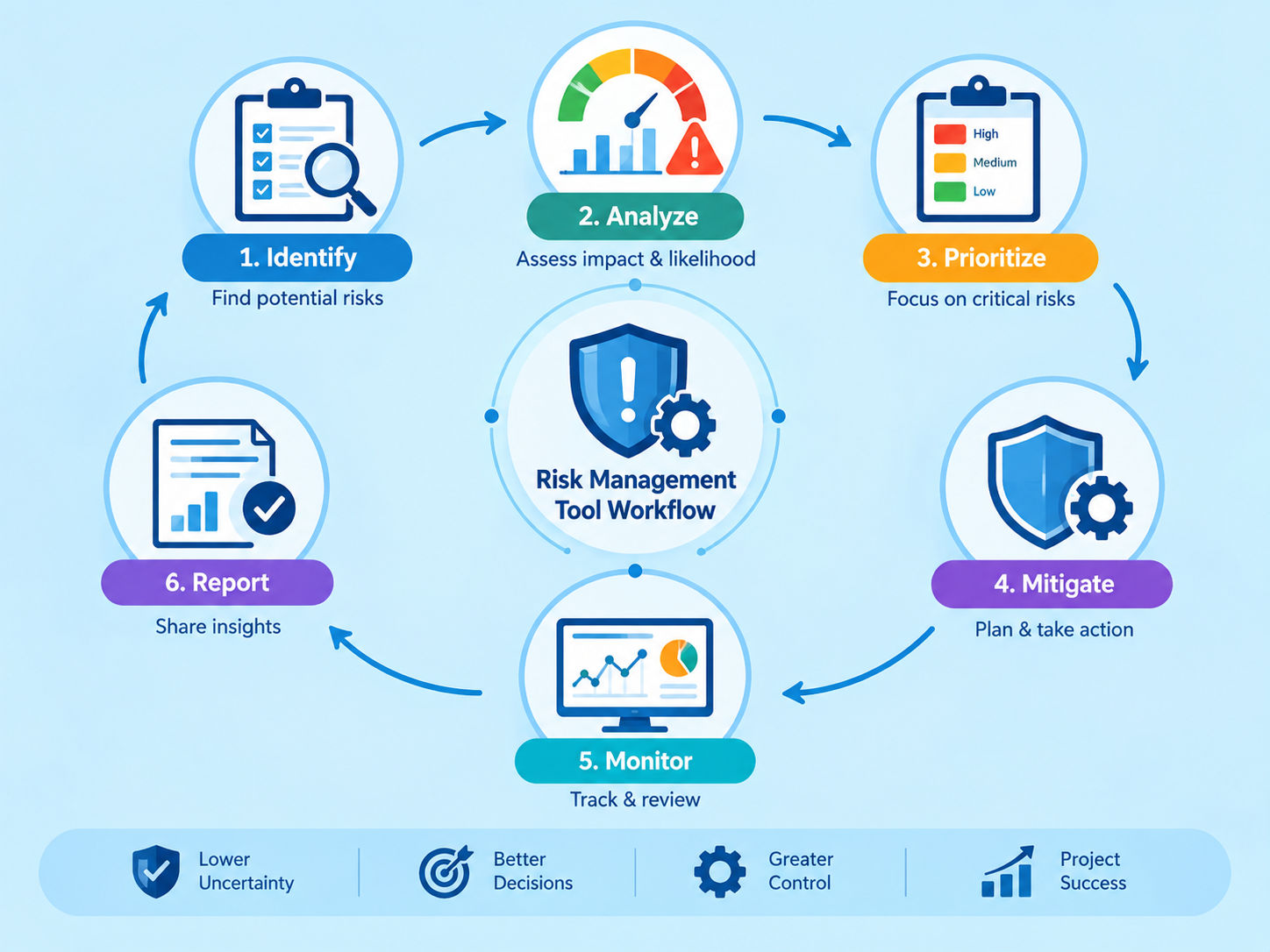
The first step is to determine what could prevent the organisation or project from achieving its objectives.
Teams can identify risks through:
Brainstorming
The identified risks should be described clearly so that everyone understands what is being assessed.
Once risks have been identified, the team assesses their likelihood and possible impact.
For example, a supplier delay may have a medium probability but a high impact if there are no alternative suppliers.
Depending on the situation, teams may use qualitative or quantitative analysis.
Qualitative analysis uses categories such as low, medium, and high.
Quantitative analysis uses numerical information to estimate potential outcomes, costs, probabilities, or time impacts.
Not every risk requires the same level of attention.
Teams compare risks and determine which ones need immediate action. A risk matrix can make this process easier by displaying risks according to probability and impact.
High-impact and high-probability risks usually receive greater attention than risks that are unlikely to occur and would have limited consequences.
Having prioritised the risks, it is now time to choose the most appropriate response. Common examples of risk response options are as follows:
Avoid: modify the project plan to eliminate the risk
Mitigate: take measures to reduce the probability or impact
Transfer: shift some of the responsibility to another party (e.g. through insurance)
Accept: acknowledge the risk and monitor it if no other actions can be taken effectively.
As can be seen, the most appropriate option depends on the nature and level of impact of the risk.
The process of risk management is continuous, and as such, even after risks are identified and prioritised, they still need to be monitored. Changes in any aspect of a project can impact the probability and scale of risk, and new risks can emerge in the course of a project.
For example, a previously reliable supplier can enter financial difficulties, turning a minor risk into a major risk.
Regular reviews enable the teams to update their information on risks and take appropriate actions to address them in the changed circumstances.
Also Read : Risk Management Process: Steps, Examples, Benefits and Best Practices
The choice of an appropriate technique for risk management depends on several factors. Therefore, before selecting the most suitable among the best risk management tools, organisations should consider the following:
Type of Risk
Different risks require different approaches. Financial, operational, safety, strategic, technical, and project risks may need different assessment methods.
Project Size and Complexity
A simple project may only need a risk register and matrix. Larger projects with many dependencies may benefit from more detailed analysis.
Available Data
Quantitative methods require reliable data. If detailed historical or numerical information is unavailable, qualitative approaches may be more practical.
Industry Requirements
Some industries have specific regulatory, safety, or reporting requirements. The selected tool should support those requirements.
Level of Uncertainty
If a decision has several possible outcomes, decision tree analysis or Monte Carlo simulation may provide greater insight.
Team Expertise
The tool should be understandable and practical for the people who will use it. An advanced method may not be useful if the team does not have the required skills to interpret its results.
Time and Resources Available
Some methods require more time, software, data, and expertise than others. Teams should consider the effort involved before choosing a tool.
Risk management tools help teams understand potential threats and take timely action. They also make it easier to prioritise risks and use resources wisely.
Risk management tools are useful for assessing and prioritising risks, but they also have some limitations. Teams should understand these limits before relying on their results.
Also read: What Is Enterprise Risk Management? A Complete Guide
Risk management tools help teams identify, assess, prioritise, and track risks. Tools such as risk matrices, registers, FMEA, and Monte Carlo simulation serve different purposes.
The best risk management tools depend on the project, type of risk, available data, and team needs. Regular risk reviews and timely action help organisations stay prepared and make better decisions.
Ready to start your journey? Book a free consultation with upGrad today to find the best path for your career.
Five commonly used risk management tools are the risk assessment matrix, SWOT analysis, risk register, decision tree analysis, and bow-tie analysis. Each serves a different purpose, from prioritising risks and recording them to analysing uncertain decisions and understanding the causes and consequences of major risk events.
The best risk management tools depend on the situation. A risk matrix is useful for prioritising risks, while a risk register helps track them. FMEA suits failure analysis, decision trees support uncertain choices, and Monte Carlo simulation is useful when numerical modelling is required.
Examples include risk matrices, risk registers, SWOT analysis, FMEA, decision trees, Monte Carlo simulation, and bow-tie analysis. These tools can help teams identify risks, assess their potential effects, prioritise responses, analyse uncertainty, and monitor changing risk conditions throughout a project or business activity.
Risk management tools help businesses identify potential problems, assess their likelihood and impact, prioritise important risks, and plan suitable responses. They can also improve communication, support resource allocation, and help managers make informed decisions when dealing with uncertain business conditions.
A risk matrix and risk register are commonly useful for projects. The matrix helps prioritise risks based on probability and impact, while the register records important details and tracks responses. Larger or more complex projects may also require quantitative methods such as Monte Carlo simulation.
A risk assessment matrix is a visual method for evaluating risks using factors such as probability and impact. Risks are generally assigned ratings such as low, medium, or high. This helps teams compare risks and focus their attention on issues that may have greater consequences.
A risk register is used to document and monitor identified risks. It can contain information such as the risk description, probability, impact, owner, response strategy, mitigation actions, status, and review date. Teams can update the register as project conditions and risk levels change.
SWOT analysis can help identify internal weaknesses and external threats that may create risks for an organisation or project. It also highlights strengths and opportunities that may help address those risks. This makes SWOT useful during strategic planning and early-stage risk identification.
Risk management tools are structured methods or frameworks used to analyse and manage risks, such as a risk matrix or risk register. Techniques refer more broadly to approaches used during the process, including brainstorming, interviews, expert judgement, scenario analysis, and data analysis.
Choose a tool based on the type and complexity of risk, available data, project size, industry requirements, team expertise, uncertainty, and available resources. Simple risks may need basic tools, while complex financial, engineering, or operational risks may require more detailed quantitative analysis.
Common challenges include limited resources, lack of employee awareness, inaccurate or incomplete data, difficulty identifying emerging risks, resistance to change, and inconsistent monitoring. Organisations can address these challenges through clear processes, employee training, regular risk reviews, effective communication, and appropriate risk management tools.
724 articles published
Sriram K is a Senior SEO Executive with a B.Tech in Information Technology from Dr. M.G.R. Educational and Research Institute, Chennai. With over a decade of experience in digital marketing, he specia...
Get Free Consultation
By submitting, I accept the T&C and
Privacy Policy
Top Resources
Certification
3 Months
Certification
6 Months
O.P. Jindal Global University
Masters in International Accounting and Finance (Accredited by ACCA, UK)Master's Degree
12 Months