Data Quality Tools: Types, Features, Examples and How They Work
By Sriram
Updated on Jul 12, 2026 | 10 min read | 7.15K+ views
Share:

All courses
Certifications
More
By Sriram
Updated on Jul 12, 2026 | 10 min read | 7.15K+ views
Share:
Table of Contents
Key Highlights
This guide explains how data quality tools work, the problems they solve, and their key features. You'll also learn about data quality management tools, explore practical data quality tools examples, understand how an AWS data quality tool fits into cloud environments, and discover what to consider when comparing the best data quality tools.
Understanding data quality tools is just the first step. Build in-demand skills in AI
data science, machine learning, data engineering, and analytics with upGrad's AIcourse through flexible online learning and hands-on industry projects.
Popular AI Programs
Every organization relies on data to support daily operations, from managing customer records to processing transactions and generating reports. However, incomplete, duplicate, outdated, or inconsistent data can lead to inaccurate insights and poor business decisions.
Data quality tools are software solutions that profile, validate, cleanse, and monitor data throughout its lifecycle. They automate quality checks, detect issues early, and help maintain accurate and reliable datasets. Effective data quality management tools can also identify duplicate records, flag inconsistencies, and apply predefined rules to improve data quality before it affects business operations.
Data powers almost every business process today. Clean data improves reporting, forecasting, customer experiences, compliance, and AI initiatives.
When organizations ignore data quality, they often face issues such as:
Each issue seems small on its own. Together, they can slow down operations and reduce trust in business data.
That's one reason many organizations now invest in data quality software instead of relying on manual reviews.
Do read: Top Artificial Intelligence Tools & Frameworks for 2026
Free Courses
Not all data quality tools offer the same capabilities. While some focus on data cleansing, others provide end-to-end quality management by combining profiling, validation, monitoring, reporting, and automation. The right solution depends on your organization's data challenges and business needs.
Key Features at a Glance:
Feature |
Purpose |
| Data Profiling | Identifies data quality issues |
| Data Validation | Verifies business rules |
| Data Cleansing | Corrects inaccurate or inconsistent data |
| Duplicate Detection | Finds and merges duplicate records |
| Continuous Monitoring | Tracks data quality in real time |
| Reporting & Dashboards | Visualizes quality metrics |
| Integrations | Connects with existing data systems |
Different organizations face different challenges, but most data quality management tools focus on solving common data problems.
Common Issue |
How Data Quality Tools Help |
| Duplicate records | Detect and merge duplicate entries |
| Missing values | Flag incomplete records for correction |
| Invalid formats | Validate phone numbers, emails, and dates |
| Inconsistent data | Standardize naming conventions and formats |
| Outdated information | Monitor and refresh stale records |
| Data inconsistencies | Compare records across multiple systems |
Most businesses don't suffer from just one problem. They deal with several at once. That's why modern data quality software combines profiling, validation, cleansing, monitoring, and reporting into a single solution.
You don't have to be a data engineer to benefit from cleaner data.
Organizations use data quality tools across many departments, including:
For example, an online retailer preparing for a festive sales campaign can't afford duplicate customer profiles. Marketing emails sent twice to the same customer reduce trust and increase unsubscribe rates. Running automated quality checks before launching the campaign helps prevent that issue.
Do read: AI Impact on Jobs: 16 Critical Shifts in Work, Skills, and Employment
AI Courses to upskill
Explore Artificial Intelligence Courses for Career Progression
Clean data doesn't happen by accident. Organizations collect information from websites, mobile apps, CRM systems, ERP software, APIs, spreadsheets, and cloud databases. As data flows through these sources, issues such as missing values, duplicates, inconsistent formats, and outdated records can quickly accumulate.
Data quality tools address these challenges through a continuous process that identifies, corrects, and monitors data issues before they impact business operations.
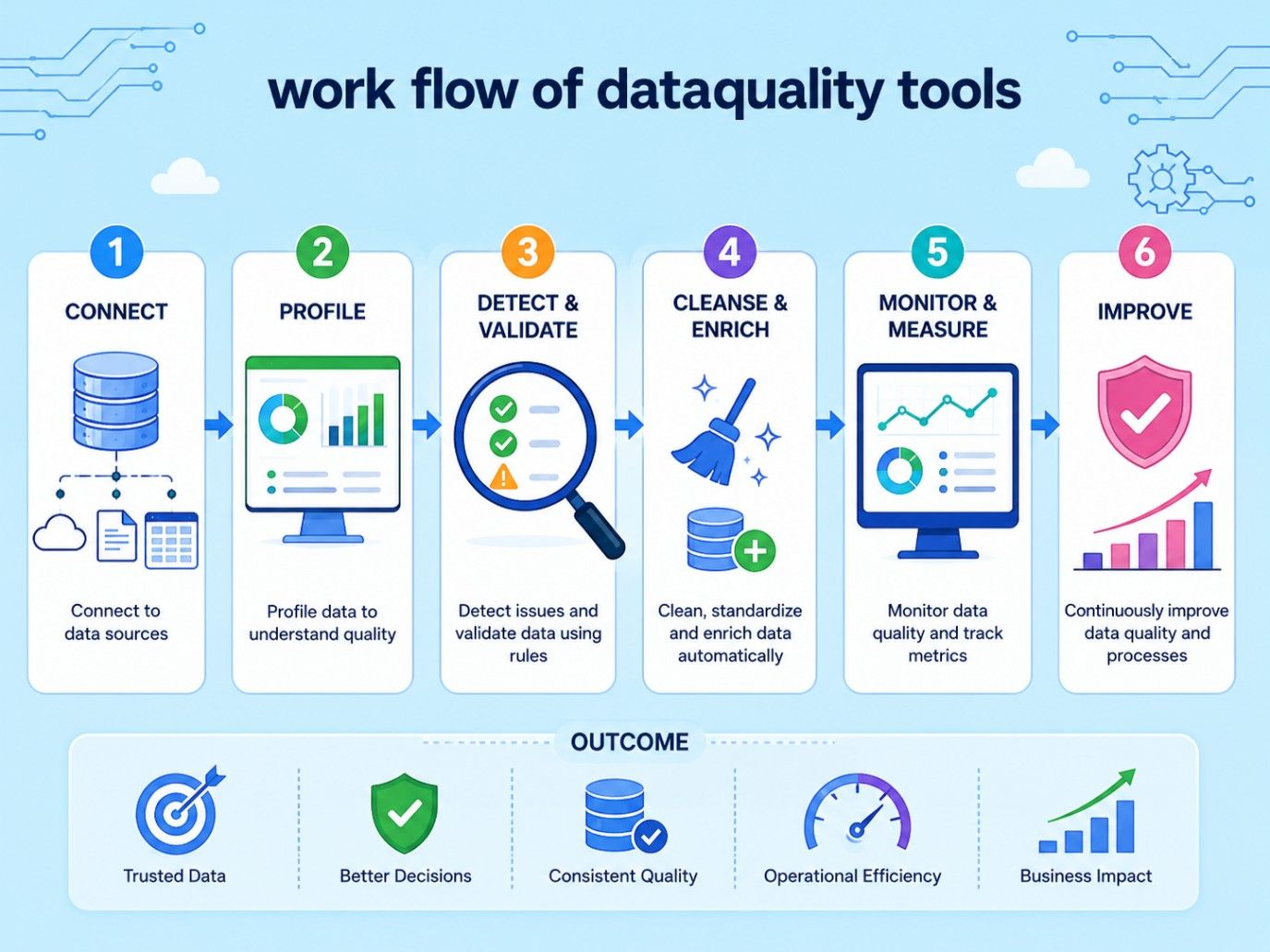
Data Collection → Data Profiling → Data Validation → Data Cleansing → Matching & Deduplication → Continuous Monitoring → Reporting
Also read: How AI Tools for Business Are Revolutionizing Enterprises
Organizations have different data quality needs, so there isn't a one-size-fits-all solution. Some need simple tools for data cleanup, while others require enterprise platforms for large-scale data management. Understanding the main types of data quality tools helps you choose the right solution.
These tools focus on basic data quality tasks and are ideal for small datasets or individual teams.
Best for: Small businesses, analysts, and ad hoc data cleanup.
Designed for large organizations, these data quality management tools support enterprise-wide governance, automation, and compliance across multiple data sources.
Best for: Large enterprises with complex data environments.
Cloud-native solutions validate and monitor data directly within cloud environments, making them ideal for modern data platforms.
An AWS data quality tool, for example, integrates with services like Amazon S3, AWS Glue, and Amazon Redshift to automate quality checks.
Best for: Organizations managing cloud-based data pipelines.
Open-source tools provide a cost-effective option for organizations with limited budgets or technical teams that need flexible customization.
Best for: Small teams, educational projects, and organizations exploring data quality solutions.
The best data quality tools aren't necessarily the ones with the longest feature list. They're the ones that solve your specific data challenges without adding unnecessary complexity.
Do read: How AI in Healthcare is Changing Diagnostics and Treatment
Poor-quality data isn't always easy to spot. Missing values, duplicate records, inconsistent formats, and outdated information can reduce reporting accuracy and affect business decisions. Data quality tools automatically identify and resolve these issues before they impact analytics or operations.
Data Quality Issue |
Description |
How Data Quality Tools Help |
| Missing Values | Records with incomplete information, such as missing customer IDs or phone numbers. | Detect missing fields and flag or complete records based on predefined rules. |
| Duplicate Records | Multiple records exist for the same customer, product, or transaction. | Use matching algorithms to identify and merge duplicate entries. |
| Invalid Data Formats | Data is stored in inconsistent formats, such as dates, emails, or phone numbers. | Validate and standardize formats before data is used for reporting. |
| Inconsistent Information | The same value is recorded differently across systems, such as "USA" and "United States." | Standardize values to maintain consistency across datasets. |
| Outdated Records | Information becomes obsolete as customer, employee, or supplier details change. | Continuously monitor data and flag outdated records for review or updates. |
One incorrect value can spread across dashboards, machine learning models, customer communications, and executive reports. That's why organizations increasingly adopt data quality management tools as part of everyday operations rather than treating data cleanup as an occasional project.
Also Read: Why AI Is The Future & How It Will Change The Future?
As data grows, manual quality checks become inefficient. Data quality tools automate validation, cleansing, monitoring, and reporting to identify issues before they affect business operations.
Data Source → Quality Rules → Validation → Cleansing → Duplicate Detection → Monitoring → Alerts → Reporting
Manual Process |
Data Quality Tools |
| Time-consuming | Automated checks |
| Higher chance of human error | Consistent validation |
| Difficult to scale | Works across millions of records |
| Periodic reviews | Continuous monitoring |
| Limited reporting | Real-time dashboards and alerts |
The difference becomes even more obvious as data volumes grow. A spreadsheet with a few thousand records might still be manageable. A cloud data warehouse containing hundreds of millions of records isn't.
Also Read: 40+ Artificial Intelligence Projects for Final Year Students
Many people confuse data quality tools with other data management technologies.
They work together, but they don't solve the same problems.
Understanding the differences helps organizations choose the right solution instead of buying overlapping products.
Data profiling examines data and identifies potential issues. Data quality tools go further by validating, cleaning, monitoring, and improving that data over time.
Data Profiling Tools |
Data Quality Tools |
| Analyze datasets | Improve datasets |
| Identify issues | Detect and fix issues |
| Generate statistics | Validate and automate corrections |
| Mainly diagnostic | Continuous quality management |
Data cleansing focuses on correcting errors. Data quality tools include cleansing,
but they also provide monitoring, reporting, validation, profiling, and automation.
Data Cleansing Tools |
Data Quality Tools |
| Correct inaccurate data | Manage the entire quality lifecycle |
| Focus on cleaning | Include validation, monitoring, reporting, and automation |
| Usually one-time activities | Continuous quality management |
Think of cleansing as one feature inside a broader quality platform.
The market offers many solutions, each designed for different business needs.
Some products focus on enterprise governance, while others specialize in data preparation, matching, or cloud-based workflows. Looking at several data quality tools examples makes it easier to understand how these platforms differ.
Tool |
Best For |
Key Strength |
| IBM InfoSphere QualityStage | Large enterprises | Enterprise data quality management |
| Talend Data Quality | Data integration projects | Profiling and cleansing |
| Informatica Data Quality | Large organizations | Governance and automation |
| Ataccama ONE | AI-driven quality management | Intelligent automation |
| OpenRefine | Small datasets | Open-source data cleaning |
| Data Ladder | Customer data | Matching and deduplication |
| Oracle Enterprise Data Quality | Oracle ecosystem | Enterprise validation |
| Experian Aperture | Customer data management | Identity matching |
| SAS Data Management | Analytics environments | Data preparation and governance |
| Syniti | Enterprise migration projects | Data quality and migration |
Also read : Who Is Called the Father of AI? His Role, Contributions, and Impact
Choosing a solution isn't just about features. It's about finding software that fits your business processes, existing systems, and long-term goals.
A platform with hundreds of capabilities won't add much value if your team only needs automated validation and duplicate detection.
Decision Checklist :
Question |
Why It Matters |
| Does it solve current quality issues? | Addresses real business needs |
| Can it integrate with existing systems? | Reduces implementation effort |
| Does it support automation? | Saves time and improves consistency |
| Can it scale with business growth? | Avoids future migrations |
| Does it provide reporting and monitoring? | Improves visibility into data health |
Choosing among the best data quality tools isn't about finding the platform with the most features. It's about selecting one that helps your organization maintain accurate, reliable, and trusted data every day.
Read : Artificial Intelligence Subjects: Everything You Need to Know Before Enrolling
Organizations should adopt data quality tools before poor data starts affecting reporting, customer experiences, or business decisions. Implementing them early helps prevent costly errors and improves long-term data reliability.
Consider using data quality management tools if your organization is experiencing:
These tools help maintain accurate data across systems, making analytics, operations, and decision-making more reliable.
Read: Power BI Tutorial: Components, Usage, Operation.
Implementing data quality tools requires more than software. Following the right practices helps maintain accurate and reliable data over time.
Data quality tools help organizations maintain accurate, consistent, and reliable data, leading to better decisions and improved operational efficiency.
Organizations often make the same mistakes when implementing data quality tools.
Recognizing them early saves time and money.
Mistake |
Better Approach |
| Treating data cleansing as a one-time project | Make quality monitoring continuous |
| Ignoring business rules | Define validation standards early |
| Cleaning data without understanding its source | Fix root causes first |
| Monitoring only one system | Monitor the complete data pipeline |
| Focusing only on technology | Include people and business processes |
Some organizations try to fix every issue immediately. That's rarely practical.
Start with the problems that affect business decisions the most. Expand gradually as processes mature.
Organizations across industries use data quality tools to improve data accuracy, reduce errors, and support better decision-making.
Industry |
How Data Quality Tools Help |
| Customer Relationship Management (CRM) | Detect duplicate customer records, standardize data, and improve customer communication. |
| Business Intelligence (BI) | Validate data to create accurate dashboards and reliable reports. |
| Financial Services | Improve fraud detection, transaction accuracy, and regulatory compliance. |
| Healthcare | Maintain accurate patient records and support better clinical and compliance outcomes. |
| Retail & E-commerce | Clean customer and product data to improve inventory management and personalized marketing. |
| Manufacturing | Monitor production and sensor data for better operational efficiency and quality control. |
As organizations adopt AI and cloud technologies, data quality tools continue to evolve with smarter automation and real-time capabilities. Key trends include:
Reliable data quality tools help organizations maintain accurate, consistent, and trustworthy data by automating profiling, validation, cleansing, monitoring, and reporting. This improves business decisions, analytics, AI initiatives, and regulatory compliance while reducing manual effort and costly data errors.
Whether you're evaluating data quality management tools, exploring data quality tools examples, considering an AWS data quality tool, or comparing the best data quality tools, choose a solution that aligns with your business goals, integrates with your existing systems, and supports long-term data quality management.
Ready to start your journey? Book a free consultation with upGrad today to find the best path for your career.
Data quality tools are software solutions that help organizations identify, correct, and monitor issues in their data. They automate tasks such as profiling, validation, cleansing, duplicate detection, and reporting to improve data accuracy, consistency, and reliability across business systems.
Businesses rely on data for reporting, customer engagement, AI, and decision-making. Poor-quality data leads to inaccurate insights, operational delays, and higher costs. Data quality management tools help maintain trusted data, reduce manual effort, and improve the performance of analytics and business applications.
The seven basic quality tools commonly used in quality management are the cause-and-effect diagram, check sheet, control chart, histogram, Pareto chart, scatter diagram, and flowchart. While these improve process quality, data quality tools apply similar principles to monitor and improve the quality of digital data.
The seven commonly used data quality measures are accuracy, completeness, consistency, validity, uniqueness, timeliness, and integrity. Organizations use these metrics to evaluate how reliable their data is and identify areas that require improvement through automated quality checks and monitoring.
The six widely accepted dimensions of data quality include accuracy, completeness, consistency, validity, uniqueness, and timeliness. Together, these dimensions help organizations determine whether data is fit for reporting, analytics, regulatory compliance, and AI applications
The four pillars of data quality are often defined as accuracy, completeness, consistency, and timeliness. These core principles provide a foundation for maintaining reliable business data and are commonly monitored using data quality software across enterprise data pipelines.
Five essential qualities of good data are accuracy, completeness, consistency, validity, and timeliness. Organizations use these characteristics to evaluate data before using it for analytics, customer management, financial reporting, or machine learning projects.
AI systems perform best when they are trained on clean and reliable datasets. Data quality tools remove duplicate records, standardize formats, validate values, and improve overall data consistency, helping machine learning models produce more accurate predictions and reducing the risk of biased outcomes.
Yes. Most modern data quality management tools integrate with cloud platforms such as AWS, Azure, and Google Cloud. An AWS data quality tool can automatically validate data stored in Amazon S3, AWS Glue, and Redshift, making cloud-based analytics more reliable and efficient.
Start by evaluating your data sources, business goals, and existing technology stack. Compare features such as automation, integrations, scalability, reporting, security, and deployment options. The best data quality tools are those that solve your specific data challenges while supporting future growth.
Data governance defines the policies, ownership, and standards for managing data, while data quality tools enforce those standards through validation, cleansing, monitoring, and reporting. Both work together to maintain reliable, compliant, and business-ready data rather than serving the same purpose.
730 articles published
Sriram K is a Senior SEO Executive with a B.Tech in Information Technology from Dr. M.G.R. Educational and Research Institute, Chennai. With over a decade of experience in digital marketing, he specia...
Speak with AI & ML expert
By submitting, I accept the T&C and
Privacy Policy
Top Resources
Master's Degree
18 Months
Executive Diploma
12 Months
IIIT Bangalore
Executive Programme in Generative AI & Agentic AI for LeadersIndia’s #1 Tech University
Dual Certification
5 Months