Research Ethics: Principles, Importance, Types, and Examples
By upGrad
Updated on Aug 13, 2026 | 8 min read | 2.5K+ views
Share:

All courses
Certifications
More
By upGrad
Updated on Aug 13, 2026 | 8 min read | 2.5K+ views
Share:
Table of Contents
Key Highlights
Want to turn your professional experience into advanced business expertise? Explore a DBA online degree and take the next step in your leadership journey.
Research ethics is about making sure a study is carried out in a fair and responsible way. It covers how participants are treated, how their information is handled, and how the results are presented.
A simple way to understand it is to ask: Would the people involved consider the research fair and respectful? The answer can change depending on the type of study.
For instance, a researcher interviewing cancer patients may need to pay close attention to privacy and emotional wellbeing. A study based on customer data may raise different concerns, such as whether people gave permission for their data to be used and how that information is stored.
Research ethics covers several parts of a study. Some of the main ones are:
Depending on the study, a research ethics committee may also need to review the research before it begins. The committee looks at possible risks and checks whether the study has suitable measures to protect participants.
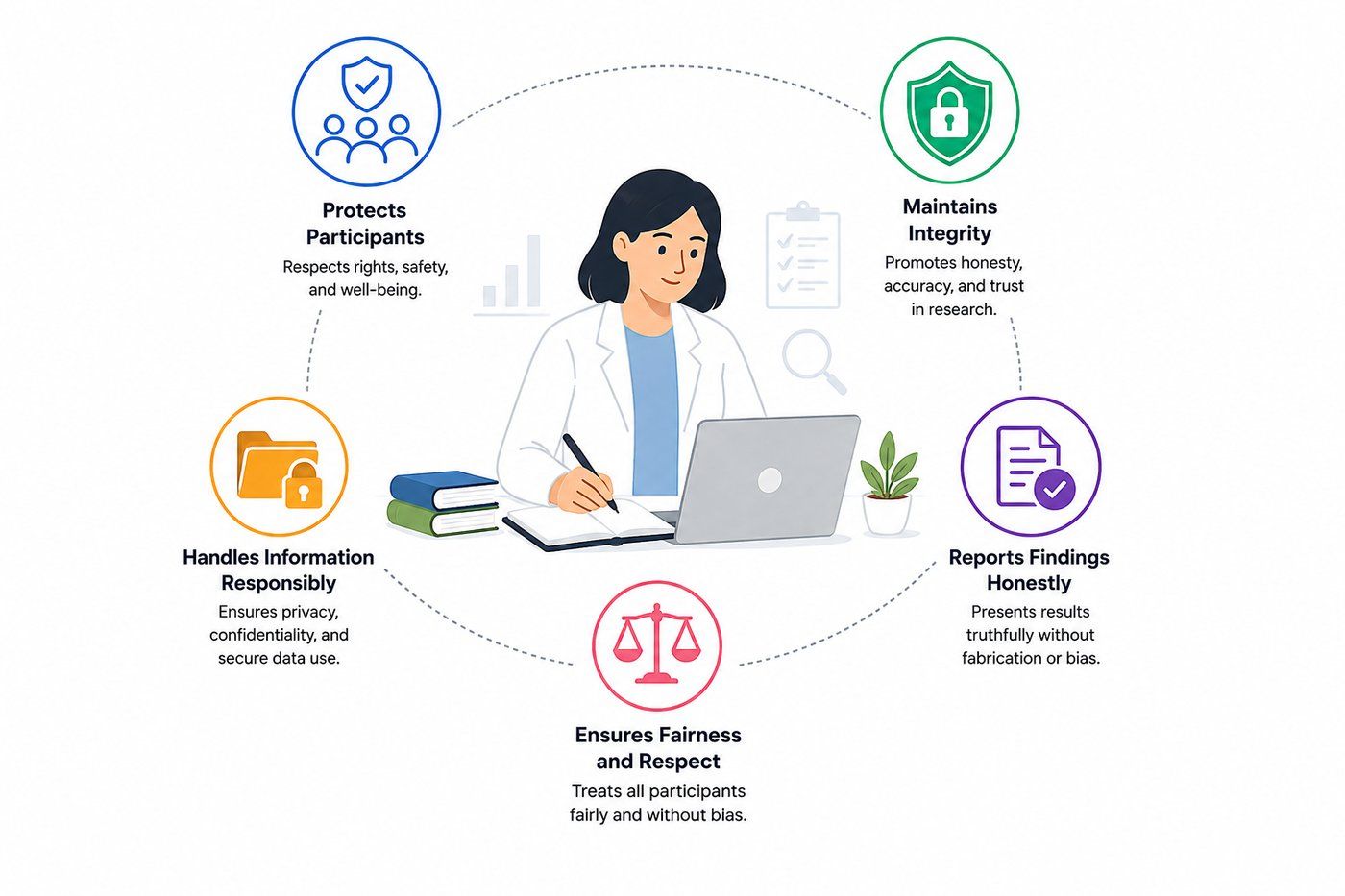
Imagine taking part in a study and later finding out that your private answers were shared without your knowledge. Even if the study produced useful results, you would probably question the way it was conducted.
That is where research ethics comes in. It is not only about following rules. It is also about treating people fairly, handling information carefully, and being honest about the results.
People may share personal experiences, medical details, opinions, or other private information during a study. They should be able to trust that this information will not be used inappropriately.
There can be other risks too. A study might cause emotional stress, affect someone's job, or create social or professional problems. Thinking about these risks before the research starts gives researchers a chance to reduce them.
Good research depends on accurate information. If data is changed, important details are hidden, or findings are presented in a misleading way, readers have less reason to trust the study.
Ethical research means being open about how the study was carried out. It also means:
People should not have to guess what they are signing up for. Before joining a study, they should know what the research is about, what they will be asked to do, and what will happen to their information.
Take a recorded interview. If someone agrees to a 60-minute conversation, they should know before it starts that the interview will be recorded. They should also be told if those recordings may be used for future research.
Not every research decision has an obvious answer. A study can be useful and still involve some level of risk.
In these situations, researchers need to stop and look at both sides. They may ask:
These questions can help researchers find a sensible balance between the value of the study and the safety of the people involved.
The effects of poor research do not always end when a study is published.
Suppose a researcher makes up data or presents false findings. Other researchers may later use that work in their own studies. Their conclusions could then be affected by information that was never reliable in the first place.
Plagiarism can cause similar problems. So can misleading reports. Following ethical practices helps keep the wider research record more reliable and gives future researchers a stronger base to work from.
Also read: How To Do Market Research - [Ultimate Guide]
DBA Courses to upskill
Explore DBA Courses for Career Progression
IIIT-B & IIM, Udaipur
Chief Technology Officer & AI Leadership ProgrammeResearch involves people, personal information, and decisions that can affect others. Ethical principles help researchers handle these responsibilities and avoid putting participants or the research itself at unnecessary risk.
There are a few basic principles that come up across different types of research ethics.
People should know what they are agreeing to before they take part in a study. This means explaining what the research is about, what participants will do, any important risks, and what will happen to their information.
Consent should be freely given. Participants should also have a chance to ask questions before deciding whether to take part.
Research can involve information that people would not normally share publicly. Medical details, financial information, personal experiences, and workplace concerns are a few examples.
Two simple steps can make a big difference:
3. Reducing Harm and Considering the Benefits
A study may be useful, but that does not mean every risk is acceptable. Participants can face physical harm, but they may also experience emotional distress, financial problems, social difficulties, or issues at work.
Before starting the research, it is important to think about what could go wrong. If a risk can be reduced without affecting the study, it should be.
Fairness starts with deciding who takes part in the study. People should not be chosen simply because they are easy to find or unlikely to say no.
It is also worth looking at who is taking on the risks and who is likely to benefit from the research. The burden should not fall unfairly on one group.
Researchers may not always get the results they expected. That is part of doing research.
Unexpected findings should not be changed or hidden just to make the study look more successful. The same goes for limitations. Being clear about what the research could and could not establish gives readers a more realistic picture of the findings.
Research involves many decisions, from choosing a method to deciding how data will be analysed. Important decisions should not be kept unclear from readers or relevant stakeholders.
Researchers also need to take responsibility when something goes wrong. New problems can come up after a study has been approved, so ethical responsibility continues throughout the research process.
Research Ethics Principles at a Glance
| Principle | What It Means |
| Informed consent | Participants know what they are agreeing to and choose to take part. |
| Privacy and confidentiality | Personal information is collected and handled carefully. |
| Beneficence and non-maleficence | The research aims to provide value while avoiding unnecessary harm. |
| Justice and fairness | People are selected and treated fairly during the study. |
| Honesty and integrity | Data, methods, and findings are presented truthfully. |
| Transparency and accountability | Important decisions are explained and researchers take responsibility for their work. |
Also read: Difference Between Law and Ethics Explained
Not every ethical problem in research is intentional. Some involve clear misconduct, while others happen because a researcher overlooks a risk or makes a poor judgement.
Here are some common issues that can affect the way research is conducted.
Plagiarism is more than copying and pasting someone else's words. It also includes using another person's ideas, findings, tables, figures, or other original work without giving proper credit.
For example, a researcher may read an original idea in another study and later present it as their own. Even if the wording is completely different, the source still needs to be acknowledged.
Keeping good notes while researching and citing sources as you go can help avoid accidental plagiarism.
Fabrication and falsification are both serious, but they mean different things.
Suppose a researcher collects 180 valid survey responses but reports that 300 people took part. If those extra responses were never collected, that is fabrication.
Now imagine that some genuine responses do not support the researcher's expected conclusion. Removing them without a valid methodological reason could be falsification.
Researchers can have financial, professional, or personal interests connected to their work. These interests do not automatically make a study unethical. The concern is whether they could influence the research or create the appearance of bias.
For this reason, relevant conflicts should be disclosed. Knowing about a potential conflict gives readers more context when they assess the study and its findings.
Deciding who gets listed as an author can sometimes become complicated.
Someone who makes a significant contribution to the research may deserve authorship. On the other hand, a person who only provides a small administrative favour may not qualify.
Problems can occur in both directions. Someone may be added because they hold a senior position, even without making a meaningful contribution. Or a person who did important work may be left off the author list.
Clear expectations about contributions can help avoid these situations.
Research can affect participants in ways that are not always obvious. Harm could include:
It could also lead to:
Take a workplace harassment study. Asking employees sensitive questions may not cause physical harm. But if their identities are revealed, they could face problems at work or even fear losing their jobs.
That is why participant safety needs to be considered beyond the research session itself. Researchers also need to think about what might happen if personal information is exposed or misused.
Also read: Market Research Analyst Skills: What You Need for Success
Ethics applies to more than participant consent. Researchers need to make responsible decisions before, during, and after collecting data.
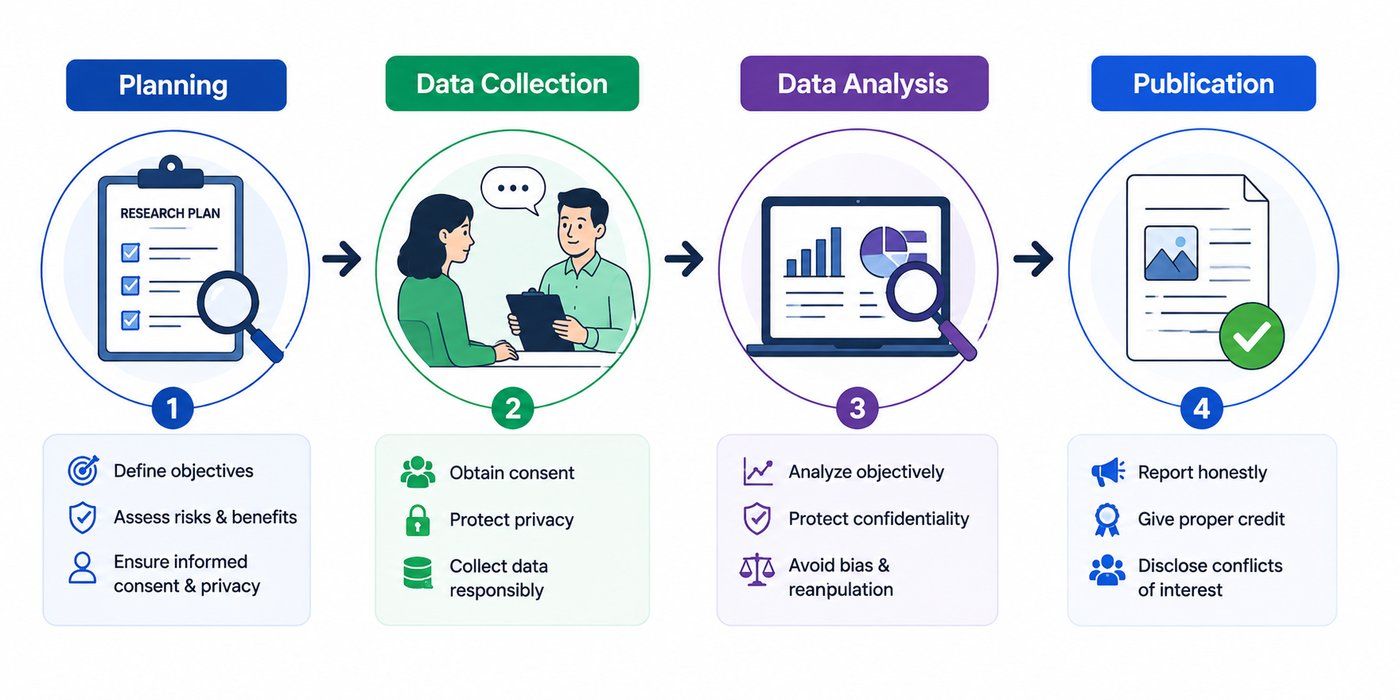
A lot of ethical decisions are made before anyone starts collecting data. Researchers need to think about who should take part, what information is actually needed, and what risks participants might face.
They should also check whether the study needs ethical approval. Participation must be voluntary, too. For example, an employee may feel that they cannot say no if their manager personally asks them to join a workplace study.
This is when researchers put their plans into practice. They need to respect the consent given by participants and keep their information private.
If an interview becomes uncomfortable, the participant should be able to skip a question or stop the session. The location also matters. A sensitive conversation held where other people can hear it could put confidentiality at risk.
Once the data has been collected, researchers need to work with it honestly. They should not change the data just to get a result that supports their original idea.
A few things matter here:
Ethical responsibility does not end when the analysis is finished. Researchers still need to report what they found accurately and give proper credit to previous work and contributors.
They should also mention relevant limitations and conflicts of interest. If they discover an important error after publication, correcting it is better than allowing readers to continue relying on incorrect information.
Aspire to lead technology and AI transformation? Explore the Chief Technology Officer Program - CTO & AI Course & Certification and accelerate your leadership journey.
Research ethics and research integrity are closely connected, but they are not interchangeable.
A simple way to separate them is:
| Research Ethics | Research Integrity |
| Focuses strongly on responsible treatment of participants and ethical conduct | Focuses broadly on honesty, reliability, and responsibility in research |
| Includes consent, privacy, participant safety, and fairness | Includes accurate reporting, proper authorship, data management, and avoiding misconduct |
| Often asks, "Is this research responsible toward the people involved?" | Often asks, "Is this research honest and trustworthy?" |
There is considerable overlap.
An example can be, fabricating data is a research integrity problem. At the same time, it can violate ethical responsibilities because other researchers, participants, institutions, or the public may rely on those findings.
Think of the two concepts as connected parts of responsible research.
Ethics protects people and guides responsible decisions. Integrity protects the trustworthiness of the research itself. Together, they support research ethics and integrity across the entire research lifecycle.
The easiest way to understand ethical principles is to see them in everyday research situations.
Researchers want to understand how patients manage long-term health conditions. The survey asks about personal experiences and medical information.
An ethical approach would explain the purpose of the research, make participation voluntary, protect identifying information, and allow participants to stop if they no longer want to continue.
Ethical principle involved: informed consent, privacy, confidentiality, and minimising harm.
A student wants to study whether social media affects study habits. Instead of collecting students' names and private account information unnecessarily, the student designs an anonymous questionnaire.
Participants are told what the project is about and can choose whether to participate.
Ethical principle involved: privacy, informed consent, and proportionality.
A company wants to understand why employees are leaving. Employees are invited to complete an anonymous survey. However, managers are not allowed to see individual responses. They receive only aggregated findings.
Why does this matter?
Employees may not provide honest answers if they believe their manager can identify them. Protecting confidentiality can therefore improve both ethical standards and the quality of the data.
Ethical principle involved: confidentiality and voluntary participation.
A researcher publishes a study and finds that one of the conclusions contains an important error. Instead of ignoring it, the researcher informs the journal and works toward correcting the published record.
Ethical principle involved: honesty, transparency, and accountability.
Also read: What is Data Analytics? A Complete Guide for 2025
Artificial intelligence is becoming part of many research activities. Researchers may use AI to summarise literature, analyse datasets, identify patterns, generate text, or examine images.
However, these tools also create new ethical issues in research.
1. Data Privacy: Uploading interview transcripts, survey responses, or other sensitive information to an AI tool can create privacy risks. Researchers should check whether they have permission to use the data in this way.
2. Accuracy: AI can generate incorrect or unsupported information. Researchers must verify AI-generated content instead of accepting it without review.
3. Bias: AI systems can reproduce biases present in their data. Using biased outputs for participant selection, classification, or analysis can affect research findings.
4. Transparency: Researchers may need to disclose how AI was used, particularly when it contributes significantly to writing, analysis, or other research activities.
Before using an AI tool, researchers should consider:
AI can support research, but it does not replace the researcher's responsibility. Ethical principles still apply, regardless of the technology being used.
Also read: Data Modeling for Real-Time Data Processing Systems
Research ethics helps researchers protect participants, handle data responsibly, and report findings honestly. Key research ethics principles include informed consent, privacy, fairness, honesty, transparency, and accountability.
As AI and large datasets become more common, new ethical challenges will emerge. However, the core goal remains the same: conduct research responsibly without compromising people's rights, safety, dignity, or trust.
Looking to take the next step in your career? Book a consultation call with upGrad to explore the right programme for your professional goals.
The main goal is to ensure that research is conducted responsibly. It protects participants from unnecessary harm, supports informed participation, protects personal information, and encourages researchers to report and use findings honestly.
The primary responsibility lies with the researchers conducting the study. However, supervisors, institutions, ethics committees, funders, and publishers can also play important roles in reviewing and supporting ethical research practices.
Studies involving human participants, sensitive information, or other potential risks may require ethical approval. The exact requirements depend on the institution, research area, study design, and applicable rules.
Valid consent requires participants to receive enough relevant information to make a voluntary and informed decision. They should understand what participation involves, including important risks, and should not be pressured into participating.
Researchers can reduce bias through careful study design, appropriate sampling, consistent procedures, transparent analysis, and critical review of their assumptions. Declaring conflicts of interest can also improve transparency.
Sometimes, but permission, licensing, privacy, consent, and data-use restrictions need to be considered. Researchers should also verify whether the original collection process met the requirements relevant to their new use of the data.
The consequences depend on the nature and seriousness of the violation. Possible outcomes include investigation, correction of research, withdrawal of publications, institutional disciplinary action, or restrictions on future research.
Ethical problems can affect the reliability and credibility of findings. Like poor consent procedures, biased recruitment, missing data, or manipulated results can make conclusions less trustworthy.
Yes. Laws, institutional requirements, professional standards, and approval processes can differ between countries. However, many core ideas, such as informed consent, privacy, fairness, and protection from harm, are widely recognised.
They should pause and assess the situation rather than automatically continuing with the original plan. Depending on the problem, they may need to protect participants, modify procedures, document what happened, and consult the relevant ethics authority.
Disclosure helps readers and other researchers understand circumstances that could influence, or appear to influence, the study. It does not automatically mean the research is unreliable. Transparency allows others to evaluate the work with the relevant context.
987 articles published
We are an online education platform providing industry-relevant programs for professionals, designed and delivered in collaboration with world-class faculty and businesses. Merging the latest technolo...
Speak with DBA expert
By submitting, I accept the T&C and
Privacy Policy