Guide on Digital Marketing for Dentists in India
By upGrad
Updated on Sep 21, 2026 | 8 min read | 3.47K+ views
Share:

All courses
Certifications
More
By upGrad
Updated on Sep 21, 2026 | 8 min read | 3.47K+ views
Share:
Table of Contents
Key Highlights
Learn the skills you need to succeed in marketing. Our digital marketing courses cover SEO, content marketing, content strategy, paid ads, and other relevant domains. Take the step and build the skills that employers are looking for.
As per the Ortho Marketing survey, “Dentist Near Me” searches have skyrocketed by over 400%. But patients are not only choosing the first result on search engines, they are checking websites, reviews, and social pages in detail before they decide to book an appointment.
This changes the entire game for a dental practice. A patient's decision is rarely based on the clinic they pass by on the road anymore. It is based on what shows up on their screen.
Along with this, paid search contributes to 35% of business traffic for dental offices. Running Google Ads and other paid dental advertising campaigns are important for reaching patients who are actively searching for dental services.
Put together, these numbers point to one conclusion. A dental clinic's digital presence, its website, its reviews, its ranking on Google, and its ads, has become just as important to patient acquisition as the quality of treatment provided inside the clinic. A dentist who ignores this side of the practice is handing over patients to competitors who have simply shown up better online.
Also read: Fundamentals of Digital Marketing – What You Need to Know
Free Courses
Now, as you know that patients search online before choosing a dentist is only the starting point. What actually brings in appointments is how a clinic uses that knowledge in practice.
Below six strategies cover the basics that most dental clinics need to get right.
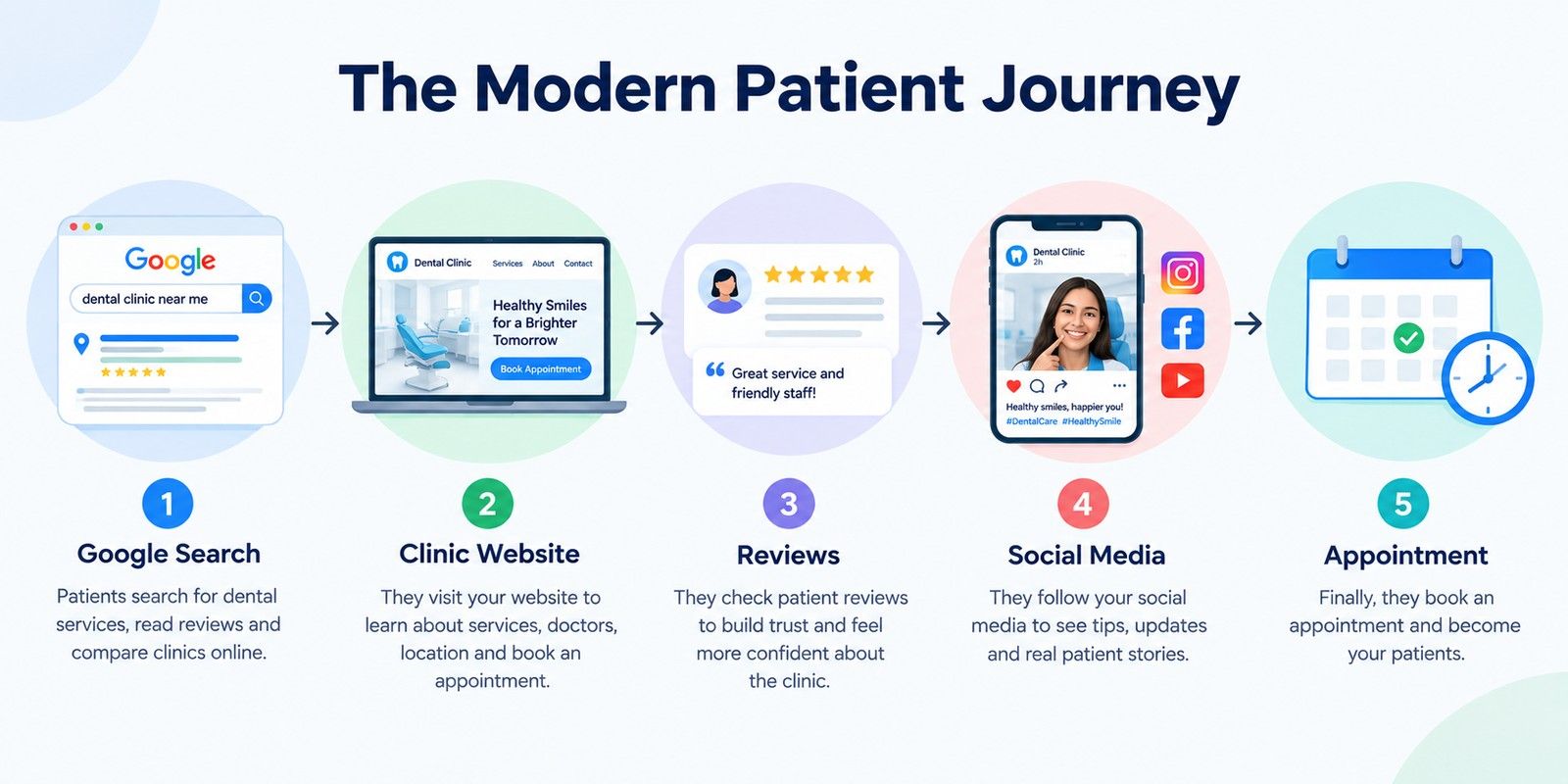
The website is often the first thing a patient sees about a clinic. If a website page takes longer than 3 seconds to load, 53% of visits are likely to be abandoned. They simply move to your competitor's website.
A good dental website makes basic information easy to find like services offered, dentists' qualifications, location, and section for booking an appointment or call.
Real photographs of the clinic matters too, do not use stock images. Patients feel more familiar with the clinic when they research about your clinic. Also, add before and after photographs of treatment. Add genuine patient testimonials. All of this adds a layer of trust that plain text alone cannot give.
These days people just do not look for dentists, they want their clinic near their home or offices. Local SEO is what helps a clinic show up when someone searches for something like a dentist near me or dental clinic in a particular area, especially in that map section that appears at the top of Google, usually called the local pack.
For doing local SEO in digital marketing follow these points:
Before booking an appointment, the patients usually search queries related to their dental issues. These queries can be:
If you add answers related to these types of queries on your website, and social media. Your content helps a clinic to show up in search engines even before patients pick a dentist.
No need to add technical content Just answer the queries in simple language, so people can easily understand the information. Over time, this content like articles or short videos keep bringing in new visitors through search. Many of them turn into patients once they are ready for treatment.
Social media works differently from a website or search engine. People are not actively searching here. Instead, this is where a clinic builds familiarity before a patient makes contact.
A short video explaining a common procedure can help. So can a photo from inside the clinic, or a before and after result shared with patient consent. These small things make a new visitor feel comfortable before their first visit.
Posting regularly matters more than posting a lot. A clinic that shares two or three good posts a week builds more trust over time. This works better than posting only during festivals or offers.
SEO and content take months to show results. Google Ads work differently. They can bring in inquiries on an immediate basis.
A few things make Google Ads work well for dental clinics:
None of the strategies above matter much if a clinic has no way to know whether they are working. This step often gets skipped, but it is one of the most important parts of any marketing effort.
Some simple tools can help track this:
Together, these show a dentist exactly which channel is bringing in patients and which one is just spending money without much return. Checking this regularly to decide where to put more effort and where to pull back.
Get the Advanced Certificate in Digital Marketing and learn the skills dental clinics and businesses are hiring for, from local SEO to Google Ads. Enroll today and turn your knowledge into a career that grows with every industry.
Digital Marketing Courses to upskill
Explore Digital Marketing Courses for Career Progression
MICA Executive Alumni Status
Knowing individual strategies like SEO or social media is useful, but without a plan getting desired results is tough. A proper digital marketing strategy gives direction to all these efforts, so that time and budget go toward things that actually bring sales.
Here is a simple, step by step way a dentist or clinic owner can put one together.
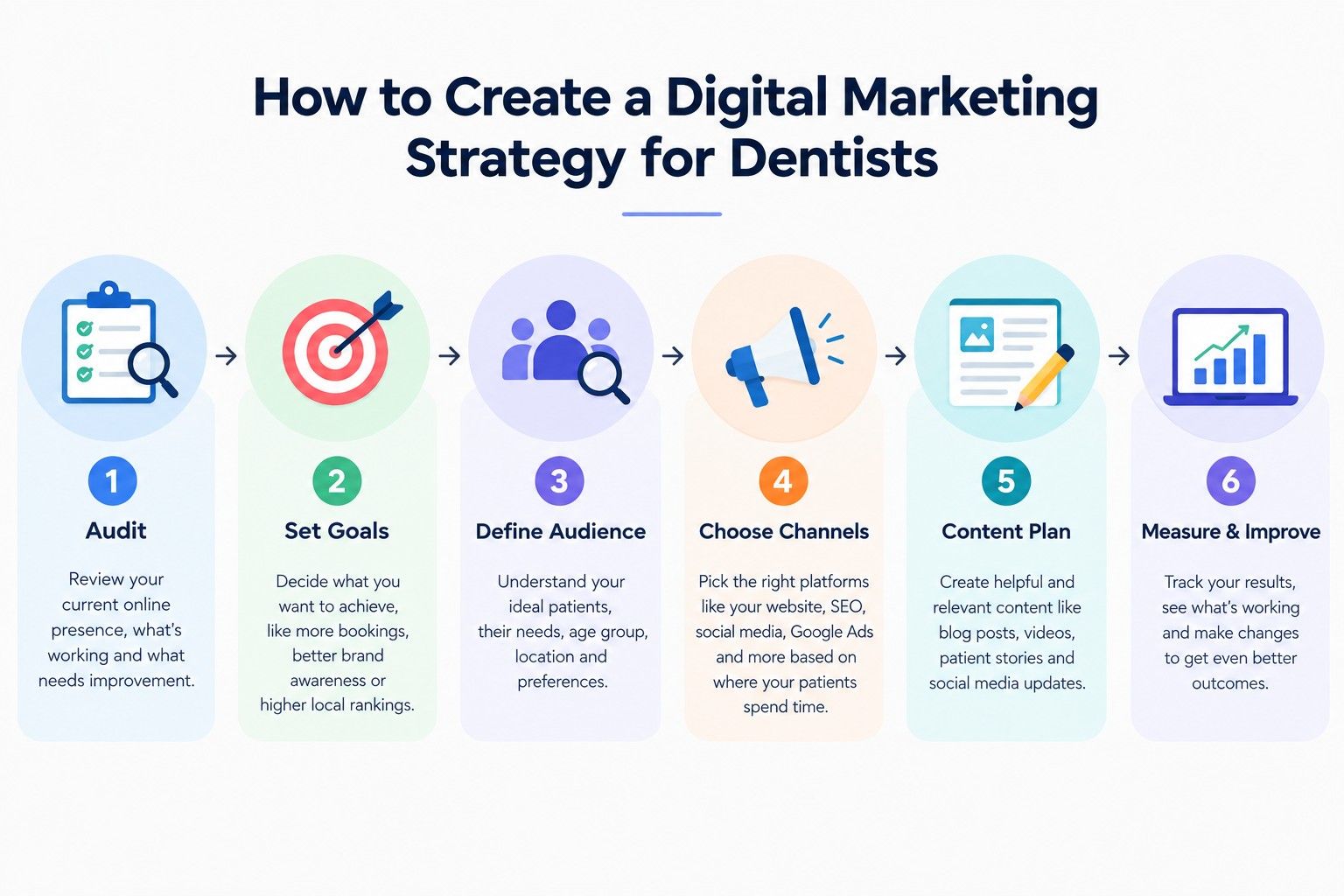
Understand your current situation by asking these questions, and you will get a starting point for your strategy.
If you set a goal like "getting more patients", this is not a clear goal. It is too vague to act on. A better goal is specific and easy to track:
A dental clinic serving families needs a different approach than a clinic focused on cosmetic dentistry or implants. So, understanding the right audience shapes almost everything, including what content gets written, which platforms get used, and how the ads get targeted.
Not every clinic needs to be active everywhere. The right channels depend on where the clinic stands.
Clinic Type |
Best Channels to Focus On |
| Newly opened clinic | Local SEO and Google Ads for quick visibility |
| Established clinic with steady patients | Content and social media for long term trust |
| Clinic with a tight budget | Local SEO and Google Business Profile first |
Once the channels are decided, write down what will actually be done and when. This can be as simple as:
Even a basic spreadsheet works for this. Having it written down keeps marketing consistent, instead of it happening only when someone remembers.
A strategy is not something to set once and forget. Reviewing website traffic, calls, and appointment bookings every month shows what is actually working. If a certain type of content or a specific ad brings in more patients, put more effort there. If something is clearly not working, change it or drop it, instead of continuing just out of habit.
Also read: Digital Marketing for Startups
The table below gives a quick comparison of each marketing channel available for dentists.
Channel |
Best For |
Time to Results |
Ongoing Cost |
| Website and SEO | Steady inquiries without paying per visitor | A few months | Low |
| Google Business Profile | Local patients nearby | A few weeks | Free |
| Social Media | Long term trust and familiarity | Several months | Low |
| Google Ads | Quick, immediate inquiries | Same day to a few days | Ongoing, per click |
| Content Marketing | Trust building at research stage | A few months | Low |
| Email and WhatsApp | Bringing patients back for recurring visits | Immediate | Low |
| Online Reviews | Trust before the first appointment | Ongoing | Free |
Also read: Digital Marketing Eligibility: Who Can Apply and What You Need to Know
Even after following all the digital marketing for dentists strategies, many dental clinics do not get the results they want. Some reasons behind not getting the results are as follows:
Also read: Digital Marketing Resume: Complete Guide
Some numbers, if tracked consistently, can tell a dentist exactly how the marketing is performing. These measures are as follows:
Google Analytics is free to use. It shows how many people visited the website and where they came from, whether it was a Google search, a social media link, or a paid ad. This helps a clinic see which channels are actually driving attention, instead of guessing.
A website visit does not mean much on its own if it does not lead to an inquiry. Two simple things help here:
Together, these show how many people actually took the next step toward becoming a patient.
Not every call or form fill turns into a booked appointment. Keeping a simple log, even in a spreadsheet, of which channel each new patient came from connects marketing directly to real patients walking in. This is the number that matters most in the end.
For clinics investing in SEO and content, it helps to check where the website ranks for important searches, like a treatment name combined with the city. This shows whether the SEO work is moving in the right direction.
For clinics running Google Ads, calculate how much is spent to get one new patient.
Watching how the number of reviews and the average rating change month over month shows whether the clinic's online reputation is improving, staying flat, or slipping. A steady rise in genuine reviews is usually a good sign.
7. Social Media Engagement
For clinics active on social media, likes, comments, and shares say more about performance than follower count alone. A smaller, engaged audience is often more valuable than a large one that never interacts.
None of these numbers need daily checking. A simple monthly review of these basics is usually enough to know what is working, what needs improvement, and where the marketing budget should go next.
Also read: A Complete Guide to Crafting an Impactful Digital Marketing Strategy
Conclusion
Digital marketing for dentists is no longer something to think about later. Patients are already online, searching, comparing, and reading reviews before they pick a dentist. A clinic that shows up clearly in these places, with a good website, active local SEO, helpful content, and a steady presence on social media, has a real advantage over one that does not.
None of this needs to happen all at once. A clinic can start small, maybe fixing the Google Business Profile first, or running a single Google Ads campaign, and build from there. What matters more is staying consistent and checking what is actually working along the way.
The clinics that grow steadily online are usually not the ones spending the most. They are the ones paying attention, tracking results, and making small improvements over time. With the right approach, digital marketing can bring in a steady stream of new patients, without depending only on walk-ins or referrals.
Ready to start your journey? Book a free consultation with upGrad today to find the best path for your career.
Digital marketing for dental clinics in India works much like elsewhere, but local SEO matters even more since patients usually prefer a nearby clinic. Reviews and WhatsApp also play a bigger role in how patients decide and communicate.
Pricing depends on the scope of work involved. A basic package covering local SEO and Google Business Profile costs less, while a full package with a website, ads, and content costs more. Quote based on the exact services included, not a flat number.
Yes, digital marketing often helps small clinics even more than larger ones. It offers a lower cost way to reach nearby patients compared to traditional advertising like hoardings or newspapers, and even basic efforts like local SEO can bring in noticeable results.
This depends on the channel used. Google Ads can bring in calls within a day or two of launching. Local SEO usually shows improvement in a few weeks. SEO and content marketing take the longest, often three to six months to show real results.
A dentist can manage basics like updating a Google Business Profile or posting occasionally on social media. However, tasks like SEO, running Google Ads, and building a proper website usually need specific skills, which is why many clinics prefer hiring help.
For most dental clinics, the Google Business Profile is the best starting point. It is free, relatively quick to set up, and directly affects how the clinic appears in local searches, making it a strong first step before other channels.
Yes, these usually need separate budgets. Social media, when managed organically, mainly involves time or content creation cost. Google Ads run on a pay per click model, meaning the clinic pays continuously based on how many people click the ads.
There is no fixed number of reviews a clinic needs. What matters more is consistency, having a steady stream of genuine, recent reviews coming in regularly, along with thoughtful replies from the clinic, rather than just a large total count.
Yes, digital marketing works well for specialized practices too. A clear focus actually makes targeting easier. A pediatric clinic can create content aimed at parents, while a cosmetic dentistry practice can focus on before and after visuals and treatment specific pages.
A dentist should avoid agencies that promise instant rankings or guaranteed results, since search engines do not work that way. It helps to ask for past dental client examples, check how leads are tracked, and confirm what the monthly fee actually covers.
No, digital marketing does not replace referrals, it works alongside them. Word of mouth remains valuable, especially for retaining existing patients. Digital marketing simply adds another consistent source of new patients who do not already know someone at the clinic.
978 articles published
We are an online education platform providing industry-relevant programs for professionals, designed and delivered in collaboration with world-class faculty and businesses. Merging the latest technolo...
Get Free Consultation
By submitting, I accept the T&C and
Privacy Policy
Level Up Your Digital Marketing Career Today!
Top Resources
MICA
Advanced Certificate in AI-Powered Digital Marketing & Communication from MICAMICA Executive Alumni Status
Certification
5 Specialisation
Classroom
4 Months
Certification
2 Months