Digital Marketing Business in India
By upGrad
Updated on Jun 17, 2026 | 5 min read | 2.46K+ views
Share:

All courses
Certifications
More
By upGrad
Updated on Jun 17, 2026 | 5 min read | 2.46K+ views
Share:
Table of Contents
The digital marketing business in India is growing fast in fact it is one of the growing parts of Indias digital economy. People are spending more time online and because of this, businesses are shifting their advertising investment from platforms like TV and newspapers to digital. Now all kinds of businesses from startups and local shops to big companies use digital marketing. They do this to get customer leads and gain sales.
In this guide you will learn everything about Digital marketing business in India. You will also learn about how big the industry is, what kinds of business models are popular, and what services are offered. How much does it cost to start a marketing business, what trends are emerging, what challenges there are, and what opportunities in the future.
Explore Online Digital Marketing Courses from upGrad and gain a deeper understanding of how businesses in India are leveraging digital channels.
The digital marketing business in India is about companies and professionals that help brands promote their products and services online. They use channels like search engines, social media, websites, email, and online ads to do this.
India’s digital world has grown fast over the last ten years. There are now over 1 billion people in India using the internet. This means businesses have a chance to connect with customers online.
Thus, digital ads are growing faster than regular offline ads. So digital marketing is now a part of business, for companies of all sizes. It helps them reach customers and grow their business.
Unlike Traditional Media, digital channels allow businesses to track every click, impression, and conversion. This makes marketing budgets more accountable and performance focused.
Several factors are driving the growth of digital marketing:
Also Read: Digital Marketing Scope in India – The Perfect Career Move
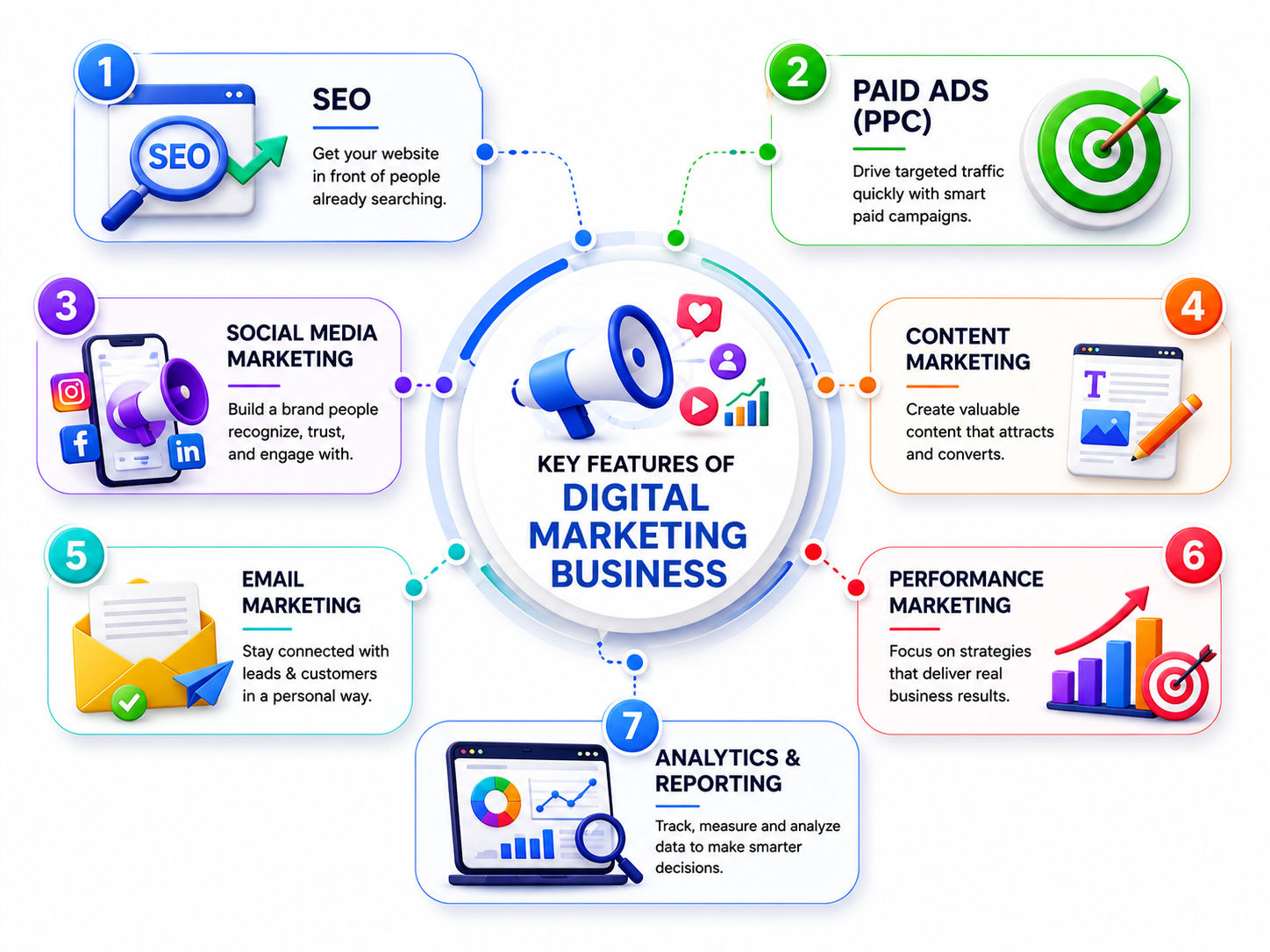
A full-service digital marketing business brings together a range of specialized services, each playing a distinct role in helping brands grow their online presence, connect with the right audiences, and deliver real, measurable results.
Together, these services form the backbone of a digital marketing strategy that doesn't just look good on paper; it delivers where it counts.
The short answer is - everyone. As more organizations shift away from traditional advertising like television, print, and outdoor campaigns, digital channels have become the go-to choice. And it's easy to see why they're more targeted, more measurable, and far more cost-effective.
Whether a brand is just finding its feet or looking to dominate its market, digital marketing has something to offer, and that's exactly what makes it such a dynamic and fast-growing industry.
The digital marketing industry serves an incredibly diverse mix of clients, including:
Industry reports show that digital channels now command a significant and rapidly expanding share of the country's total advertising spend, and that growth isn't showing any signs of slowing down.
What is driving this shift?
Businesses are increasingly moving their budgets away from Traditional Media television, print, and outdoors toward digital channels that offer something traditional advertising simply can't: the ability to track, measure, and optimize every rupee spent. For organizations focused on real, measurable growth, the choice is becoming clearer by the day.
Also Read: What is Digital Marketing?
Free Courses
One reason marketing in India is attractive to entrepreneurs is that there are many business models to choose from. These models suit skills, budgets, and growth goals.
Full-Service Agencies offer services in one place.
They provide services like:
The good things about Full-Service Agencies are:
But they also face challenges like:
Niche Agencies focus on one area instead of offering everything. Many Niche Agencies charge more because they have expertise in the field.
Examples include:
Performance Marketing Agencies
These agencies focus on Performance Marketing campaigns that give results. Clients like Performance Marketing solutions because results are easy to see.
They measure success by:
Many professionals start as Freelance marketers or consultants before building agencies.
They offer services like:
The benefits are:
Agencies that focus on B2B Lead Generation help businesses get prospects.
They use tactics like:
There is demand, for B2B Lead Generation as software and technology companies grow in India.
Choosing the right model depends on expertise, resources, and target clients.
Model |
Description |
| Retainer | Monthly recurring fee |
| Project-Based | Fixed project cost |
| Commission | Percentage of ad spend |
| Performance-Based | Revenue tied to results |
| Consulting | Hourly or strategic advisory fee |
Also Read: Growth of Digital Marketing in India: Evolution, Opportunities, and Future Trends
Digital Marketing Courses to upskill
Explore Digital Marketing Courses for Career Progression
MICA Executive Alumni Status
Starting a Digital marketing business in India is not that hard. You do not need a lot of money to begin with, and you need the right skill set, systems in place, and a good reputation to succeed.
Before you start serving clients you need to be good at a certain thing:
Clients expect you to know tools like Google Analytics, SEMrush and HubSpot.
Do not try to offer everything at once. Start with a few services like:
Then you can add services as you get more clients.
Having an online presence shows that you are an expert and helps build trust with potential clients.
Your digital marketing agency website should have:
Here are some essential tools you will need:
Many people start as freelancers or consultants before hiring employees.
Here are some estimated startup expenses you might have:
For medium-sized businesses it is often more important to show that your services will give them a good return, on investment.
Here are some ways to get your clients:
Also Read: Digital Marketing Course Syllabus : Everything You Should Know
Building a successful digital marketing business isn't just about knowing what to do; it's equally about knowing what to avoid. Some of the most common pitfalls that trip up new and growing agencies include:
The agencies that stand the test of time aren't necessarily the flashiest or the fastest growing they're the ones that show up consistently, deliver on their promises, and make sure every client can see the value they're getting.
Subscribe to upGrad's Newsletter
Join thousands of learners who receive useful tips
The digital marketing business in India is no longer a niche industry. It has become a critical growth engine for businesses across sectors. Rising internet usage, growing digital advertising budgets, expanding E-commerce, and advances in AI Integration are creating new opportunities every year.
Whether you choose to build Full-Service Agencies, launch Niche Agencies, specialize in B2B Lead Generation, or work through a Freelance/Consultancy model, the market offers significant potential. Businesses increasingly want measurable results, making Performance Marketing (ROI-driven) approaches, SEO, Paid Ads (PPC), and cost-effective digital strategies more valuable than ever.
For aspiring entrepreneurs and marketers, the opportunity remains strong. The key is to build expertise, stay adaptable, and focus on delivering real business outcomes.
Want personalized guidance on Digital Marketing Business in India? Speak with an expert for a free 1:1 counselling session today.
Yes. Profitability depends on client retention, service quality, and operational efficiency. Businesses increasingly allocate marketing budgets toward digital channels because results are measurable. Agencies that specialize in high-demand services often achieve healthy margins and recurring revenue.
A small agency can start with limited investment. Initial costs usually include a website, software subscriptions, branding, and basic marketing. Many founders begin with a Freelance/Consultancy model before expanding into a full agency setup.
Services such as SEO, Paid Ads (PPC), Performance Marketing (ROI-driven) campaigns, and B2B Lead Generation often generate substantial revenue. Retainer-based services typically provide more predictable income than one-time projects.
Technology, education, healthcare, real estate, finance, and E-commerce companies are among the biggest spenders. These industries rely heavily on online customer acquisition and lead generation to support business growth.
Absolutely. Many Medium Enterprises (SMEs) and local businesses use digital channels to compete with larger brands. Well-planned campaigns often provide more affordable and cost-effective digital strategies than traditional advertising methods.
AI Integration helps marketers automate tasks, improve targeting, analyze customer behavior, and optimize campaigns. It allows businesses to make faster decisions and improve campaign performance without significantly increasing resources.
Popular tools include Google Analytics, SEMrush, HubSpot, Google Ads, and social media management platforms. These tools help marketers track performance, manage campaigns, and identify growth opportunities.
Digital marketing provides measurable results, detailed targeting, and faster optimization. Unlike Traditional Media, businesses can track customer actions and adjust campaigns based on real-time performance data.
It depends on business goals. Niche Agencies often command higher fees due to specialized expertise. However, Full-Service Agencies may attract larger clients seeking multiple services from a single provider.
Companies selling high-value products and services need qualified prospects rather than broad awareness. B2B Lead Generation helps organizations connect with decision-makers and build predictable sales pipelines through targeted campaigns.
The outlook remains highly positive. Growth in internet users, increasing digital ad spending, expanding E-commerce, stronger Automation, and wider adoption of AI Integration are expected to drive continued demand for digital marketing services across industries.
965 articles published
We are an online education platform providing industry-relevant programs for professionals, designed and delivered in collaboration with world-class faculty and businesses. Merging the latest technolo...
Get Free Consultation
By submitting, I accept the T&C and
Privacy Policy
Level Up Your Digital Marketing Career Today!
Top Resources
MICA
Advanced Certificate in AI-Powered Digital Marketing & Communication from MICAMICA Executive Alumni Status
Certification
5 Specialisation
Classroom
4 Months
Certification
2 Months