Difference Between Private and Public Cloud in Cloud Computing
By upGrad
Updated on Sep 21, 2026 | 8 min read | 2.36K+ views
Share:

All courses
Certifications
More
By upGrad
Updated on Sep 21, 2026 | 8 min read | 2.36K+ views
Share:
Table of Contents
Key Differences
Want to work with the massive datasets that run on cloud infrastructure? Our Data Science Course teaches you to analyze, model, and deploy data at scale.
Popular Data Science Programs
Below are some difference between public cloud and private cloud, check for clarity:
Parameter |
Private Cloud |
Public Cloud |
| Ownership | Single organization (or dedicated provider) | Third-party cloud service provider |
| Access | Restricted to one organization | Shared among multiple organizations (multi-tenant) |
| Cost | Higher upfront investment, predictable long-term costs | Pay-as-you-go, lower upfront cost |
| Scalability | Limited by owned infrastructure | Virtually unlimited, on-demand |
| Security & Compliance | Higher control, easier to customize for compliance | Provider-managed, shared responsibility model |
| Customization | Highly customizable | Standardized, less flexible |
| Maintenance | Managed by internal IT team (or vendor on their behalf) | Fully managed by the provider |
| Best suited for | Regulated industries, sensitive data, custom workloads | Startups, variable workloads, cost-conscious businesses |
Also read: Scope of Cloud Computing in 2026 - Advantages, Salary, Jobs
Free Courses
Private and public cloud may differ in ownership and access, but they share the same core cloud computing foundation. Here is where they overlap:
Also read: 17+ Essential Cloud Computing Models You Should Know
Data Science Courses to upskill
Explore Data Science Courses for Career Progression
IIIT Bangalore
Executive Post Graduate Certificate in Data Science & AIPlacement Assistance
A private cloud is a computing environment built for and used by only one organization. In a public cloud, infrastructure is shared across many customers. In a private cloud, everything is different. The servers, storage, and network all belong to a single company and nobody else uses them.
The setup can live on the organization's own premises. It can also be managed by an outside provider at a separate location. Either way, no other organization touches those resources.
This model is common among organizations that deal with sensitive information or have compliance rules to follow. Banks, hospitals, and government bodies are typical examples. Because the environment belongs to just one organization, there is more room to control security, manage data properly, and set up the infrastructure exactly as needed.
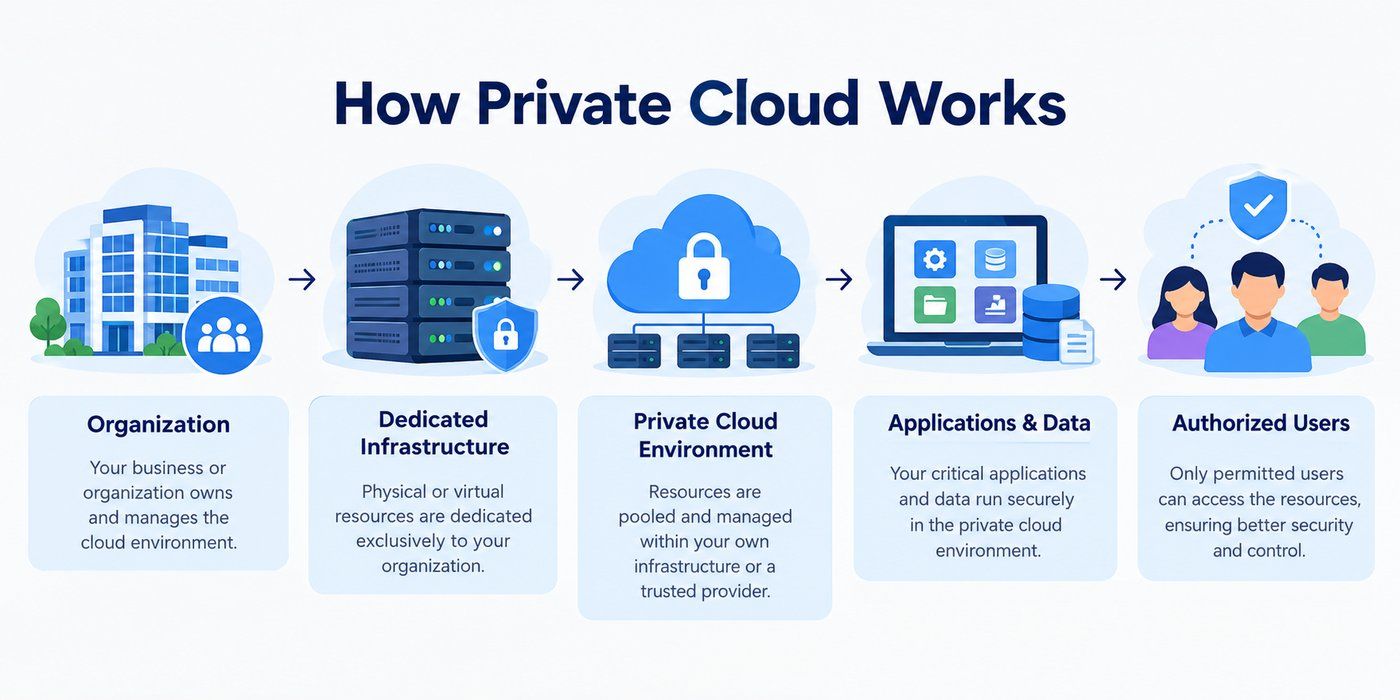
The following are the advantages and disadvantages of private cloud.
Advantages of Private Cloud
Limitations of Private Cloud
Also read: Blockchain vs Cloud Computing: Difference Between Blockchain and Cloud Computing
Public cloud is a computing model where infrastructure, like servers, storage, and networking, is owned and operated by a third-party provider and shared across multiple customers over the internet. Instead of buying and maintaining your own hardware, you rent computing resources from providers like AWS, Microsoft Azure, or Google Cloud, and pay only for what you use.
Since the same physical infrastructure serves many customers at once (a setup known as multi-tenancy), providers use strict isolation and security measures to keep each customer's data separate. This model is popular because it removes the need for heavy upfront investment and lets businesses scale resources up or down almost instantly based on demand.
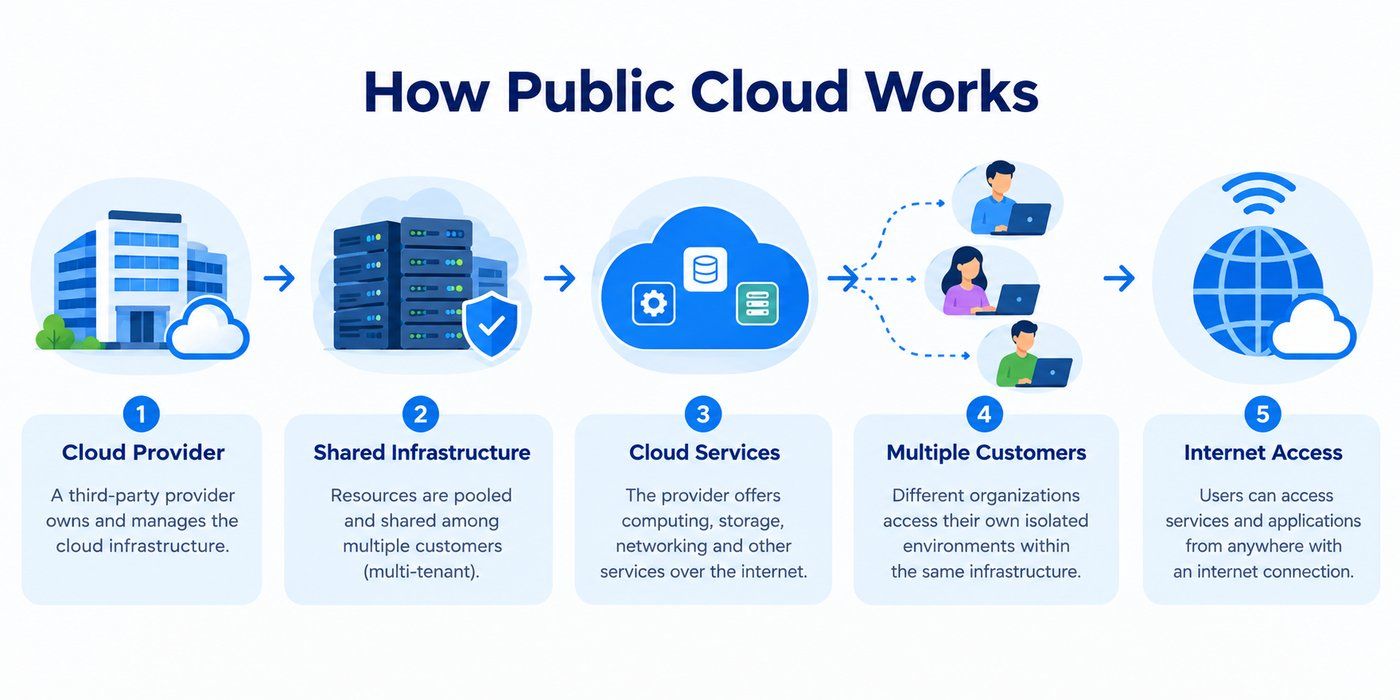
Below are some of the advantages and disadvantages of public cloud.
Advantages of Public Cloud
Limitations of Public Cloud
Get an MS in Data Science from Liverpool John Moores University, UK that too in just 18 months, with an Executive Diploma from IIITB.
Deciding between private and public cloud isn't something you can answer with a formula. It comes down to your situation: how much control you need, what you can spend, what rules you have to follow, and where you expect to be in a few years.
Private Cloud Work Better If:
Public Cloud Work Better If:
In practice, plenty of companies don't fully commit to either side. They keep sensitive workloads on the private cloud and push everything else to the public cloud for flexibility and cost savings. That combination is basically what people mean when they talk about hybrid clouds.
Also read: Types of Cloud Computing & Cloud Computing Services
Test what you have learned so far. For each scenario below, work out whether private cloud or public cloud would be the better fit.
Scenario 1: A hospital needs to store patient records and must comply with strict healthcare data regulations.
Answer: Private Cloud. Sensitive data and compliance requirements call for dedicated, controlled infrastructure.
Scenario 2: A new e-commerce startup expects unpredictable traffic spikes during sales seasons and wants to avoid large upfront costs.
Answer: Public Cloud. Flexibility and pay-as-you-go pricing suit unpredictable, growing workloads.
Scenario 3: A government agency needs full control over its data location and security policies because of national regulations.
Answer: Private Cloud. Data residency rules and strict control needs favor a dedicated environment.
Scenario 4: A software company wants to quickly deploy and test new applications without investing in physical servers.
Answer: Public Cloud. Fast deployment and no hardware investment make public cloud the practical choice here.
Scenario 5: A bank wants to run its core transaction systems on infrastructure it fully controls, while using extra computing power during peak hours from an external provider.
Answer: Hybrid Cloud (Private and Public). This combines dedicated control for critical systems with public cloud scalability for peak demand.
Also read: Top 25 Advantages of Cloud Computing For an Organization
Choosing between private and public cloud is not about which one is better. It is about which one fits your organization's needs. Private cloud gives you more control, security, and customization, so it works well for businesses dealing with sensitive data or strict compliance rules. Public cloud offers flexibility, faster deployment, and lower upfront costs, which suits businesses that need to scale quickly without investing heavily in infrastructure.
The decision does not always have to be either-or. Many organizations combine both through a hybrid cloud approach, keeping critical workloads on private infrastructure while using public cloud for scalability and cost savings. Understanding how the two compare makes it easier to choose a setup that actually supports your business goals, now and as you grow.
For clear and personalized career answers, book a consultation call with our upGrad today.
Not always. Public cloud can end up costing more over time due to ongoing usage-based billing, especially for consistently high workloads. Private cloud requires a bigger upfront investment but can be more cost-effective long-term for organizations with steady, predictable resource needs.
Yes. A private cloud doesn't have to be on-premises. Many providers offer "hosted private cloud" services where the infrastructure is dedicated to a single organization but managed off-site by the vendor.
Industries with strict regulatory or data sovereignty requirements, such as defense, government intelligence agencies, and certain financial institutions, sometimes avoid public cloud entirely due to compliance mandates that require full infrastructure control.
Not exactly. While public cloud uses shared physical infrastructure, providers use virtualization and strict isolation techniques to logically separate each customer's data, even though the underlying hardware is shared.
Migration typically involves assessing workload compatibility, choosing compatible tools (since many platforms use similar container or virtualization technology), transferring data securely, and testing performance before fully cutting over. It's rarely an instant switch and often requires a phased approach.
No. Multi-cloud means using services from multiple public cloud providers (like AWS and Azure together), while hybrid cloud specifically refers to combining private and public cloud environments.
It's less common due to cost, but some small businesses in regulated industries (like local healthcare clinics or financial advisory firms) opt for private cloud or hosted private cloud when compliance outweighs budget concerns.
In a private cloud, the organization (or its hosting vendor) typically holds most of the security responsibility. In public cloud, security follows a "shared responsibility model," where the provider secures the infrastructure, but the customer is responsible for securing their data, applications, and access controls.
Generally, no. Public cloud allows near-instant provisioning since resources are already available at scale. Private cloud deployment usually takes longer since new capacity may require purchasing or configuring additional hardware.
Unlike public cloud, private cloud doesn't automatically scale beyond its existing infrastructure. Organizations often need to purchase additional hardware or temporarily use public cloud resources (a "cloud bursting" strategy) to handle overflow demand.
Not necessarily. While both can meet major compliance frameworks like ISO 27001 or SOC 2, private cloud is often preferred for stricter regulations (like HIPAA or GDPR data residency rules) since it allows more direct control over where and how data is stored.
977 articles published
We are an online education platform providing industry-relevant programs for professionals, designed and delivered in collaboration with world-class faculty and businesses. Merging the latest technolo...
Speak with Data Science Expert
By submitting, I accept the T&C and
Privacy Policy
Start Your Career in Data Science Today
Top Resources
Executive Diploma
12 Months
Master's Degree
18 Months
Bootcamp
6 Months