Will AI Replace Digital Marketers in the Future? Know the Real Truth
By upGrad
Updated on Sep 14, 2026 | 8 min read | 3.56K+ views
Share:

All courses
Certifications
More
By upGrad
Updated on Sep 14, 2026 | 8 min read | 3.56K+ views
Share:
Table of Contents
Key Highlights
AI is changing the rules of digital marketing, and rewarding those who know how to use it. The best time to learn is now. Check out our digital marketing courses and get ahead of the curve.
AI did not suddenly appear in marketing. Anyone who is working in the marketing industry for at least 10 years must have watched this shift happen in stages.
Understanding the timeline of how AI rises in marketing is important to explain why every digital marketer is asking the same question now “will AI replace digital marketers”.
61% of marketers believe that marketing is experiencing its biggest disruption in 20 years due to AI - HubSpot State of Marketing Report, 2026.
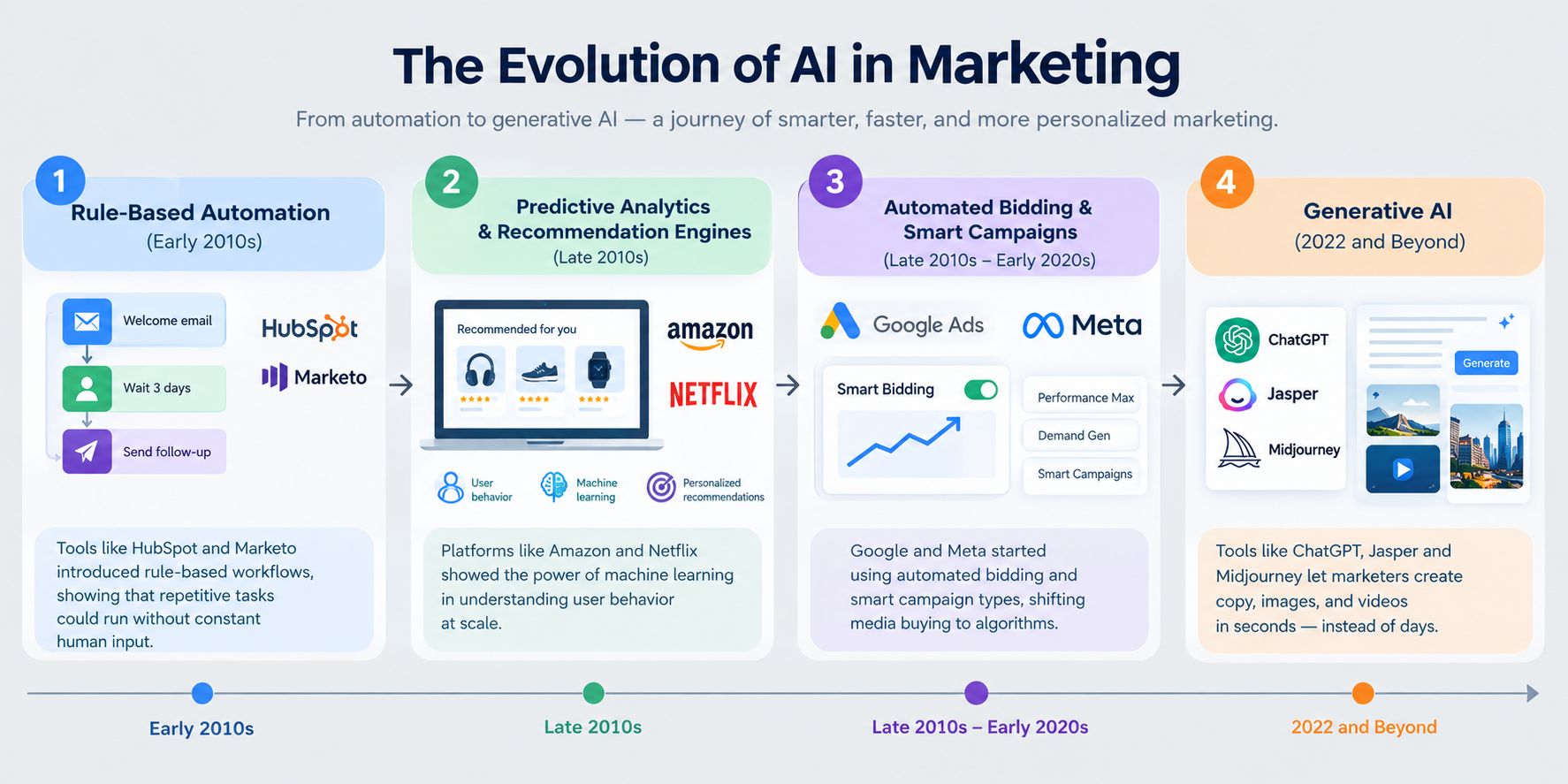
Why AI Is Changing Marketing Faster Than Past Technologies
The earlier technologies only handled one specific task at a time. But Generative AI is different, it targets the creative work directly. This is why the topic of replacing digital marketing with AI feels personal to marketers.
How Marketing Teams are Using AI in 2026
Also read: Why AI Is The Future & How It Will Change The Future?
Free Courses
AI is not a future threat for digital marketers, it is helping them make their daily repetitive tasks automated. You will see AI helping you with your ad bidding, suggestions for ad copy, understanding your audience better, analysis, and more.
Check below all the tasks in which AI is adding value and where it is falling short.
Where AI is Useful:
Where AI Needs a Marketer:
In practice, most experienced marketers are not worried about AI doing their entire job. They are focused on knowing which parts of their workflow to hand off, and where their judgment is the actual value they bring to a campaign.
Also read: A Beginner’s Guide to Developing a Digital Marketing Strategy
Digital Marketing Courses to upskill
Explore Digital Marketing Courses for Career Progression
MICA Executive Alumni Status
Not every role in digital marketing is affected by AI in the same way. Some jobs are changed completely, but some are barely touched.
If you want to know, is your job affected by AI or not. Check the roles shared below:
1. Content Writers and Copywriters
This role is affected the most because AI can generate blog drafts, product descriptions, social media posts and captions in seconds. So, entry level writing jobs have completely vanished.
The writers who focus only on writing and delivering content are facing the most pressure but the writers who bring content strategy, storytelling, facts, unique information, are becoming valuable, not replaceable.
2. Paid Media and PPC Specialists
Automated bidding, smart campaigns, and AI driven budget allocation have already changed how paid media works. A lot of manual bid adjustments and audience testing that used to take hours are now handled by the platform itself. Specialists who only knew how to execute campaigns manually are affected the most.
People who understand strategy, account structure, and how to interpret AI recommendations are still in demand.
3. SEO Specialists
With the help of AI, the keyword research, content briefs, and some technical audits become easy. The tools can now suggest SEO audits with detailed reports that a beginner could easily understand. Some of the tools available in the market are:
4. Social Media Managers
Social media managers who handle only basic social media management like content scheduling, caption generation, basic designs, can now be completely handled by AI. But if you know community management, brand voice, real time engagement during trends or crisis, AI will not replace you.
5. Data Analysts and Reporting Roles
Here, the AI has made some of the biggest changes in manual work. Dashboards, performance reports, and pattern recognition across large datasets are now largely automated. The value has shifted toward people who can interpret that data and turn it into strategic recommendations, not just the people who pull the numbers.
Roles Less Affected by AI
AI is not wiping out entire job titles. It is absorbing the repetitive, execution heavy parts of each role. The marketers most at risk are the ones whose entire job was execution without strategy behind it. The ones who combine AI tools with judgment, creativity, and business understanding are becoming more valuable, not less.
AI is rewriting the rules of marketing. Learn to lead that change with upGrad's AI-Powered Marketing Mastery Program, built for marketers who want to stay ahead, not catch up.
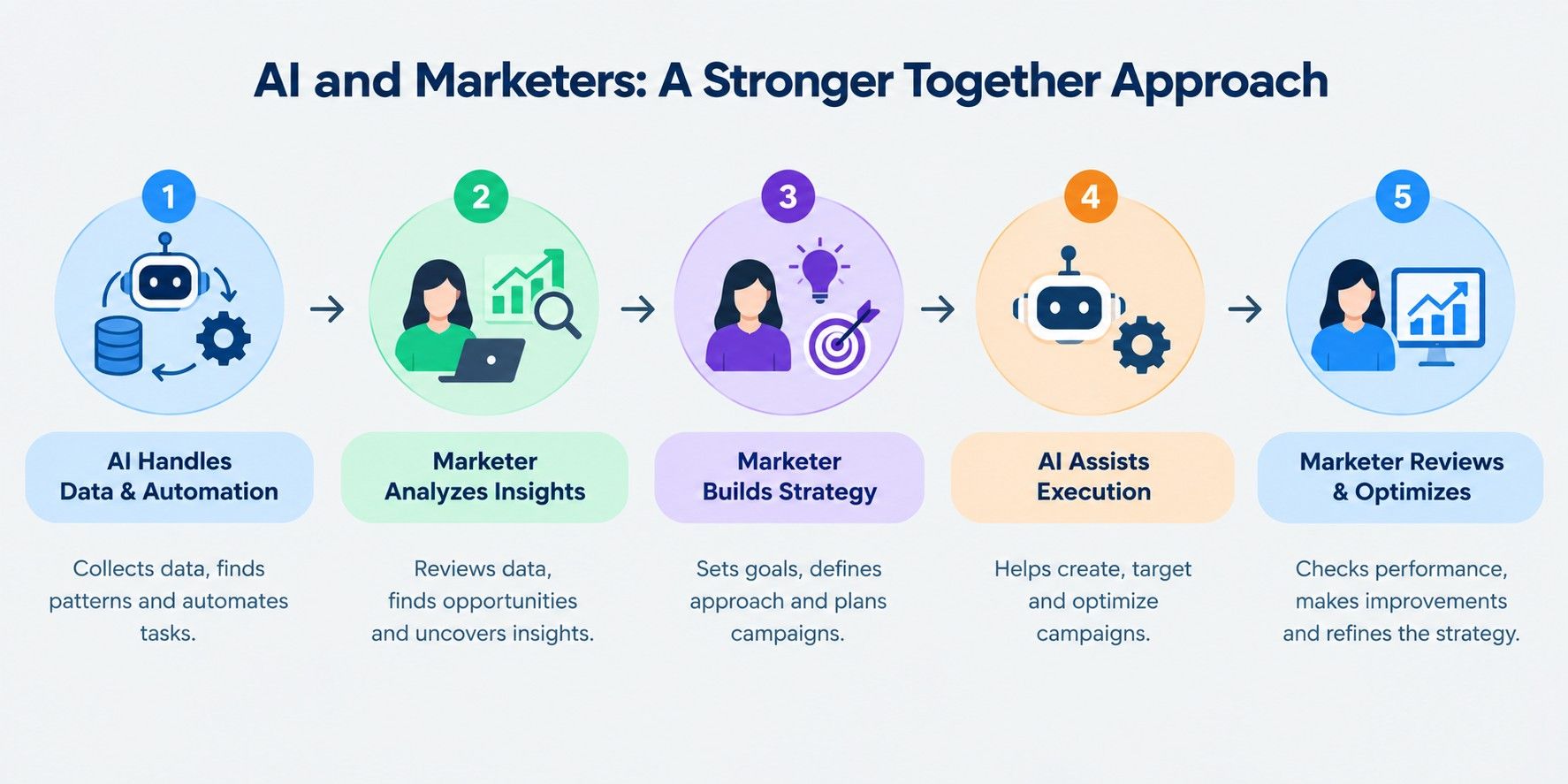
AI falls short on skills that require human judgment, experience, and genuine understanding of people. Some of these skills are as follows:
Also read: Generative AI Fundamentals: A Practical Guide to Understanding How Modern AI Works
AI is not going away, so the real question for marketers is how to work alongside it instead of competing. Here is how to stay relevant as the industry keeps shifting.
Also read: Future of Generative AI: Trends and What Comes Next
So, will AI replace digital marketers? No, not entirely. AI is working on repetitive, data heavy parts of the job, but it still cannot replicate strategy, creativity, relationships, or judgment of a human.
The marketers who are only doing execution tasks like writing basic copy, running manual bid adjustments, are the ones feeling the most pressure of replacement. But, the marketers who bring strategy, creativity, and the ability to build trust with clients and customers are the one becoming important.
Do not resist AI. Instead, learn to work with it, and double down on the skills it cannot replace. AI is not ending marketing careers, it is changing what the job looks like, and marketers need to grow with that change.
Get personalized career guidance from upGrad's experts. Book your free consultation call now.
No. Industry reports and marketer surveys consistently show AI is automating specific tasks, not entire careers. Roles are evolving to include more strategy and AI oversight, not disappearing.
Yes, especially if you build AI literacy alongside core marketing skills. Beginners who learn to use AI tools from day one often move faster than those relying only on manual processes.
Start with prompt engineering, data interpretation, and one specialization like SEO, paid media, or content strategy. Pair these with soft skills like communication and strategic thinking.
Not necessarily. Basic data literacy helps, but most marketing roles need you to interpret AI outputs and apply strategy, not build AI models yourself.
This varies by role and experience. Entry level execution roles may see slower salary growth, while marketers who combine AI skills with strategy and leadership often see stronger demand and pay.
AI can handle content creation and basic ad management for small budgets, but businesses still need human oversight for brand voice, strategy, and reputation management, especially as they grow.
Look for courses covering prompt engineering, AI powered marketing tools, and platform specific AI certifications from Google, Meta, or HubSpot, along with broader digital marketing programs that include AI modules.
Not necessarily safer, but freelancers who specialize and build strong client relationships often adapt faster since their value is tied to trust and results, not just task execution.
If your daily tasks include repetitive content generation, basic reporting, manual bid adjustments, or scheduling, these are the areas most likely already automated or soon to be.
Search engines are increasingly prioritizing original, high quality, human reviewed content. Overly generic AI content without human input or fact checking can hurt rankings, which is why editing and strategy still matter.
Treating AI as a replacement for skill development instead of a tool to build on. Marketers who stop learning and rely entirely on AI outputs risk falling behind those who use AI to work faster while still developing expertise.
968 articles published
We are an online education platform providing industry-relevant programs for professionals, designed and delivered in collaboration with world-class faculty and businesses. Merging the latest technolo...
Get Free Consultation
By submitting, I accept the T&C and
Privacy Policy
Level Up Your Digital Marketing Career Today!
Top Resources
MICA
Advanced Certificate in AI-Powered Digital Marketing & Communication from MICAMICA Executive Alumni Status
Certification
5 Specialisation
Classroom
4 Months
Certification
2 Months