Generative AI Fundamentals: A Practical Guide to Understanding How Modern AI Works
By Sriram
Updated on Jul 27, 2026 | 7 min read | 4.5K+ views
Share:

All courses
Certifications
More
By Sriram
Updated on Jul 27, 2026 | 7 min read | 4.5K+ views
Share:
Table of Contents
Generative AI analyzes massive datasets to identify patterns and relationships within data. Using these learned patterns, it creates new content such as text, images, audio, and code. Unlike traditional AI systems that focus on analysis or classification, generative AI enables machines to generate original, human-like outputs for a wide range of applications.
In this blog, you'll learn how generative AI works, the technologies behind it, common models, training methods, practical applications, and current limitations. Whether you're a developer, student, or technical professional, this article offers a practical understanding beyond basic definitions.
Build practical expertise by exploring our Generative AI and Agentic AI courses and move forward in your AI career with confidence.
Generative AI Courses to upskill
Explore Generative AI Courses for Career Progression
IIIT Bangalore
Executive Diploma in Machine Learning and AI360° Career Support
Generative AI fundamentals refer to the core concepts and technologies that enable AI systems to create new content such as text, images, audio, and code. Unlike traditional AI, which focuses on prediction or classification, generative AI learns patterns from existing data and generates original outputs based on those patterns.
At its core, generative AI relies on deep learning models trained on massive datasets. These systems do not understand information like humans do. Instead, they identify relationships in data and predict the most likely output for a given input.
Must read : Generative AI Roadmap
How Generative AI Models Work: A Step-by-Step Approach
Generative AI models follow a structured process to learn patterns from data and generate new content. From training on large datasets to producing outputs, each step helps the model understand and respond to user inputs effectively.
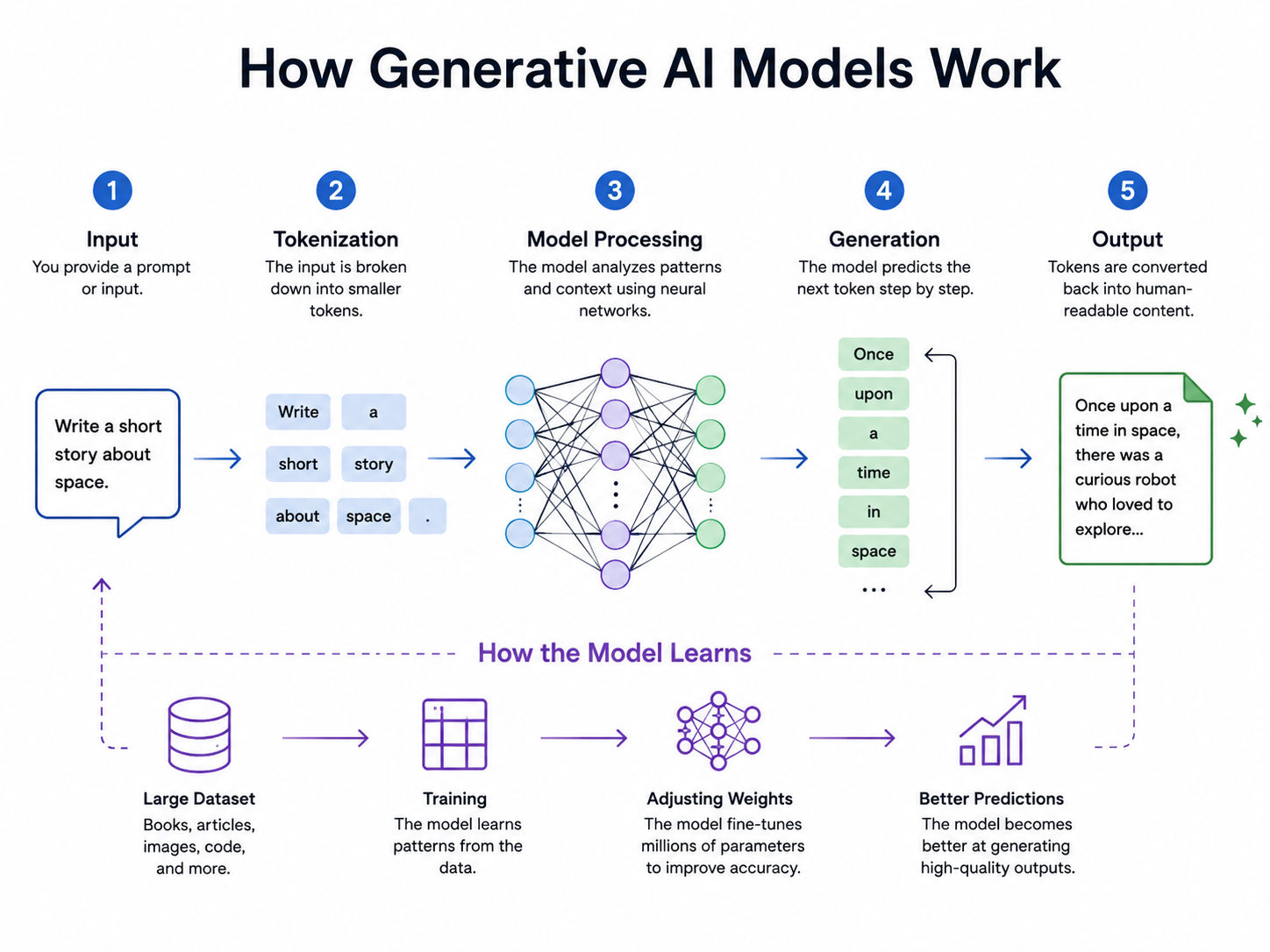
Generative AI models are trained on massive datasets containing text, images, audio, or code. These datasets provide examples that help the model learn patterns, relationships, and structures within the data.
Raw data often contains errors, duplicates, or irrelevant information. During preprocessing, the data is cleaned, organized, and converted into a machine-readable format to improve training quality.
The AI model uses deep learning algorithms and neural networks to analyze the data. During training, it adjusts millions or billions of parameters to learn patterns and improve prediction accuracy.
After general training, the model may be fine-tuned using domain-specific datasets. For example, a healthcare AI system can be trained further on medical data to provide more relevant responses.
When a user enters a prompt, the model breaks it into smaller units called tokens. It then analyzes the context and relationships between these tokens.
Using probability-based predictions, the model generates the next word, pixel, or code snippet one step at a time until a complete response is created.
The generated output is converted into human-readable text, images, audio, or code and presented to the user. The quality of the output depends on the model, training data, and prompt provided.
Do Read : Generative AI Course Eligibility
Different applications require different architectures. Not every generative model works the same way.Learning these model families is a key part of generative AI fundamentals because each architecture solves different problems.
The following table summarizes major model categories.
| Model Type | Primary Use Case | Example Output |
| Large Language Models | Text generation | Articles, code |
| Diffusion Models | Image creation | Artwork, designs |
| GANs | Synthetic media | Faces, videos |
| VAEs | Data representation | Feature generation |
LLMs produce human-like text by predicting the next word or token in a sequence. They drive applications such as:
For example, GPT-based models, open-source Large Language Models(LLMs), etc.
Diffusion models are a popular choice for AI image generation. They learn by taking images, adding noise to them, and then removing the noise to create new images. This process allows for the creation of realistic images from text prompts.
GANs consist of two networks:
Generator – generates content
Discriminator – check it looks real
Both improve through competition. This makes GANs useful for image enhancement and synthetic data generation.
VAEs compress information into dense representations called latent spaces. This allows models to learn hidden patterns and generate or reconstruct data efficiently.
Many modern AI systems use combinations of different types of models to achieve better performance.
Must Read: Agentic AI vs Generative AI
While both technologies rely on advanced AI models, they serve different purposes.
Generative AI is designed to create new content, such as text, images, code, audio, or videos, based on user prompts. Agentic AI, on the other hand, combines reasoning, planning, memory, and tool usage to autonomously execute multi-step tasks with minimal human intervention.
In many modern AI systems, Generative AI acts as the content generation engine, while Agentic AI orchestrates workflows, makes decisions, and completes end-to-end objectives. Understanding this distinction helps learners see how Generative AI forms the foundation for many emerging AI agents.
A well-designed Generative AI and Agentic AI course combines AI fundamentals with hands-on implementation so you can build real-world AI applications. Typically, you'll learn:
Industry-aligned programmes also include hands-on projects and portfolio development, helping learners apply these concepts to solve real business problems while preparing for emerging AI roles.
Generative AI is changing industries by automating content creation and boosting productivity in a range of areas. However, like any new technology, it has technical, ethical and operational challenges. Awareness of these limitations and future developments is critical to the development of reliable and responsible AI systems.
Generative AI is revolutionizing the way humans create, analyze and interact with information. Its capabilities go far beyond chatbots and image generators.
By understanding the basics of generative AI, learners are able to better evaluate AI systems, create practical applications, and recognize opportunities and limitations. As technology evolves, strong foundation knowledge will be one of the most valuable skills in the era of AI.
Ready to start your journey? Book a free consultation with upGrad today to find the best path for your career.
Yes. You can understand the basics of generative AI without programming knowledge. Many concepts such as prompts, model outputs, and AI applications are accessible to non-technical learners. However, if you want to build or fine-tune models, learning Python and machine learning fundamentals will be helpful.
The amount of data depends on the model's purpose and size. Large language models often train on billions of words or images, while smaller domain-specific models may require much less data. High-quality datasets usually matter more than simply increasing data volume.
After learning generative AI fundamentals, you should explore Python, deep learning, prompt engineering, and model deployment. Knowledge of frameworks like TensorFlow or PyTorch can also help. These skills make it easier to build practical AI applications and understand model behavior.
Generative AI predicts outputs based on patterns rather than verifying facts in real time. As a result, models may generate incorrect information that sounds convincing. This issue, known as hallucination, highlights why human review remains important in many real-world applications.
Prompt engineering helps users provide clearer instructions to AI systems. A detailed prompt often produces better outputs than a vague one. For example, specifying format, tone, and context can significantly improve generated text, code, or images.
Open-source models offer flexibility, customization, and cost advantages. Organizations can fine-tune them for specific use cases and maintain greater control over data. However, they may require additional infrastructure and expertise compared to managed AI services.
Developers evaluate models using metrics such as accuracy, coherence, relevance, and safety. Human feedback also plays a major role in assessing output quality. Since AI performance varies by task, evaluation often combines automated testing with expert review.
Industries such as healthcare, software development, education, marketing, and finance are rapidly adopting AI technologies. Businesses use AI for automation, content generation, customer support, and data analysis. Adoption continues to grow as models become more reliable and accessible.
Understanding generative AI fundamentals allows you to choose suitable models, write effective prompts, and identify system limitations. This knowledge helps teams deploy AI responsibly and avoid unrealistic expectations during implementation in business or technical environments.
Generative AI can accelerate creative tasks, but it does not replace human judgment, experience, or context. Writers, designers, and developers still guide the creative process. AI works best as an assistant that enhances productivity rather than replacing expertise.
The demand for AI professionals continues to grow across industries. Roles in machine learning engineering, prompt engineering, AI product management, and research are expanding. A strong understanding of generative AI fundamentals can create opportunities in both technical and non-technical careers.
727 articles published
Sriram K is a Senior SEO Executive with a B.Tech in Information Technology from Dr. M.G.R. Educational and Research Institute, Chennai. With over a decade of experience in digital marketing, he specia...
Speak with AI & ML expert
By submitting, I accept the T&C and
Privacy Policy