Investment Management: A Practical Guide to How It Works
By Sriram
Updated on Aug 11, 2026 | 6 min read | 4.74K+ views
Share:

All courses
Certifications
More
By Sriram
Updated on Aug 11, 2026 | 6 min read | 4.74K+ views
Share:
Investment management involves managing assets such as stocks, bonds, mutual funds, and real estate to achieve financial goals. It focuses on allocating investments, monitoring portfolio performance, managing risks, and making informed decisions to balance growth, stability, and tax efficiency while aligning with an investor’s objectives and time horizon.
In this blog, you’ll understand how professionals build portfolios, manage risk, and choose strategies in real-world conditions. You’ll also see how decisions are made in practice, not just theory.
Build stronger self-management skills with upGrad’s management courses and learn how to manage your time, goals, productivity, and professional growth more effectively.
Popular MBA Programs
Investment management is the professional management of various securities (stocks, bonds, etc.) and assets (e.g., mutual funds) to achieve specified investment goals for the benefit of investors. It underlines the balance between risk, return and time according to an individual’s goals, investment horizon and risk tolerance.
Professional managers use research, market analysis and financial data in making informed investment decisions. They seek to increase wealth and manage risk in dynamic market conditions through diversification and ongoing portfolio review.
What’s at stake: Key reasons
But there’s also a practical limitation. No system guarantees returns. Even well-managed portfolios can underperform during volatile markets. That’s why understanding the process matters as much as trusting the outcome.
In short, investment management is about structured decision-making in uncertain environments. It brings order to financial chaos, but it doesn’t remove uncertainty completely.
Also read : Essential Functions of Financial Management for Effective Business Strategy
Free Courses
Investment management follows a structured workflow rather than random decisions. Professionals usually follow a cycle that repeats as markets change. This process helps maintain consistency even when conditions are unpredictable.
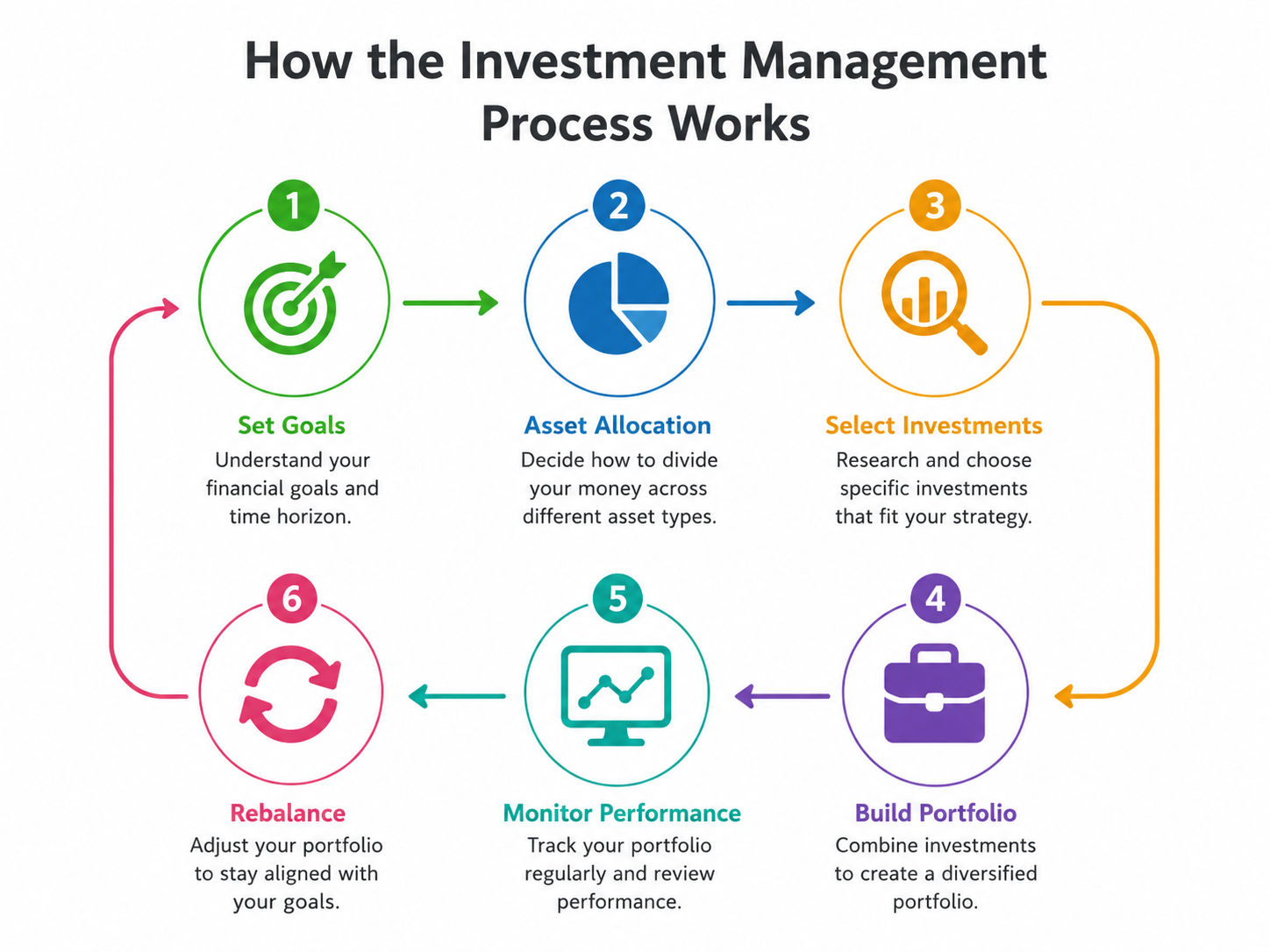
Investing starts with setting goals. This step determines what the investor wants to accomplish and in what time frame. In the absence of well-defined objectives, decisions on where to invest money tend to be random and inconsistent.
For instance, saving for a home in 3 years is a very different strategy than saving for retirement over 25 years. The time horizon directly impacts the degree of risk an investor can afford to take and the appropriate assets.
Next is asset allocation, after you set goals. This is one of the most important decisions in investment management.
Research has found that how you split your assets has a bigger impact on the performance of your portfolio than choosing the right stocks. A good blend of stocks, bonds and cash keeps risk down but still allows for steady growth.
Then the security selection. After the allocation is decided. This is where you decide on specific investments like stocks, bonds or funds.
Analysts look at companies and judge them on important things like their earnings, how much they might grow, how much debt they have and where they sit in the market. The idea is to pick assets that match the overall investment strategy.
Then there is the construction of the portfolio, in which the selected assets are combined into a complete portfolio.The key thing here is diversification. The investments are diversified into different sectors instead of depending on a single stock or sector. This helps lower risk and improves overall stability.
Investment management does not stop after the portfolio is built. It requires constant monitoring and rebalancing.
As time progresses and market movements take place, the portfolio can deviate from its initial structure. Rebalancing keeps the portfolio in line with the desired asset allocation and financial objectives.
In practice the process is not always a strict linear pattern. Sudden market developments or financial crises might call for rapid changes.
In such cases, managers may choose to reallocate immediately, rather than wait for the scheduled review. Flexibility is essential in dealing with real-world uncertainty.
This structured workflow is what makes investment management effective in professional environments. It replaces random decision-making with a disciplined, repeatable system.
However, even with data and models, human judgment remains crucial. Numbers provide direction, but experience and interpretation determine final decisions.
Also read : Financial Management Course: Learn Finance, Risk & Strategy in 2025
MBA Courses to upskill
Explore MBA Courses for Career Progression
O.P.Jindal Global University
MBA (with Career Acceleration Program by upGrad)Become interview ready with Career Services
PSB MBA + IIML Certification
MBA from Paris School of Business with Certification from IIM LucknowStrategies vary based on an investor's goals, risk tolerance, and investment horizon. No single strategy works for everyone. Each approach offers distinct advantages and limitations, which is why many investors combine multiple strategies within a single portfolio.
The table below summarizes the most widely used investment strategies and their primary objectives.
Strategy |
Primary Focus |
| Active Investing | Outperforming the market through research and timing |
| Passive Investing | Matching market performance through index tracking |
| Growth Investing | Investing in companies with high future growth potential |
| Value Investing | Identifying undervalued companies with strong fundamentals |
| Income Investing | Generating regular income through dividends or interest |
Active investing is a strategy to outperform market benchmarks through research, analysis and strategic buying or selling decisions. Portfolio managers also pay close attention to market trends and company performance to look for opportunities.
This approach can produce higher returns, but generally entails higher management fees, higher trading costs and higher risk.
Passive investing is about tracking the performance of an index in the market, not trying to beat it. Common examples are index funds that track Nifty 50 or S&P 500.
Lower fees, less trading, and a long-term view typically characterise this approach. It’s attractive for investors looking for simple and consistent market exposure.
Growth investors seek out companies that are expected to grow revenue, profits or market share at an above-average rate. These companies often reinvest earnings in support of future growth, rather than paying dividends.
These are typically technology companies and entrepreneurial startups. Growth stocks can produce big returns, but they can also be volatile.
Value investing involves identifying companies that appear undervalued compared to their intrinsic worth. Investors analyze financial statements, competitive position, and future prospects to find opportunities that the broader market may have overlooked.
The main challenge with this strategy is patience. It can take years for the market to recognize a company's true value.
Income investing prioritizes steady cash flow over rapid capital appreciation. Investors typically choose dividend-paying stocks, bonds, or other income-generating assets.
This approach is popular among retirees and conservative investors who prefer predictable returns and lower portfolio volatility.
Rarely will a professional stick to only one strategy. Instead, they combine different approaches to diversify and manage risk effectively.
For example, a portfolio could include:
A diversified portfolio helps reduce the impact of market fluctuations while supporting multiple financial objectives. Effective risk management ensures that even aggressive portfolios maintain some level of stability during periods of uncertainty.
Do read : How to Become an Investment Banker in India? Complete Guide [2026]
Technology plays a major role in modern investment management. Professional managers use specialized tools to analyze markets, track portfolio performance, and identify potential risks. These tools help improve decision-making, but they do not guarantee successful outcomes.
The following tools are commonly used in investment management:
Tool |
Purpose |
| Portfolio Management Software | Tracks assets, performance, and portfolio allocation |
| Financial Models | Supports valuation, forecasting, and investment analysis |
| Risk Assessment Systems | Measures volatility and identifies potential risks |
| Market Data Platforms | Provides real-time market information and insights |
These technologies make it easier to manage large portfolios and respond quickly to changing market conditions. However, tools only provide information. Investment decisions still require human interpretation and judgment.
Even with advanced technology, investment management involves several challenges. Markets are influenced by economic events, investor behavior, and unexpected developments that no model can predict perfectly.
Some of the most common challenges include:
The real challenge lies in balancing data, strategy, and discipline. Successful investment management requires managers to respond to meaningful signals while avoiding impulsive reactions to short-term market movements. Human judgment remains essential because models can analyze data, but people must interpret uncertainty and make the final decisions.
Also Read: 10 Different Types of Management Styles
Financial markets will always stay uncertain, but structured decision-making minimises chaos. Investors with clear goals, disciplined processes and adaptable strategies can better navigate complexity.
Investment management is not about perfect market prediction. This is about creating systems that function in all kinds of conditions, and being consistent when the markets are not behaving the way that you want them to.
Ready to start your journey? Book a free consultation with upGrad today to find the best path for your career.
You can start investment management with a relatively small amount, especially through mutual funds, exchange-traded funds (ETFs), or systematic investment plans (SIPs). The ideal starting amount depends on your financial goals and income. What matters more is consistency and having a clear strategy rather than waiting until you have a large sum to invest.
Yes, effective investment management can help reduce the impact of inflation on your purchasing power. Assets such as equities, real estate, and inflation-linked securities have historically offered better protection against rising prices than cash alone. The right approach depends on your risk tolerance and investment horizon.
Most portfolios benefit from a review at least once or twice a year. However, major life events, significant market changes, or shifts in financial goals may require more frequent assessments. Reviewing too often can sometimes lead to unnecessary decisions based on short-term market movements rather than long-term objectives.
No. Investment management principles apply to investors at all income levels. Whether you are investing ₹5,000 or ₹50 lakh, the same concepts of goal setting, diversification, risk management, and portfolio monitoring remain relevant. Many platforms now make professional investment solutions accessible to smaller investors.
Investment management focuses primarily on managing investment portfolios and maximizing returns based on risk preferences. Wealth management takes a broader approach and may include tax planning, retirement planning, estate planning, insurance, and overall financial strategy alongside investment decisions.
Interest rate changes, inflation data, government policies, and global events can influence asset prices significantly. Different asset classes react differently to economic conditions. A diversified portfolio helps reduce the impact of any single event and provides greater resilience during uncertain periods.
Not always. Market volatility alone is not necessarily a reason to change strategies. Decisions should be based on financial goals, risk tolerance, and long-term plans. Frequent strategy changes driven by fear or short-term market movements often lead to poor investment outcomes and missed opportunities.
Diversification helps spread risk across different asset classes, industries, and geographic regions. If one investment performs poorly, others may help offset the losses. While diversification cannot eliminate risk entirely, it can reduce portfolio volatility and improve consistency over long investment periods.
The answer depends on your objectives. Active funds aim to outperform the market through research and portfolio adjustments, while index funds seek to match market performance at lower costs. Some investors prefer a combination of both to balance growth potential, costs, and diversification.
Technology provides access to real-time market data, portfolio analytics, automated investing tools, and advanced risk assessment systems. These tools improve efficiency and decision-making. However, technology does not remove uncertainty, which is why human judgment remains important in interpreting market conditions and investment opportunities.
Many new investors chase short-term returns, follow market trends without research, or invest without clear goals. Others overlook diversification or react emotionally to market fluctuations. A disciplined investment management approach focused on long-term objectives can help avoid these common mistakes and improve decision-making over time.
715 articles published
Sriram K is a Senior SEO Executive with a B.Tech in Information Technology from Dr. M.G.R. Educational and Research Institute, Chennai. With over a decade of experience in digital marketing, he specia...
Speak with MBA expert
By submitting, I accept the T&C and
Privacy Policy
From MBA to Dream Job - Explore Our Alumni Success Stories
Top Resources
Master's Degree
13 Months
Master's Degree
12 Months
Master's Degree
15 Months