Theory of Constraints: What It Is, How It Works, and How to Apply It
By upGrad
Updated on Jul 09, 2026 | 7 min read | 1.83K+ views
Share:

All courses
Certifications
More
By upGrad
Updated on Jul 09, 2026 | 7 min read | 1.83K+ views
Share:
Table of Contents
Key takeaway
This blog walks you through what the concept means, how it works in practice, and where it fits inside operations management.
Explore upGrad's Management programs to build practical skills in operations management, supply chain optimization, process improvement, project management, business strategy, and AI-powered decision-making.
Popular Management Programs
So what is theory of constraints, really? It's a management approach built on one simple observation. A chain is only as strong as its weakest link, and a business is no different.
Every process, whether it's a factory line or a hiring pipeline, has a limiting factor. That's the constraint. It caps how much output the entire system can produce, no matter how efficient every other step becomes.
Goldratt's theory of constraints treats this constraint as the lever for improvement. Instead of spreading effort across ten departments, you find the one department slowing everyone else down. Then you fix that.
Improving a non-bottleneck step often does nothing for overall output. It just creates idle capacity somewhere else in the chain.
Traditional Approach |
TOC |
| Improve every process equally | Improve the bottleneck first |
| Judges each department alone | Judges the whole system's throughput |
| Many priorities at once | One priority at a time |
Do read: Decision Making Models: The Complete Guide for Business and Leadership
Free Courses
Goldratt Theory of constraints in operations management isn't a one-time fix. It's a loop. You find the constraint, you squeeze more value from it, and you keep repeating that cycle as the constraint shifts.
Picture a small assembly line with four stations. Three of them can each process 100 units an hour. The fourth can only handle 60. That fourth station sets the pace for the entire line, whether you like it or not.
Speeding up the other three stations won't help. You'd just get more unfinished parts piling up in front of station four, waiting.
This is why theory of constraints in operations management focuses managers on flow instead of local speed. Throughput, the rate at which the system generates finished output, becomes the main scoreboard. Not machine utilization. Not individual department metrics.
Once the bottleneck moves, and it will, the same loop restarts somewhere new.
Must read: Techniques of Decision-Making: 15+ Tools & Methods for Success in 2026
Management Courses to upskill
Explore Management Courses for Career Progression
IIIT-B & IIM, Udaipur
Chief Technology Officer & AI Leadership ProgrammeIIM Kozhikode
PCP in AI for Business ProfessionalsThe principles of Goldratt theory of constraints rest on a few core beliefs about how systems behave under pressure.
These principles of theory of constraints push teams away from local optimization. A warehouse manager obsessing over pick rates while the truck loading dock sits idle isn't solving anything. That's effort in the wrong place, and it happens more often than most managers admit.
Also read: What Are the Triple Constraints of Project Management? A Complete Guide
This is the operational core of Goldratt's theory of constraints. Five steps, applied in order, over and over.
Teams fix one bottleneck, celebrate, and stop looking. Then a new constraint quietly takes over, and nobody notices until output stalls again.
Step |
Objective |
Common Mistake |
| Identify | Locate the true bottleneck | Guessing based on noise, not data |
| Exploit | Maximize current capacity | Jumping straight to buying new equipment |
| Subordinate | Sync other steps to the constraint | Letting non-bottlenecks run at full speed anyway |
| Elevate | Add capacity where needed | Elevating before exploiting fully |
| Repeat | Restart the cycle | Assuming the job is finished |
Explore upGrad's IIM Kozhikode AI for Business Professionals Programme to build practical skills in AI strategy, Generative AI, Agentic AI, business transformation, AI governance, workflow automation, and data-driven decision-making. Learn through real-world business projects, leadership case studies, and a capstone designed to help you lead enterprise AI initiatives with confidence.
Not every constraint looks the same, and treating them all identically is a common error.
Type of Constraint |
Description |
Example |
| Physical Constraints | Limited machines, floor space, or raw materials restrict production capacity. | A factory has only one packaging machine, creating a production bottleneck. |
| Capacity Constraints | There aren't enough staff, equipment hours, or production capacity to meet demand. | A customer support team can't handle the growing number of daily service requests. |
| Policy Constraints | Internal rules, procedures, or approval chains slow work without adding value. | Every purchase requires approval from multiple managers, delaying production. |
| Market Constraints | Customer demand is lower than the organization's production capacity. | A manufacturer can produce 10,000 units a month, but demand is only 7,000 units. |
| Supply Constraints | Vendors or suppliers can't provide materials or components quickly enough. | A delayed shipment of raw materials stops the production line. |
| Behavioral Constraints | Employee habits, incentives, or resistance to change limit overall performance. | Teams continue using outdated workflows despite more efficient processes being available. |
Policy constraints deserve extra attention. They're invisible because nobody labels a slow approval process as a "constraint." It just feels like how things are done. But it behaves exactly like a machine that's too slow, except it's a rule instead of a piece of equipment.
Also Read: 10 Most Popular Type of Management Style: Understanding and Choosing the Right Approach
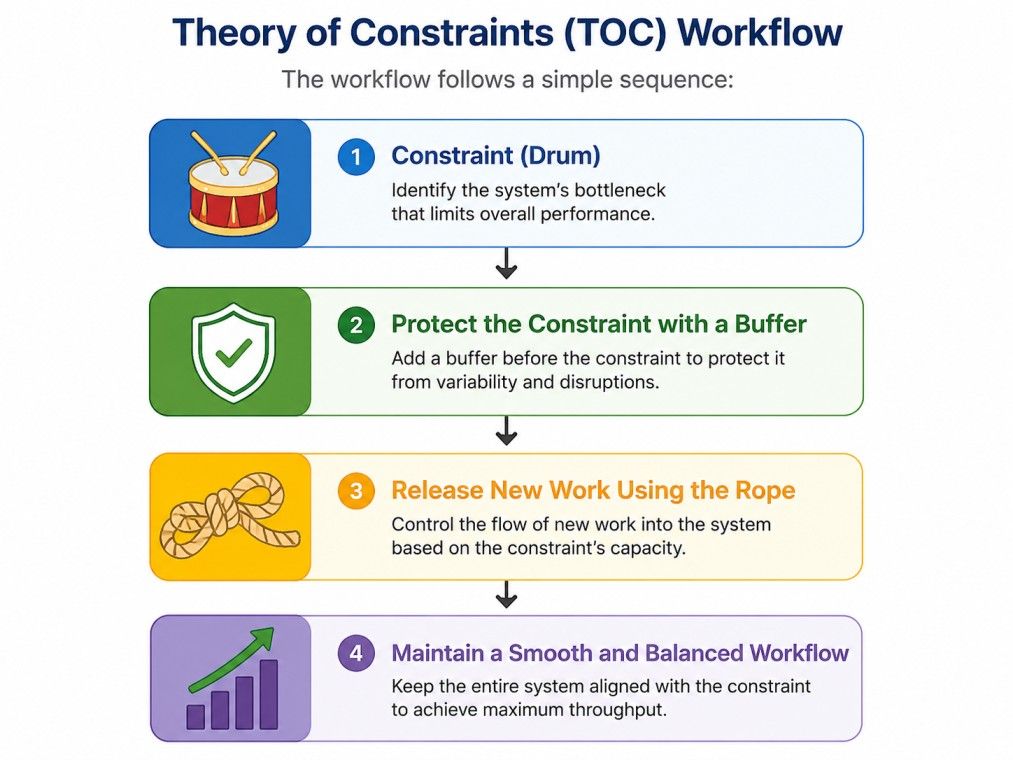
Drum-Buffer-Rope (DBR) is a scheduling and production control method developed as part of the Theory of Constraints (TOC). It synchronizes the entire workflow around the system's bottleneck, ensuring that production flows smoothly without creating excess inventory or idle time.
Instead of allowing every process to operate at maximum speed, DBR sets the pace based on the system's constraint. This helps organizations improve throughput while reducing delays and unnecessary work-in-progress inventory.
Component |
What It Means |
Example |
| Drum | The bottleneck or constraint sets the production pace for the entire system. | If one assembly machine can produce 80 units per hour, the whole production line is scheduled around 80 units per hour. |
| Buffer | A small safety buffer protects the bottleneck from disruptions such as material shortages or delays. | Extra raw materials are kept ready near the bottleneck machine so it never stops waiting for supplies. |
| Rope | A communication mechanism that controls the release of new work into the system at the bottleneck's pace. | Production orders are released only when the bottleneck has enough capacity, preventing excess inventory from building up. |
The workflow follows a simple sequence:
A furniture factory has three production stages:
The painting department is the bottleneck because it can process only 80 tables per day.
Using Drum-Buffer-Rope:
This prevents excess inventory, reduces waiting time, and keeps the entire production system aligned with the bottleneck.
Visual Suggestion:
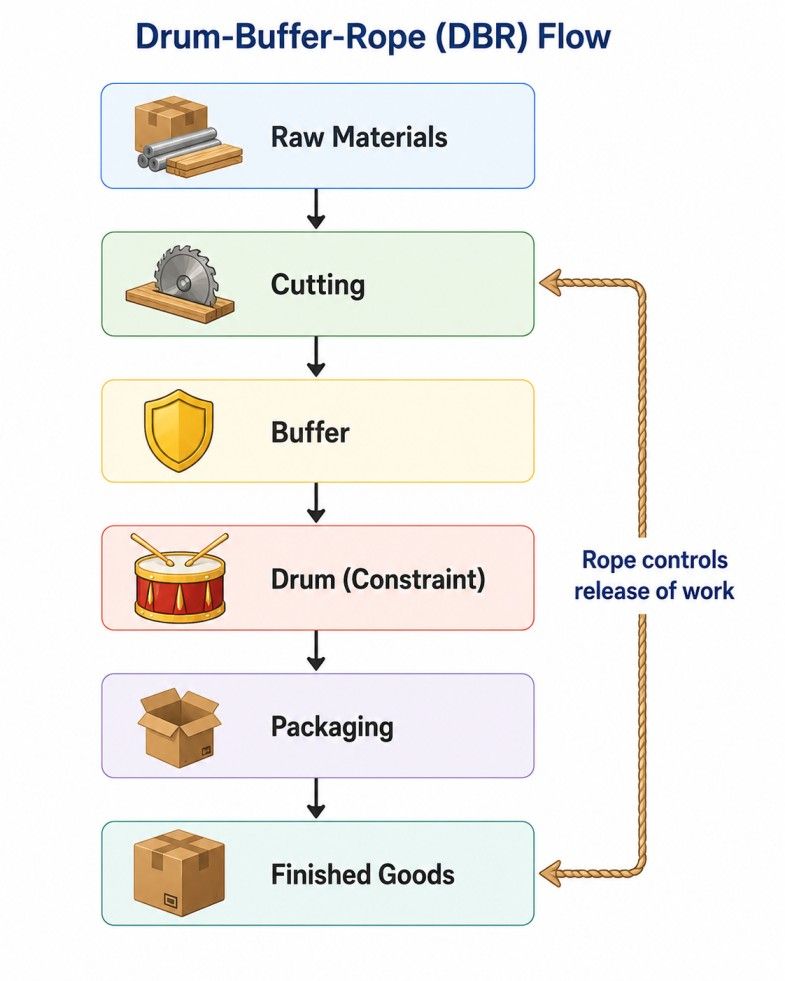
Drum-Buffer-Rope is one of the most practical tools in the Theory of Constraints because it ensures that every process supports the system's bottleneck, helping organizations maximize throughput without overloading resources.
Here's how this plays out across different settings.
A furniture manufacturer had one CNC machine that couldn't keep up with cutting orders from three separate product lines. Instead of buying a second machine right away, the plant rescheduled jobs so the CNC never sat idle between shifts. Output rose almost 20 percent without any new capital spend.
A regional hospital found that discharge paperwork, not bed availability, was the actual constraint on patient flow. Nurses were waiting on physician sign-offs that piled up in the afternoon. Shifting sign-off windows earlier in the day cut average wait times noticeably.
A software company's release cycle was bottlenecked by one senior engineer who reviewed every pull request. Distributing review authority to two more engineers, after clearing a backlog first, doubled release frequency within a quarter.
Industry |
Constraint |
Fix Applied |
Result |
| Manufacturing | Single CNC machine | Rescheduling, not new equipment | Higher throughput |
| Healthcare | Discharge paperwork delays | Earlier sign-off windows | Shorter patient wait times |
| Software | One-person code review | Distributed review authority | Faster release cycles |
Also Read: Top 10 People Management Skills for Managers
No framework is perfect, and this one has real tradeoffs worth knowing before you commit to it. This is also why theory of constraints in operations management still gets debated in supply chain and process courses today, since the tradeoffs are real and worth weighing.
Advantages of Theory of Constraints |
Disadvantages of Theory of Constraints |
| Focuses limited resources on the one improvement that has the greatest impact on overall performance. | Assumes a single dominant constraint, which may not always reflect the complexity of modern business systems. |
| Often increases throughput and productivity without requiring major capital investment. | Constraints can shift quickly, so organizations must continually identify and manage new bottlenecks. |
| Provides teams with a clear, measurable objective by focusing on improving system throughput. | Policy and behavioral constraints are often harder to identify and address than physical constraints. |
| Can be applied across industries, including manufacturing, healthcare, software development, supply chain, and project management. | Requires continuous monitoring and improvement rather than a one-time implementation effort. |
Teams that treat this as a single initiative, run it once, and move on usually see the gains fade within a year. The constraint doesn't disappear. It just relocates, and if nobody's watching, it grows back quietly.
Also Read: A Comprehensive Guide to General Management: Roles, Skills, and Career Opportunities
How to Implement theory of constraints is straightforward in concept, but success depends on applying it consistently. Many organizations understand the framework yet fail to achieve lasting improvements because they focus on the wrong problems or stop too soon. Knowing what to avoid is just as important as knowing what to do.
Even experienced teams can make mistakes that reduce the effectiveness of TOC. Watch out for these common pitfalls.
Mistake |
Impact |
| Improving non-constraints first | Doesn't improve overall performance. |
| Treating every delay as the bottleneck | Leads to solving the wrong problem. |
| Investing too early | Increases costs without fixing the constraint. |
| Ignoring policy constraints | Hidden bottlenecks remain unresolved. |
| Focusing on department metrics | Overall system performance doesn't improve. |
| Stopping after one improvement | New constraints are left unmanaged. |
The principles of theory of constraints emphasize that improvement is an ongoing cycle rather than a one-time project. Every time a constraint is resolved, the system should be reassessed to identify the next opportunity for improvement.
Also read : Best Business Management Courses in India [2026]
Successful organizations don't rely on complex strategies. They build consistent habits that keep improvement efforts focused on the system's biggest constraint.
Follow these best practices:
Small improvements made consistently usually produce better long-term results than large, infrequent changes. By following these practices, organizations can sustain the benefits of the theory of constraints and continue improving performance as new constraints emerge.
The theory of constraints offers a practical way to improve business performance by concentrating on the system's biggest limitation instead of trying to optimize every activity at once. From identifying bottlenecks to increasing throughput, the framework provides a clear path for continuous improvement.
Whether you're studying the Goldratt theory of constraints, exploring the theory of constraints in operations management, or looking for ways to improve an existing workflow, the key idea remains the same. Find the constraint, improve it, and repeat the process. Over time, those focused improvements can create meaningful and measurable business results.
Ready to start your journey? Book a free consultation with upGrad today to find the best path for your career.
Most TOC initiatives fail because organizations identify the wrong constraint or stop improving after resolving the first bottleneck. The framework is designed as a continuous cycle. Regularly reviewing processes and measuring throughput helps sustain long-term improvements instead of short-term gains.
Large organizations may experience several constraints across different departments. However, the theory of constraints recommends identifying the one constraint that has the greatest impact on overall system performance. Solving the primary limitation first usually delivers the highest business value before addressing secondary constraints.
The theory of constraints process improvement approach helps managers prioritize decisions based on business impact rather than local efficiency. Instead of investing equally across departments, resources are directed toward removing the biggest performance limitation, leading to faster improvements and better returns on investment.
Yes. Although TOC began in manufacturing, it works equally well in service industries such as healthcare, banking, consulting, and IT services. Delays caused by approvals, staffing shortages, or inefficient workflows can all become constraints that reduce overall performance.
If you're wondering what is theory of constraints, it's a management philosophy that focuses on improving the system's biggest bottleneck instead of optimizing every process. Unlike many improvement methods, it gives organizations one clear priority, making improvement efforts more focused and measurable.
A constraint is considered resolved when it no longer limits the system's overall throughput. Once production flow improves and another process becomes the slowest point, the original bottleneck has shifted. That's the signal to begin the next improvement cycle.
After implementation, businesses should monitor throughput, lead time, cycle time, work-in-progress inventory, on-time delivery, and customer demand. Tracking these metrics regularly helps identify new constraints early and supports continuous improvement across the entire system.
In project management, what is theory of constraints often relates to identifying the critical task or resource that delays project completion. Teams use TOC principles to allocate resources more effectively, reduce delays, and improve project delivery without increasing unnecessary workloads.
No. Automation improves efficiency but doesn't automatically solve the biggest business constraint. If the real limitation is an outdated approval process, poor planning, or market demand, adding technology alone won't improve overall throughput or business performance.
Organizations should reassess constraints whenever customer demand changes, production capacity increases, or major process improvements are completed. Since bottlenecks shift over time, regular reviews help maintain performance and prevent new constraints from slowing the system.
The Goldratt theory of constraints continues to guide manufacturers, supply chain teams, healthcare providers, and technology companies in improving workflow. Modern analytics and business intelligence tools make it easier to identify constraints, but the core principle of focusing on the biggest limitation remains unchanged.
1141 articles published
We are an online education platform providing industry-relevant programs for professionals, designed and delivered in collaboration with world-class faculty and businesses. Merging the latest technolo...
Get Free Consultation
By submitting, I accept the T&C and
Privacy Policy
Top Resources
Certification
3 Months
Certification
6 Months
O.P. Jindal Global University
Masters in International Accounting and Finance (Accredited by ACCA, UK)Master's Degree
12 Months