Game Theory: What It Is, How It Works, and Why It Matters
By Sriram
Updated on Jun 16, 2026 | 3 min read | 2.19K+ views
Share:

All courses
Certifications
More
By Sriram
Updated on Jun 16, 2026 | 3 min read | 2.19K+ views
Share:
Table of Contents
Game theory is a branch of mathematics and economics that models how individuals or groups make strategic decisions. Game theory is the study of how rational people make decisions when their outcomes depend on what others do. It shows up everywhere, like salary negotiations, business pricing wars, and international trade deals.
This blog covers what game theory is, the core concepts behind it, the different types of games, and real examples that make these ideas click.
Explore upGrad's Management and MBA programs to develop expertise in strategic decision-making, game theory concepts, business strategy, competitive analysis, and data-driven problem-solving for real-world business challenges.
Popular Management Programs
The field was formally created in the 1940s by mathematician John von Neumann and economist Oskar Morgenstern. John Nash later expanded it with his concept of the Nash Equilibrium, which earned him a Nobel Prize in 1994.
Game theory is a mathematical framework used to study how people make decisions when they are trying to figure out what to do. It looks at what happens when one persons decision affects not them but also what others decide to do. Game theory is used in areas, such as business strategy and economics to understand how people work together or compete against each other. Game theory is also important, in politics and artificial intelligence. It really helps us understand why people make choices when they are playing games or just trying to get what they want. Game theory is a part of understanding how people interact with each other.
Also Read: 4 Key Differences Between Leadership and Management
Every game in game theory has three basic building blocks.
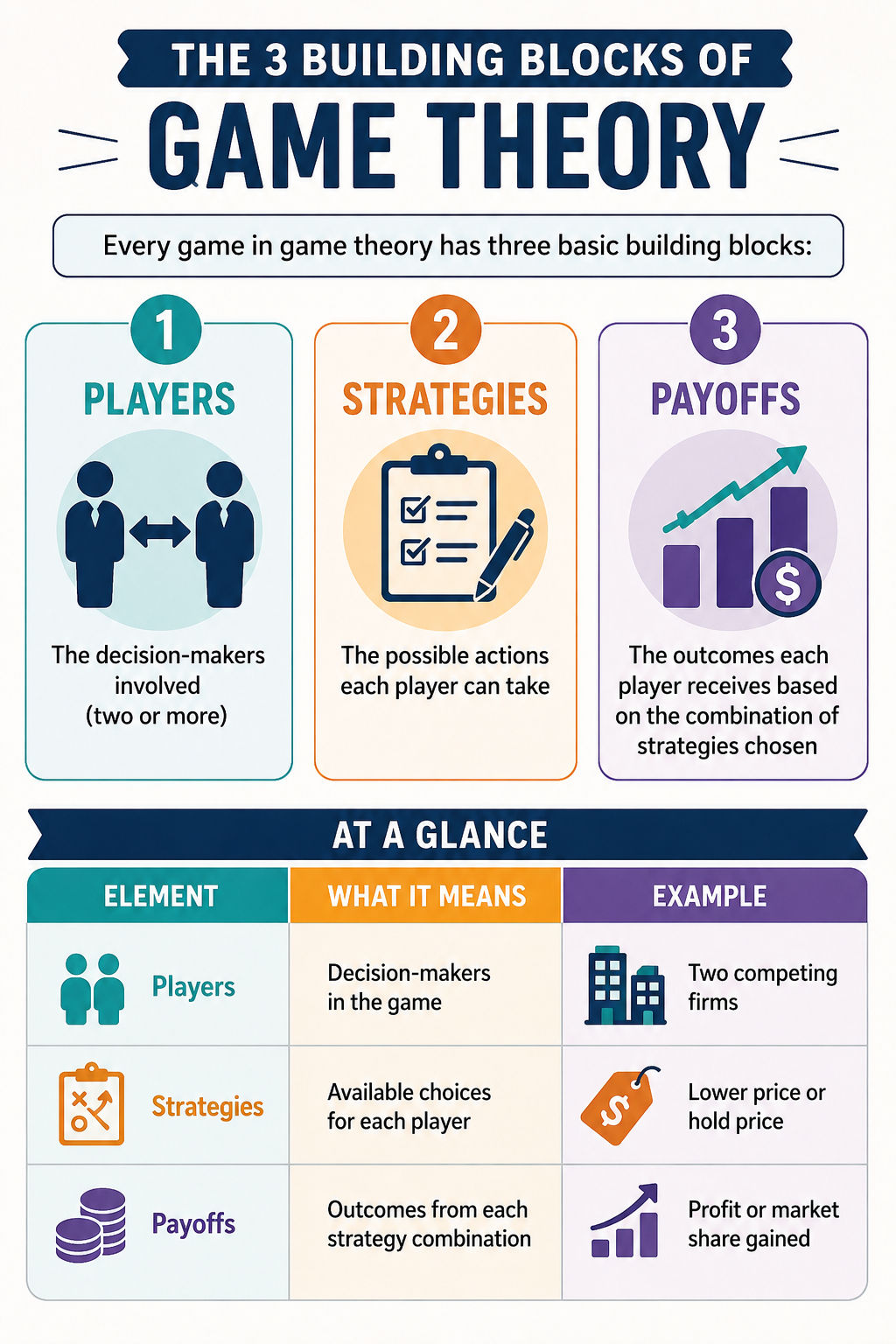
Once you identify these three elements in any real situation, game theory gives you tools to predict what rational players will do.
Also read: 4 Key Differences Between Leadership and Management
Free Courses
Game theory classifies strategic situations into distinct types based on how players interact.
In cooperative games, players can form binding agreements and work together. In non-cooperative games, every player acts in their own interest. Most of the famous examples in game theory are non-cooperative.
Non-cooperative doesn’t mean that it’s a hostile situation. It just means there's no enforceable agreement between players.
Must read: Negotiation Skills: Definition, Process, Various Stages, Benefits [With Examples]
In a zero-sum game, one player's gain is exactly another player's loss. Think of poker. In a non-zero-sum game, both players can win or both can lose depending on what they choose.
Business competition is usually non-zero-sum. Two companies cutting prices simultaneously can both end up worse off than if they'd held steady.
In simultaneous games, players decide at the same time without knowing what the other chose. In sequential games, players take turns and can observe previous moves before deciding.
Chess is a sequential game. Whereas Sealed-bid auctions are simultaneous. The structure changes the strategy completely.
Type |
How It Works |
Real-World Example |
| Zero-Sum Game | One player's gain is exactly equal to another player's loss. The total payoff remains constant. | Poker, certain stock trading scenarios |
| Non-Zero-Sum Game | Players can either benefit together or suffer losses together depending on their decisions. | Trade negotiations, pricing wars |
| Cooperative Game | Players form binding agreements and work together to achieve shared outcomes. | Business mergers, strategic alliances |
| Non-Cooperative Game | Each player acts independently and pursues their own interests without formal agreements. | Market competition, arms race |
| Sequential Game | Players make decisions one after another, allowing later players to react to earlier moves. | Chess, salary negotiations |
| Simultaneous Game | Players make decisions at the same time without knowing the choices of others. | Sealed-bid auctions, rock-paper-scissors |
Do read: What Is the Algorithmic Game Theory? Explained With Examples
Management Courses to upskill
Explore Management Courses for Career Progression
IIIT-B & IIM, Udaipur
Chief Technology Officer & AI Leadership ProgrammeNo explanation of game theory is complete without this. Two suspects are arrested. They're held in separate rooms and can't communicate. Each is offered the same deal:
The rational choice for each individual is to betray. But if both betray, they both get 5 years. If they'd both stayed silent, they'd only get 1 year each.
That's the paradox. Individual rationality leads to a collectively worse outcome.
Countries building nuclear weapons follow the same logic. Companies racing to slash prices do too. Nations failing to coordinate on climate agreements? They all follow the same structure.
The prisoner's dilemma isn't just an interesting puzzle. It's a blueprint for understanding why rational people keep ending up in situations that hurt everyone.
Do read: Top 10 Risk Management Strategies You Need to Follow for Success!
A Nash Equilibrium is a situation where no player can improve their outcome by changing their strategy, given what everyone else is doing. It's a stable point. Rational players have no reason to deviate.
Named after mathematician John Nash, this concept is central to modern game theory. It doesn't mean the outcome is optimal. It just means it's stable.
A Simple Example
Two coffee shops sit across the street. Each is deciding whether to lower prices. If both lower, both lose margin. If one lowers and the other doesn't, the lower-priced shop wins customers. If neither lowers, both maintain profit.
The Nash Equilibrium here? Both lower their prices. Even though both would be better off holding steady, neither can afford to be the one who doesn't lower first. That's the trap.
Classical Nash Equilibrium assumes that players are perfectly rational and have complete information. But real people aren't always rational. They act on their emotion, habit, or incomplete data.
A game can also have multiple Nash Equilibria, which makes predicting outcomes even harder. The theory gives you just a framework, but it doesn't always give you a clean answer.
Do read: What is Decision-making in Management: Explore Types, Tools, & Techniques
Game theory isn't confined to economics textbooks or math's textbooks. It's applied across fields in ways that can affect your decisions you'd never expected.
When companies set prices, they're playing a game. Airlines, telecom providers, and e-commerce platforms watch competitors' moves constantly. Dynamic pricing systems are essentially game-theoretic models running in real time.
Auction formats are designed using game theory. Governments use it to structure spectrum auctions for telecom licenses. The goal is to build an auction where bidders reveal their true valuations. Different formats like English, Dutch, sealed-bid, change bidder behavior significantly.
Must read: What is Logical Thinking & How to Improve Logical Thinking Skills? [2026]
Trade negotiations, arms control agreements, and international coalitions all involve players with different interests trying to reach stable outcomes. The EU's Brexit negotiations were a live game-theory experiment with real consequences.
Should you drive or take the metro? If everyone switches to metro, roads clear. But if too many stick to cars, roads jam. Your choice depends on what you expect others to do. That's game theory in your morning commute.
Even splitting a dinner bill involves strategic behavior. Who orders the expensive dish? Who holds back? It's a small-scale coordination problem.
Field |
How Game Theory Applies |
| Economics | Oligopoly pricing, market competition, auction design, and strategic decision-making among firms. |
| Politics | Voting systems, international negotiations, coalition building, and conflict resolution strategies. |
| Biology | Evolutionary competition, animal behavior, survival strategies, and resource allocation among species. |
| Technology | Network design, cybersecurity planning, platform competition, and algorithmic strategy development. |
| Law | Plea bargaining, litigation strategy, contract design, and |
Like any analytical framework, game theory offers strengths and weaknesses. While game theory is a powerful tool for analyzing strategic interactions, it is not perfect. A model can say one thing will happen. People can be unpredictable because of how they feel and what they know. Things can also change quickly. That is why game theory is more useful when we use it with our common sense and experience from the real world. Game theory is really helpful. It needs to be used with practical judgment and real-world experience to get the best results, from game theory.
Aspect |
Advantage |
Limitation |
| Decision-Making | Better strategic choices | Depends on assumptions |
| Competition | Predicts rival moves | Competitor behavior may vary |
| Risk | Evaluates possible outcomes | Not all risks are predictable |
| Resources | Improves allocation | Complex scenarios are harder to model |
| Negotiation | Supports bargaining decisions | Emotions can affect outcomes |
| Behavior | Provides a structured approach | People aren't always rational |
| Information | Uses available data effectively | Data may be incomplete |
| Application | Useful across many fields | Real-world conditions change quickly |
Also read: What are Critical Thinking Skills? Why are they Important?
The world runs on strategic interaction. Whether you're negotiating a raise, launching a product, or just figuring out when to merge in traffic, you're in a game. The question is whether you're thinking about it clearly.
Game theory won't give you a script for all situation. But it trains you to think about the structure of decisions like who the players are, what they want, and how your choice affects their choices.
If you want to go deeper, look into behavioral game theory, which accounts for irrational players, and mechanism design, which asks how to build systems that produce desired outcomes.
Game theory provides a structured way to analyze decisions in situations where outcomes depend on the actions of multiple participants. It helps explain competition, cooperation, negotiation, and strategic behavior across business, economics, politics, healthcare, and technology.
Understanding what is game theory goes beyond learning mathematical concepts. It teaches you how people and organizations think, react, and make choices when their success depends on others. In a world driven by strategic interactions, that knowledge has lasting value.
Ready to start your journey? Book a free consultation with upGrad today to find the best path for your career.
Game theory is widely used outside economics. Businesses apply it to pricing decisions, governments use it during negotiations, and technology companies rely on it when designing platforms and algorithms. Even everyday choices, such as negotiating salaries or deciding when to buy a house, involve strategic thinking that game theory helps explain.
A common example is two competing restaurants deciding whether to offer discounts. If one lowers prices while the other doesn't, it may attract more customers. If both lower prices, profits fall for both. Game theory studies these situations where one person's outcome depends on another person's decision.
Businesses use game theory to anticipate competitor reactions before making important moves. It helps with pricing, product launches, market entry, advertising strategies, and negotiations. Rather than focusing only on internal goals, companies also consider how rivals are likely to respond to their actions.
Decision theory focuses on making choices when outcomes depend mainly on chance or uncertainty. Game theory deals with situations where outcomes depend on the actions of other decision-makers. If another person, company, or government can influence your result, game theory becomes more relevant.
Yes. In fact, its importance has grown. AI systems often interact with other AI systems, users, and organizations. Game theory helps developers design algorithms that can predict behavior, allocate resources efficiently, and respond strategically when multiple intelligent agents operate in the same environment.
Not always. Game theory provides a framework for understanding incentives and possible outcomes, but people don't always behave rationally. Emotions, biases, incomplete information, and unexpected events can influence decisions. That's why game theory is often used alongside behavioral economics and psychology.
A basic understanding of mathematics, probability, economics, and logical reasoning can help. However, beginners can start by studying concepts such as incentives, payoffs, Nash Equilibrium, and the Prisoner's Dilemma. Many practical applications can be understood without advanced mathematics.
The Prisoner's Dilemma demonstrates how rational individuals can make choices that lead to worse outcomes for everyone involved. It helps explain price wars, environmental challenges, international conflicts, and cooperation problems where individual incentives clash with collective interests.
Evolutionary game theory applies strategic concepts to biology and natural selection. Instead of assuming perfectly rational players, it studies how behaviors evolve over time through competition and adaptation. Researchers use it to understand animal behavior, cooperation, and survival strategies in nature.
Game theory is commonly used in economics, finance, consulting, data science, public policy, political analysis, cybersecurity, and business strategy. Professionals in these fields regularly evaluate strategic interactions where decisions and outcomes depend on the actions of multiple participants.
One major limitation is its assumption that participants act rationally and have clear objectives. Real-world decisions are often influenced by emotions, uncertainty, misinformation, and changing circumstances. As a result, game theory offers valuable insights but shouldn't be treated as a perfect prediction tool.
727 articles published
Sriram K is a Senior SEO Executive with a B.Tech in Information Technology from Dr. M.G.R. Educational and Research Institute, Chennai. With over a decade of experience in digital marketing, he specia...
Get Free Consultation
By submitting, I accept the T&C and
Privacy Policy
Top Resources
Certification
3 Months
Certification
6 Months
O.P. Jindal Global University
Masters in International Accounting and Finance (Accredited by ACCA, UK)Master's Degree
12 Months