Multimodal Generative AI: What It Is, How It Works, and Why It Matters
By Rahul Singh
Updated on Jun 17, 2026 | 10 min read | 4.33K+ views
Share:

All courses
Certifications
More
By Rahul Singh
Updated on Jun 17, 2026 | 10 min read | 4.33K+ views
Share:
Table of Contents
Multimodal generative AI is a type of artificial intelligence that can understand, process, and generate content across multiple data formats, known as modalities. These modalities include text, images, audio, video, code, and structured data, allowing a single AI system to work with different forms of information simultaneously.
Unlike traditional AI models that focus on a single data type, multimodal generative AI combines information from multiple sources to deliver more accurate, context-aware, and versatile outputs. This capability powers applications such as image-based chatbots, AI assistants, content generation tools, visual search systems, and advanced recommendation engines.
In this guide, you will learn exactly what multimodal generative AI means, how it works under the hood, which models are leading the space, where it is being used today, and what challenges still exist.
Generative AI Courses to upskill
Explore Generative AI Courses for Career Progression
IIIT Bangalore
Executive Diploma in Machine Learning and AI360° Career Support
Think of it this way. A traditional AI model might only read text or only recognise an image. A multimodal generative AI system can do both at the same time. You can give it a photo and ask a question in text, and it will respond with a written answer. You can describe a scene in words and it will generate an image. You can upload a chart and ask it to explain the trend in plain language.
Function |
What It Means |
Example |
| Understanding | Processing inputs from multiple modalities | Reading an image and a question together |
| Reasoning | Making sense of relationships between modalities | Connecting what is in a chart with your written query |
| Generation | Producing new content in one or more modalities | Writing a caption for a photo or creating an image from text |
Regular generative AI, like early versions of language models, worked with text only. You put text in and got text out. Multimodal generative AI removes that limitation. It treats different types of data as different "languages" and learns to translate between them.
This shift is significant. The world is not made of text alone. Images, sounds, videos, and documents carry enormous amounts of information. When AI can work with all of these together, it becomes far more useful in the real world.
Also Read: The Ultimate Guide to Gen AI Tools for Businesses and Creators
To understand how these systems work, you do not need a computer science degree. Here is a clear breakdown.
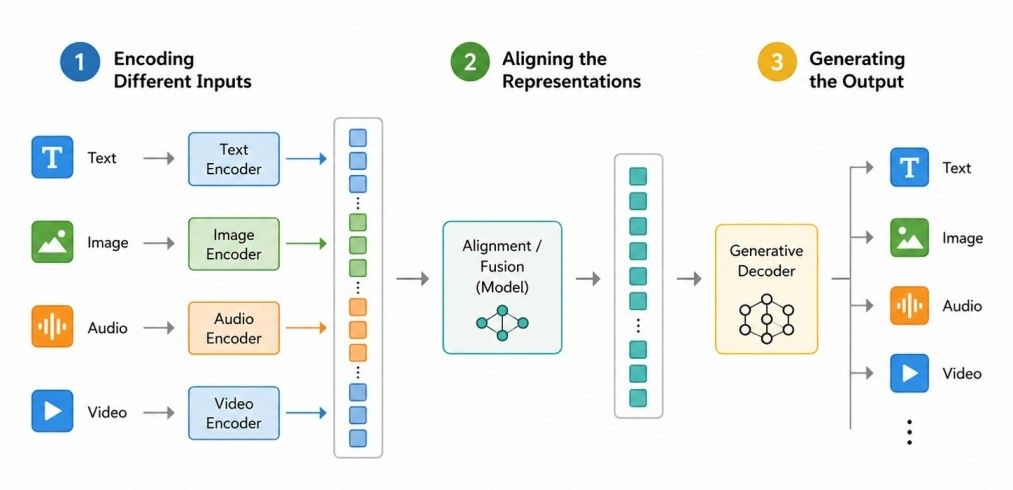
When you send an image and a text query to a multimodal model, the system first encodes each input separately. Encoding means converting raw data into a format that the model can process mathematically. Images are broken into patches or visual tokens. Text is broken into word pieces called tokens. Audio is converted into frequency representations.
Each modality has its own encoder, a specialised neural network trained to understand that type of data.
Also Read: What is Generative AI? Understanding Key Applications and Its Role in the Future of Work
This is the clever part. The model learns to map different modalities into a shared space where they can be compared and combined. Think of it like translating French and German into English so you can reason about both at once.
This alignment is typically done through a process called contrastive learning or through cross-attention mechanisms in transformer architectures.
Once the inputs are aligned in a shared representation space, the model uses a decoder or a generative component to produce the output. This output can be text, an image, a video clip, audio, or a combination.
These models are trained on massive datasets that include paired examples across modalities. For example, billions of image-text pairs scraped from the internet, video transcripts, and captioned diagrams. The scale of training data and compute required is enormous, which is why only large organisations have built frontier multimodal models so far.
The field has moved incredibly fast. Here are the most important models and what makes each one notable.
GPT-4o, pronounced "4 omni," processes text, images, and audio natively in a single model. Earlier versions required separate models for each modality and stitched them together. GPT-4o handles all three end to end, which makes it faster and more coherent. It can analyse a photo, answer a spoken question, and respond in a human-sounding voice within seconds.
Also Read: Top 7 Generative AI Models in 2026
Gemini was built multimodal from the start. It can process long documents, images, audio, and video within a single context window of up to one million tokens. This is useful for tasks like analysing an hour-long video or reading an entire research paper alongside images.
Claude 3.5 Sonnet and later versions support vision inputs alongside text. It is particularly strong at reasoning about images, interpreting charts, and handling documents with mixed content.
Meta has open-sourced versions of its multimodal models, making it possible for developers and researchers to build on top of them without API costs.
These are generative models focused on creating images from text descriptions. They sit within the multimodal ecosystem as specialised image generation engines.
Model |
Developer |
Key Strength |
Open Source |
| GPT-4o | OpenAI | Real-time audio, image, and text | No |
| Gemini 1.5 Pro | Google DeepMind | Long context, video understanding | No |
| Claude 3.5 | Anthropic | Reasoning, document analysis | No |
| LLaMA 3 Vision | Meta | Open weights, customisable | Yes |
| Stable Diffusion XL | Stability AI | Text-to-image generation | Yes |
Also Read: Generative AI Roadmap
This is where things get genuinely exciting. Multimodal generative AI is not just a research curiosity. It is already being used across industries in ways that are changing how work gets done.
Also Read: What Is GenAI Used For? Applications and Examples
Also Read: 23+ Top Applications of Generative AI Across Different Industries in 2026
No technology is without problems. Being honest about these challenges matters, especially if you are building with or evaluating multimodal generative AI systems.
All generative AI models can hallucinate, meaning they produce confident but incorrect outputs. In multimodal systems, this risk compounds. A model might correctly describe an image but draw a wrong conclusion when combining it with a text prompt.
Training data reflects the biases present in real-world media. Images on the internet are not evenly distributed across cultures, demographics, or topics. Models trained on this data can produce biased or culturally narrow outputs.
Also Read: Top 20 Challenges of Artificial Intelligence: Key Issues and Solutions for 2026
Running multimodal generative AI models is expensive. Processing images and video requires significantly more computation than text alone. This creates access barriers, particularly for smaller organisations and developers in lower-income regions.
When users upload photos, documents, or audio for processing, questions arise about data retention and privacy. Healthcare and legal sectors face especially strict regulations around this.
It is harder to measure the quality of multimodal outputs than text-only outputs. How do you automatically score whether a generated image matches a complex text prompt? This makes benchmarking and quality control more difficult.
Also Read: The Pros and Cons of GenerativeAI
Multimodal generative AI represents a genuine shift in what machines can do. By processing and generating content across text, images, audio, and video together, these systems come far closer to how humans naturally experience and communicate about the world.
We are still early. The models are powerful but imperfect. The challenges around hallucination, bias, cost, and privacy are real and unsolved. But the trajectory is clear. Multimodal generative AI will increasingly be embedded in the tools used in healthcare, education, creative work, software development, and business operations.
Want personalized guidance on GenAI and upskilling? Speak with an expert for a free 1:1 counselling session today.
Multimodal generative AI refers to AI systems that can understand and create content using more than one type of data at the same time, such as text, images, audio, and video. Unlike older AI that only worked with text, these systems process multiple data types together to produce richer and more accurate outputs.
Unimodal AI works with only one type of data, for example, a language model that only reads and writes text. Multimodal AI can handle several data types simultaneously. It can, for instance, read an image and a question together and respond in text, or take a written description and produce an image.
Some of the leading models include GPT-4o from OpenAI, Gemini 1.5 Pro from Google DeepMind, Claude 3.5 from Anthropic, and LLaMA 3 with Vision from Meta. Each has different strengths. GPT-4o excels at real-time audio and image interaction, while Gemini handles very long documents and video well.
Yes, certain models like Google Gemini 1.5 Pro can process and reason about video content. They can analyse what is happening across different frames, identify objects, and answer questions about what occurred in a video. However, truly deep temporal understanding, especially over long videos, remains a challenge.
Healthcare, education, creative industries, retail, software development, and legal services are among the most active adopters. In healthcare, the technology helps interpret medical images alongside clinical text. In education, it enables interactive tutoring with both visual and written explanations.
It depends on the platform and the safeguards in place. Many enterprise solutions offer data privacy guarantees and do not retain uploaded content. However, uploading personal, medical, or confidential documents to consumer-facing AI tools carries risk. Always review the privacy policy of the specific tool you are using.
Costs vary widely. Consumer apps often offer limited free tiers with paid subscriptions for heavier use. Enterprise API pricing from providers like OpenAI and Google is typically usage-based, charged per token or per image processed. Running open-source models on your own infrastructure has hardware and cloud costs instead of per-use fees.
You need a foundation in Python, basic machine learning concepts, and familiarity with deep learning frameworks like PyTorch. Computer vision knowledge is especially valuable, as is experience with transformer architectures. For non-technical roles, understanding what these systems can and cannot do is enough to manage products or projects effectively.
A vision-language model (VLM) is a specific type of multimodal model that focuses on combining visual and text understanding. Multimodal generative AI is a broader category that also includes audio, video, and other data types alongside vision and language. All VLMs are multimodal, but not all multimodal models are limited to just vision and language.
Yes. Models like DALL-E 3 from OpenAI and Stable Diffusion generate images from text descriptions. Some models, including certain versions of Gemini, can both understand and generate images within the same interface. This ability to both consume and produce visual content is what makes these systems particularly powerful for creative and design applications.
The direction is toward more seamless integration of all modalities, faster and cheaper inference, better accuracy in complex reasoning tasks, and wider availability through open-source releases. We will likely see multimodal AI become a standard layer in most software products, from productivity tools to healthcare systems, rather than remaining a standalone speciality.
98 articles published
Rahul Singh is an Associate Content Writer at upGrad, with a strong interest in Data Science, Machine Learning, and Artificial Intelligence. He combines technical development skills with data-driven s...
Speak with AI & ML expert
By submitting, I accept the T&C and
Privacy Policy