Contrastive Learning: The Foundation Behind Modern Self-Supervised AI
By Sriram
Updated on Jun 09, 2026 | 7 min read | 3.65K+ views
Share:

All courses
Certifications
More
By Sriram
Updated on Jun 09, 2026 | 7 min read | 3.65K+ views
Share:
Table of Contents
Contrastive learning, is a machine learning technique where models are trained to learn by contrasting examples and deciding whether they are similar or not. Instead of depending on large amounts of labelled data, it strives to learn relationships between examples to construct meaningful representations.
The method maps data into an embedding space, where similar items, e.g., different images of the same object, are close to each other. It pushes unrelated or dissimilar items further apart, helping models to better recognise patterns across AI tasks.
This guide, you’ll learn what contrastive learning is, how it works, why it matters, popular architectures, practical applications, and the challenges developers face when implementing it in real-world systems.
Explore upGrad's AI courses to gain hands-on experience with cutting-edge machine learning technologies.
Popular AI Programs
Contrastive learning is a class of self-supervised learning that aims to train a model to bring similar data points closer in a feature space, and to push dissimilar points farther apart.
Consider how humans identify objects. You can recognise a dog because you understand how it differs from a cat, a horse, or a car. Contrastive learning works on the same principle. It learns representations by contrasting examples, not by memorising labels.
A model receives:
The training objective encourages the model to create embeddings where positive pairs stay close and negative pairs remain separated.
For example, imagine training an image recognition system:
| Sample A | Sample B | Relation ship |
| Original dog image | Augmented dog image | Positive Pair |
| Original dog image | Cat image | Negative Pair |
| Original dog image | Car image | Negative Pair |
Over time, the model learns features that capture semantic meaning rather than superficial pixel patterns.
This approach became especially important because collecting labeled data is expensive, while unlabeled data exists everywhere.
Know more: Self Supervised Learning: The Foundation Behind Modern AI Systems
Free Courses
Contrastive learning follows a structured process that helps models learn meaningful patterns from unlabeled data. Rather than memorizing labels, the model learns by comparing examples and identifying which samples belong together. Understanding these steps makes it easier to see why contrastive learning has become a key technique in modern AI systems.
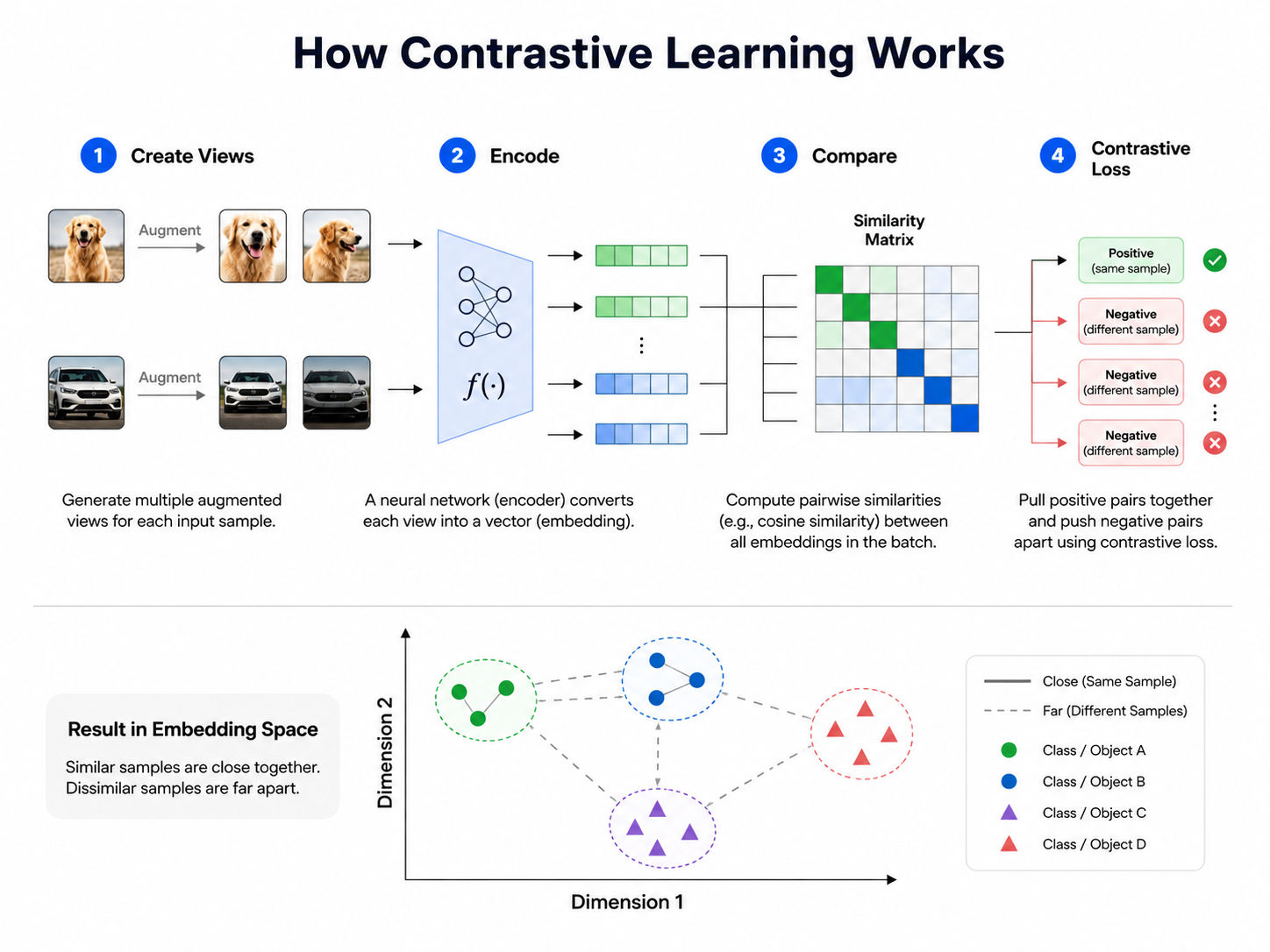
The model first generates different versions of the same sample.
For images, transformations may include:
Even though these transformed images look slightly different, they represent the same underlying object.
For text, augmentations may include:
The goal is to create positive pairs that share semantic meaning.
A neural network encoder converts each sample into a numerical representation called an embedding.
Instead of comparing raw images or text directly, the model compares these embeddings.
The model calculates how close embeddings are using similarity metrics such as:
Higher similarity scores indicate related samples.
The model minimizes a loss function designed to:
One of the most widely used objectives is the InfoNCE loss.
The training process gradually shapes the embedding space into a meaningful representation of the data.
Traditional supervised learning often needs millions of labeled examples.
Contrastive learning can leverage vast amounts of unlabeled data. As a result, organizations can build powerful models without spending years on annotation projects.
This shift mirrors a broader trend in machine learning. Just as discussions around the Compare online learning vs traditional classroom learning essay often focus on learning efficiency and flexibility, contrastive learning explores how machines can learn effectively with less direct supervision.
Do read : Machine Learning Free Online Course with Certificate
AI Courses to upskill
Explore Artificial Intelligence Courses for Career Progression
Contrastive learning has evolved rapidly over the past few years, driven by architectures that demonstrated its effectiveness across computer vision, natural language processing, and multimodal AI tasks. These models introduced innovative training strategies for learning meaningful representations without relying heavily on labeled data. Today, many state-of-the-art AI systems build on the principles established by these pioneering contrastive learning architectures.
Several breakthrough models helped establish contrastive learning as a mainstream AI technique.
this Architecture demonstrated that strong image representations could emerge through data augmentation and contrastive objectives alone.
Key characteristics include:
SimCLR showed that carefully designed self-supervised learning could rival supervised approaches.
introduced a memory-efficient method for maintaining large sets of negative examples.
Instead of requiring extremely large batches, MoCo uses a dynamic memory queue.
Benefits include:
BYOL is challenged a core assumption in contrastive learning.Unlike previous methods, BYOL does not require explicit negative samples.
The model learns by predicting one augmented view from another. This discovery surprised many researchers because negative examples were previously considered essential.
This is One of the most influential examples for contrastive learning
CLIP learns relationships between:
By associating visual content with text, CLIP can perform zero-shot classification across thousands of categories.
Many modern generative AI systems build upon similar concepts.
Must read : What Is Machine Learning and Why It’s the Future of Technology
Contrastive learning has moved from research labs into production systems across industries. By learning useful representations from large amounts of unlabeled data, it enables AI models to perform tasks such as image recognition, search, recommendation, and language understanding more effectively. This approach has become especially valuable in applications where labeled data is scarce, expensive, or constantly changing.
The impact of contrastive learning extends far beyond academic research.
Contrastive learning has been popularised in image-based applications.
Typical examples are:
For example, a medical AI model can learn useful visual patterns from millions of unlabelled scans before fine-tuning on smaller labelled datasets.
Contrastive objectives have been used in language models to capture semantic relationships between text samples
Applications include :
The embeddings that result often provide a better sense of context than traditional keyword based approaches.
For example, contrastive learning is applied for understanding user preferences in streaming platforms and e-commerce companies.
The model learns relations between:
This improves the quality of recommendations.
Modern AI is increasingly mixing different types of data.
Examples are:
Contrastive learning aligns representations across modalities.
If a system can understand that a picture of a beach and the phrase “sunny tropical coastline” are the same, then it becomes a lot more useful.
Also Read: Email Classification Using Machine Learning and NLP Techniques
Contrastive learning has gained widespread adoption because it can learn powerful representations from large volumes of unlabeled data. However, its effectiveness depends on factors such as data quality, computational resources, and training strategy.
Like every machine learning technique, contrastive learning offers benefits alongside practical challenges.
The table below shows the benfits of contrastive Learning :
| Benfits | Why it Matters |
| Reduced labeling requirements | Save time and cost |
| Better representation learning | Improves downstream performance |
| Scalability | Works with massive datasets |
| Transferability | Supports fine-tuning across tasks |
| Strong performance | Often rivals supervised methods |
Despite its strong performance across many AI applications, contrastive learning is not without challenges. Factors such as data preparation, computational requirements, and domain-specific constraints can affect its effectiveness and scalability.
1.Dependence on Data Augmentation
Performance often depends heavily on augmentation quality.
Poor transformations can weaken representation learning.
2.Computational needs
Large scale contrastive learning may require:
This makes life difficult for smaller teams.
3.Negative Sampling Selection
Picking good negative examples is still hard.
Some negatives might actually belong to similar semantic categories, which bring noise to training.
4,Domain-Specific Problems
Techniques that work well for images may not directly translate to:
Developers often have to come up with custom strategies.
It might be less effective when there are sufficient labeled data and when computational resources are limited.
As AI models become larger and more data-intensive, contrastive learning is expected to play an even greater role in representation learning and self-supervised training. Ongoing research is focused on improving efficiency, reducing dependence on negative samples, and extending its capabilities across multimodal and domain-specific applications.
Contrastive learning continues to influence some of the most advanced AI systems being built today.
Researchers are studying:
Most of the advances in generative AI, retrieval systems, and multimodal applications stem from ideas presented by the contrastive learning.
As AI models continue to grow, the ability to learn from unlabeled information will be even more critical.
Future systems will learn from relationships, context and similarity, not just from human-generated labels. Contrastive learning is one of the most promising avenues to that end.
Contrastive learning has revolutionized the way modern AI systems learn from data. It does not depend completely on labeled examples, but instead teaches models to learn relations between similar and dissimilar samples.
This allows for powerful representation learning on images, text, audio and multimodal datasets. Methods like SimCLR, MoCo, BYOL, and CLIP have shown that self-supervised approaches can match and even exceed traditional supervised methods in many cases.
For developers, researchers and AI practitioners, understanding contrastive learning is no longer optional. It has become a foundational concept behind many of today’s most capable machine learning systems, and will likely remain a key driver of future AI innovation.
Want personalised guidance on Machine Learning and upskilling? Speak with an expert
for a free 1:1 counselling session today.
Contrastive learning has gained attention because it reduces the dependence on labeled datasets. Many organizations have access to large amounts of unlabeled data but lack the resources to annotate it. By learning from similarities and differences between samples, models can develop strong representations that improve performance across tasks such as image recognition, search, recommendation systems, and natural language processing.
Yes, but results vary depending on the quality of the data and augmentations. Contrastive learning typically performs best when large amounts of unlabeled data are available. With smaller datasets, carefully designed transformations and domain knowledge become more important. In some cases, traditional supervised learning may still deliver better results if enough labeled examples exist.
Both approaches learn relationships between data points, but they differ in training objectives and use cases. Metric learning often focuses on measuring distances for tasks like face verification, while contrastive learning primarily learns general-purpose representations through self-supervised training. Many modern contrastive learning methods are designed to support a wide range of downstream AI applications.
Contrastive learning helps models understand semantic relationships rather than relying only on exact matches. For example, an e-commerce platform can learn that users who view running shoes may also be interested in fitness accessories. This deeper understanding enables more relevant recommendations and search results, even when users phrase queries differently.
Yes. Many generative AI systems use representations learned through contrastive objectives during pretraining. Models that connect images with text, audio with text, or video with language often rely on contrastive learning techniques. These representations help the model understand relationships across different types of content before generating outputs.
One common challenge is selecting effective data augmentations. Poor transformations can reduce model performance instead of improving it. Developers must also manage computational costs, large batch sizes, and negative sample selection. These factors can significantly influence training quality and often require experimentation to optimize results.
Not entirely. Contrastive learning reduces the amount of labeled data required but does not always replace it. Many teams use contrastive pretraining followed by supervised fine-tuning. This approach combines the strengths of self-supervised learning with task-specific labeled examples to achieve better performance.
Healthcare, e-commerce, finance, cybersecurity, and media companies actively use contrastive learning. Medical imaging systems use it to learn from large scan repositories. Retail platforms apply it to product recommendations and visual search. Cybersecurity teams use representation learning techniques to identify unusual behavior patterns and potential threats.
Data augmentations create different views of the same sample, which form positive training pairs. Effective augmentations help the model focus on meaningful features rather than noise. However, overly aggressive transformations may alter the sample's meaning and confuse the model. Finding the right balance is often a key part of successful implementation.
Yes. Contrastive learning plays an important role in multimodal AI systems that combine text, images, audio, or video. By learning shared representations across different data types, models can better understand connections between modalities. This capability supports applications such as image captioning, visual search, content retrieval, and AI assistants.
It is usually better to understand core deep learning concepts first. Knowledge of neural networks, embeddings, optimization, and representation learning makes contrastive learning much easier to understand. Once you have a foundation in these topics, contrastive learning becomes a practical next step for exploring modern self-supervised AI techniques.
727 articles published
Sriram K is a Senior SEO Executive with a B.Tech in Information Technology from Dr. M.G.R. Educational and Research Institute, Chennai. With over a decade of experience in digital marketing, he specia...
Speak with AI & ML expert
By submitting, I accept the T&C and
Privacy Policy
Top Resources
Master's Degree
18 Months
Executive Diploma
12 Months
IIIT Bangalore
Executive Programme in Generative AI & Agentic AI for LeadersIndia’s #1 Tech University
Dual Certification
5 Months